The Eagle and the Hart by Helen Castor

The Eagle and the Hart is a dual biography of two English kings, Richard II and Henry IV (also known as Bolingbroke). Cousins born just a few months apart, they were both grandsons of Edward III, so their lives were linked from the beginning, although their paths to the throne were very different. In this biography, which was longlisted for last year’s Women’s Prize for Non-Fiction, historian Helen Castor explores the stories of the two kings, with the title of the book inspired by their heraldic emblems, Richard’s white hart and Henry’s golden eagle. The book moves forward chronologically, beginning with the childhoods of both kings then continuing through Richard’s reign and deposition by Henry, finally ending just after Henry’s death in 1413.

Richard II is shown very much as he usually is: a weak, unpopular king whose reign was marked by high taxation and accusations of favouritism, his only shining moment being his handling of the Peasants’ Revolt; a man who believed in his divine right to rule, who liked the status and power that came with being king but didn’t have the personal qualities needed to be a good leader. Castor doesn’t challenge any of these ideas and her sympathies are clearly more with Henry, portrayed as having all the abilities Richard lacks but the misfortune to be born to a younger son and not in the direct line of succession. However, when Henry eventually seizes his chance to become king, his own reign is also beset with problems and he spends his time dealing with various plots, assassination attempts and rebellions.

Although I’ve read historical fiction featuring Richard II and Henry IV and both have popped up in some general non-fiction I’ve read about the period (such as The Plantagenets by Dan Jones), this is the first time I’ve read a full biography of either of them. It wasn’t quite what I would have preferred, though. The book is described in the blurb as ‘the story of one of the strangest and most fateful relationships in English history’, so I would have liked more focus on this relationship, more direct comparison of their backgrounds and discussion of how this shaped their different political and leadership styles, some analysis of their meetings and interactions etc. In fairness, as Castor points out in her introduction, it’s difficult to draw a psychological portrait without access to diaries, private letters or memoirs. What we get, then, is a book that feels like two separate biographies unfolding in parallel, with little crossover between the two, and I found the writing style generally quite dry and impersonal.

The Eagle and the Hart is a long book and I took my time reading it as there’s so much information to take in. There’s also some additional material at the front of the book including maps, family trees, a list of illustrations and at the back, taking up the final 25% of the book, a bibliography, directory of the main players in the royal and noble families, notes and an index. I think for anyone wanting to make a serious study of the period, this book could be a very useful resource. For the general reader, there’s maybe a bit more detail than is really necessary, but it obviously depends on the type of book you prefer and are looking for. The other book I’ve read by Castor, She-Wolves, was more enjoyable but I did get a lot out of reading this one as well.

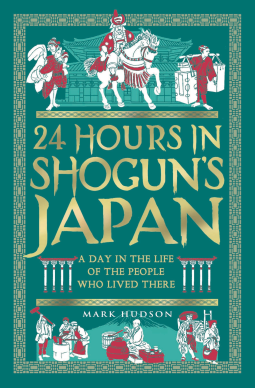
24 Hours in Shogun’s Japan by Mark Hudson

This is part of a series in which each book explores the history of a different time and place through the lens of one twenty-four-hour day. I haven’t come across any of the previous books, but I was drawn to this one because I know relatively little about Japan’s history and wanted to add to my limited knowledge. Most of what I do know about this period (the Tokugawa shogunate of 1603 to 1868) comes from novels like James Clavell’s Shogun so I thought it would be interesting to read some nonfiction on the subject – although as it turned out, this book is an unusual combination of fiction and nonfiction.

24 Hours in Shogun’s Japan focuses on a day in 1614 and devotes one chapter to each hour of the day, beginning at midnight. The chapters are headed with both the Western time and the equivalent Japanese term, a system introduced from China – for example, Upper Hour of the Rat or Lower Hour of the Dragon – which I thought was a nice touch. We are then given a short fictional story providing a snapshot of one person’s life as they go about their usual daily activities during that hour. As we progress through the day one hour at a time, we meet a range of characters from all walks of life – a doctor, a pilgrim, a merchant, a pirate and many more – and each one has their own story to be told.

The stories are too short to be very satisfying as works of fiction, but they are there to serve a purpose and they do that very well, providing snapshots of all aspects of daily life – the food people ate, the clothes they wore, the housing they lived in and the types of job they did. Some of the characters who stood out for me included a tea master preparing for the elaborate ritual of the tea ceremony, a fisherman trying to persuade everyone to buy a new type of fish they’d never even seen, a Kabuki dancer performing on stage by the river in Kyoto and a man known as a Yamabushi, or mountain ascetic, getting ready to climb Mount Fuji.

Each chapter includes some key historical facts, there are illustrations and at the end of the book there’s an index and a list of sources and suggestions for further reading. If you want something more academic you would need to look elsewhere, but this is an excellent starting point. The book is obviously intended as an introduction to the time period and the style and structure make it very accessible to readers who are new to the subject.

If you like the sound of the format of these books but aren’t interested in Shogun-era Japan, the others in the series cover Ancient China, Ancient Egypt, Ancient Athens, Ancient Rome and the Viking World. They’re not all by the same author but I assume they’re all written in a similar way. I found this one a quick and informative read, so I would probably consider reading another one.

Can you recommend any good books about Japanese history?

Thanks to Michael O’Mara Books for providing a copy of this book for review via NetGalley.

The Tower by Thea Lenarduzzi – #ReadIndies

This month Karen of Kaggsy’s Bookish Ramblings is hosting #ReadIndies, celebrating books from independent publishers. I’ve never read anything published by Fitzcarraldo Editions before, so this seemed a good opportunity to read one of their books.

The Tower is a difficult book to describe. It’s not quite fiction, but it doesn’t feel like non-fiction either. It’s a memoir but it’s also an essay and an ode to the power of storytelling. The book follows an author known only as ‘T.’ – presumably Thea Lenarduzzi herself – as she becomes obsessed with the story of a young woman, Annie, who developed tuberculosis in the early 20th century and, according to local legend, was locked away by her father in a tower specially built on the family estate. After living there in isolation for several years, she is said to have died from the disease and although the house has since been demolished, the tower still remains.

T. becomes completely fixated on Annie and her tragic life, determined to find out everything she can about her illness, her imprisonment and her death. She spends a lot of time researching the history of TB, its symptoms and the various treatments, also looking at the lives of famous sufferers such as the author Katherine Mansfield. She visits the now abandoned tower, speaks to historians and archivists and listens to tales told by local residents. All of this is covered in the first two sections of the book and I found most of it fascinating. T. goes off on a lot of lengthy tangents and meanders from one subject to another, but in general Annie’s story was very compelling…

Until, suddenly, we discover that everything we – and T. – thought we knew about Annie may not necessarily be completely accurate after all. In the third section of the book, Lenarduzzi switches from writing in the third person to the first person and becomes herself again, instead of a character known as T. This final section takes the form of a long discussion of storytelling, raising lots of intriguing questions. What is a story and who chooses how it should be told? What is it that draws us to certain stories and not others? As Lenarduzzi explains:

Perhaps for now I should simply say that we don’t always tell the story we want to tell. We can’t always choose our place in it, nor how it ends, or even if it does. That, reader, is the stuff of fiction.

The Tower, then, wasn’t quite what I expected, but it’s a book that surprised me several times and left me with a lot to think about at the end! Thea Lenarduzzi has written another book, Dandelions, inspired by her family history, which sounds equally interesting.

The Official Agatha Christie Puzzle Book

This is a book I received last Christmas (a present from my sister) and now that I’ve completed all of the puzzles in it, and with Christmas almost here again, I thought I would post a short review. It would make a great gift for any friends or family members who are Agatha Christie fans.

The book is divided into sections, with each one themed around a different Christie novel. For example, Chapter 5 is based on The ABC Murders, so many of the puzzles involve the alphabet or the letters A, B and C, while Chapter 9, Murder on the Orient Express, has puzzles about trains and snow. A few of them do require a knowledge of the original novel, but the majority could be solved even if you’d never read Christie before.

The puzzles in the book are nicely varied and range from crosswords and wordsearches to anagrams, logic puzzles and many more. I found some of them very easy to solve, but others were much more challenging. There are solutions included at the back of the book if you get stuck!

Each chapter ends with a letter written by Charles, a new librarian at Greenway, Christie’s old holiday home which is now a museum owned by the National Trust. The letters are addressed to his Aunt Mary and relate to the disappearance of the former librarian, Mrs Ashmore, who has gone missing, leaving behind a bundle of puzzles for Charles to solve. This framing story helps to tie the whole book together, as the mystery of Mrs Ashmore’s disappearance can only be solved once you’ve completed all of the other puzzles in the book.

If you already own this book, or if it doesn’t appeal, maybe you would prefer The Offical Poirot Puzzle Book, which has just been released in time for Christmas. There’s also The Official Agatha Christie After School Detectives Club aimed at children aged 8 and up, so something for all the family!

100 Books to Live By: Literary Remedies for Any Occasion by Joseph Piercy

I’m sure we’ve all turned to books in times of need, whether for advice and support or simply for comfort and distraction from the realities of life. 100 Books to Live By is Joseph Piercy’s guide to the books he believes can help with various problems and difficult situations. It’s part of a planned series from Michael O’Mara Books which will also include 100 Poems to Live By and 100 Speeches to Live By.

After an introduction in which Piercy describes the meaning of bibliotherapy – “the practice of using literature as a tool for emotional and psychological healing” – he then provides his 100 recommendations, prefacing each one with the condition or situation it is intended to remedy. Processing a Divorce, Questioning One’s Faith/Sexuality, Feeling Lost in the World, Learning Lessons from the Past and Valuing Friendship are just a few examples. Following each ‘prescription’, we are given one or two alternative remedies – just in case our TBR wasn’t already long enough!

Many of the books recommended here are classics from the 19th and 20th centuries, but Piercy does also include some contemporary titles and translated works to add variety and diversity. Sometimes the book suggestion seems an obvious match for the condition it’s remedying, such as Wuthering Heights for the Perils of Forbidden Love and the Folly of Vengeance or As I Lay Dying for Facing the Inevitability of Death, but other times I was surprised by the choice of book. Piercy explains his reasons for his decisions and you can see that a lot of thought has gone into choosing appropriate books, but be aware that although he does usually avoid giving away major plot points, if you haven’t already read the book you may come across things you would prefer not to know.

As well as the specific ‘prescriptions’ and ‘remedies’, Piercy also includes books he describes as ‘medicine cabinet essentials’ – in other words, they cover several different problems and issues. Anna Karenina, Madame Bovary and I Know Why The Caged Bird Sings are some examples of these. His discussion of each book is very short, usually just a page or two, and I think if you were hoping for a more in-depth analysis of bibliotherapy you would need to look elsewhere, but this is a quick, fun read and I can almost guarantee you’ll end up with a long list of titles you can’t wait to explore!

Thanks to Michael O’Mara Limited for providing a copy of this book for review via NetGalley.
A History of England in 25 Poems by Catherine Clarke

If you had to choose a selection of poems to represent your country’s past, which ones would you pick? What can poetry teach us about a nation’s history, culture and identity? These are some of the questions Catherine Clarke sets out to answer in this wonderful new book which tells the story of England through twenty-five famous and not-so-famous poems.

Beginning with the 8th century poem Cædmon’s Hymn, written in Old English, the book then moves chronologically through time, ending with Zaffar Kunial’s The Groundsman from 2022. Familiar names including Geoffrey Chaucer, Shakespeare, Tennyson and Lewis Carroll are all represented, but so are some lesser known poets from more diverse backgrounds such as Phillis Wheatley, the first African-American woman to have her poems published, and Grace Nichols, an immigrant to Britain from Guyana. The poems have all been selected for what they can tell us about specific moments in English history: Viking raids, the Battle of Agincourt, the plague, the miners’ strikes, the Great Storm of 1987 and many more.

Before picking up this book, it’s important to know that it shouldn’t really be approached as simply a poetry anthology. Not all of the poems appear in full – many are just extracts – and they haven’t necessarily been chosen for the beauty of the language. The literary merit of each poem is discussed only briefly or not at all, as Clarke is more interested in the life of the writer, why they chose to write that particular poem at that particular time and how the poem fits into the wider context of what was happening in England during that period. Each poem is given its own chapter and with twenty-five of them to get through, the chapters are relatively short, although still long enough to say everything that needs to be said.

I enjoyed every chapter – although I was already familiar with most of the historical figures and topics discussed in the book, it was interesting to see them from different, unusual perspectives and to discover some new poems I’d never read before. Some of my favourites were Mary Leapor’s Crumble Hall, written through the eyes of a servant in an 18th century country house; Adlestrop by Edward Thomas, describing a train briefly stopping at a station in 1914; and Elizabeth Barrett Browning’s The Cry of the Children, a protest against child labour during the Industrial Revolution.

I can highly recommend this book to anyone with an interest in English history. If you also like poetry it would be helpful, but not essential! I thought it was a fascinating approach and it would be good to read about another country’s history seen through the lens of its poetry like this.

Thanks to Penguin Classics/Allen Lane for providing a copy of this book via NetGalley.

The Living Stones: Cornwall by Ithell Colquhoun

Earlier this year I enjoyed reading Ithell Colquhoun’s The Crying of the Wind, an account of the author’s travels around Ireland, so I decided to read her other travel book, The Living Stones, published two years later in 1957. This one is inspired by her visits to Cornwall in the late 1940s, where she came in search of escape from post-war London. As an artist, she wanted a suitable property to use as an occasional refuge where she could paint in peace and in 1949 she purchased Vow Cave, a small wooden studio with very basic living facilities.

Vow Cave (Colquhoun tells us that Vow is derived from vugha, the Cornish word for cave) is in the village of Lamorna on the Penwith peninsula a few miles from Penzance. Although she writes about the landscape, the surrounding countryside and some local places of interest, this book isn’t really a travelogue in the same sense as The Crying of the Wind, where the author described trips and excursions to different areas of Ireland. Instead, she explores the culture and history of Cornwall in general, with chapters devoted to separate topics, giving it almost the feel of a collection of short essays.

Lots of Cornish customs and rituals are discussed, ranging from the Gorsedh of Cornwall, or gathering of the bards, and the ‘Obby ‘Oss (hobby horse) festival in Padstow to the Furry Day celebrations which mark the arrival of spring (the name likely has nothing to do with fur and comes from the Cornish word for ‘fair’ or ‘feast’). There’s a chapter on traditional Cornish foods such as potato cakes, Cornish cream and the Cornish pasty, and another on folk medicine and witchcraft – Colquhoun has a particular interest in the occult. Some sections are fascinating, although there were others where I found my attention wandering.

Both books I’ve read by this author feel random and meandering, lacking in focus. I found that the best way to read them was in small doses, a few short chapters at a time alternating with other books, rather than straight through from beginning to end. As a pair, they’re definitely worth reading if you have any interest in Ireland or Cornwall, and I did learn a lot from them. Colquhoun has also written a novel, Goose of Hermogenes, which sounds intriguing!

Thanks to Pushkin Press Classics for providing a copy of this book for review via NetGalley.