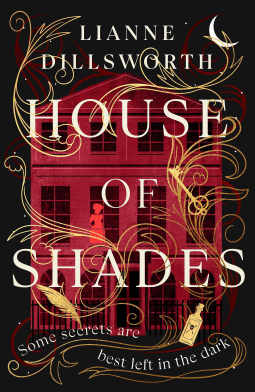
 I enjoyed Lianne Dillsworth’s first novel, Theatre of Marvels, so I was looking forward to her new book, House of Shades, which sounded like an atmospheric Gothic mystery. It turned out to be not quite what I expected, although that’s not necessarily a bad thing.
The setting is London, 1833. Hester Reeves is a young black woman whose mother has recently died, urging Hester to take care of her younger sister, Willa. Unfortunately, Willa already seems to be getting herself into trouble, having caught the eye of Rowland Cherville, the manager of the factory where she works. Rowland is running the factory on behalf of his invalid father, Gervaise, and with the differences in race and social status, Hester is sure his intentions towards her sister are not good. If only Hester and her husband, Jos, could improve their financial situation, then they could move out of the slums of King’s Cross and get Willa away from Rowland’s influence…
Hester’s chance to make some money comes when the local vicar puts her name forward for a job at Tall Trees, home of the elderly Gervaise Cherville, who has a serious medical condition and wants someone to nurse him through it. Hester is considered suitable for the position as she is a ‘doctoress’ – not really a female doctor, as it will still be several decades before the first woman earns her medical degree and even longer for the first black woman to do the same, but someone with a knowledge of herbs and healing potions. However, Hester soon discovers that Mr Cherville has another task in mind for her.
The Chervilles made their fortune through mahogany and they own slaves on a plantation in Honduras. With the Slavery Abolition Act of 1833 stating that slavery is to be abolished across most of the British Empire, it seems that Gervaise has developed a conscience and wants to give compensation to his slaves – not the ones in Honduras, though, whom he has never met, but two who once lived at Tall Trees before running away. Aphrodite and Nyx have been missing for many years and Gervaise wants Hester to help track them down so he can make amends.
If you can accept the rather unlikely plot (for a start, is it really believable that a wealthy 19th century gentleman like Gervaise Cherville would bring an unknown young woman from a slum community into his home as a nurse?), this is quite an entertaining novel. Like Dillsworth’s first book, it has a likeable heroine, it’s easy to read and the pages go by surprisingly quickly. There are a few twists, although they’re fairly predictable and I was hoping for one or two more! Apart from Hester herself, most of the other characters lack depth and nuance – there’s no real explanation for why Rowland is such a wicked person with seemingly no redeeming qualities at all, and we don’t see much of Willa’s good side either, which makes it difficult to understand why Hester views her as such a beloved sister, putting her needs above those of herself and her husband.
The most interesting aspect of the book is Gervaise Cherville’s desire for atonement and his attempt to make reparations for the harm he has caused. It seems clear that, at least at first, Cherville’s main motive is to assuage his own guilt, but Hester reflects that “maybe when it came down to it, all apologies were like that, even when they were heartfelt.” I would have liked more depth here as well, but maybe that would have been difficult as the whole novel is narrated by Hester and we never get inside Cherville’s head to see what he’s really thinking or whether his feelings are genuine.
House of Shades is a book with lots of good ideas and interesting themes, but I struggled to get past the implausibility of the plot and on the whole I preferred Lianne Dillsworth’s first book.
Thanks to Hutchinson Heinemann for providing a copy of this book for review via NetGalley.

Book 32/50 for the Historical Fiction Reading Challenge 2024
 She Reads Novels
Good review. It seems implausible. Historical fiction is truly difficult to do with a semblance of realism. We don’t think that way, speak that way, behave that way anymore. Some licenses are understandable, others can ruin the experience of the book, although some readers may not mind.
I always think about this when I read eastern authors, Japanese for example, and how their books in general are void of certain elements and words and I think it’s because they don’t have the same worldview, a very different social construct that results in a different je ne se qua in the books.
It does seem that a lot of readers don’t mind a lack of plausibility in historical fiction, but it’s something that can really spoil a book for me! That’s a good point about Japanese books. I’ve read quite a lot of them in the last few years and they do have a different feel, although as I’m not able to read them in the original language I don’t know how much is lost in translation.
I’d agree Helen, I think one would need the basic premise to be actually plausible for it to work unless the other elements are so well done that they let us forget about that shaky foundation. But glad this wasn’t a complete disappointment.
It’s quite enjoyable purely as a story, if you’re able to suspend disbelief and accept the premise. I would have preferred something more realistic, though!
I reread your review of her first book and that one does sound like the better read to me. I always like that circus/carnival kind of setting, and Zillah sounds like an interesting character. Of course, Hester always sounds like a character I would like. 😀
Yes, I preferred the setting of the first book too and the plot felt more believable to me.
It is challenging for some writers of historical fiction to try something new without sacrificing plausibility. I sympathize yet am impatient at the same time. Sometimes the quality of the writing or appealing characters can help me suspend my disbelief but often I ask (talking to myself, usually) why the editor didn’t coax the author into addressing these inconsistencies. I mean, her mother could have come from Tall Trees or there could have been some connection, just to give one example.
There does turn out to be a connection, which I didn’t mention in my review to avoid spoilers, but Gervaise Cherville doesn’t know about it anyway so it still doesn’t make any sense. The book was quite enjoyable and the author had a lot of interesting ideas, but there were too many holes in the plot.
I don’t know if I could get by the premise.
It was definitely a problem!
What a shame this didn’t work for you!
Thanks for sharing this review with the Historical Fiction Reading Challenge.