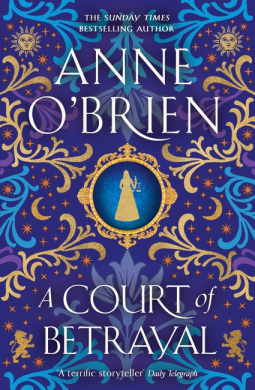
 I enjoyed Anne O’Brien’s last two novels, about the Pastons – one of England’s most influential families in the 15th century, who left behind a collection of correspondence known as the Paston Letters – and I wondered if she would continue to write about them in a third novel. However, with A Court of Betrayal she has chosen to tell a very different story: the story of Johane de Geneville.
Johane (or Joan) de Geneville is not a well known historical figure and most people have probably never heard of her, but as the wife of Roger Mortimer, 1st Earl of March, she played a part in an important and eventful period of English history. Having been imprisoned for leading a revolt against King Edward II, Mortimer escaped to France where he joined forces with Edward’s estranged queen, Isabella, and together they led a successful invasion of England in 1326. With Edward forced to abdicate and his young son crowned in his place, Mortimer and Isabella effectively ruled the country for several years. The Stone Rose by Carol McGrath, The She-Wolf by Maurice Druon and Isabella by Colin Falconer are just a few of the novels I’ve read that cover this period, but the focus is always firmly on Isabella, Edward and Mortimer. What was Johane doing while all of this was happening and how did she feel about it? These are the questions Anne O’Brien sets out to explore in A Court of Betrayal.
The novel is written in the first person from Johane’s perspective and I found her much more likeable and sympathetic than some of O’Brien’s other heroines. Throughout the course of the novel, as the title would suggest, she experiences and witnesses betrayal of many kinds, but the most significant for Johane personally is the betrayal she faces at the hands of her own husband. The marriage between Johane and Roger Mortimer is portrayed as a happy one at first. Although it was an arranged marriage, which was normal amongst the medieval nobility, there seems to be genuine love and affection between them and they go on to have twelve children together. This all changes when Mortimer begins an affair with Isabella and makes no real attempt to hide it, either from Johane or from the public – and even insists on Isabella being accepted as a guest in Johane’s home. I feel bad that, despite having read about the Mortimer/Isabella relationship before, I’ve never really given any thought to the fact that Roger had a wife!
With the story being told from Johane’s point of view, there’s a limit to the things she sees and experiences for herself (particularly as she spends large chunks of the novel imprisoned or under house arrest) and information often comes to her via other people. This doesn’t make the novel boring, however; there’s always something happening in Johane’s personal life and it’s still interesting to read about the political developments happening elsewhere even if we’re not seeing them at first-hand. Like most periods of history, this one has its fair share of controversies, mysteries and other matters on which historians have never been able to agree – how and when did Edward II die, for example, and what was the nature of his relationships with his favourites, Piers Gaveston and Hugh Despenser? O’Brien has her opinions on these things and incorporates them into the plot. It’s all very fascinating, whether you’ve read about this period before or not.
Although I haven’t read all of Anne O’Brien’s books yet, I have read a lot of them and I think this is one of her best. I’ve discovered that her next novel, due in 2025, is going to be set during the Wars of the Roses and will tell the stories of Margaret of Anjou and Anne, Countess of Warwick. Something to look forward to!
Thanks to Orion for providing a copy of this book for review via NetGalley.

Book 36/50 for the Historical Fiction Reading Challenge 2024
 She Reads Novels
This sounds like a fascinating story that is overlooked. Glad you read and reviewed it! Also, I’m excited about her upcoming book in 2025 now. Great information Helen 🙂
Yes, it was really interesting! I’m excited for the new book too.
I don’t think I even knew Mortimer had a wife.
I don’t think I did either, unless I just forgot.
I enjoyed this, but I was expecting another Paston book!
I would have liked another Paston book, but it looks as if she’s finished with them for now.
The BBC history podcast had an episode on Roger Mortimer and then an article in their magazine, both of which I found really interesting. I hadn’t remembered him from my British history classes decades ago now. But I don’t know that either had much to say about his wife, versus Queen Isabella.
She definitely seems to be a forgotten figure! I suppose she didn’t have much direct influence on the course of history, whereas Roger and Isabella obviously did, but she still deserves to be remembered.
I haven’t read this author yet but am moving her higher on my mental TBR, thank you!
I haven’t read a lot from this period but I recall a book from Isabella’s point of view, maybe by Hilda Lewis. I’ll have to ponder as it is going to drive me crazy. Or am I thinking of Susan Howatch?
Susan Howatch’s Cashelmara is the Edward/Isabella/Mortimer story retold in a more modern setting. Not all from Isabella’s perspective, though, so maybe it’s a different book you’re thinking of.
Sounds like an interesting book! 😊
It is! I learned a lot from it.
This book does sound really good. And I know nothing about Joan de Geneville. Anne O’Brien is an author I think I really need to try. Her books always sound so interesting.
I’ve enjoyed a lot of her books. She picks such interesting female historical figures to write about.
Hi Helen, this sounds great and not a time period I have read about before – looking forward to reading it even more now. 😊
I’m sure you’ll enjoy it, especially if it’s a new time period for you.
Love that this is a different take on a relatively well known story, featuring the forgotten character..
Thanks for sharing this review with the Historical Fiction Reading Challenge.
Anne O’Brien is great at giving forgotten women a voice; I can’t wait to read her next book.