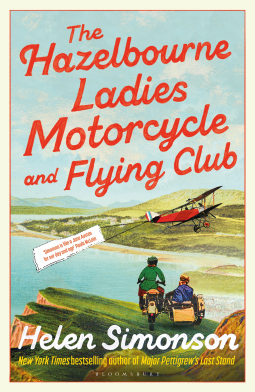
 I enjoyed Helen Simonson’s previous two novels, Major Pettigrew’s Last Stand and The Summer Before the War, but we seem to have had a very long wait for her third one. Eight years, in fact! Was it worth waiting for? I think so.
Although there’s not really any connection with The Summer Before the War, this book could easily have been titled ‘The Summer After the War’. It’s set in a small English seaside town in 1919, the year after the end of World War I. Now that the men have been returning from the front, Constance Haverhill has had to give up her wartime job running a farm and estate and is now at a loose end. Reluctantly contemplating work as a governess, she is given a temporary respite when a family friend asks her to accompany her elderly mother to Hazelbourne-on-Sea for the summer. Working as a lady’s companion is not really what Constance has in mind, but she agrees and soon she and Mrs Fog are settling into the hotel that will be their home for the next few months.
Everything changes for Constance when she meets Poppy Wirrall, a young woman from a wealthy local family who has started a motorcycle club for ladies so that they can use the skills they gained during the war. Some of the women are mechanics, while others are using their motorcycles to provide a taxi service for Hazelbourne residents. Constance is intrigued, particularly when Poppy decides to buy a damaged Sopwith Camel fighter plane so that, once it’s been restored, the club can begin training women pilots in addition to their other services. Poppy herself has never flown a plane, but she knows who will be the perfect instructor: her brother Harris, a former fighter pilot who returned from the war missing a leg and has been sinking into depression ever since.
The Hazelbourne Ladies… is a fascinating portrayal of life in the aftermath of the war. The War Practices Act, which is referred to in the novel, means that men returning from war must be given their jobs back – jobs which have been filled by women during their absence. It’s easy to have sympathy for women like Constance and her new friends who had, at least in some ways, experienced a greater degree of equality during the war that seems to be being eroded again in peacetime. Simonson also explores a different but equally frustrating situation through the story of Harris, whose disability has left him feeling useless and unwanted.
Another interesting character is Klaus, originally German but now a naturalised British citizen, who is working as a waiter at the hotel and is worried for his safety and position due to the general anti-German sentiment of the public. Although most of the novel is written from the perspectives of Constance and Harris, we do occasionally hear from Klaus as well, adding another layer to the story. I felt that the book was a bit longer than it really needed to be and it took me a while to become fully absorbed in it, but once I did I found it a perfect summer read.
Thanks to Bloomsbury Publishing for providing a copy of this book for review via NetGalley.

This is book 18/20 of my 20 Books of Summer 2024.

Book 37/50 for the Historical Fiction Reading Challenge 2024
 She Reads Novels
Hadn’t twigged this was the same author as Major Pettigrew. I really enjoyed that one!
Yes, I enjoyed Major Pettigrew as well. All three of her books are really good!
I have this one from the library. I’m very interested in the post-war period. The end of the Great War doesn’t seem to get as much attention as World War II. This also reminds me of Virginia Nicholson’s Singled Out, which you may know, a history of women in Britain after the war.
I’ve always found the aftermath of the Great War fascinating to read about. Society had changed in so many ways in such a short space of time. I haven’t read Singled Out, but I remember reading reviews of it and thinking it sounded interesting.
I’m usually leery of long titles like this intended to intrigue
… (I blame The Guernsey Literary and Potato Peel Pie Society and such novels) but nevertheless this sounds a worthwhile read drawing attention to the post-Great War situation, for women and servicemen invalided out, that isn’t often as known or discussed as it ought to be. (Sorry, I was all thumbs with ‘sending’ when I didn’t mean to!)
I’m not a fan of these very long titles either – they just feel like a gimmick (and aren’t much fun when you have to keep typing them out in reviews and comments). This book is definitely a worthwhile read, though.
I have this in my stack, but I was a little disappointed in her second book, I liked the first one so much.
I think this book is more similar to her second one than her first one, but I hope you enjoy it anyway.
So do I!
Good review–I think I’m ready for this now. I just read The Great Silence–set in the exact time period–now I will be ready for the Hazelbourne Ladies https://www.amazon.com/Great-Silence-Britain-Shadow-First/dp/B08GG9Q2MV
The Great Silence sounds interesting. Thanks!
I’ve not read The SUmmer Before the War. Enjoyed this one, though Klaus was A VERY minor character.
I wish we had seen more of Klaus. Some of those minor characters had interesting stories to tell!
I’m looking forward to reading this one, Helen.
I hope you enjoy it, Sandra.
I also enjoyed both of the other books by this author, and I am definitely looking forward to reading this latest. I really like the time period. The tone and subject matter remind me a bit of Fannie Flagg’s The All-Girl Filling Station’s Last Reunion, which I really enjoyed. The whole women-doing-men’s jobs is a topic that has legs! I enjoyed your review.
I’m sure you’ll like this one if you’ve enjoyed both of her others! It was interesting and also frustrating to read about the women having to give up their jobs after the war.
I like the sound of this book and I am adding it to my TBR list! Thank you for the review. 😊
You’re welcome. I hope you’re able to read it soon!
I really enjoyed this one, I had it from NetGalley and really enjoyed the coverage of this time period which really as you’ve said doesn’t get as much attention as post WW2.
I’m glad you enjoyed it too. Yes, that time period tends to get ignored a little bit, I think, but it’s always fascinating to read about.
I loved Major Pettigrew. I definitely want to read this one at some point.
Thanks for sharing this review with the Historical Fiction Reading Challenge.
Major Pettigrew is quite different, but I loved that one too.