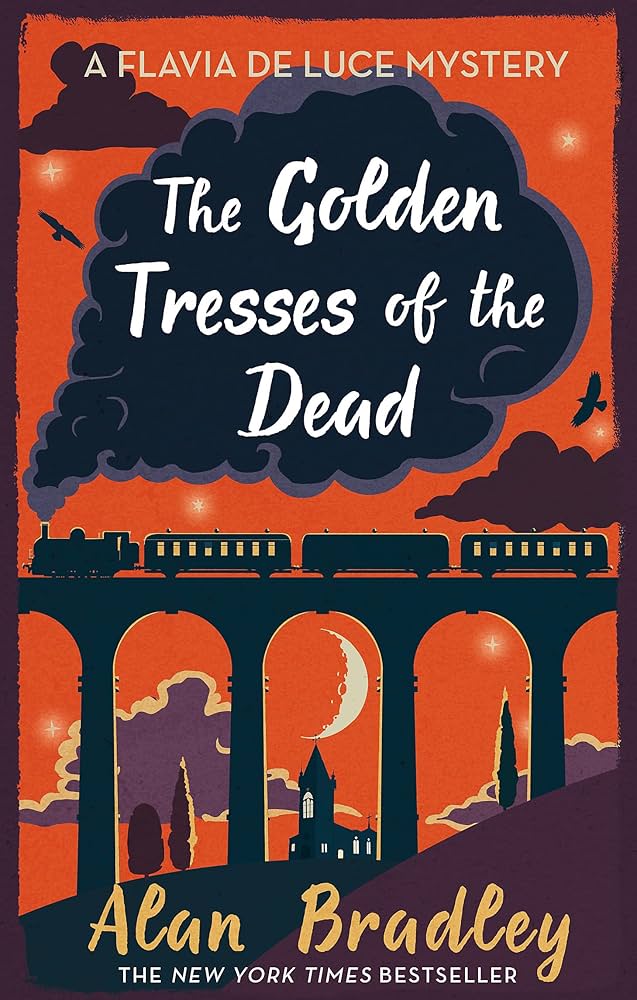
 I had thought this book, published in 2019, was going to be the last in Alan Bradley’s Flavia de Luce series, so I hadn’t rushed to read it, thinking that once I had I would have no more to look forward to. Then I discovered that there’s actually another book coming in September – which will be the eleventh in the series – and decided to pick this one up now in preparation.
The Golden Tresses of the Dead begins in 1952 with our twelve-year-old heroine Flavia de Luce attending the wedding of her elder sister, Ophelia (known as Feely). I won’t tell you who she’s marrying, in case you haven’t reached this point in the series yet – or haven’t started at all. Everything is going well, apart from the usual naughtiness of Flavia’s annoying little cousin, Undine, but when Feely steps forward to cut into her wedding cake she screams in horror. There’s a human finger inside the cake! As Feely retreats to her room to recover from the shock, Flavia whisks the finger away to her laboratory so she can examine it and try to identify its owner.
The next day, Arthur W. Dogger & Associates, the new detective agency Flavia has formed with her father’s friend and manservant Dogger, receives its first client. A Mrs Prill is trying to track down some stolen letters and wants Flavia and Dogger to help. When they begin investigating, however, they discover that Mrs Prill hasn’t been entirely honest with them. Are the letters really missing – and could there be any connection with the severed finger in the cake?
As I’ve come to expect from the Flavia de Luce books, The Golden Tresses of the Dead (the title comes from Shakespeare’s Sonnet 68) is a quick, entertaining read; I did enjoy it, but it’s not one of the strongest and I think if I didn’t know there was another book on its way, I would have been disappointed with this one as a conclusion to the series. In general, I think the earlier books are more fun and have more charm than the later ones, so if you still haven’t tried one I would recommend going back to the beginning and starting with The Sweetness at the Bottom of the Pie.
Although this book has many of the same elements as most of the others in the series – it’s set, as usual, in and around the small English village of Bishop’s Lacey in the 1950s; Flavia still gets around on her trusty bicycle, Gladys; she still loves chemistry and conducting experiments in her fully equipped laboratory – there are also some differences. Feely leaves for her honeymoon early in the book and Flavia’s other sister, Daffy (Daphne), is tucked away working on her memoirs and only makes one or two brief appearances. The relationship between Flavia and her two sisters is one of the things that has always fascinated me about the series, so I was sorry that it’s not really explored any further here. We do see a lot of Undine, but I’ve never liked her and she doesn’t make up for the absence of Feely and Daffy! Also, as hinted at in the previous book, The Grave’s a Fine and Private Place, crime-solving is no longer a solitary activity for Flavia and she forms a new partnership with Dogger. It works well – Flavia does most of the trespassing, risk-taking and hunting for clues, but Dogger, with the benefit of age and life experience, knows how to interpret those clues. I’ve always loved him and was pleased to see him take such a prominent role in this book.
The mystery itself is complex, involving potential grave-robbing, poisonous plants and two missionaries who may not be quite what they seem, and I’ll admit that I found it confusing and didn’t really understand how everything tied together. I wondered if I just hadn’t been paying enough attention and had missed something, but looking at other reviews it seems that a lot of people had similar problems. This is not a favourite Flavia de Luce book, then, and I’m glad it’s not how the series ends! I’m looking forward to reading book eleven, What Time the Sexton’s Spade Doth Rust, and am hoping it will be better than this one.

Book 38/50 for the Historical Fiction Reading Challenge 2024
 She Reads Novels
Glad this was entertaining even if not amongst the better ones. I’ve still only caught up to book 6 so have four more to go!
I think the earlier books were the best, but I’m still enjoying the series and am glad it’s continuing. You still have a lot to look forward to!
I still need to read this one. Knowing a new one is coming out next month is good incentive to get caught up. Flavia is one of my favorite amateur sleuths. Dogger is great, too. Though it sounds like this one falls a little short when compared to the other novels in this series.
I’m glad you love Flavia and Dogger too. This was still a good book, but I missed Flavia’s usual interactions with Feely and Daffy.
I quit reading this series a while back when it seemed to be turning to spying. I can’t believe Flavia is only 12! She was 11 when the series started, and she went to school for a year plus did a bunch more things. How can she be 12?
I was sure she must be at least 13 or 14 by now, but apparently she’s still just 12. Time must pass very slowly in Bishop’s Lacey!
😉
Glad to hear another Flavia book will be coming out soon.
Harvee https://bookdilettante.blogspot.com
Yes, it’s something to look forward to!
I was reading these a while back and then stopped, not sure why, availability I think. I was expecting Flavia to be a lot older by now, but it has meant I will endeavour to see where I got up to and perhaps carry on reading.
Flavia is starting to feel more mature, but she doesn’t seem to be ageing in years! I think the earlier books in the series were stronger, but the more recent ones are still entertaining.
Hi Helen, sorry to hear this wasn’t one of the best from the series for you. Hopefully the next one will more to your taste. 🤞 You have reminded me how much I wanted to read this series though.
Blessings, Jessica 💌
I think you would like this series. Flavia is a great character and the setting has a lovely, cosy feel. Start with one of the earlier books, though – they are the best!
Thank you, Helen and I have added the first book to Goodreads to remind me 🙂
Blessings, Jessica 💌