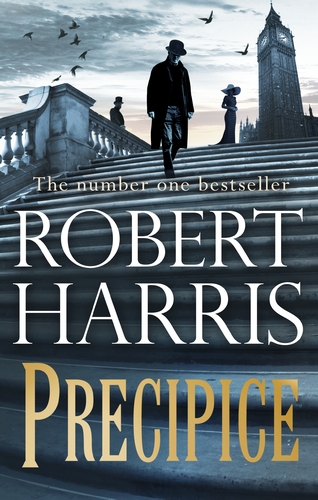
 Robert Harris became a must-read author for me after reading and loving An Officer and a Spy, the Cicero trilogy and Conclave, but some of his more recent books have left me feeling slightly disappointed. His new one, Precipice, sounded promising, but would it be a return to form?
The novel opens in London in the summer of 1914 and introduces us to Venetia Stanley, a twenty-six-year-old woman from a wealthy, aristocratic family. Venetia is growing bored with the aimlessness of her days and the spoiled, shallow group of friends, known as the Coterie, that she has fallen in with, so when Herbert Henry Asquith begins an affair with her she sees it as a welcome escape. Not only is Asquith more than twice her age, he is also the Prime Minister and Venetia finds it flattering that he seems to value her opinion on politics and includes her in discussions on important matters of state.
Asquith is currently preoccupied with the situation in Ireland where the Nationalists are campaigning for Home Rule, but soon he has an even bigger problem to deal with as tensions begin to escalate in Europe and it looks increasingly possible that Britain could be pulled into a war. At this crucial moment in British history, it seems that the security of the nation is being put at risk – several confidential documents giving details of the government’s military and diplomatic plans have been found by members of the public and handed to the police. Only a small number of high-ranking government ministers have access to this information so, unlikely as it seems, one of them must be responsible for the leaks. Detective Sergeant Paul Deemer is given the task of investigating and it’s not long before he makes a shocking discovery.
Although I’ve read many novels set during WWI, they’ve usually dealt with ordinary people rather than politicians and certainly haven’t been written from the perspective of the Prime Minister. I knew nothing about H.H. Asquith’s private life, what he was like as a person or how he was viewed by his friends, colleagues and the public, so I learned a lot from this book. Harris draws on Asquith’s published letters to Venetia Stanley as one of his main sources and quotes from them extensively throughout the novel (Venetia’s letters to Asquith were apparently destroyed, so Harris uses his imagination to recreate them).
The impression I got of Asquith from this book, as a politician, was of a generally well-meaning man who was competent enough as a peacetime Prime Minister (apart from where the challenge of Ireland was concerned) but definitely not the right person to lead the country through a war. His overly cautious approach in the early stages was very frustrating to watch; it’s likely that the outbreak of war was inevitable and nothing he could have done would have averted it, but he didn’t seem to grasp the seriousness of the situation at all and refused to commit Britain one way or the other when he was being pressed from all sides to take decisive action. Even when war did break out, it seemed to be of less importance to him than his relationship with Venetia and again it was frustrating to see him sitting composing letters to her during cabinet meetings and plotting ways to escape from political duties to go and visit her. Although the general public weren’t supposed to know about the affair, it was an open secret amongst their family members and I couldn’t help feeling sorry for Margot, Asquith’s wife.
The thriller element of the novel is weaker and although I was never bored, the book never quite became unputdownable either. There’s no real mystery surrounding the security breaches because both we and Paul Deemer know from very early on who is responsible, but it’s still interesting to see how Deemer approaches the situation and there’s an entertaining section where he goes undercover in Wales in search of more information. There’s also a small twist towards the end of the book, which I hadn’t really seen coming, although it had started to occur to me that something wasn’t quite right!
Precipice is definitely more historical fiction than thriller, which may or may not appeal depending on your personal taste. Although it hasn’t become one of my absolute favourites by Robert Harris, I really enjoyed it for the fascinating insights into Asquith and his government.
Thanks to Hutchinson Heinemann for providing a copy of this book for review via NetGalley.

Book 42/50 for the Historical Fiction Reading Challenge 2024
 She Reads Novels
I’ve never read anything by Harris but this one sounds interesting, Helen. I prefer historical fiction to historical thrillers and the mix here, together with the period, sounds like one I would enjoy.
This would probably be a good one for you to start with as it’s not too much of a thriller and is set in that fascinating period right at the beginning of the war. It’s not a favourite, but I did enjoy it.
I’m trying to remember if I’ve actually read any Harris or am just v familiar with his plots from various people I know reading him. I think I’ve maybe read Fatherland? Conclave appeals – I love pope drama.
Fatherland is one I haven’t read yet, although I’m sure I’ll get to it eventually. Yes, if you love pope drama I would definitely recommend Conclave. It’s not really a subject I’m interested in so I didn’t expect to enjoy it as much as I did!
Robert Harris isn’t a familiar name, but I see our library is well-stocked with his books. I don’t think I’d start with this one, though.
His books cover a lot of different time periods and subjects. I particularly enjoyed An Officer and a Spy, about the Dreyfus Affair, and his books set in Ancient Rome. I hope you can find something that appeals.
Definitely already on ‘The List’. I’ve really liked everything of his I’ve read (with one NOTABLE exception!) and will – eventually – be reading this too. The period is an interesting one, indeed fascinating, and I intend to read more about the approach to WW1 next year. Looking forward to the paperback!
I hope you enjoy this one when you get to it. I was surprised to find how little I really knew about the buildup to WWI in comparison to WWII. This book made me wonder how different things would have been (or not) if someone else had been Prime Minister in place of Asquith.
For a Europe wide look at the origins of WW1 try ‘July 1914 – Countdown to War’ by Sean McMeekin. It’s VERY good. My review is here: https://cyberkittenspot.blogspot.com/2024/08/just-finished-reading-july-1914.html
I also have ‘The Fateful Year: England 1914 – The Year that Began in Peace and Ended in War by Mark Bostridge. I haven’t read it (yet) but it *is* a Penguin book and I’ve hardly ever been let down by them.
I’ve got this one to read from the library at the moment. I’m not too worried about the lack of thrills as I always enjoy his writing and am interested in the politics of the time Like you, I’ve read loads of books set in this period but never one from the government angle before. I’m glad you enjoyed it
I found it really interesting to read about this period from the government perspective rather than the usual social or military perspectives. I hope you enjoy it.
The last one I read was Pompeii which I rather liked but I have lots to catch up with. All I’ve read of Asquith was a quote from him that a character in another book would refer to, We had better wait and see!
I still need to read Pompeii, which I’m looking forward to. Yes, ‘wait and see’ was Asquith’s approach to politics. Sometimes it was sensible, but there were other times when he really needed to make a decision and take action!
I’ve read a few Robert Harris books – Pompeii is my favourite I think. My husband has read this one and really enjoyed it.
I’m glad your husband enjoyed this one! I haven’t read Pompeii yet but I will eventually and am looking forward to it.
I’ve had the same reaction to Harris’s later books. I can’t tell from this whether I would prefer it or not. It at least sounds like he’s trying something different.
Yes, it’s a bit different. I liked it better than his last two or three books, but not as much as his earlier ones.
He has written some good ones! Probably hard to live up to.
One thing about Harris is that he’s always trying something a little different. His “Fear Index”, for instance, is completely unlike any of his other works. Aside from the Cicero trilogy and Pompeii, his books are more different from one another than any other author I’ve found .
A lot of them are suspense, but I see what you mean. I haven’t read Fear Index.
I feel sorry for Asquith’s wife, too. This one sounds interesting, but probably not one I’ll be reading.
I found it interesting to read about the politics behind WWI, but I think Robert Harris has written better books.
I’ve followed a similar path to you with Harris, so while he’s still a must-read I now always have a mixed feeling of anticipation and apprehension. This one sounds right up my street, so I’m glad you felt it worked well overall even if it hasn’t become a favourite. I’ll be reading it very soon…
It’s fascinating as an exploration of the politics behind the early stages of the war. I knew almost nothing about Asquith and this book really made me wonder how different things could have been with someone else in charge! I hope you enjoy it – I’ll be interested to hear what you think.
I had to skim your review a bit because I’m definitely reading this — I’ve read all of Harris, beginning with Fatherland and then his Roman fiction — and anticipate enjoying this.
I’ve read most of his books, but there are a few of the earlier ones I still need to read (including Fatherland). I’m sure you’ll enjoy this one – it’s fascinating to see the political situation unfold at the beginning of the war.
I find the lead up to both world wars fascinating, because it is so much more complicated than history suggests. It would be interesting to read this one.
Thanks for sharing this review with the Historical Fiction Reading Challenge.
I know more about the lead up to WWII than WWI, so I found that aspect of the book really interesting and learned a lot from it.