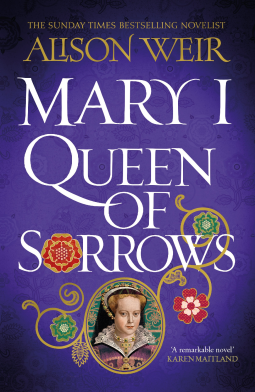
 This is the third novel in Alison Weir’s Tudor Rose trilogy, following Elizabeth of York: The Last White Rose and Henry VIII: The Heart and the Crown. You definitely don’t need to have read the previous two books before starting this one, although if you’re not very familiar with Tudor history it would probably be helpful to read them in order.
The novel begins in 1525, introducing us to nine-year-old Mary who has recently become betrothed to Charles V, Holy Roman Emperor and King of Spain. As the daughter of Henry VIII and his Spanish wife, Katherine of Aragon, a marriage between Mary and Charles would cement England’s alliance with Spain. Mary’s future looks bright, but things don’t go as planned and it’s not long before her whole life is thrown into turmoil. First, Charles decides he doesn’t want to wait for Mary to grow up and takes another bride, one who is richer and old enough to give him children. Then, Mary’s father becomes obsessed with the idea of marrying Anne Boleyn and casts Mary’s mother aside.
It would be difficult not to sympathise with the young Mary as she is put under pressure to betray her mother and denounce her Catholic faith, gains and loses one stepmother after another and, with the arrival of a younger half-sister and half-brother, becomes uncertain of her place in the succession. However, I did find these early sections of the book quite repetitive as having read all of Weir’s Six Tudor Queens series, as well as her novel on Henry VIII, I felt that there wasn’t much here that was new to me. The second half of the book interested me more as it moved on to Mary’s own reign as Queen, her marriage to Philip of Spain and her ‘phantom pregnancies’, and, of course, the persecution of Protestants that famously gained her the nickname ‘Bloody Mary’.
On finishing the book and reading the author’s note at the end, I was interested to find that Alison Weir herself felt that she and Mary shared some childhood experiences, such as the separation of their parents and dislike of the new woman in their father’s life; this probably explains why the chapters dealing with Mary’s early years are written with such sympathy and understanding. Later in the novel, however, Mary becomes a much more difficult character to like as she ignores advice and public opinion, makes some poor decisions, and those who don’t share her Catholic faith burn at the stake. Weir states that she found it hard to make the adult Mary sympathetic when the historical evidence tells us otherwise.
As I wouldn’t want anyone to accidentally buy the same book twice, be aware that the US title of this book is The Passionate Tudor: A Novel of Queen Mary I. Alison Weir’s next novel, coming in 2025, stays in the Tudor period and is about the rise and fall of Cardinal Wolsey. I’ve never read a book written from Wolsey’s perspective before, so that should be interesting.
Thanks to Headline for providing a copy of this book for review via NetGalley.

Book 43/50 for the Historical Fiction Reading Challenge 2024
 She Reads Novels
Hmm, I have been staying away from Weir as a novelist after the first one I read, although she is a good historian. I like her nonfiction much better.
I liked the earlier part of her life better too as she was a more sympathetic character. It was hard to warm to her as queen though
It’s on my Amazon wishlist. Hoping the price’ll come down!
I enjoyed it but I don’t think I would have wanted to pay the full price for it. I hope it comes down soon!
99p on Kindle at the moment!
Great! It’s definitely worth that 🙂
I liked this one very much. I thought that younger Mary’s experiences shaped the woman she became in older years, warts and all.
Yes, I agree. Although the older Mary frustrated me at times, it was easy to see what had made her that way. I’m glad you enjoyed this one.
A fascinating era. I’ve read a few of Alison Weir’s books and enjoyed them but they are so huge that fitting them in is a problem!
Yes, I enjoyed this one but it seemed to take forever to read!
I have a *large* stack of Weir I still need to work through. I’m hoping to turn at least some attention to the Tudors next year. Endlessly fascinating!
The Tudors are always interesting. I haven’t read as much about Mary as some of the other Tudor figures, so I enjoyed this one!
I read a biography of Mary years ago and found it both interesting and sad. She did not lead a very happy life. I wish I could remember the title of it, but I can’t. But it was a little more sympathetic towards Mary and her role in everything. Because it seemed like it was the men around her who had the most say in what happened to her.
Yes, it’s a sad story and I did feel sorry for her. She was definitely influenced by the men around her and didn’t have the power and independence that Elizabeth had. I’ll have to look for a good biography of her.
I like the sound of this book series! I would be interested in learning more about this time period. 😊
It’s a fascinating period and I think Alison Weir’s books are a good place to start.
Fabulous! What is the name of the first book in the series? I will add it to my TBR. 😊♡
The first book in this series is Elizabeth of York: The Last White Rose.
Great, thank you Helen! 🤗
Hi Helen, looks like we had very similar thoughts on this novel. I didn’t realise the next book will be about Cardinal Wolsey, that should be interesting 😀
Blessings, Jessica 💌