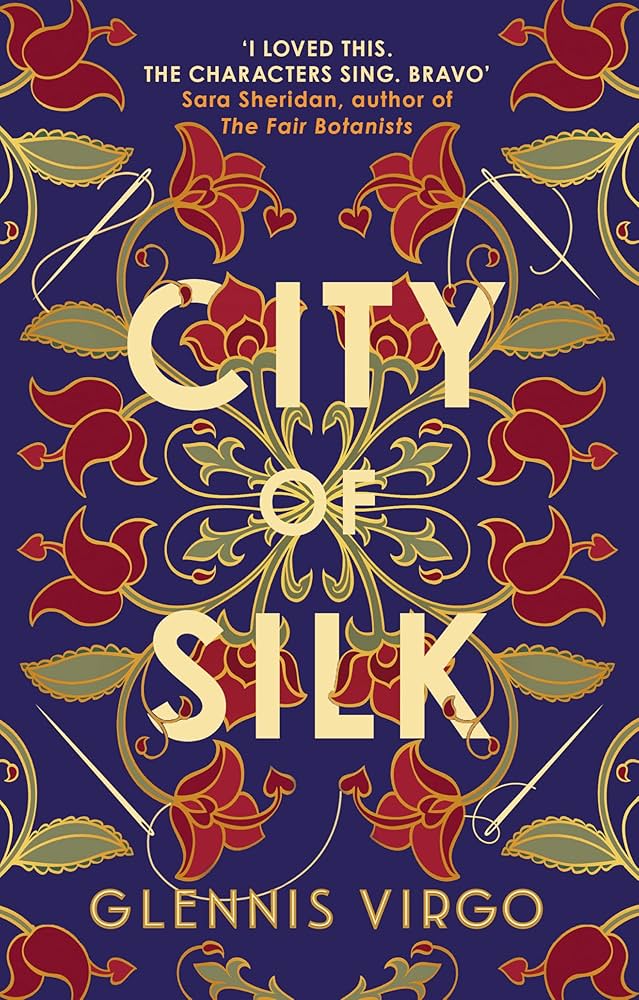
 I love reading about Renaissance Italy, but most novels focus on Rome, Florence or Venice, so this one, set in Bologna – famous for its silk industry in the 16th century – was something slightly different.
It’s 1575 and our narrator, Elena Morandi, is working as a seamstress in Signora Ruffo’s workshop. Although she was raised in an orphanage from the age of ten after the death of both parents, Elena remembers the skills she was taught by her father, a tailor, and has proved to have a real talent for needlework. However, she’s bored with sewing women’s gowns and capes and longs to work on men’s clothing and gain the title of tailor rather than seamstress. Sadly, this is not an option for a woman and Elena seems destined to stay with Signora Ruffo – until she flees to escape an arranged marriage.
In need of a new job, Elena decides to pursue her dreams and manages to obtain a lowly position in a tailor’s workshop, sweeping the floor and fetching fabrics and threads for the Maestro, Francesco Rondinelli, and his three tailors. Then, just as she’s settling into her new life, a figure from her past walks into Rondinelli’s workshop to ask for a fitting. This is Antonio della Fontana, benefactor of the orphanage Elena attended and one of the most powerful men in Bologna. He had abused his position of power at the orphanage and it seems that nothing has changed; when even Rondinelli and his friends begin to suffer at the hands of Fontana, Elena decides it’s time to take revenge.
City of Silk is one of several historical novels I’ve read recently that deal with women trying to forge a career for themselves in fields traditionally dominated by men. Tracy Chevalier’s The Glassmaker, Joanne Burn’s The Bone Hunters and Ambrose Parry’s The Spendthrift and the Swallow are three I’ve read just this year (featuring, respectively, a female glassmaker, a female would-be geologist and a woman desperate to become a doctor). This is obviously another and while I admired Elena’s determination and ambition, I would have liked more detail on why she felt it was so important to become a tailor instead of aspiring to be like Signora Ruffo, who was running her own successful business and was financially independent. I’m not sure I really understood why Elena seemed to look down on seamstresses so much or why she considered it so much more rewarding to make clothes for men rather than women.
As mentioned above, I did love the setting. I’ve never been to Bologna, but Virgo’s descriptions brought it to life for me. I also found it interesting to learn about the city’s role as a leading European centre of silk production and what it was like to work in a tailor’s or seamstress’s workshop during that period. Most of the characters are fictional, but Virgo explains in her author’s note at the end that a few of them really existed and another is inspired by a portrait in the National Gallery!
The scheme Elena and her friends come up with to take their revenge on Fontana seemed very unlikely to me – I couldn’t imagine anybody actually doing what they did, particularly not in the 16th century – but otherwise the plot was quite entertaining. This is Glennis Virgo’s first novel (for which she has won the Debut Writers Over 50 Award) and although I’m not sure if I’ll read her next one, I could be tempted depending on the subject.
Thanks to Allison & Busby for providing a copy of this book for review via NetGalley.

Book 50/50 for the Historical Fiction Reading Challenge 2024
 She Reads Novels
Renaissance Italy/craft workshop is catnip to me, but this does sound a bit disappointing, perhaps more akin to Harriet Constable’s The Instrumentalist, which I did not like at all. What a shame!
The setting and the details of the textile industry were fascinating, but the plot was just too unconvincing.
I don’t love books with revenge themes in them, but the Bologna setting is certainly appealing. I didn’t know it was famous for it’s silk industry back in the day. But then I don’t really know much about Bologna at all.
I didn’t know Bologna was famous for silk either until I read this book. I don’t think I’ve ever read anything else with a Bologna setting.
Definitely with you on Renaissance Italy – fascinating place/time. I *loved* visiting Florence. Totally amazing place. You can just imagine what it was like in the 16th century. I *think* I have a few books (novels) based in the zone. Maybe I need to dig them out.
I still haven’t been to Florence, but loved Rome and Venice.
I was a bit disappointed with Venice (shocking I know!) but really liked Rome. Some much history… So much FOOD….. [lol] Although the visit did completely ruin my ice-cream appetite for *years* afterwards. Nothing seemed to match real Italian gelato!
I’m not sure I’d read this, given your reservations, but I can confirm that Bologna is a lovely colonnaded city, quite unlike the big three you mention, and being a university city feels quite civilised.
Bologna does look and sound lovely. I hope to have a chance to visit it one day.
That sounds interesting. As you say, it’s always Rome, Florence or Venice!
Yes, Bologna made an interesting change!
Bologna is lovely. I was there a few years ago, but a coworker visited often because her nephew lived there. In town there’s a chocolate maker that doesn’t sell anywhere but in Bologna, and their stuff is DELICIOUS! She used to bring it as a gift when she came to our offices for work visits. So, of course, when I was in the area in Italy, I went and found not only a lovely place, but also great chocolates. These books sound really nice – just my style. Thanks.
Bologna does look lovely and it sounds like it’s worth visiting just for those chocolates!