The story of our Roman Escape Line has been characterised as a tale of courage. But it was always a story of friendship, first and last. The friends we knew and those we did not, some fleetingly encountered, others never at all. I am no sentimentalist, but I call it a love story.
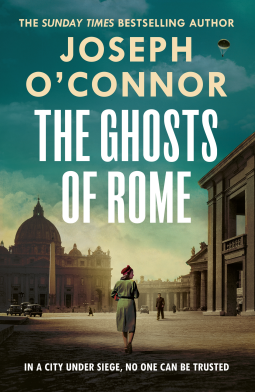 This is the second book in Joseph O’Connor’s new trilogy inspired by the true story of the Rome Escape Line, a secret network that smuggled thousands of Jewish refugees and Allied soldiers out of Nazi-occupied Rome. The first novel, My Father’s House, introduces us to the work of the Escape Line who meet in the neutral Vatican under the guise of a choir to avoid the attentions of the Gestapo and focuses on one member in particular – Monsignor Hugh O’Flaherty, the Irish Catholic priest who is the leader of the network.
The Ghosts of Rome continues the story, beginning in February 1944, six months into the Nazi occupation. Although Hugh O’Flaherty is still part of the group, we see very little of him in this book as he steps into the background to let other characters’ stories be told. The main focus this time is the widowed Contessa Giovanna Landini, known as Jo, whose palazzo is commandeered by Gestapo officer Paul Hauptmann. Hitler isn’t satisfied with Hauptmann’s performance in Rome so far and he is under pressure to produce results. If he could obtain evidence of the Choir’s activities he’s sure that would help to improve his reputation with the Führer. Hauptmann hopes that the Contessa, whose house he is living in, will lead him to her fellow Escape Line members, but Jo is a resourceful woman and decides to take advantage of Hauptmann’s interest in her to try to protect herself and the Choir.
Another significant storyline revolves around a Polish airman who is shot down over Rome. Some members of the Escape Line want to help him, but others are more cautious. How can they be sure he is who he says he is? What if he betrays them? When it becomes obvious that he has life-threatening injuries and will die if not treated, they are faced with an important decision to make.
Of the two books, I think I preferred My Father’s House because it was more suspenseful, describing the countdown to a major mission on Christmas Eve, and because I found Hugh O’Flaherty such an interesting character. This is an excellent book as well, though, and I’m sure other readers will like it better than the first one. Although Jo Landini is at the forefront of the story, most of the characters we met in the previous book also reappear, including British Envoy Sir Francis D’Arcy Osborne, diplomat’s wife Delia Kiernan and escaped soldier Sam Derry. We also see a lot of Delia’s teenage daughter, Blon, who is angry when her mother leaves the Escape Line and insists on trying to take her place, which not everyone is happy about! These are all people who really existed, but O’Connor includes an author’s note to explain that the way they are portrayed in the book is just his interpretation and shouldn’t be relied on as fact.
If you haven’t read the previous novel, you’re probably wondering whether it’s necessary to have read it before starting this one. I would say it’s not really essential, but it would make it easier to follow what’s happening in this book. There are a lot of characters and O’Connor constantly switches between different perspectives throughout the novel, as well as inserting passages written in other styles – such as transcripts of (fictional) BBC interviews – which means you do need to pay attention otherwise it would be easy to lose track of things. As with My Father’s House, I was particularly interested in the insights we get into the mind of Paul Hauptmann – a very human villain, which just makes him all the more unsettling to read about. It’s the brave and tireless work of the Escape Line, however, that makes these novels so compelling; in this book, I loved the way they managed to hide hundreds of people inside a derelict old theatre right under the noses of the Gestapo.
This is a planned trilogy and although I can’t see any details of the third book yet, I know it will be something to look forward to!
Thanks to Harvill Secker for providing a copy of this book for review via NetGalley.
 She Reads Novels
I’m keen to read this, but think I’d benefit from reading My Father’s House first
I would definitely recommend starting with My Father’s House if possible!
I saw a brilliant review for this at the weekend too so I definitely want to read both of these.
They are both great books.
I’ve ordered the first one from the library
Reading this just now and loving it!
It’s great, isn’t it? I’m glad you’re enjoying it!
If you’ve developed an interest in the real Monsignor Hugh O’Flaherty I can heartily recommend ‘Priests De La Resistance! – The Loose Cannons Who Fought Fascism in the 20th Century’ by Fergus Butler-Gallie.
My review is here: https://cyberkittenspot.blogspot.com/2024/12/just-finished-reading-priests-de-la.html
That does sound fascinating – thank you!
I thought the first book said it all, and I didn’t think it was that successful. If you say the first book was better, then I don’t think I’ll be reading the second or third. Too bad. I usually like O’Connor.
This is very similar to the first book, so if you didn’t really like that one you’ll probably feel the same way about this one.
I just thought he used his talent better on other projects and was taken aback that this was going to be a trilogy.
I enjoyed your review very much, Helen, and I’m very drawn to this and its predecessor as a result. I shall in the first place check our library for this author’s work – see what you’ve forced me to do?! 😁
I also enjoyed two of O’Connor’s other books – Ghost Light, about the playwright John Millington Synge, and Shadowplay, about Bram Stoker, Henry Irving and Ellen Terry. Sorry if I’ve made your TBR even longer!
Oh, I think I remember you reviewing the Stoker/Irving/Terry title not so long ago, another reason to firmly bear O’Connor in mind!
Im going to have to look out for the first book in this trilogy. Stories like this based on true events tend to be fascinating and deeply moving. Most things focusing on slightly similiar events I’ve seen rather than read but I did think The Good Doctor Of Warsaw was fantastic and need to make more of an effort to pick up these sort of books in the future.
I would definitely recommend starting with the first book, although they’re both good. I hadn’t heard of The Good Doctor Of Warsaw, but I’ve just looked it up and it does sound interesting.
That’s the one I’ve added to my TBR 😊 I’m never fond of reading books out of order. Especially so when you said you preferred the first one. It is really good but also definitely not an easy read given its dark subject matter. I will admit that I don’t quite understand why it isn’t more widely known like Tattoist though
I don’t know much at all about this Rome Escape Line! but I want to. This series sounds like a good one…and one I think my mom and sister would really enjoy, too. 😀
I knew nothing about the Rome Escape Line either until I read this series. I love it when you can learn something new from a book.
I enjoyed the first book so I preordered this one. I am not sure when I will get to it, but I will eventually.
Thanks for sharing this review with the Historical Fiction Reading Challenge
I hope you enjoy it whenever you get to it!