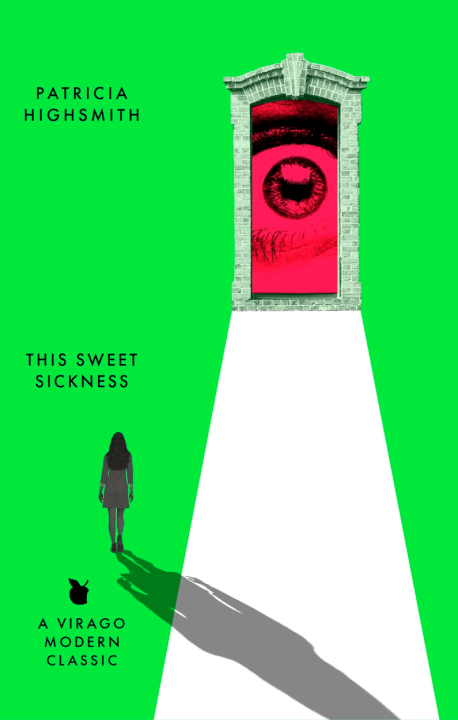
 Virago have just reissued ten of the books from their Modern Classics range with new green cover designs, including Valley of the Dolls by Jacqueline Susann, Their Eyes Were Watching God by Zora Neale Hurston – and this one, Patricia Highsmith’s This Sweet Sickness. I’ve been meaning to try another Highsmith novel since reading Strangers on a Train a few years ago, so when I spotted this book on NetGalley it seemed the perfect opportunity.
This Sweet Sickness was first published in 1960 and takes us inside the mind of David Kelsey, a young man who lives in a boarding house in the town of Froudsburg, New York, and works as a scientist at a fabrics factory. At least, this is his life from Monday to Friday. When the weekend comes around, David leaves for his own house in nearby Ballard, where he becomes William Newmeister, a freelance journalist. For two whole days he locks himself away and imagines he is happily married to Annabelle, the love of his life. He has decorated the house the way he thinks Annabelle would have wanted it, prepares the meals he’s sure she would like and has even bought her a piano. The only problem is, Annabelle ended their relationship two years earlier and married another man. She and her husband, Gerald Delaney, live in Connecticut with their baby son and Annabelle has never even visited the house in Ballard, let alone lived in it.
David thinks he has successfully covered up his dual identities, having convinced everyone at work and at the boarding house that he visits his elderly mother at her nursing home every weekend. His mother has actually been dead for many years, but he’s sure no one will ever find out! However, two of his friends – a work colleague, Wes Carmichael, and a fellow boarder, Effie Brennan – begin to grow suspicious and decide to investigate. They are right to be concerned, because David is becoming increasingly unstable. He can’t and won’t accept that his relationship with Annabelle is over and bombards her with letters and phone calls, urging her to leave Gerald and marry him. Eventually, things take a more sinister turn and David finds himself in trouble. Is his double life about to be exposed at last?
I loved this book and although the first half is quite slow, I was completely gripped by it all the way through. It’s definitely a disturbing read, though, particularly as the whole book is written from David’s perspective (in third person). I was so impressed by the way Highsmith changed my perception of him several times throughout the book. At first I saw him as a basically decent person who’d had his heart broken and was struggling to move on, then I quickly lost sympathy for him when it became clear how dangerous his obsession was and how relentlessly he was stalking Annabelle, and finally, despite his actions, I began to pity him again because by then he had completely lost his grip on reality and desperately needed help.
Annabelle, although we do meet her occasionally, exists mainly as a fantasy woman in David’s mind and it seems obvious that if he got his wish and married her he would find that the real Annabelle didn’t quite live up to the imaginary one. Annabelle frustrated me because she could have been much more firm with David; instead, at least at first, she seems to be encouraging him, speaking to him on the phone, agreeing to meet him and letting him think there’s still hope. It would have been interesting to have seen things from Annabelle’s perspective, I think. Did part of her still care about David and not want to hurt him? How did she really feel about Gerald?
Effie is another character who interested me. She’s clearly in love with David, but he’s too preoccupied with his delusions and obsessions to pay her much attention. He becomes more and more irritated by her persistence and her ‘spying’, without acknowledging that he is behaving the same way towards Annabelle. Effie and the other characters in the book are seen only through David’s eyes which almost certainly doesn’t give us a true or fair picture of what they are really like.
This Sweet Sickness is an unsettling novel and not very comfortable to read, but it’s also fascinating from a psychological point of view and I found it very immersive. I liked it better than Strangers on a Train and look forward to reading more of Patricia Highsmith’s books.
Thanks to Little, Brown Book Group UK/Virago for providing a copy of this book for review via NetGalley.
 She Reads Novels
I haven’t read any of this authors books before but I may well have to check this out one day. Stalker type storylines and obsession always have a tendency to fascinate me and this one certainly sounds disturbing and complex. I love the new cover design too, the green is so vivid that it definitely catches your eye.
It’s definitely a disturbing book, but also fascinating, particularly from a psychological aspect. It’s not one of Patricia Highsmith’s better known books, but I think it would be a good place to start.
That cover is lovely! I’m a big fan of Highsmith
It’s very eye-catching, isn’t it? I need to read more Highsmith!
Highsmith knew how to write unsettling psychological thrillers. Her characters are always so unforgettable. I need to read more of her novels.
This one is very unsettling! I’m looking forward to reading more of her books too. I particularly want to read the Ripley series.
This one sounds good.
Yes, I thought so!
I do need to revisit Highsmith, though this isn’t one of her titles I recall seeing before, though I like the way she – as she so often does – get us to form competing and contrary opinions of her main character.
It’s not one I had heard of either until recently, but I was very impressed by it and by the complexity of the main character. I’m looking forward to reading more of her books, having enjoyed both this one and Strangers on a Train.
I saw that you had read this novel and was looking forward to your review. Patricia Highsmith is such an interesting writer.
Yes, her books are fascinating from a psychological perspective and the way she gets inside the minds of her main characters. I’m looking forward to reading more of them.