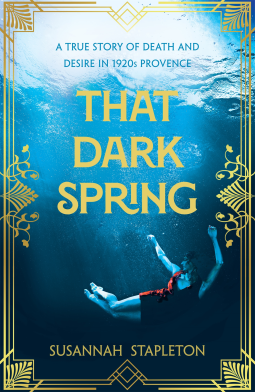
 One of my resolutions for 2025 was to read more non-fiction books, so I’m ashamed to say this is only my second one this year. Oh, well – I still have more than seven months to add a few more to that total. I would also like to widen the range of topics I normally choose to read about and try something different, but for now, with That Dark Spring, I have stayed within one of my usual areas for non-fiction – true crime.
The crime in question is the murder – or could it be suicide? – of Olive Branson, an Englishwoman in her forties found dead at her farmhouse in a village in Provence. This happens in April 1929, when she is discovered submerged in a water tank outside the house, a bullet wound between her eyes and a revolver nearby. The local policeman and doctor conclude that Olive shot herself, but not everyone is happy with this verdict. Back in England, Olive’s wealthy, influential cousin demands that the case be reopened, so one of France’s top detectives, Alexandre Guibbal, is summoned from Marseille to investigate.
It’s an intriguing mystery! Could Olive really have lifted the heavy cistern lid, lowered herself in and shot herself – with her left hand, despite evidence suggesting that she was right-handed? Guibbal doesn’t think so and quickly turns his attentions to François Pinet, believed to be a lover of Olive’s for whom she had changed her will to leave him the Monte Carlo Hotel, which she had recently purchased. As evidence mounts up against Pinet, he insists that he is innocent and is defended by many of the villagers who are keen to support ‘one of their own’. There’s eventually a trial, but even then a lot of questions are left unanswered. Susannah Stapleton can’t – and doesn’t – give us those answers, leaving us to draw our own conclusions and try to decide what really happened.
I enjoyed That Dark Spring overall, although it took me a while to get into it due to the amount of background information provided in the first half of the book: a history of the village of Les Baux and the Baussenc people; an account of Olive’s early life and her career as an artist; detailed descriptions of the two rival hotels in Les Baux; and a long and (as far as I could tell) irrelevant biography of the poet Frédéric Mistral. Some padding is to be expected in books of this type, of course, but I found that I only became fully engaged with the story when it returned to the central crime. There are some points that wouldn’t be out of place in a detective novel, such as where Guibbal consults an astronomer in an attempt to decide exactly when darkness fell on the night of the crime or where Pinet tries to use the sighting of a car as an alibi and becomes entangled in his own lies.
It’s frustrating that we still don’t know the truth behind Olive’s death and probably never will. If Pinet was innocent and we assume that suicide was unlikely, that must mean someone else got away with murder – but who was it? Stapleton doesn’t really steer us into one way of thinking or another; she just provides the facts and some possible theories for us to consider. She suggests that the police may have been so determined just to pin the blame on somebody that they ignored or failed to collect important evidence, leaving Pinet’s fate up to the lawyers and the jury.
Stapleton has drawn on a number of primary sources and includes excerpts from Olive Branson’s diaries and letters throughout the text, giving it a more personal touch. There are also notes at the end, a bibliography and a list of Olive’s exhibited artworks. I had never heard of Olive until now, so it’s good to have learned a little bit about her. I’ll have to go back and read Susannah Stapleton’s other book – The Adventures of Maud West, Lady Detective.
Thanks to Picador for providing a copy of this book for review via NetGalley.
 She Reads Novels
Interesting case. I wonder where the author first heard of it. I’ve been trying to read more nonfiction books this year, too. But I’ve only managed to read 4 so far…much lower than the number of fiction books I’ve read. Great review!
Yes, it’s a fascinating case and not one I’d ever heard about until now. I hope we both manage to read more nonfiction books in the rest of the year!
Intriguing, and for me a case with which I’m totally unfamiliar. Your review reminded me of the equally convoluted and detailed Kate Summerscale work The Suspicions of Mr Whicher (which I really ought to get back to and finish) which felt as if, like a proper detective, I should have opened a new notebook and begun taking down details and making connections right from the very start.
The last true crime story I remember completing, the first person narrative Zodiac: The Shocking True Story of America’s Most Elusive Serial Killer by Robert Graysmith, was based on the journalist’s own notes and investigations, his associates in the police force, and the taunts he was given by the anonymous murderer himself. Though inconclusive, Graysmith’s account sounds to have a particular suspect in the frame, unlike Stapleton’s title.
I’ve enjoyed several of Kate Summerscale’s books, including The Suspicions of Mr Whicher, and there are definitely some similarities between her work and Stapleton’s. I’m looking forward to reading more by both authors.
This is the second review of a Stapleton book I’ve seen this week when I had never heard of her before. I’ll have to try one. Nonfiction writers do sometimes get carried away with the depth of information they provide, that’s for sure.
I have to say that I have been doing pretty good this year in reading more nonfiction and more novellas, looking forward to November for both. I’ve read 7 nonfiction books this year versus 41 fiction so far. Five of them are memoirs or biography, though, so not so much on other things.
I hadn’t heard of Stapleton either until I came across this book a few weeks ago. Her first book, about a female detective, sounds really interesting so I’ll have to look for that one.
I’ll look for her, too!
I’ve just started this today so have only read the opening couple of chapters. So far, so good, but all that extraneous info might bug me too. I quite enjoyed the history of Les Baux though, but already found myself wishing we could get to the crime… if it was a crime! I’m also a wee bit worried about there being no solution – most of the true crime I’ve read has been fairly clear about guilt or innocence.
I haven’t read much true crime based on unsolved mysteries either and it was a bit frustrating not to get any conclusive answers with this one!
I enjoyed The Adventures of Maud West, Lady Detective. and I’m intrigued by this title in part because so much true crime is American centric that I think reading about a French case might offer something different
Yes, it’s unusual to find a true crime book set in France. I’m glad you enjoyed The Adventures of Maud West, Lady Detective – I would like to read that one.