Love is a light you can see only when you reach for it. You hold it in your hand and, for as long as the flame glows, it warms you.
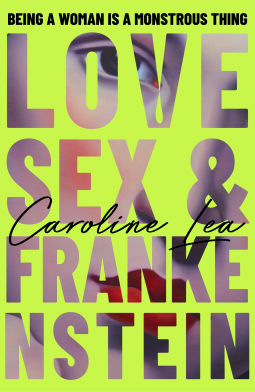 I’ve read three of Caroline Lea’s previous books, all of which I found interesting, so I was looking forward to reading her new novel about the life of Mary Shelley – although I have to admit, if I hadn’t already known I liked Lea’s work, the cover and title of this one would have probably put me off. I’m glad that didn’t happen because I really enjoyed it; it’s probably my favourite of her books so far.
The main focus of the novel is the events of 1816 – known as the Year Without a Summer due to the unusual weather caused by a volcanic eruption the year before. It’s also the year that Mary Godwin and her lover, Percy Shelley, travel to Geneva with their baby son and Mary’s stepsister, Claire Clairmont. Not for the first time, Shelley’s debts have brought the bailiffs to their door and, tired of constantly moving around London to avoid them, Claire has seized the opportunity to persuade Mary and Percy to come to Switzerland with her to visit Lord Byron. Claire is convinced that Byron loves her and claims that he has been begging her to go and spend the summer with him at Lake Geneva but Mary, who is familiar with Byron’s reputation, thinks she’s deluded. However, in their desperation to escape the bailiffs, she and Shelley agree to Claire’s plan.
As they arrive at their hotel in Geneva, the foggy, oppressive weather mirrors Mary’s mood. She and Shelley seem to do nothing but argue and with no sign of Byron, Claire has turned her attentions to Mary’s lover, making no secret of what she is doing. When Byron finally does appear and the party start to spend time with him and his companion, John Polidori, at his rented home, the Villa Diodati, Mary hopes things will improve. However, the dynamics between the four of them only grow more tense and strained and Mary thinks of taking baby Willmouse and running away. Then, during a storm one evening, they gather to read ghost stories and, unimpressed, Byron issues a challenge: they should each write one of their own and see whose is best. Now Mary has something to focus on and during this difficult, emotional time, her famous novel, Frankenstein, begins to take shape.
Despite the title, the writing of Frankenstein forms only a small part of the book; instead Lea concentrates on exploring Mary’s state of mind in the period immediately before and during the creation of the novel. There’s some jumping around between timelines in the first half of the book as Lea tries to fill the reader in on Mary’s background, her childhood and the beginning of her relationship with Shelley, and I found it slightly difficult to keep track of things, but this became less of a problem later in the book when I had settled into the story.
Having read several other novels about the Shelleys and Lord Byron, I was interested to see how Lea’s portrayal of the characters would compare. As our protagonist, Mary is a complex woman but also a contradictory one. She has the strength and determination to repeatedly defy convention to be with the man she loves – the already married Shelley – while at the same time she feels trapped in her relationship with him and unable to escape. Shelley seems to love her in his own way, but is insensitive towards her and expects her just to accept his various infidelities. Mary’s relationship with Claire is equally difficult, continually switching between resentment and affection. As seen through Mary’s eyes, Claire doesn’t come across well at all in this book, flirting openly with Shelley in front of her sister then complaining when Mary later does the same with Byron. (For a more sympathetic view of Claire, try Clairmont by Lesley McDowell.) The portrayal of Byron is also largely very negative – he treats Claire appallingly, although we see a more tender side of him in his interactions with Mary.
This is definitely not a book with likeable characters, then, but the fact that they are all, like Mary, complex and contradictory is what makes them feel human and believable. It’s also beautifully written and I enjoyed reading it, despite not really learning much about Frankenstein!
Thanks to Michael Joseph for providing a copy of this book for review via NetGalley.
 She Reads Novels
I’m not sure Percy Bysshe Shelley was particularly likable. And his relationship with Mary seemed a bit tumultuous. I read a biography of Mary Shelley once that was so good; I wish I could remember who wrote it. But I came away from it feeling sorry for Mary and not loving her husband. But their life together was certainly an interesting one.
I need to read some non-fiction about the Shelleys. So far I’ve only read novels about them. They do seem to have had an interesting life!
I don’t know anything about Mary Shelley yet – but I loved Caroline Lea’s first book so I’ll definitely read this one some day. But I understand your views about the cover, without the author’s name on it I would never pick it up.
I’ve enjoyed all of the Caroline Lea books I’ve read, particularly this one and Prize Women. I think the cover will put a lot of people off reading this book – it looks more like a modern romance novel than historical fiction.
Mmmmm…. Not completely sold on that one from your description, but it has prompted me to dig out ‘Romantic Outlaws – The Extraordinary Lives of Mary Wollstonecraft & Mary Shelley’ by Charlotte Gordon out of one of my book piles to schedule a read. It’s quite chunky at around 550pp so I’ll need to wait until my ‘To Be Reviewed’ pile is a bit deeper… Maybe by the end of the year?
Oh, ditto on the cover. It looks like one of those *endless* pulp romance novels you see stacked up in places like The Works for £1.50 a pop…
Romantic Outlaws sounds very tempting, apart from the length. I’ll look out for your review, whenever that may be! And yes, the cover of this one is awful, isn’t it? I suspect a lot of people who would have enjoyed it won’t bother picking it up, which is a shame.
I’ve enjoyed her other books, but the title and cover are putting me off this one!
The cover for the American edition is much more appropriate. I don’t know what her UK publishers were thinking of!
I too have read several novels about this period, but this one seems like the most . . . well, I’m not sure what I’m trying to say. It’s easier from the other side. I feel like the others were too conservative about imagining what might be going on and how people were feeling and thinking. This one sounds more adventurous in its approach. I liked Lea’s The Glass Woman but couldn’t really get into her The Metal Heart.
Yes, this is quite an imaginative book. I don’t know how accurate it is in its portrayal of the characters but I found it interesting. The Metal Heart is probably the Lea novel I’ve liked least, I think.
I’ve only read two, but I agree.
Interesting. I enjoyed Louisa Hall’s take on Mary Shelley in Reproduction, although that’s not a straight historical novel but told from the perspective of somebody who is trying to write a novel about Shelley.
I haven’t read Reproduction, but it sounds intriguing. Thanks!
Understandably, there seem to be several fictional takes on this complex ménage, quite a few set around the ghost storytelling at the Villa Diodati – I’ve got a couple which I keep telling myself I need to pick up – but this also sounds interesting.
Yes, Byron and the Shelleys make interesting subjects for historical novels. I remember enjoying Passion by Jude Morgan and The Year Without Summer by Guinevere Glasfurd (although that one dealt with some of the other key events of 1816 as well).
Im glad you enjoyed this one and may check it out one day. I think I’ll probably try to read something else about Mary Shelley first as I think I’d want a bit more focus on Frankenstein and it’s creation but this does sound interesting overall and I quite appreciate books having unlikeable characters on occasion. Although I have no clue whether its accurate in this case with the real people they’re portraying. What really intrigues me is the night that the short story idea began. I heard about it On TV once and it fascinated me then so the reminder now definitely makes me think I should look into the author more. Although first I really should hurry up and read Frankenstein 🙈
Yes, the night of the short story contest is fascinating to read about – Frankenstein came out of it, as well as two vampire stories by Byron and his doctor, Polidori, that inspired Bram Stoker’s Dracula. I would have liked this book to focus more on that, but it was more concerned with the personal lives of the people involved.
Ooh I didn’t know what the other stories that came out of it were but it sounds fascinating. I think if I missed those details it must have been on a show that focused on Shelley. Or possibly it was on in the other room as I think I was making a puzzle at the time and may have missed things. That’s a shame about the focus. Hopefully there are more out there about the night in question.
I agree with you about the cover but your review has sold it to me, plus my experience of reading Caroline’s previous novels.
I definitely recommend it, particularly if you’ve enjoyed her other books. Just ignore that awful cover!
That cover and title wouldn’t tempt me if I saw it in the shops!
Thanks for sharing this review with the Historical Fiction Reading Challenge.
No, I think it will put a lot of people off!