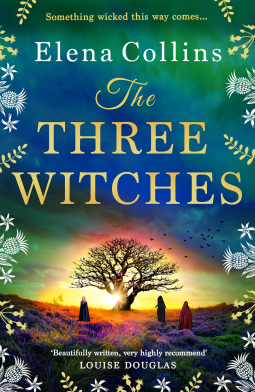
 I’ve read other novels inspired by Shakespeare’s Macbeth, but this is the first one that has focused specifically on the characters of the three witches. Although Shakespeare’s witches aren’t thought to have been based on any individual people (he took the idea from Holinshed’s Chronicles which refers to the ‘Weird Sisters’ or ‘nymphs or fairies’), Elena Collins imagines them here as three young women growing up in 11th century Scotland. They are the daughters of Sidheag, a wise woman or healer, and their names are Isobel, Ysenda and Merraid.
In modern day Bristol, Ruthie Reed is attending an audition for a new documentary about Macbeth and the historical Mac Bethad mac Findláech, King of Alba (Scotland), on whom the play is based. Acting is all Ruthie has ever wanted to do, but her career seems to be going nowhere and she’s desperate for a decent role. When she’s offered the part of one of the three witches in the documentary, she hopes this is the opportunity she’s been waiting for and will lead to bigger things. On arriving at Forres in the north of Scotland, however, things don’t go quite according to plan. The cast and crew are plagued with bad luck and disaster – and then Ruthie herself starts to catch glimpses of a mysterious young woman who seems to provide a link between past and present.
Ruthie’s story alternates with the story of Isobel and her sisters, left alone in the world after their mother’s death. Isobel, the youngest, has inherited her skills with herbs and potions, as well as her ability to see the future in the flames of the fire, but in a world where women who are different are viewed with suspicion, these talents could be a curse rather than a blessing. When Isobel falls in love with Lulach, Mac Bethad’s stepson, she believes she has found the security she needs, but Lulach’s mother, Gruoch, has other ideas…
As with most dual time period novels, there was one narrative that I enjoyed more than the other, and in this case it was the historical one. I liked the way the focus was on the fictional characters of Isobel, Ysenda and Merraid and their daily lives in the village rather than on the real historical figures such as Mac Bethad and Gruoch, who appear only occasionally. It was easy to see where Isobel’s story was heading, particularly as we get a hint of it in the prologue, but that didn’t make it any less impactful. Although widespread witch trials and burnings peaked in Scotland in the 16th and 17th centuries, women were obviously being accused of witchcraft much earlier than that, so it’s not impossible that the historical Macbeth could have met women like Isobel and her two sisters – and this is something Ruthie and her friends in the modern day narrative begin to research, believing that the witches (both in the play and in history) deserve to be given more attention after centuries of being interpreted through the lens of misogyny.
I liked Ruthie and enjoyed following the filming of the documentary, but it did feel that her storyline was there mainly to add more context to the historical one and I didn’t become quite as invested in her chapters as I did in Isobel’s. The supernatural element of the book is well done – although it’s not a time travel or timeslip novel, there are moments where past and present seem to merge – but I wasn’t convinced that everyone else would have been so ready to believe Ruthie when she told them what she’d been experiencing! There’s also a romance for Ruthie which seemed to happen very suddenly and not with the person I’d expected it would be with.
Overall, I found this an interesting, engaging read. It’s the first I’ve read by Elena Collins, so I’m looking forward to reading some of her other books.
Thanks to Boldwood Books for providing a copy of this book for review via NetGalley.
 She Reads Novels
Im not a fan of Shakespeare (I cant get along with the language) but I do get intrigued by retellings of it sometimes and this one has me curious. I love the idea of focusing on the witches for a change and imagine I’d probably come away enjoying the historical side of things most strongly too.
I love Shakespeare retellings and have read a few other retellings of Macbeth but this is the only one I’ve come across that has focused on the witches. I find that when I read dual timeline books, it’s nearly always the historical one that I prefer.
I’m on the fence on this one. Were there witch burnings as early as when MacBeth lived, in the 11th century? My quick look-up says they started in Scotland in the 16th century, the 1560s, and in Europe in the 15th century, although that’s Google, so it could be wrong. My understanding was that the Catholic church was much more accepting of these folk practitioners and that the witch trials really only got going with Protestantism.
I’m starting to wonder why so many writers feel they have to have a dual-time frame novel to write a historical novel.
Yes, I’m sure the witch trials and burnings started in the 16th century in Scotland, but I think there were still people who practiced witchcraft in the 11th century (the author calls it wortcunning). I doubt this book is particularly accurate though.
Oh, I’m sure the practices were much older, but whether they were witchcraft or not is another matter.
Interesting take on the story of the three witches from Macbeth; I kind of wish the author had chosen just one timeline to focus on…I often find myself skimming one story line in these dual timeline novels because it’s just not as interesting as the other one, which I always find frustrating.
I find that I nearly always prefer the historical timeline in books like this.
As I was reading your review I was thinking I don’t fancy that modern day storyline much as it seems superfluous.
I think the modern day storylines are often a bit superfluous in dual timeline books! This one wasn’t bad, but I did find the historical one more interesting.
This sounds intriguing, Helen. I’ll watch out for it.
It’s a fascinating story. Definitely worth looking out for.
Its a nice change from Greek myths! I’m a confirmed Shakespeare fan, so I’ll look out for this one. Coincidentally I’ve just finished a short and very interesting history of Witchcraft. Fascinating stuff.
Oh, and agree on preferring the historical bit of a split narrative like this one.
I love Shakespeare-inspired novels and as you say, it makes a nice change from Greek myths! Witchcraft is a fascinating subject.