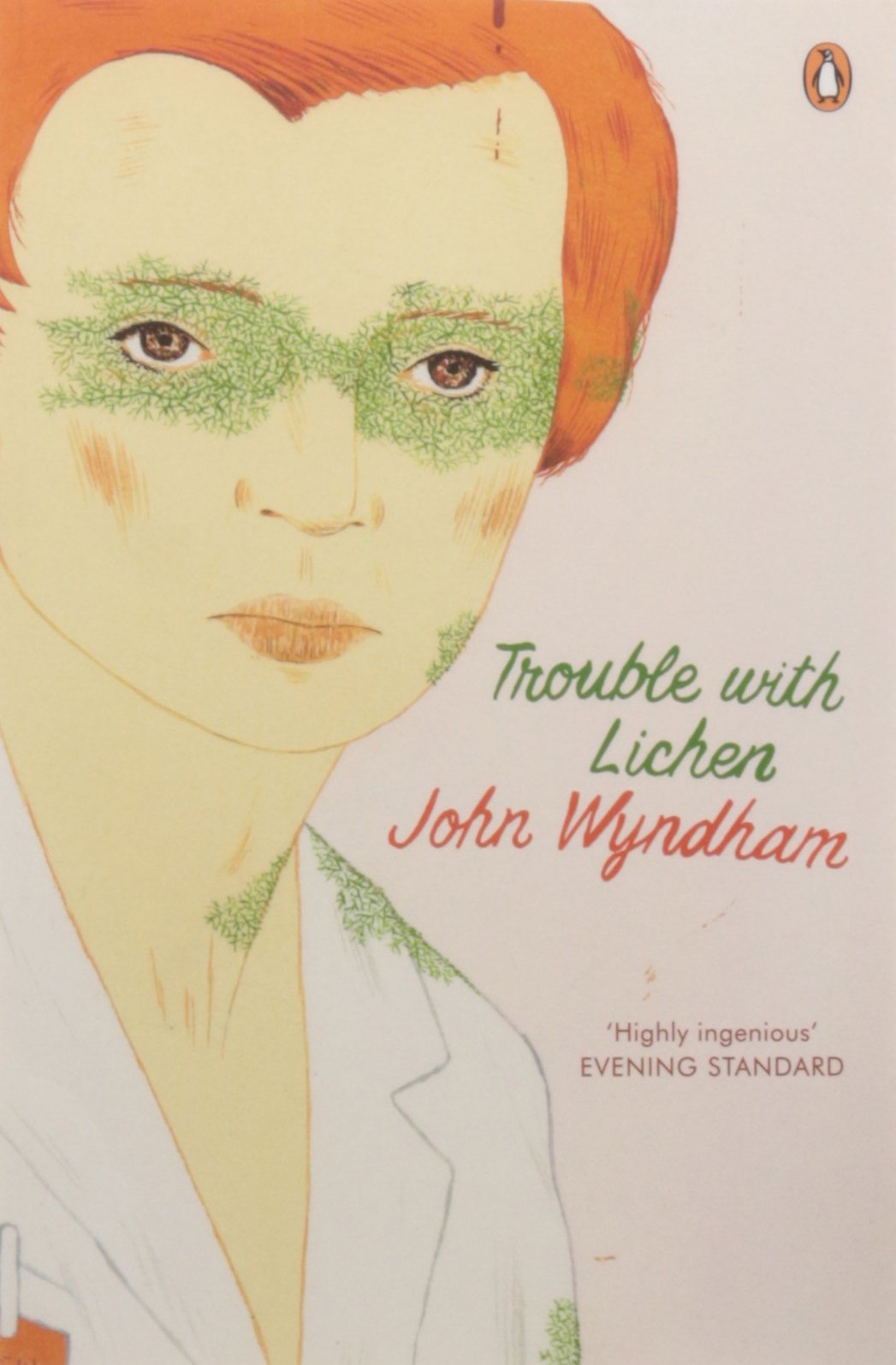
 What would you do if someone offered you the chance to live longer? Not just a few years longer, but two or three times the average lifespan? What would be the benefits and the drawbacks? And what if you were the person who had discovered a way to make all of this a reality? These questions form the premise of John Wyndham’s 1960 novel, Trouble with Lichen, the book recently chosen for me to read in the latest Classics Club Spin.
The novel is written from the perspectives of scientists Francis Saxover and Diana Brackley, as well as Francis’ two children, Zephanie and Paul. Diana is a newly qualified biochemist working for Francis at his research facility, Darr House, when they both notice the strange effects of a piece of lichen which has been accidentally dropped into the cat’s saucer of milk. Each without the other’s knowledge, Diana and Francis begin to carry out their own research and both independently come to the same conclusion: the lichen seems to have properties that preserve a youthful appearance and slow down the rate at which people age. Rather than share her findings with Francis, Diana leaves the company and the two don’t see each other again for several years.
Because the supply of this particular species of lichen is very limited – it seems that it only grows in one small part of the world – Francis and Diana both sense that it could be dangerous to make the results of their research public before they’ve found a way to create the substance synthetically in the lab. Francis begins to treat himself with the lichen extract, implanting it beneath his skin, and does the same for his two teenage children, although he doesn’t tell them exactly what it is. Diana, on the other hand, starts her own beauty company, Nefertiti Ltd, and injects the substance into some of her wealthy female clients, again without being honest with them. Of course, it’s only a matter of time before the world learns the truth…
Although I wouldn’t describe myself as a big fan of science fiction, I’ve read and enjoyed several of John Wyndham’s novels. Trouble with Lichen has a slightly different feel – there’s less plot, less action and more discussion of ideas, ethics and moral dilemmas – but I enjoyed this one as well. It was interesting to consider the various implications of increasing our longevity; Francis and Diana seem to assume that everyone will be fighting to get their hands on the substance (referred to as an ‘antigerone’), but the thought of living to be two or three hundred years old doesn’t sound at all appealing to me! What do you think? Would you like to?
The novel has a strong feminist message, which isn’t really what I expected from a book written by a male author in the 1960s, and I appreciate what he was trying to do, although it didn’t always work! Diana believes she can create a future where women don’t need to rush into marriage because their childbearing years will last a lot longer, giving them time to pursue a meaningful career. This is the motive behind Nefertiti – she wants to gain the support of some of the world’s most powerful and influential women – but the way she goes about it, giving the drug to her clients without their knowledge, is completely unethical however she tries to justify it. There’s also a strong implication that the biggest benefit for women is that they’ll be able to continue looking young and attractive for much longer, which will keep their husbands happy.
This isn’t one of my favourite books by Wyndham and if you’re new to his work, I would recommend starting with a different one – maybe The Day of the Triffids or The Midwich Cuckoos – but although it’s not the most exciting story, it’s definitely a fascinating one. The final section is particularly interesting, where we see a whole range of different views from journalists, political parties, religious groups, trade unions and the general public. Not all of our questions are answered by the end of the book – in fact, I found the ending quite abrupt – but we are certainly left with a lot to think about!
This is book 1/50 from my third Classics Club list.
 She Reads Novels
I unexpectedly loved The Day of the Triffids, and have become intrigued by Wyndham’s relationship to feminism and women in general (he often seems to be gesturing at the idea of women’s rights, more or less convincingly depending on the book, but never precisely in the way that anyone else of his era was gesturing). This one is top of the list for my next Wyndham read!
This book has the strongest feminist aspect of all the Wyndham novels I’ve read so far, but yes, he does generally show support for the idea of women’s rights and equality. I don’t think he gets it quite right in this book, but it’s a good attempt! I’ll be interested to hear what you think when you read it.
My sense is that he never quiiiiite gets it right, but he does seem to make an effort!
The feminist angle is interesting isn’t it, great, but then keeping women young and attractive for longer is a groan!
Yes, it was nice to see a male author tackling a feminist theme, but he didn’t get it quite right! Strangely enough, there was no mention of the men wanting to look young and attractive for longer to please their wives!
haha!
This certainly does sound an interesting one (and it’s the second positive review I’ve read of it recently). I wouldn’t have necessarily thought of reading it, but now I think I might…
I don’t often read science fiction, but I’ve enjoyed everything I’ve read by Wyndham. This one in particular raises a lot of fascinating questions and ideas. I hope you have an opportunity to read it as I think you would find it interesting!
I would NOT want to live to 100-200 years longer! It makes for a very interesting plot thought though. 😀
I definitely wouldn’t want to live that long, especially as we would have to spend most of that time going to work! It did make a fascinating idea for a novel, though.
I still can’t decide whether I want to try this author or not.
I wasn’t sure either until I read on of his books. I have a little bit of a bias away from SF as I have a suspicion that however full of amazing ideas it may be, it likely won’t be very well written.Wyndham is a very good writer – though he does seem to have a penchant for risible character names – and his insights into the weaknesses and strenths of humankind in a book like The Kraken Wakes seems to be sadly precient and current whenever I read it.
I am only an occasional sci-fi reader anymore.
I don’t often choose to read science fiction, but I’ve enjoyed all of the Wyndham novels I’ve read so far.
I read this (and most of Wyndham’s other works) around 40 years ago. Unfortunately I can’t remember a single thing about this particular book. I am ‘planning’ on re-reading “Triffids” at some point this year so maybe I’ll get around to a few of his other works too – maybe “Midwich”.. . [muses]
This one doesn’t have much of a plot, which maybe makes it less memorable. I think Midwich is probably my favourite so far, although I’ve enjoyed everything I’ve read by him.
Haha, yes, I loved his attempt at feminism in this one, especially how youthful-looking wives will be able to retain their husbands! He tried, bless him! Like you, I enjoyed the ideas in this one, but it didn’t become a favourite. As for living to be three hundred, that’d be fine except it means we’d all have to work for about 250 years – not a pleasant idea!
Yes, retirement would only be a distant dream – and would there be any pensions by then, anyway? Worse still, we could be stuck with Donald Trump in power for another hundred years…
Aaarrghhh! I’ll have nightmares tonight now!! 😂
As this was written two years after the untimely death of Rosalind Franklin, whose work ultimately led to understanding the structure of DNA (and which led to Crick, Watson, and Wilkins being awarded the Nobel Prize), I often wonder whether Wyndham had heard rumours of her crucial contribution to the 1953 discovery, and so was inspired to write this convoluted plot?
And no, I don’t think that – psychologically speaking – we’re ready to live much beyond a hundred: after all, many are content to see three score years and ten as a good old age to cast off mortal coils! (But, approaching 78, I’m not dead yet, and have no intention of popping my clogs any time soon . . .)
I hadn’t thought about whether Wyndham was inspired by a particular person, but yes, that’s an interesting idea. And although I’m sure most of us are hoping for a long and healthy life, I think living for two or three hundred years would create far too many problems. It certainly doesn’t appeal to me at all!
Three score years and ten seems a bit young now. Maybe we should update it to four score years and ten! Or five score!