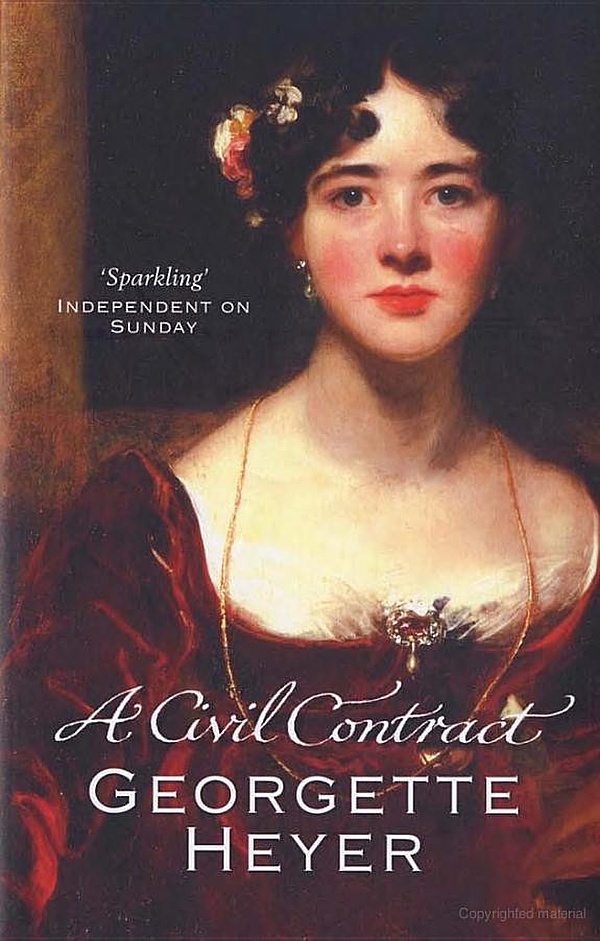
 This week, Karen of Kaggsy’s Bookish Ramblings and Simon of Stuck in a Book are hosting another of their clubs where we all read and write about books published in the same year – and this time it’s 1961! There are some authors who were so prolific you can usually rely on them to have had a book published in any given year and one of those authors is Georgette Heyer. Her novel from 1961 is A Civil Contract and it’s one I hadn’t read before, so I decided to read it for the club.
A Civil Contract is set, like most of her novels, in the Regency period and begins with Adam Deveril, the new Viscount Lynton, returning from the Peninsular War to find his family facing financial ruin. It seems that his father, who recently died, has left so much debt that the Deverils could have to sell Fontley, their beloved country estate. Adam is also forced to end his relationship with the woman he loves, Julia Oversley, knowing that a marriage between the two of them will no longer be considered appropriate. Julia’s father, Lord Oversley, however, has a possible solution to Adam’s money problems – his friend, Jonathan Chawleigh, is a very wealthy merchant and has a daughter whom he is determined to marry into the aristocracy.
Compared to the beautiful Julia, Adam finds Jenny Chawleigh plain and ordinary, but as he gets to know her better he quickly discovers that she’s intelligent, funny, sensible and kind-hearted. To Mr Chawleigh’s delight, the marriage goes ahead, with his daughter gaining the title of Lady Lynton, and in return Adam receives the money he needs to keep Fontley in the family and provide for his mother and sisters. It’s a practical marriage rather than one made for love and Jenny understands that Adam’s heart still lies with Julia, but the two are quite happy together – except on the many occasions when Mr Chawleigh interferes and becomes irritatingly over-generous with his money!
I enjoyed this book. It’s not as much fun as some of Heyer’s others – it’s a quieter, more mature novel, similar to Black Sheep, for example – but I liked the characters and the realistic portrayal of a marriage of convenience in that era. There’s no passionate romance here, just two people learning to get along together. I did feel sorry for Jenny, though, because she clearly loves Adam from the beginning and has to accept that he doesn’t feel the same way about her, at least not while Julia is still around. He does eventually start to see Julia in a slightly different light, but there’s still a sense that part of him will always love her and not Jenny. As a romance, then, the book is not entirely satisfying, but it’s believable.
We don’t really get the sparkling, witty dialogue between hero and heroine that we get in other Heyer novels, but there’s still some humour, mainly provided by Jenny’s father, Mr Chawleigh. He’s a wonderful character – he’s loud and overbearing, considered ‘vulgar’ by upper class society, but he’s also well-meaning and genuinely wants to use his money to make Adam and Jenny happy. I enjoyed watching his relationship with Adam develop as they come to understand and respect each other, despite some serious differences of opinion along the way.
 So, I don’t think I would name A Civil Contract one of my absolute favourite Heyer novels, but it’s still one that I liked very much and a perfect choice to start my 1961 Club reading.
 She Reads Novels
I haven’t read any Heyer yet, but I did pick up a copy of ‘The Conqueror’ (1931) recently from my local Charity shop. As its about William of Normandy I’m really looking forward to it.
Snap. I’ve just posted my review of this one too. I actually think this is one of my favourite Heyer novels maybe because it feels a bit more realistic. I also like the fact that it explores what married life might be like rather than just stopping at the first kiss.
I appreciate this as an adult but as a teen my heart broke for Jenny. It seemed forever before Adam could manage to tolerate her and she longed to be attractive to him. I agree it is more realistic and I appreciate all the secondary characters: the dreadful mother and Adam’s sisters.