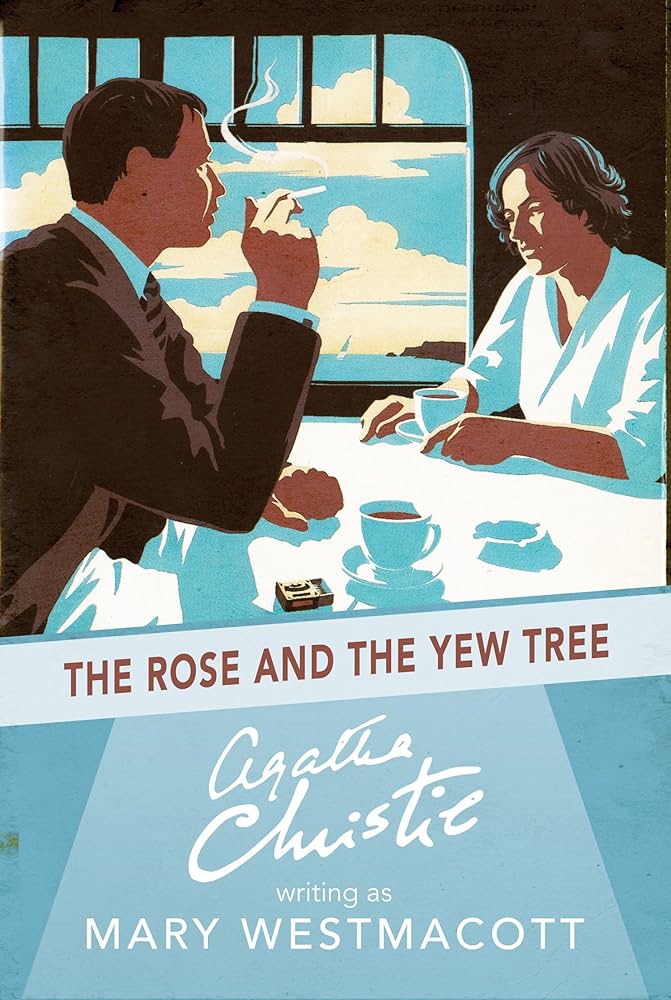
 This month’s theme for the Read Christie 2026 challenge is ‘Best-Kept Secret’ and we’re focusing on the six novels Christie wrote under the pseudonym Mary Westmacott. I have already read three of them – Giant’s Bread, Unfinished Portrait and A Daughter’s a Daughter – so I decided to read The Rose and the Yew Tree next as it’s also on my lists for both the Classics Club and the 20 Books of Summer challenge.
The Rose and the Yew Tree is narrated by Hugh Norreys, who breaks off his engagement to Jennifer after being badly injured in a car accident. Confined to a wheelchair, Hugh moves to St Loo in Cornwall to live with his brother and sister-in-law, Robert and Teresa. His condition has left him feeling bitter and worthless and he secretly keeps a bottle of pills to hand in case he decides to end his life. However, he finds several things in St Loo to distract him from thoughts of suicide…
First of all, Hugh is introduced to Lady St Loo, widow of the seventh baron, along with her sister, sister-in-law and granddaughter Isabella. Hugh has never met anyone quite like the beautiful, strange Isabella; she has a calmness and poise he’s never encountered before and several characters in the book refer to her as a fairytale princess. But Hugh is not the only man drawn to Isabella; she also catches the eye of John Gabriel, the Tory party candidate for St Loo in the upcoming elections.
Gabriel is the son of a plumber and has done his best to work his way up the social ladder, but still feels a sense of inferiority around people of a higher class, although this is masked by his confident, charismatic exterior. He’s not a natural Tory – in fact, he doesn’t have any strong political views one way or the other – but he wants a career in politics and thinks he’ll have more chance of standing out than he would in the Labour party. Gabriel’s campaign plays a large part in the novel, as does his complex relationship with Isabella, whom he both desires and resents (the resentment because she belongs to the aristocracy he despises so much).
First published in 1948, the novel takes its title from the poem, Little Gidding by TS Eliot: “The moment of the rose and the moment of the yew-tree Are of equal duration.” I won’t explain the significance here, but you’ll understand it once you’ve read the book. Compared to the other Westmacott novels I’ve read, I found this one particularly complex – not necessarily the plot, which is quite straightforward, but in terms of the psychology and the underlying messages. It’s also much more than a simple romance (the Westmacotts are often described as romances, but I think that’s misleading).
I enjoyed the political element of the novel, set during the build to the 1945 General Election, which would result in a landslide Labour win over Winston Churchill’s Conservatives. What’s striking is how many of the characters get caught up in the election campaign without actually having any particular political allegiances – Hugh admits to not really understanding politics, Teresa claims the parties are all the same, Gabriel is just interested in the power and social standing a political career will give him, and Isabella only cares because it’s important to Gabriel. We also see how a candidate’s personal actions can affect their reputation with the public, for better or worse (such as rescuing a child or becoming involved with a married woman). Christie doesn’t often write about politics on a smaller scale like this – although several of her books deal with international espionage and intrigue – so I found it fascinating.
Of the four Westmacotts I’ve now read, I think this one and A Daughter’s a Daughter are the best, but I still have The Burden and Absent in the Spring to come!
Book 7/20 of 20 Books of Summer
This is also book 4/50 from my third Classics Club list.


The 1945 election result was a BIG surprise to a lot of people – although apparently Churchill was advised that he wasn’t a shoe-in just because of his wartime service. It was a very interesting (and important!) inflection point in British politics, which, of course, gave us the NHS.
No, I don’t think anyone was expecting that result at all! The characters in this book certainly weren’t!
I think the only one I’ve read is Giant’s Bread but so long ago I don’t remember it. This does sound interesting!
Giant’s Bread was the first of the Westmacotts I read and I remember being surprised as it wasn’t really what I’d expected. I’ve liked all four that I’ve read so far, but I think this is probably the best.
I’ve never read any of her Westmacott novels. I’m still trying to work my way through her other mysteries. ;D
I’ve enjoyed all of the Westmacott novels I’ve read but I do prefer her mysteries and I’m still working my way through those too!
I didn’t realise that she’d written any books under a pseudonym. I think I’ll stick with trying her crime novels out first as I’m not sure that a political romance would be my kind of read. I’m glad you enjoyed it though and its lovely to hear that it dived quite deeply into some of its themes.
Yes, I would definitely recommend trying the crime novels first. Her books written under the pseudonym are interesting but not really typical of her work.
Lovely review, and this does sound excellent. I own most of the Westmacotts but can’t be sure I’ve read them so will have to dig them out!
I’ve enjoyed all of the Westmacotts I’ve read so far. Very different from the mysteries, but just as rewarding in their own way!
I thought that Absent in the Spring was quite complex psychologically, but maybe you haven’t read that one yet.
No, I haven’t read Absent in the Spring yet – I’ve read all of them apart from that one and The Burden.
That’s the only one I’ve read, I think, although I could swear I read another one more recently.
I found The Rose and The Yew Tree less engrossing because I couldn’t care about the characters. But it’s most certainly interesting. My favourites Westmacotts are Absent in the Spring (it’s also one of my favourite books of all time) and A Daughter’s A Daughter.
I didn’t really like any of these characters either, but enjoyed the book anyway. I also loved A Daughter’s a Daughter but haven’t read Absent in the Spring yet, so I’m pleased to hear it’s one of your favourites!
You know, these sound far darker, more serious than the books she wrote under her real name. I really should give them a try.
I love her mysteries but these books are great too and definitely deal with more serious topics. I would recommend trying one.
I think I will try one. Is there one I should try first?
Of the four I’ve read, I particularly enjoyed this one and A Daughter’s a Daughter, but most people seem to think Absent in the Spring, which I haven’t read yet, is her best.
Okay. Thanks. I’ll put them all on my wishlist.
Great, after Unfinished Portrait I didn’t think I’d read another Westmacott but you’ve convinced me otherwise!
I think Unfinished Portrait is my least favourite of the four I’ve read so far.
I really loved the politics in this, it made the book for me. I must read more of the Westmacotts sometimes.
Yes, the political aspect was fascinating and added more depth to the story. I hope you have a chance to read more of them – I’ve enjoyed all four that I’ve read so far.
I’ve read all six Westmacotts and found them intriguing. Probably The Rose and the Yew Tree was my favorite, but I liked A Daughter’s a Daughter also. Christie put so much of her own life into all the books. If readers are interested, there a a British podcast called Westmapod where Christie experts Mark Aldridge and Gray Robert Brown discuss all six books, that give more insights into the books. Highly recommended.
Yes, I can see how much Christie drew on aspects of her own life for these books, particularly Unfinished Portrait. I’m glad you found them all interesting. I still have two to read but agree that this one and A Daughter’s a Daughter are the best so far. I’ll look for the podcast you mentioned – thanks.
Glad you found this one fascinating! I really must read more by Agatha Christie! 😊
I prefer her mysteries, but these books are really good as well, in a different way.
I haven’t read any of these, but this one sounds quite intriguing. I’ll have to check it out!
It’s a really interesting book. I’ve enjoyed all four Westmacotts I’ve read so far but I think this is the best and would be a good place to start.