 Translated by Howard Curtis
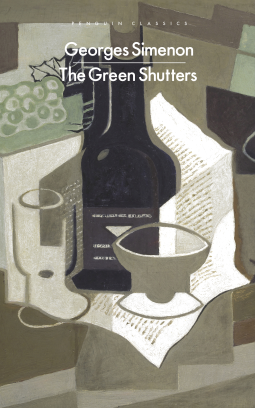
The Green Shutters, frst published in 1950, is one of Georges Simenon’s standalone psychological novels which he referred to as his romans durs or ‘hard novels’. I’ve read several others – this one is my sixth – and I’ve found them all to be dark, bleak, gritty novels. Although some of them have elements of mystery, I would describe them as character studies rather than detective stories.
In this book, we follow Émile Maugin, a famous stage and screen actor. The novel opens with his doctor giving him some devastating news: that although he’s not yet sixty years old, he has abused his body so much that he has the heart of a much older man and doesn’t have long to live. Maugin decides to keep this news to himself and instead of changing his lifestyle, continues to drink and smoke heavily, as well as keeping up his punishing acting schedule. Knowing that his time is running out, he begins to look back on his life, remembering his childhood, the early days of his career and how he treated friends and family on his way to the top.
There’s not much more to the story than that; the romans durs tend not to have a lot of plot, but this one has less than any of the others I’ve read. It’s really a portrait of a man coming to terms with the idea of his mortality and preparing himself for his death. The title of the book refers to the dream of a white house with green shutters which Maugin sees as symbolic of the normal, respectable life he could have had, a life which has always seemed to be out of reach.
If Maugin had been a different kind of person, this could have been a very moving book. However, he’s so unpleasant I found it impossible to have any sympathy for him at all. As teenagers he and his friend treat their own sisters as prostitutes and this disrespectful, abusive attitude towards women continues during his adult life as he goes through several unhappy marriages. Some of his behaviour could probably be attributed to his alcoholism but I still found it hard to find any redeeming qualities in him, which made this a difficult and disturbing book to read. If you’re new to Simenon’s romans durs, I wouldn’t recommend starting here as some of his others are much better – my favourite is The Venice Train.
 At just over 200 pages in this new Penguin edition (the upper limit for Novellas in November), I’m hoping it will still count as several pages are devoted to the foreword and other material. Oh, and if you’re wondering whether Maugin is based on a real person, Simenon includes a note to say that although he has borrowed certain features and mannerisms from various actors, Maugin himself is (thankfully) a fictional creation!
Thanks to Penguin Classics for providing a copy of this book for review via NetGalley.

