The Edge of Dark by Pamela Hartshorne

The Edge of Dark I enjoy reading time-slip novels; I love the sense of the supernatural, the atmosphere of mystery and suspense, and the intertwining of two lives – one past and one present. Pamela Hartshorne has written three novels of this type (the other two are Time’s Echo and The Memory of Midnight) but this one is the first I’ve had the opportunity to read. I found it an entertaining, compelling and genuinely eerie read and I’m now looking forward to going back and reading her earlier novels.

The Edge of Dark is the story of Roz Acclam who, at the beginning of the novel, is preparing to start a new job as Events Director at Holmwood House, a recently restored Elizabethan building in York. This is not the first time Roz has been to York; she lived there as a small child until most of her family died in a fire and she was adopted by an aunt in London. She remembers nothing of the fire or her tragic childhood, but almost as soon as she arrives in York, memories begin to come flooding back – the only problem is, they are not her own memories but those of another woman who lived more than four hundred years earlier.

The Edge of Dark is also the story of Jane, the eldest daughter of a butcher who lived in York in the 1500s. Jane’s father is planning ambitious marriages for both of his girls and Jane soon finds herself married off to the handsome, wealthy Robert Holmwood. Joining her new husband at Holmwood House, she discovers that married life is not quite what she’d expected and she begins to long for a child of her own. But Jane’s desire to be a mother eventually grows so strong that she makes a promise she could live to regret.

As Roz tries to settle into her new job the flashbacks into Jane’s life become more frequent and she begins to question why she is having these experiences. Is Holmwood House haunted? Are Jane’s ordeals in the past somehow connected with Roz’s own problems in the present? And what really happened the night the Acclams’ house was set on fire?

Usually when I read a novel set in two time periods I find that I prefer one over the other – as I love historical fiction it tends to be the one set in the past. With this book, Roz’s story and Jane’s are so closely linked that it’s difficult to separate them; the transitions between past and present felt smooth and natural and I could easily become immersed in the lives of both women. Roz and Jane are both strong characters, but there are other interesting characters in each time period too. While some feel less developed than others, the two I found most memorable are (in the present) Helen, a jealous colleague who tries to cause trouble for Roz at work, and (in the past) Margaret Holmwood, Jane’s scheming mother-in-law.

I also liked the fact that the novel is set in York, a city I have visited many times and am quite familiar with. It was obvious that the book was written by an author who knows York, its streets and its buildings very well! Something else I found interesting was seeing what goes into opening a new tourist attraction to the public. I would have liked to have read more about Roz’s work – it sounded fascinating.

I realise I’ve come to the end of this review and haven’t mentioned the significance of the beautiful Tudor necklace on the front cover of the book, but I need to leave something for future readers to discover for themselves!

Thanks to Pan Macmillan for providing a copy of this book for review.

Jakob’s Colours by Lindsay Hawdon

Jakobs Colours There are many, many novels which deal with the subject of the Jewish Holocaust, but in Jakob’s Colours Lindsay Hawdon explores another very important but largely forgotten piece of wartime history – the Gypsy Holocaust.

Beginning in Austria in 1944, she introduces us to an eight-year-old boy called Jakob. Part Roma and part Yenish, Jakob’s world has been torn apart by the horrors of war. He is running for his life across the Austrian countryside, and as he runs, he clings to his father’s words: “Don’t be afraid, Jakob. See the colours”.

But Jakob’s is not the only story to be told here. We also go back in time to the 1920s where we get to know Jakob’s mother, Lor, and learn of her troubled childhood in England. Later, in a Swiss hospital, Lor meets Yavy, the gypsy who becomes Jakob’s father, and we follow their relationship from its beginnings up to the point where Jakob finds himself alone and on the run.

Jakob’s Colours is very different from any other World War II novel I’ve read – a real accomplishment when you consider the sheer number of books set in this period. I previously knew nothing at all about the fate of the gypsies during the war (like most people, when I think of the Holocaust I tend to think of the Jews) so it’s great to have been given this opportunity to learn something new. However, I struggled with the structure of the novel. The story constantly moves back and forth in time, with each chapter titled either This Day, Before or Long Before, which I found quite confusing and difficult to follow. It felt disjointed and it meant that I never became as fully immersed in the lives of the characters as I would have liked.

I’m disappointed that I wasn’t able to love Jakob’s Colours, especially as the historical background is so fascinating and the subject matter so poignant. It was definitely my problem with the jumping around in time that prevented me from loving it; I’m sure I would have enjoyed the book a lot more if only the story had been told in chronological order. I did still find a lot of things to admire, though – the writing is very poetic and quite beautiful in places, and I liked the colour imagery that runs throughout the novel.

Most of all, I liked the concept that however bad things become we need to continue to hope and to look for the good things in life…to see the colours.

Classics Club Spin #9: The Result

The Classics Club

Last week I decided to take part in the Classics Club Spin. The rules were simple – list twenty books from your Classics Club list, number them 1 to 20, and the number announced today (Monday) represents the book you have to read before 15th May 2015.

The number that has been selected this time is 2, which means the book I’ll be reading is:

A Country Doctors Notebook

A Country Doctor’s Notebook by Mikhail Bulgakov

I added this book to my Classics Club list because I loved The Master and Margarita and wanted to read more of Bulgakov’s work. All I know about it is that it’s a collection of short stories based on Bulgakov’s experiences as a young doctor in Russia, but I’m looking forward to reading it. I’m happy with my result as I’ve managed to avoid the longer books on my list!

Did you take part in the spin? What will you be reading?

Rebellion by Peter Ackroyd

Rebellion Rebellion, subtitled The History of England from James I to the Glorious Revolution, is the third volume in Peter Ackroyd’s History of England series. I haven’t read the first one, but I did read the second – which covered the Tudor period – and enjoyed it, so I was looking forward to seeing how Ackroyd would tackle the Stuarts in this latest volume. Before I go any further I should point out that Rebellion is the US title, which I’m using here as this is the edition I received for review via NetGalley; the UK title is Civil War.

The book opens with the reign of the first Stuart king of England, James I, who acceded to the throne after the death of Queen Elizabeth I in 1603. He was, of course, also James VI of Scotland and united the two countries under one crown. James was followed by his son, Charles I, and most of the book is devoted to discussing the Civil War which ended in Charles’ execution. After several years of rule by the Lord Protector, Oliver Cromwell, the Stuart monarchy was restored under Charles II and the Restoration period is also covered in this volume. Finally, Ackroyd looks at the reign of James II and finishes with the Glorious Revolution which marked the arrival of William of Orange and his wife, Mary.

I have condensed eighty-five years of history into one paragraph here, but the book itself goes into a huge amount of detail, describing the life of each Stuart monarch and the key events of their reign. It’s a fascinating read, especially if you have a particular interest in this period of English history, and like the previous volume, Tudors, it’s written in a style that is factual without being too academic for the general reader. While the lives of kings and queens are interesting to read about, I also like to know how ordinary people lived, so I was pleased to find that Ackroyd gives some attention to the social history of the period and includes some chapters on literature, science, music and drama.

The only problem I had with this book was that I felt too much time was spent on the Civil War while the reigns of Charles II and James II had been squeezed in at the end. The chapters describing the events leading to the Civil War and the religious and political reasons for it seemed to go on forever, and although I can certainly understand why Ackroyd chose to make this the focus of the book I did start to get bored and found myself looking forward to moving on to the Restoration period.

While I didn’t enjoy this book as much as Tudors, I do feel that I’ve learned a lot from it. I am definitely not an expert on seventeenth century history but having finished this book, I now know much more than I did before I started. I haven’t heard anything about the fourth book in this series yet, but I expect it will continue to move forward chronologically into the eighteenth century. While I’m waiting maybe I should find a copy of the first volume, Foundation, which I still haven’t read…or I could try one of Peter Ackroyd’s other books. He has written more than thirty non-fiction books and a large number of novels too, so there would be plenty to choose from!

Classics Club Spin #9 – My List

The Classics Club

I love the Classics Club Spins but wasn’t sure whether to take part in this one as I know April and May are going to be busy months for me – and I’ve already started reading The Eustace Diamonds for Karen’s Anthony Trollope Bicentennial Celebration. In the end, though, I couldn’t resist joining in.

If you don’t know what the Spin involves, here are the rules:

* List any twenty books you have left to read from your Classics Club list.
* Number them from 1 to 20.
* Next Monday the Classics Club will announce a number.
* This is the book you need to read by 15th May.

And here is my list:

1. The Return of the Native by Thomas Hardy
2. A Country Doctor’s Notebook by Mikhail Bulgakov
3. The Time Machine by H.G. Wells
4. Crime and Punishment by Fyodor Dostoevsky
5. The Vicomte de Bragelonne by Alexandre Dumas
6. Mary Anne by Daphne du Maurier
7. Cyrano de Bergerac by Edmond Rostand
8. Howards End by E.M. Forster
9. Wuthering Heights by Emily Bronte (re-read)
10. The Moon and Sixpence by W Somerset Maugham
11. Excellent Women by Barbara Pym
12. The Sea-Hawk by Rafael Sabatini
13. Oliver Twist by Charles Dickens
14. Prince of Foxes by Samuel Shellabarger
15. Around the World in Eighty Days by Jules Verne
16. The Day of the Triffids by John Wyndham
17. The Leopard by Giuseppe Tomasi di Lampedusa
18. The Importance of Being Earnest by Oscar Wilde
19. The Glass-Blowers by Daphne du Maurier
20. The Woodlanders by Thomas Hardy

Most of these are books that I’m really looking forward to reading, or at least that I’m not dreading. I don’t need any more stress in my life at the moment! There are some that have been included on almost all of my previous Classics Spin lists and there are others I’m listing for the first time.

Now I just have to wait until Monday to find out what I’ll be reading!

Lost, Found and Conjured: A guest post by Andrea Chapin

Today I would like to welcome author Andrea Chapin to the blog to tell us about her research for her new novel about William Shakespeare, The Tutor.

thetutor Lost, Found and Conjured
By Andrea Chapin

A wonderful and unexpected alchemy took hold while I wrote my novel about a year in the life of Shakespeare.

When I traveled from New York to England to do research for The Tutor, one of my first stops was Hoghton Tower, a remarkable fortified manor house that sits high on a ridge between Preston and Blackburn in Lancashire. I’d scheduled an interview with Sir Richard Bernard Cuthbert de Hoghton, 14th Baronet, and was delighted when I met him that he looked the part–light hair, brilliant blue eyes, tweed jacket and gold signet pinky ring that I imagined dated back to William the Conqueror. Indeed, for over nine hundred years Sir Bernard’s family has owned the land where the current Hoghton Tower, circa 1565, stands.

Sir Bernard’s ancestor, Alexander Hoghton, Esq. wrote a will in 1581 that mentions a “William Shakeshafte,” who, by the context of the reference, might have worked at Hoghton Tower as an actor-musician. Spelling of proper names, or words in general, were not standardized in the sixteenth century; the Shakespeare family name appears in documents in various forms including Shakstaff and Shakeschafte. At that time, Shakespeare would have been, perhaps, a year or two out of Stratford Grammar School, where John Cottom, who was from a town near Preston, was the schoolmaster.

Much of Shakespeare’s life is undocumented. Where was he before his marriage at eighteen in 1582? Was he employed at Hoghton Tower? And what was he up to between twenty-one, when he was living in Stratford with three children, and twenty-eight, when he emerged as an actor, playwright and poet in London? The speculation as to what he was doing during those “lost years” includes: deer poacher in Stratford, horse handler for theaters in London, soldier, sailor, actor, and schoolmaster in the country.

Sir Bernard recounted stories and anecdotes about his ancestors and shared his boundless knowledge of Lancashire and the Catholics during the Elizabethan era. All of which was very helpful because the story I was creating involved a recusant Catholic family in 1590 in Lancashire and William Shakespeare, who arrives to tutor the children and to finish his first poem. I hadn’t told Sir Bernard anything about my novel, other than I was interested in the theories about Shakespeare’s “lost years.” At one point, I asked Sir Bernard if his family kept books in the late 16th century, and he replied yes they did and that they had a great library. He then said that in the 1600s a Catharine de Hoghton asked her father, Sir Gilbert, for a hundred books for her dowry.

My protagonist was named Katharine, and in the hundred pages I had already written, she loved books and enjoyed her uncle’s vast library. Here was Sir Bernard recounting his ancestor with the same name and the same love of books. A chill ran down my spine. As I continued to research and to write The Tutor, there were other instances when I felt this sort magic sweep over me, where fact and fiction, history and inspiration, co-mingled in a surprising and thrilling way.

Andrea Chapin’s novel, The Tutor, was published last week by Penguin Random House UK.

March reading summary

March is over and I can’t say that I’m sorry to see it go. It’s been a stressful month for me at work as the woman I’ve been working with and sharing an office with for the last six years retired last week and the company directors decided to take the opportunity to restructure our department. This means that I’ve spent the whole month not knowing if my job would be changing, who I would be working with and even where I would be working. Things are settling down now and while I’m not exactly thrilled about the changes, at least I know what’s happening now and I’m hoping April is going to be a better month for me.

RomolaIn terms of reading, March got off to a great start with Ross Poldark, the first of Winston Graham’s Poldark series which I really enjoyed and finished just in time for the start of the BBC’s new adaptation. I also finished two long novels that I had begun in February. One of these was George Eliot’s classic novel set in Renaissance Italy, Romola, a detailed and demanding read but one that I loved; the second was Sea of Poppies by Amitav Ghosh, the first in a trilogy set during the Opium Wars. Sea of Poppies ended on a cliffhanger but luckily I had a copy of the sequel, River of Smoke, so I could start that one straight away!

I managed to read two books for Jess’s Forgotten Histories challenge. One was Temeraire by Naomi Novik, an alternate history in which dragons play a part in the Napoleonic Wars. The other was City of God by Cecelia Holland, a novel set in Borgia-ruled Rome. I’m interested in reading more by both of these authors, particularly Naomi Novik – I have the second Temeraire novel, Throne of Jade, and also a review copy of her new novel Uprooted waiting to be read.

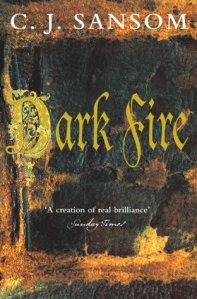
The TapestryI also read two Tudor novels this month – Dark Fire, the second book in CJ Sansom’s Shardlake series, and The Tapestry, the third and final volume of Nancy Bilyeau’s Joanna Stafford trilogy. I read some non-fiction too – An Accidental Tragedy by Roderick Graham, a biography of Mary, Queen of Scots, and Rebellion, the latest book in Peter Ackroyd’s History of England series. And I continued working through Baroness Orczy’s Scarlet Pimpernel books; The League of the Scarlet Pimpernel is a collection of short stories and although they were fun to read I’m disappointed that none of the Pimpernel sequels I’ve tried so far are as good as the original novel.

There were also two books that I started reading towards the end of the month but didn’t finish. I read the first three chapters of The Marigold Chain by Stella Riley, which I was interested in reading because I’d heard that it was similar to Dorothy Dunnett’s Lymond Chronicles; I wasn’t prepared for just how similar it was, to the point where it made me feel uncomfortable and I had to stop reading. I gave up on The Buried Giant by Kazuo Ishiguro as well. It was a very intriguing book with some fascinating concepts and ideas, but somewhere in the middle I accepted that I wasn’t engaging with either the story or the characters and couldn’t go any further. I’ll probably write more about that book soon as I did read more than half of it before abandoning it.

In April I’m hoping to read The Eustace Diamonds for Karen’s Anthony Trollope Bicentennial Celebration. Lory is also hosting an Elizabeth Goudge Reading Week and I would like to read something for that too. And of course, there’s Easter to look forward to this weekend!

What did you read in March? Do you have any plans for April?