It’s time for R.I.P. VIII

RIP8main300

September is rapidly approaching, the nights are starting to get darker again, and that means it’s time for R.I.P. (R.eaders I.mbibing P.eril), the annual reading event hosted by Carl at Stainless Steel Droppings.

For those of you who are new to R.I.P. the idea is to read books that could fit one of the following categories:

Mystery.
Suspense.
Thriller.
Dark Fantasy.
Gothic.
Horror.
Supernatural.

As always, there are different levels of participation to choose from and I am signing up for Peril the First, which means reading at least four books between now and the end of October.

rip8peril1st

I’ve listed below some of the books I’m thinking about reading for R.I.P. this year. I don’t expect to read all of them, of course, but I like to have lots of books to choose from!

Frankenstein by Mary Shelley
The Haunting of Hill House by Shirley Jackson
The Romance of the Forest by Ann Radcliffe
These first three books are all taken from my Classics Club list so I’m hoping to read at least one of them.

Speaking from Among the Bones by Alan Bradley – I loved the first four Flavia de Luce books and can’t wait to read this one.

What Angels Fear by C.S. Harris – These books have been recommended to me a few times and I’ve finally managed to get a copy of the first one in the series.

Blood Harvest by S.J. Bolton – The only Bolton novel I still haven’t read.

Ten Second Staircase by Christopher Fowler – It’s been too long since I last read a Bryant & May book and this is the next in the series.

The Woman in Black by Susan Hill – This was on my R.I.P list last year but I didn’t have time for it so will try again this year.

Dragonwyck by Anya Seton – Another one I was hoping to read last year and never got round to.

The Curse of the Pharaohs by Elizabeth Peters – Hearing about Elizabeth Peters’ death a few weeks ago reminded me that I really want to continue the Amelia Peabody series!

A Monstrous Regiment of Women by Laurie R. King – I’ve also been meaning to continue this series since reading The Beekeeper’s Apprentice more than a year ago.

The Asylum by John Harwood – I loved both of John Harwood’s two previous books so I’m looking forward to this one.

Bellman & Black by Diane Setterfield – I requested this book from Netgalley and can’t wait to start reading it. I’m sure it will be a perfect R.I.P. book!

I’m also planning to take part in the Mary Stewart Reading Week so will be reading one of Mary Stewart’s suspense novels in September too – I still haven’t decided which one yet!

Are you going to join in with R.I.P this year? What are you planning to read?

After the Sunday Papers #11

“She had read novels while other people perused the Sunday papers”
~ Mary Elizabeth Braddon, The Doctor’s Wife

*

Time for one of my (very) occasional Sunday posts, I think!

War and Peace Readalong – May update

I’ll start with some brief thoughts on May’s reading for the War and Peace Readalong I’m participating in this year. In May, we read Book 2, Parts 3 and 4. I’m finding the book much easier to read now that we’re further into it and have had the opportunity to get to know the characters. However, I’ve also found that for some reason I have very little to say about this section of the book. I was pleased that there was no ‘war’ – though instead, we get a very long and detailed description of a hunt, which made me think I might actually have preferred a battle scene after all! It was good to spend more time with some of the female characters, especially Natasha and Sonya, whose storylines are starting to move forward now. And I still feel sorry for poor Princess Marya. I’m looking forward to reading Part 5 in June – and being halfway through the book!

Barbara Pym Reading Week

Barbara Pym Reading Week

Are you taking part in Barbara Pym Reading Week? I’ve never read anything by Pym before but so many of the bloggers I follow love her books that I knew it was time to try one. I’m reading Less Than Angels, which is maybe not the one I would ideally have chosen to begin with (I really wanted to read Excellent Women first) but it’s the only one I actually own. Anyway, I’m enjoying it so far and will post my thoughts on it later in the week.

New book arrivals

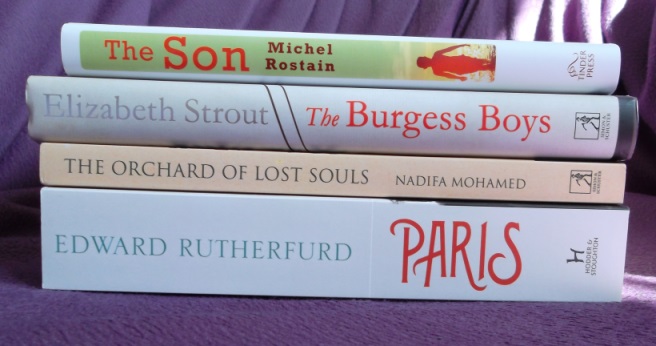
I haven’t bought any new books for a while, but I’ve received a few review copies. Paris is the one I’m most looking forward to reading as I love Edward Rutherfurd and have read all of his previous books. I don’t know much about the others (The Son by Michel Rostain, The Burgess Boys by Elizabeth Strout and The Orchard of Lost Souls by Nadifa Mohamed) though I’ve read some very positive reviews of the first two.

I hope you’ve all had a good weekend! What are you planning to read this week?

War and Peace Readalong: March and April

warandpeace2013

This year I’m taking part in a year-long group read of War and Peace, hosted by Amy and Iris. I had fallen behind with the reading in March (which is why I didn’t post an update for that month) but I managed to catch up again in April.

After struggling with February’s very war-dominated section I’m now enjoying the book again and I’m pleased that there does seem to be more balance between the war scenes and domestic scenes than I had feared at first! I also made things easier for myself this month by doing what I should probably have done from the beginning and printing off a character list to keep beside me while I read – although as I get further into the book I’m finding the number of characters less overwhelming and easier to keep track of anyway.

Book 1 Part 3

This was the section I really should have read in March. In the first half of this section we return to Russian society and rejoin some of the female characters we haven’t seen since Part 1, including Princess Helene, who marries Pierre, and poor Princess Marya, who turns down the chance of happiness for the sake of her father. In the second half we are with the army again, before and during the Battle of Austerlitz. Although I still don’t think the ‘war’ scenes of War and Peace are ever going to be my favourites, I found these easier to follow and understand than the battle scenes in Part 2 (see my comments from February). They still feel a bit chaotic and confusing, but that’s probably the point!

The most memorable parts of this section for me were Nikolai Rostov getting his first glimpse of Tsar Alexander, and Andrei Bolkonsky meeting his hero, Napoleon. The scene with Napoleon shows how we can build people up in our minds to be something they’re not, which can lead to disillusionment when we finally meet them and discover they are ordinary human beings like ourselves. In Rostov’s case the fact that he idolises the Tsar so much means that when he finally gets the chance to speak to him he is too awestruck to approach him and ends up regretting a missed opportunity.

Book 2 Parts 1 & 2

And this was April’s reading. There was a lot happening this month, including a birth, a death and a duel! With Nikolai Rostov coming home on leave, we are also reacquainted with the members of the Rostov household, including Natasha and Sonya.

From these two sections, I thought some of the scenes that stood out the most were the ones where Pierre, after leaving his wife, meets a mysterious stranger at the station and makes the decision to become a Freemason. There are a few chapters devoted to this part of the story and they had a slightly surreal, otherworldly feel in comparison to what we’ve read so far. I also thought Pierre’s discussions with Andrei were interesting, with Pierre explaining how much happier he has been since he stopped being selfish and started considering other people, and Andrei arguing that his actions could actually be making things worse rather than better.

Towards the end of this month’s reading we return to the ‘war’ when Rostov rejoins the army and feels the same joy on being welcomed back to his regiment that he felt on being welcomed home by his family. But this time, rather than facing chapter after chapter of military tactics and strategies (the reason I wasn’t enjoying the book in February) we are shown more of the human side of war, as the men begin to suffer from starvation and illness. Rostov experiences more of the disillusionment I mentioned earlier when he visits the wounded Denisov in a military hospital and is shocked by the way the patients are being treated.

I really enjoyed April’s two sections and found them surprisingly quick to get through. And we’re now 33% into the book, which is very encouraging!

Irish Short Story Month Year 3: Two from Oscar Wilde

Irish Short Story Month

Irish Short Story Month is an annual event hosted by Mel U of The Reading Life. To participate all you need to do is read at least one Irish short story during the month of March. In 2011 I read Laura Silver Bell by Sheridan Le Fanu. I didn’t manage to take part in 2012, but as I’ve been neglecting my short story-reading in recent months, I decided to join in again this year.

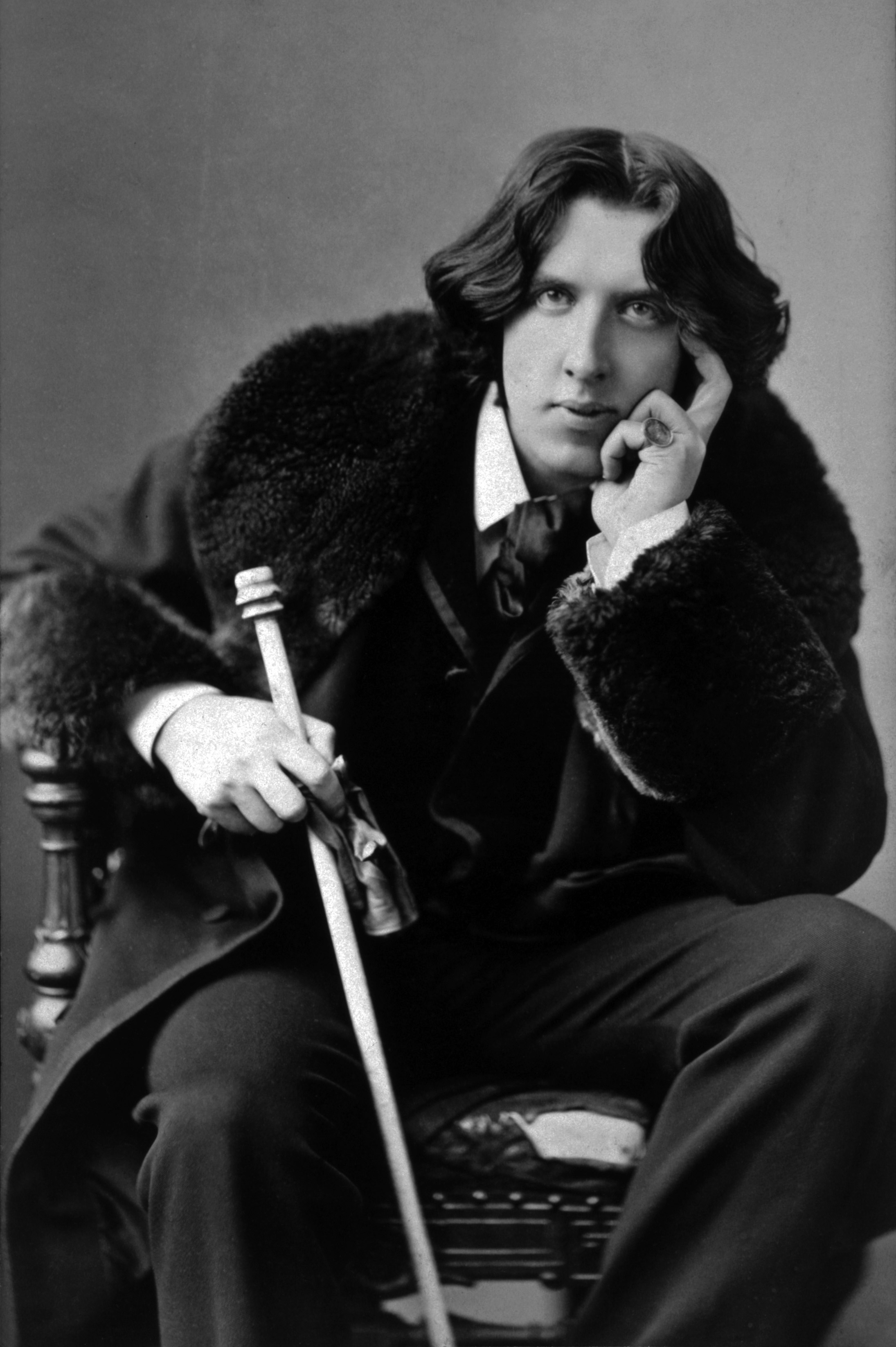
Oscar Wilde, 1854-1900

Oscar Wilde, 1854-1900

I have previously read one of Oscar Wilde’s fairy tale collections for children, A House of Pomegranates, but none of his short fiction for adults. For Irish Short Story Month I’ve read two of his stories – The Model Millionaire and The Sphinx Without a Secret. Both of these are available online and can easily be read in just a few minutes. They also appear in the collection, Lord Arthur Savile’s Crime and Other Stories.

In The Model Millionaire we meet Hughie Erskine, who is in love with Laura Merton, the daughter of a retired Colonel. Hughie is handsome and good-natured but unfortunately has no money and the Colonel will not let him marry Laura until he has ten thousand pounds of his own. One day, Hughie visits his artist friend, Alan Trevor, and finds him painting a portrait of an old beggar dressed in rags, who is standing in the corner of the room.

The beggar himself was standing on a raised platform in a corner of the studio. He was a wizened old man, with a face like wrinkled parchment, and a most piteous expression. Over his shoulders was flung a coarse brown cloak, all tears and tatters; his thick boots were patched and cobbled, and with one hand he leant on a rough stick, while with the other he held out his battered hat for alms.

‘What an amazing model!’ whispered Hughie, as he shook hands with his friend.

‘An amazing model?’ shouted Trevor at the top of his voice; ‘I should think so! Such beggars as he are not to be met with every day. A trouvaille, mon cher; a living Velasquez! My stars! what an etching Rembrandt would have made of him!’

‘Poor old chap!’ said Hughie, ‘how miserable he looks! But I suppose, to you painters, his face is his fortune?’

‘Certainly,’ replied Trevor, ‘you don’t want a beggar to look happy, do you?’

Hughie asks his friend how much he will be paying the beggar for modelling for him and is shocked at how little the amount is compared to the amount Trevor will make from selling the picture. Although Hughie himself is very poor, he feels sorry for the old man and as soon as his friend leaves the room he gives the beggar all the money he has in his pocket. Later that night he discovers that his act of generosity has had a surprising result.

I thought it was very easy to predict what was going to happen in this story, but I enjoyed it and despite it being so short, I still found it satisfying – and very well written, of course.

The other story I read, The Sphinx Without a Secret, is another very short one. The narrator meets his friend, Lord Murchison, in Paris and seeing that something is wrong, asks him what the problem is. Murchison tells him about the beautiful Lady Alroy, whom he had loved and planned to marry.

He took from his pocket a little silver-clasped morocco case, and handed it to me. I opened it. Inside there was the photograph of a woman. She was tall and slight, and strangely picturesque with her large vague eyes and loosened hair. She looked like a clairvoyante, and was wrapped in rich furs.

‘What do you think of that face?’ he said; ‘is it truthful?’

I examined it carefully. It seemed to me the face of some one who had a secret, but whether that secret was good or evil I could not say. Its beauty was a beauty moulded out of many mysteries – the beauty, in face, which is psychological, not plastic – and the faint smile that just played across the lips was far too subtle to be really sweet.

Finding her to be very secretive and surrounded by an atmosphere of mystery, Murchison decided to follow her one day and saw her entering a boarding house where she stayed for a few hours before returning home. When Lady Alroy tried to deny visiting the house, Murchison became convinced that she was hiding something – but what could it be?

Although I didn’t find either of these to be particularly memorable stories, I did enjoy them both as I love Oscar Wilde’s writing style. I liked the ambiguous ending of The Sphinx Without a Secret; despite the suspense that builds up throughout the story it’s not hard to guess what Murchison is going to discover as the title does give it away, but we are still left with something to think about at the end. This story may have been intended as a satire on Victorian sensation fiction, in which everybody had a secret to hide and an ulterior motive for every seemingly innocent action, as well as being a study of a person’s desire to pretend to be something they’re not.

Have you read any of Oscar Wilde’s short stories? Who are your favourite Irish writers?

War and Peace Readalong: February

warandpeace2013 This is my second monthly update on the readalong of War and Peace I’m participating in this year (hosted by Amy and Iris). Unlike last month, when I reported on how much I was enjoying the book and finding it difficult to put down, this month I had a very different experience.

Our goal for February was to read Book 1, Part 2. This is a very male-dominated section of the book, with none of the female characters we met in the first part (no Natasha or Sonya or Princesses Hélène or Liza). Instead we get to learn more about some of the men in the story including Prince Andrei Bolkonsky, Nikolai Rostov, Dolokhov and General Kutuzov. I found it a bit easier to keep track of the characters this month but what I struggled with instead was the fact that Part 2 is spent entirely with the Russian army, on the battlefield and in the barracks. I think my complete lack of knowledge of this period of history and Russia’s involvement in the Napoleonic Wars was a problem here, as well as the fact that I often find battle scenes and military tactics difficult to follow. Some background reading before I started this section would probably have been a good idea!

One thing that did make an impression on me was the sheer confusion and chaos of war and also the conflicts, arguments and fighting that went on in the ranks of the Russian army before they even faced the enemy. For example, there’s an episode where Nikolai’s commanding officer, Denisov, has some money stolen by a fellow soldier.

My favourite part of this month’s reading came towards the end of the section, when we rejoin Nikolai Rostov who has been wounded in battle. He can’t believe that anybody would actually want to kill him, a person everybody likes. Of course, none of that matters when you’re at war; you are simply another enemy soldier and no longer an individual.

“Who are they? Why are they running? Can it be they’re running to me? Can it be? And why? To kill me? Me, whom everybody loves so?” He remembered his mother’s love for him, his family’s, his friends’, and the enemy’s intention to kill him seemed impossible.

It’s through the thoughts of characters like Rostov that Tolstoy succeeds in showing us the harsh reality of war, in contrast to the romantic ideas the characters may have had about it at first. Prince Andrei is another character who had notions of success and heroism but after he visits the Austrian government to report on a Russian victory and discovers that it is not appreciated by the Austrians he also becomes disillusioned with war.

Finally, this is just a minor point but was anyone else irritated by the way Denisov’s speech impediment was handled? I don’t know how it is represented in other translations but in the one I’m reading (Pevear & Volokhonsky) I thought the way the guttural r’s were written was very distracting and annoying.

“They don’t even give us time to dghrink!” replied Vaska Denisov. “They dghrag the ghregiment here and there all day…”

So, this month was less enjoyable for me than last month but I will keep reading, though I’m now a bit concerned that there’s going to be too much ‘war’ in War and Peace for me. The end of Part 2 couldn’t come quickly enough, but I look forward to seeing what Part 3 will bring.

For other participants’ thoughts, see the War and Peace February Check-In.

War and Peace Readalong: January

warandpeace2013
Throughout 2013 I am taking part in a readalong of Tolstoy’s War and Peace hosted by Amy of My Friend Amy and Iris of Iris on Books. Amy has posted some questions to help us discuss January’s reading.

Why are you reading War & Peace?

I read Anna Karenina years ago and enjoyed it so I’ve been meaning to read War and Peace for a long time but haven’t been able to find the motivation to actually get round to doing it. After taking part in a year-long group read of Clarissa by Samuel Richardson last year, when I saw that Amy and Iris were planning a readalong of War and Peace for 2013, I decided to join in with this one too. It seemed like a good opportunity to read another long novel and the reading schedule looked very manageable – this month we had to read Volume 1 Part 1 and I had no difficulty finishing it in time. In fact, I didn’t want to stop at the end of Part 1 and I admit to starting Part 2 before the end of January!

War and Peace What translation are you reading? Are you reading print, ebook, or audio?

I’m reading the Kindle version of the Vintage Classics edition. Opinions seem to be very divided on all of the available War and Peace translations so I wasn’t sure which one to choose. I read the Pevear and Volokhonsky translation of Mikhail Bulgakov’s The Master and Margarita a couple of years ago and was quite happy with it and as I remember disliking the Maude translation of Anna Karenina (though it didn’t affect my enjoyment of the story too much) I decided it might be best to go with P&V again.

So far, is it different than you expected or the same?

I had high hopes for this book and I’m pleased to be able to say that I’ve loved what I’ve read so far, though it does have quite a different feel to Anna Karenina. I’ve found it surprisingly easy to read, though this first section has been mainly concerned with introducing us to the characters – I suspect I might be going to struggle with the military scenes as I don’t have much knowledge of the Napoleonic Wars or the French invasion of Russia.

The only problem I’ve had is that so much of the dialogue is in French and in this edition and format the English translations are in the notes at the end of each chapter – not very convenient with the Kindle (one of the negative things I’ve found with ebooks in general is that it’s not as easy to move backwards and forwards through the text as it is with a physical book).

Do you have a favorite character?

Not yet – I don’t feel I know any of them well enough to have favourites. And there are so many of them too! I’m still having trouble keeping them all straight (and especially remembering how each of them is related to the others) but I’m sure that will become easier as I progress through the book. The characters I’ve found most memorable so far are Pierre, Count Bezukhov’s illegitimate son, and Natasha, the thirteen-year-old daughter of the Rostovs. We haven’t seen much of Natasha yet but she seems a strong, lively character and I’m looking forward to getting to know her better.

What do you see as the biggest obstacle to finishing?

The mistake I made with Clarissa last year was that I kept abandoning the book without picking it up for long periods of time which made it difficult to start reading again. I loved Clarissa while I was actually reading it, but as soon as I stopped and allowed a few weeks to pass, I lost all my enthusiasm for it. I don’t want that to happen with War and Peace so this time I really need to find a reading pace that I’m happy with. I’ll try to stick to the readalong schedule at first as it’s more fun to be reading and posting at the same time as other participants, but it could be that a different pace would suit me better. The important thing is that I continue to enjoy reading this book and don’t start to feel that it’s a chore, which is what happened with Clarissa.

I don’t really have much more to say about the book at this early stage but I’ll post another update at the end of February.

Classics Club Readathon

classics-club-readathon-january-2013

Today I’m taking part in the first ever Classics Club Readathon. The readathon starts at 8am EST, which is 1pm here, though I think I will probably have to miss the first few hours and start later in the afternoon. When I signed up for this last month I expected to have plenty of time to read today, but I now have some other commitments so I might not be able to get as much reading done as I had hoped.

I’m currently in the middle of reading The Small House at Allington by Anthony Trollope so I’m going to concentrate on finishing that before I start anything else. If I do finish it, I’ll be choosing another book from my Classics Club list to read next.

To avoid overwhelming you with extra posts I’ll be updating this post throughout the readathon.

The Small House at Allington Update 8.30pm – I’ve read another 8 chapters of The Small House at Allington and am still hoping to finish the book before the end of the readathon. I’m enjoying this one a lot more than the previous Barsetshire novel, Framley Parsonage, despite some very frustrating characters!

Update 9.00am – It’s Sunday morning, I’ve had some sleep and there are still 4 hours of the readathon to go. I am still reading The Small House at Allington and have 7 more chapters to read.

Final Update 12.30pm – I finished The Small House at Allington this morning and with the readathon almost over, I decided not to start another book. I’m quite happy with what I’ve achieved and I think immersing myself in the story for long periods enabled me to enjoy it more than I would have done if I had dragged it out over a few weeks. My thoughts on the book will follow soon!