My Commonplace Book: July 2017

A selection of words and pictures to represent July’s reading

My Commonplace Book

commonplace book
Definition:
noun
a notebook in which quotations, poems, remarks, etc, that catch the owner’s attention are entered

Collins English Dictionary

~

“That’s the only way we ever will go. You can’t sit on the bank and think about it. You have to plunge. That’s the way I’ve always done, and it’s the right way for people like you and me. There’s nothing so dangerous as sitting still. You’ve only got one life, one youth, and you can let it slip through your fingers if you want to; nothing easier. Most people do that.”

Hemmed In edited by MR Nelson (2017) (Quotation from The Bohemian Girl by Willa Cather, 1912)

~

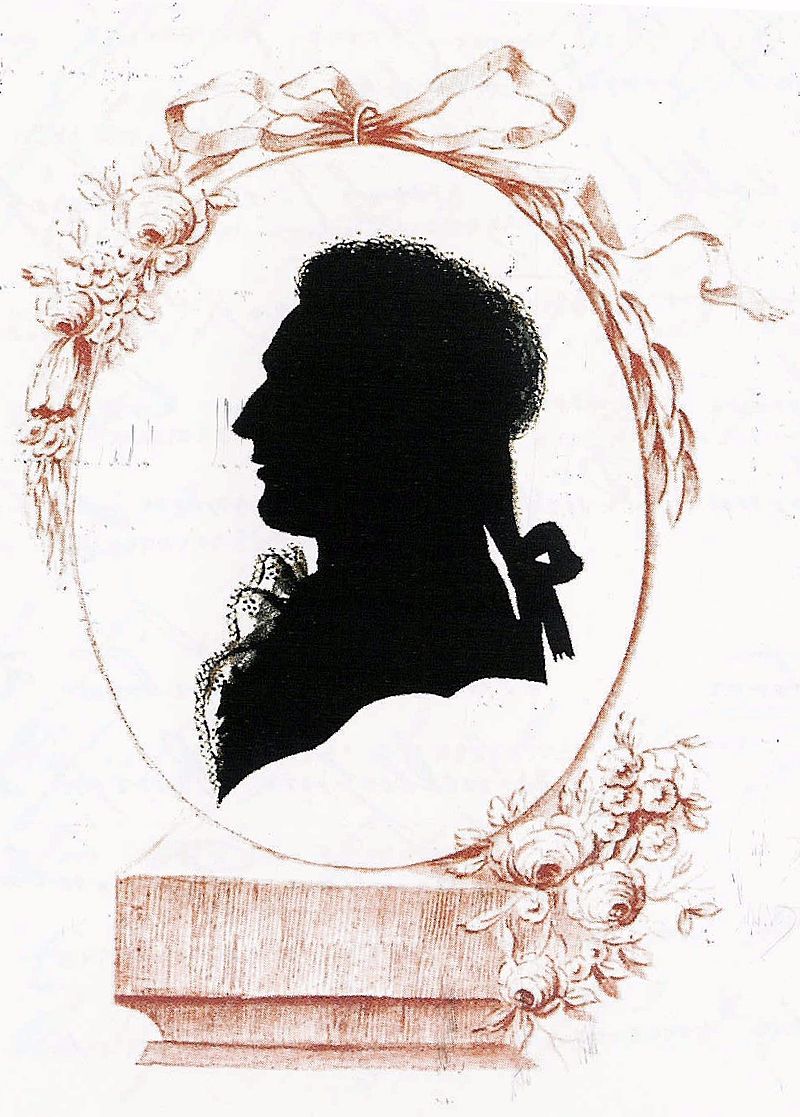
A traditional silhouette portrait of the late 18th century

The walls were hung with shades, exemplars of the dead man’s trade. These were mostly plain black on a white background, but some had embellishments of gold or silver around the edge of the figure, creating a kind of halo. The subjects were usually single individuals, but there was one family group, sitting on delicately made iron chairs – the very same chairs, I now saw, as those partly covered in sacking by the window. There was something salutary about this society of shadows. The meaning appeared to be that everyone’s life was occluded – a notion I could very easily credit.

Soot by Andrew Martin (2017)

~

“This violence of landscape, this cruelty of climate, this continual tension in everything, and even these monuments of the past, magnificent yet incomprehensible because not built by us and yet standing round us like lovely mute ghosts; all those rulers who landed by main force from every direction who were at once obeyed, soon detested, and always misunderstood, their only expressions works of art we couldn’t understand and taxes which we understood only too well and which they spent elsewhere: all these things have formed our character, which is thus conditioned by events outside our control as well as by a terrifying insularity of mind.”

The Leopard by Giuseppe Tomasi de Lampedusa (1958)

~

“Well, lad, the Bible teaches us that if Satan can disguise himself as an angel of light, then his servants will almost certainly follow suit. People and things are not always what they seem. You must treat everyone and everything with suspicion. It is the only way to root out evil.”

Widdershins by Helen Steadman (2017)

~

Atalanta and Hippomenes by Willem van Herp (circa 1650)

“Don’t you see?” Iris asks, and in spite of herself, she leans forward a little on her seat, her breath coming rather fast. “It means that it’s not about Fate, or forcing the mortals to do our will, as we thought. It is about the choices mortals make – a world of freedom, where our destiny is our own, and not determined for us.”

For the Winner by Emily Hauser (2017)

~

That’s me, thought Laure, a mad intellectual! They had all been mad for a few weeks in Paris. Never again would she feel that intense sense of freedom, empowerment and fellowship. What were they fighting for? Sometimes they had all wondered themselves, but they knew they were fighting against something – against the suffocating old University and its lack of freedoms, against the brutality of the police and the authorities, against the old regime that was leaving France a century behind the world.

Mediterranean Summer by Jane MacKenzie (2017)

~

M. de Sarcey was fascinated by this spirit so akin to his own. For the first time in his life he felt a pang of wonder as to whether he had not missed something by the assured magnificence of his position, a sudden glimpse of how splendid it might have been to have been free even from the chains of luxury and custom.

Eugenie by Marjorie Bowen (1917)

~

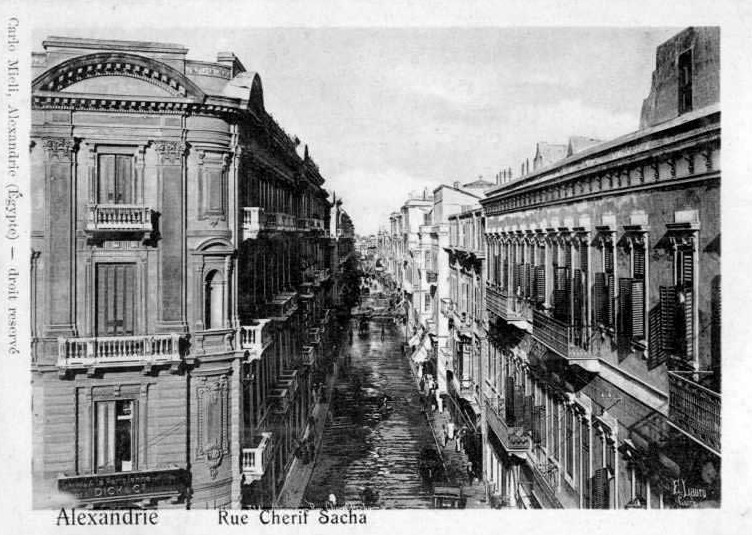
Rue Cherif Pacha, Alexandria, Egypt in early twentieth century

They left the carriage in Alex’s centre square, the palm-fringed Place Mohammed Ali, and set off to Draycott’s on foot. It was as they joined the crowds coursing down the main shopping thoroughfare, the elegant Rue Cherif Pasha, that Olivia felt the straining atmosphere of the day dip and darken. She looked to the heavens to see if a storm was coming, but the sky was pure blue.

Beneath a Burning Sky by Jenny Ashcroft (2017)

~

I believe there is a theory that men and women emerge finer and stronger after suffering, and that to advance in this or any world we must endure ordeal by fire. This we have done in full measure, ironic though it seems. We have both known fear, and loneliness, and very great distress. I suppose sooner or later in the life of everyone comes a moment of trial. We all of us have our particular devil who rides us and torments us, and we must give battle in the end. We have conquered ours, or so we believe.

Rebecca by Daphne du Maurier (1938)

~

Craddock stood looking up at it for several minutes, watching the west windows turn ruby in the sun and as he stared, eyes half closed against the sun, the silent building began to stir with life, so that he saw it as an ageing and once beautiful woman, awaiting the return of sons who had marched away centuries since and been swallowed up in a forgotten war. There was patience here, patience and a kind of desperate dignity, as though all hope of their return had never been abandoned, and that one day all the windows would glow with candles.

Long Summer Day by RF Delderfield (1966)

~

Hot air balloon in flight

The balloon hung in the air like an inverted Christmas bauble, its voluptuous, candy-striped sphere reflected perfectly in the lake. In the early light, the water glowed with the colours of a ripe peach, pale gold towards its edges, a deeper, richer pink at its heart. There was no wind. No sound. The trees along the shoreline had ceased their pre-dawn rustling and none of the balloon’s thirteen passengers was either moving or speaking. The world seemed to be holding its breath.

Dead Woman Walking by Sharon Bolton (2017)

~

“How will you know what is true,” Adam asked, “if they are conflicting accounts? Who is telling the truth? You see, it’s not just you. We all have to face this. People have different versions of what happens. Everyone is sure that theirs is the right one.”

A Week in Paris by Rachel Hore (2014)

~

Favourite books read in July: Soot, Long Summer Day, Dead Woman Walking – and my re-read of Rebecca.

My Commonplace Book: June 2017

A selection of words and pictures to represent June’s reading

My Commonplace Book

commonplace book
Definition:
noun
a notebook in which quotations, poems, remarks, etc, that catch the owner’s attention are entered

Collins English Dictionary

~

“Wintrow,” he chided softly. “Refuse the anxiety. When you borrow trouble against what might be, you neglect the moment you have now to enjoy. The man who worries about what will next be happening to him loses this moment in dread of the next, and poisons the next with pre-judgement.”

Ship of Magic by Robin Hobb (1998)

~

Anne Boleyn

“But that’s dreadful!” Anne cried. “If she is not mad, then she should be restored to her throne. Surely her own father would not treat her so terribly.”

“When kingdoms are at stake, Mistress Anne, human feelings count for nothing,” Sir John observed.

Anne Boleyn: A King’s Obsession by Alison Weir (2017)

~

How could the child bear not just the hunger, but the boredom? The rest of humankind used meals to divide the day, Lib realised – as reward, as entertainment, the chiming of an inner clock. For Anna, during this watch, each day had to pass like one endless moment.

The Wonder by Emma Donoghue (2016)

~

Unconsciously, she had always clung to dignity as her sole possession. She had asked for no pity, made no lamentation, and had endured each moment as it came, waiting patiently for release, because she believed that in all circumstances there must be some right way in which to think and act, which can lift them into a kind of beauty.

Lucy Carmichael by Margaret Kennedy (1951)

~

Prague Castle

It was the heart of winter, and a crescent moon hung crookedly over the bulk of Hradčany Castle, looming above the narrow laneway where the body lay. Such stars there were! – like a hoard of jewels strewn across a dome of taut black silk. Since a boy I had been fascinated by the mystery of the heavens and sought to know their secret harmonies.

Prague Nights by Benjamin Black (2017)

~

β€œModern society is the greatest criminal of all. Distribution of wealth notoriously unjust. So-called β€œjustice” a mockery. Organised society makes criminals by the hundred, and then revenges itself upon them – if they’re poor. Big thieves get off and get honours. All wrong. Prevention of crime is the great thing – not punishment.”

Miraculous Mysteries edited by Martin Edwards (2017)

~

History wasn’t made without taking risks, that much he knew. So maybe sometimes you had to take risks to write it, too.

Archangel by Robert Harris (1998)

~

It was easy to wander into the heart of the ancient streets, laced together by alleys aromatic with the smell of ginger and charcoal. She watched women traders shouting out their wares in shrill voices, their socks, shawls and cotton reels displayed on trolleys covered with straw and tarpaulin, while the men sat crosslegged on low stools, rolling dice on the pavement. Canaries sang in bamboo cages hanging from canopies outside narrow shops and the sun lit up particles of dust, making the air shimmer.

The Silk Merchant’s Daughter by Dinah Jefferies (2016)

~

Elizabeth Stuart, Queen of Bohemia

Elizabeth could not imagine being dismissed with a shrug and a careless sentence. That was not the lot of princesses. If they were not beautiful men pretended that they were. If they were fortunate enough to possess beauty, charm and wit then poets wrote sonnets to them and artists had no need to flatter them in portraits.

House of Shadows by Nicola Cornick (2015)

~

“You are right, Mother: long before I was born, you tied my fate to the Palmisanos. I can’t break away from that. Even if I hated them with all my might I couldn’t get away. If I chose not to take sides, I would still be shackled to them. But am I condemned to death by this curse? Aren’t I a free man? Don’t I control my actions? Can’t I rebel and fight against destiny?”

The Last Son’s Secret by Rafel Nadal Farreras (2017)

~

But tomorrow there will be another theory, and another; one will be discredited and the other praised; they’ll fall from fashion and be resurrected a decade later with added footnotes and a new edition. Everything is changing, Mrs. Seaborne, and much of it for the better: but what use is it to try and stand on quicksand? We will stumble and fall, and in falling become prey to folly and darkness – these rumours of monsters are nothing more than evidence that we have let go of the rope that tethers us to everything that’s good and certain.

The Essex Serpent by Sarah Perry (2016)

~

Favourite books read in June: The Wonder, Ship of Magic and The Essex Serpent

My Commonplace Book: May 2017

A selection of words and pictures to represent May’s reading

My Commonplace Book

commonplace book
Definition:
noun
a notebook in which quotations, poems, remarks, etc, that catch the owner’s attention are entered

Collins English Dictionary

~

When you are young you are too busy with yourself – so Caroline thought – you haven’t time for ordinary little things, but, when you leave youth behind, your eyes open and you see magic and mystery all around you: magic in the flight of a bird, the shape of a leaf, the bold arch of a bridge against the sky, footsteps at night and a voice calling in the darkness, the moment in a theatre before the curtain rises, the wind in the trees, or (in winter) an apple-branch clothed with pure white snow and icicles hanging from a stone and sparkling with rainbow colours.

Vittoria Cottage by DE Stevenson (1949)

~

Mata Hari

“Tell me where you learned to dance.”

“Java.” I paint the picture for him. Gamelan orchestras playing in the night. White orchids floating in private pools. Parties so lavish the queen of Holland might have attended. “There was a woman who danced at these affairs. Mahadevi.” I describe how she taught me to dance and I can see him struggling to decide whether or not I’m telling the truth. But he doesn’t say anything. He must believe me.

Mata Hari by Michelle Moran (2016)

~

She loved her country, Botswana, which is a place of peace, and she loved Africa, for all its trials. I am not ashamed to be called an African patriot, said Mma Ramotswe. I love all the people whom God made, but I especially know how to love the people who live in this place. They are my people, my brothers and sisters. It is my duty to help them to solve the mysteries in their lives. That is what I am called to do.

The No. 1 Ladies’ Detective Agency by Alexander McCall Smith (1998)

~

With a conscious effort, he brought his focus back to the present. He had decided long ago that dwelling on the past was for fools. You could not go back and change your actions, so why go over and over your mistakes in your memory? Because he was a fool. A sentimental fool, who was getting old. He smiled at the thought.

The Serpent Sword by Matthew Harffy (2015)

~

Possible portrait of Lucrezia Borgia.

How else to explain the chaos strewn in our wake, the ravaged lives, the sacrificed innocence and spilled blood? How else to justify the unexpected trajectory of my own life, forever wandering the labyrinth of my family’s ruthless design?

There can be no other reason. Infamy is no accident. It is a poison in our blood.

It is the price of being a Borgia.

The Vatican Princess by CW Gortner (2016)

~

“So I ask you,” said the boy. “Here I am on this rock. Am I the same boy as the one on land? Do the same codes apply if you’re wholly, entirely alone?”

The Winter Isles by Antonia Senior (2015)

~

Below her, gentle flower filled gardens sloped down to the lake in three terraces, with paths, steps and benches strategically placed between the three. The lake itself was the most gloriously shining silver she’d ever seen. All memory of the previous day’s car journey, with its terrifying hairpin bends, deep ravines, and nauseating bumps, was instantly washed away. Rising up behind the lake, and surrounding it, was a tapestry of green velvet, the tea bushes as symmetrical as if they’d been stitched in rows, where women tea pickers wore eye-catching brightly coloured saris, and looked like tiny embroidered birds who had stopped to peck.

The Tea Planter’s Wife by Dinah Jefferies (2015)

~

House of Atreus family tree

I know as no one else knows that the gods are distant, they have other concerns. They care about human desires and antics in the same way that I care about the leaves of a tree. I know the leaves are there, they wither and grow again and wither, as people come and live and then are replaced by others like them. There is nothing I can do to help them or prevent their withering. I do not deal with their desires.

House of Names by Colm TΓ³ibΓ­n (2017)

~

The gift of independence once granted cannot be lightly taken away again.

I, Claudius by Robert Graves (1934)

~

I sit up straight and clasp my hands, my heart soaring at the thought of it, to see London; to pass through these walls, to be free. “From my window I often think I should dearly love to sprout wings and rise above the rooftops and see beyond the buildings, the city and the river. I should like to see whence the moon rises. I want to go where the sun sets.”

Song of the Sea Maid by Rebecca Mascull (2015)

~

Fumata nera (black smoke) from the Sistine Chapel

Conclave. From the Latin, con clavis: ‘with a key’. Since the thirteenth century, this was how the Church had ensured its cardinals would come to a decision. They would not be released from the chapel, except for meals and to sleep, until they had chosen a Pope.

Conclave by Robert Harris (2016)

~

Favourite books read in May: The Tea Planter’s Wife, Song of the Sea Maid and Conclave

My Commonplace Book: April 2017

A selection of words and pictures to represent April’s reading

My Commonplace Book

commonplace book
Definition:
noun
a notebook in which quotations, poems, remarks, etc, that catch the owner’s attention are entered

Collins English Dictionary

~

“What a beautiful situation,” he said, “The house nestles so contentedly.”

She smiled. “That is very poetic, Master Marcus. I have never thought of it like that.”

“That is because you are used to it. Rare beauty is treated as something quite ordinary by those who see it every day.”

To Sleep No More by Deryn Lake (1987)

~

I began to see how people could need drink to cover up embarrassments, and I remembered many sticky church functions which might have been improved if somebody had happened to open a bottle of wine. But people like us had to rely on the tea-urn and I felt that some credit was due to us for doing as well as we did on that harmless stimulant.

Excellent Women by Barbara Pym (1952)

~

She glanced uncertainly at Timothy, who said at once, “Sit down and answer the kind policeman truthfully, my child.”

She obeyed but said reluctantly, “It sounds so unlikely!”

“Most of the stories I have to listen to do,” observed Hemingway. “And they’re not always lies either!”

Duplicate Death by Georgette Heyer (1951)

~

Surely those were the things that mattered – the little everyday things, the family to be cooked for, the four walls that enclosed the home, the one or two cherished possessions. All the thousands of ordinary people on the earth, minding their own business, and tilling the earth, and making pots and bringing up families and laughing and crying, and getting up in the morning and going to bed at night. They were the people who mattered, not these Angels with wicked faces who wanted to make a new world and who didn’t care whom they hurt to do it.

They Came to Baghdad by Agatha Christie (1951)

~

Aviatrix Hélène Dutrieu

And then, something mysterious happened. Now that her body had had time to adjust, and the same for her mind, once she realised she wasn’t going to drop from the air she was suffused with elation, streaming out of her fingertips and toes and hair and eyes and she just couldn’t believe she was there, up, up, up, above the world. It was so beautiful, so beautiful!

The Wild Air by Rebecca Mascull (2017)

~

“A foolish, foolish situation. Each, as an individual would pull the other out of the water; each would succour the other, even at considerable danger to himself. But each, as the representative of his tribe, will batter the other with great guns and small; sink, burn and destroy at the drop of a hat. A foolish, foolish situation, that must be dealt with by men of sense, not by gamecocks stalking about on stilts and high horses.”

Desolation Island by Patrick O’Brian (1977)

~

Her most recent life – four years at a good college, and then a few years of shelving books – had given her a vague sense of freedom with no disorder attached, apart from her inner misery.

In other words, nothing in her previous experience had prepared her for the feeling of being suddenly locked in a monastic room with a stranger five thousand miles from the Blue Ridge Mountains, holding an urn containing the ashes of another stranger.

The Shadow Land by Elizabeth Kostova (2017)

~

Charles Edward Stuart (‘Bonnie Prince Charlie’)

But when he was alone, when the door had closed with a certain air of finality on one whom he knew to be at least a faithful friend, a wave of melancholy swept over his young, impetuous heart.

He thought of his truly precarious position, and how this house, his pension, his servants, his very clothes, and the money in his pocket might melt away like fairy gold which, gleaming over-night, is but withered leaves in the morning.

Everything depended on France.

Mr Misfortunate by Marjorie Bowen (1919)

~

He never cried. He could often feel a cry trying to come up from his heart, but he always forced it down. Because this was how Emilie had told him to behave in the world. He had to master himself. The world was alive with wrongdoing, she said, but Gustav had to emulate his father who, when wronged, had behaved like an honourable man; he had mastered himself. In this way, Gustav would be prepared for the uncertainties to come.

The Gustav Sonata by Rose Tremain (2016)

~

“You must not let your artistic talents go to waste. It is such a lovely thing to be able to show the world how you see it, the shadows and the light, and the spaces in between. We miss those details in everyday life. Art reminds us of what we have no time to see.”

A Dictionary of Mutual Understanding by Jackie Copleton (2015)

~

Magdalen Tower, Oxford

We are never quite the same person with everyone, he found; the clash of personality upon personality strikes out a different flame in every case and those we love the best are those whose impact upon us creates most light and warmth.

Towers in the Mist by Elizabeth Goudge (1937)

~

So I was ugly. So what? I was sturdy and squat, a bit squashed, with features uneven, I knew. But so were some of my favourite mountains: lumpy, offkilter, with mismatching planes and pointy bits.
And I was clever. This woman, Daisy’s mother, was wrong.

The Valentine House by Emma Henderson (2017)

~

Joan of Kent

The lines of the troubadour’s song revolved again and again in my mind.

Love is soft and love is sweet, and speaks in accents fair;
Love is mighty agony, and love is mighty care;
Love is utmost ecstasy and love is keen to dare;
Love is wretched misery. To live with it’s despair.

The Shadow Queen by Anne O’Brien (2017)

~

Favourite books read in April: They Came to Baghdad, The Wild Air, Towers in the Mist

My Commonplace Book: March 2017

Looking back at March’s reading – in words and pictures.

My Commonplace Book

commonplace book
Definition:
noun
a notebook in which quotations, poems, remarks, etc, that catch the owner’s attention are entered

Collins English Dictionary

~

My brother buried his resentment that day. But resentment buried is not gone. It is like burying a seed: for a season it may stay hidden in the dark, but in the end, it will always grow. I did not see it, though we were still close, even at that age. I think now that to be too close to someone can be to underestimate them. Grow too close, and you do not see what they are capable of, or you do not see it in time.

The Witchfinder’s Sister by Beth Underdown (2017)

~

Nero

No one in the training grounds knew who I was. I had taken another name – I called myself Marcus and gave myself a familial name not connected to anyone of importance. No one ever came to watch me, except Anicetus, so people assumed I was an orphan or a ward; in any case, not anyone of importance. I loved the freedom of being nobody. I think all children want this freedom. That does not mean they would be content with it forever.

The Confessions of Young Nero by Margaret George (2017)

~

But extracting the stumps and roots almost killed him each time he hacked and dug and pulled and ground. Prying out a stump reminded him of how deeply a tree clung to the ground, how tenacious a hold it had on a place. Though he was not a sentimental man – he did not cry when his children died, he simply dug the graves and buried them – James was silent each time he killed a tree, thinking of its time spent in that spot.

At the Edge of the Orchard by Tracy Chevalier (2016)

~

“Autumn-coloured?” said Silence, struck by the aptness of the description. Tabby had a felicity with words which delighted her mother, and often such phrases would emerge casually without, it appeared, much thought, and yet strangely poetic. In her mind’s eye she saw Captain Hellier, his brown and tawny colouring, and smiled. “What a good description – ‘the autumn-coloured man’! Much too good for the likes of him, though, chicken – you’ll have to call him something foul, something more appropriate for him.” She gave Tabitha a sudden, flashing grin, crackling with mischief. “Take your time, and think of a good one.”

Wintercombe by Pamela Belle (1988)

~

Sir Christopher Wren

There were diagrams of instruments for grinding glass, illustrations of the lenses of telescopes, and other inventions for pneumatic engines, embroidering by machine, a variety of musical instruments and a weather wheel. He told her that some of his inventions had been put to use over the years while others were still only working models.

Circle of Pearls by Rosalind Laker (1990)

~

“Oh yes, there is no official bar on females. It is just a habit they have fallen into. There is even talk of electing Caroline Herschel as an honorary member.”

I thought that unlikely considering the Academy’s history with regard to women. When it was founded, one of its most prominent antiquarians was Charlotte Brooke, who translated Gaelic poetry into English. She fell on hard times, and members of the Academy wondered what they could do to improve her situation. They decided to appoint her housekeeper of the Academy premises.

The Coroner’s Daughter by Andrew Hughes (2017)

~

British Museum

“It’s a wonderful place,” Rhoda was asserting, “and ‘instructive’ very; it makes one realise the depth and extent and thoroughness of one’s own ignorance. Do people reading here never sigh for an easy-chair and a footstool and a collection of comfortable, unreproachful light literature?”

“No, we are all profound students here,” Stephen assured her; “when we want relaxation we come for a walk among the mummies.”

London Roses by Dora Greenwell McChesney (1903)

~

Mr Bridge smiled. “I suspect that timetables are written for people of the opposing disposition to your good self, those who live their lives in a perpetual rush. Obviously they need a two-minute grace period to manage themselves on to a train. We all have our flaws, William.”

Mr Bridge loved to argue a good defence, but William was unsympathetic. “The latest I’ve ever managed to be was on time.”

The Fourteenth Letter by Claire Evans (2017)

~

Madame de Montespan

Her firm chin, straight nose, fine wrists, waist and neck; her thick and plentiful blond locks. She had invented a style of coiffure and baptised it the hurluberlu. Her hair had been pulled back from the forehead and was held in place by a hoop on top of her head, leaving her hair to fall on either side in a cascade of curls that framed her face.

The Hurlyburly’s Husband by Jean TeulΓ© (2008)

~

“Nat! You can’t give your grandmother’s name to a parrot!”

“Why not? They have so much in common – both venomous, abusive, malicious and terrifying old birds.”

“You can’t,” said Silence, trying unsuccessfully not to laugh. “You really can’t. I can probably, if I’m extremely lucky, and even more extremely careful, explain away a parrot, even one with Royalist views and a profane vocabulary. I cannot face the servants knowing that it has been christened in memory of my mother-in-law.”

Herald of Joy by Pamela Belle (1989)

~

Simon Forman c. 1611

“Am I then to put myself in his power?” whispered Frances from the shadow of her hood. She knew well enough in what repute witches and warlocks were held; she had been told by her great-uncle that Simon Forman lived within the jurisdiction of the Archbishop that he might better escape the authorities…she had heard, too, that he had once been in prison for trying to raise the dead; she shuddered, half afraid, half excited.

The King’s Favourite by Marjorie Bowen (1937)

~

Even the unexpected has a double image to it as if it had occurred sometime before in the same way and in the same place. There is a pattern to the week: the mail-boat on Saturday; mass on Sunday; the weekly wash on Monday. So the memory shortens itself and goes from day to day; the pattern is lost among the individual threads…

The Sea Road West by Sally Rena (1975)

~

Favourite books read in March: Wintercombe and Herald of Joy.

My Commonplace Book: February 2017

Looking back at February’s reading – in words and pictures.

My Commonplace Book

commonplace book
Definition:
noun
a notebook in which quotations, poems, remarks, etc, that catch the owner’s attention are entered

Collins English Dictionary

~

Yes, Memory is a cruel thing. For it knows our struggle to remember, and to forget, and it ignores Time. It whispers or withholds, suggesting more, or less, secure in the knowledge that it will have the final say. Secure in the knowledge that it can – at any time it so wishes – erase, adapt or rewrite our story. Redeeming, damning, it thrusts upon us, altering statements to questions and shrinking our vistas.

The Echo of Twilight by Judith Kinghorn (2017)

~

View of Delft by Johannes Vermeer, 1660–1661

View of Delft by Johannes Vermeer, 1660–1661

The working day is over and it’s busy on the streets. Maids and workers are heading home, farmers are leaving the city before the gates shut and shopkeepers are fastening the drop-down hatches they’ve been displaying their goods on. Delft isn’t all that much bigger than Alkmaar, and there are similarities, with all their little canals and houses with stepped gables. It gives me a pleasant sense of homecoming.

Midnight Blue by Simone van der Vlugt (2017, English translation)

~

“Why are you a pirate?” she said at last, breaking the silence.

“Why do you ride horses that are too spirited?” he answered.

“Because of the danger, because of the speed, because I might fall,” she said.

“That is why I am a pirate,” he said.

Frenchman’s Creek by Daphne du Maurier (1941)

~

triffid

Triffid, as illustrated by John Wyndham

She did not speak for a little while, then she said:

“You know, one of the most shocking things about it is to realise how easily we have lost a world that seemed so safe and certain.”

The Day of the Triffids by John Wyndham (1951)

~

He had said that our lives are steered by uncertainties, many of which are disruptive or even daunting; but that if we persevere and remain generous of heart, we may be granted a moment of supreme lucidity – a moment in which all that has happened to us suddenly comes into focus as a necessary course of events, even as we find ourselves on the threshold of the life that we had been meant to lead all along.

A Gentleman in Moscow by Amor Towles (2016)

~

We paused for a moment to survey the opposite bank and see which was the nearest point to head for, and I suddenly realized that neither Bob nor I had removed our hats. There was something so ludicrous about the sight of Bob splashing about in the dark waters, doggedly doing the breast-stroke, with an elegant green pork-pie hat set at a jaunty angle over one eye, that I got an attack of the giggles.

“What’s the matter?” asked Bob.

I trod water and gasped for breath.

“Intrepid Explorer Swims Lake In Hat,” I spluttered.

Three Singles to Adventure by Gerald Durrell (1954)

~

“What a complete waste of my time,” she complained as we drove through the traffic for home. “If they didn’t like my work, why on earth did they come along to hear me?”

“I think they expected you to read for only a few minutes,” I told her. “And then perhaps to answer some of their questions.”

“The novel is four hundred and thirty-four pages long,” she said, shaking her head. “If they want to understand it, then they must hear the entire thing. Or, preferably, read the entire thing. How can they possibly get a sense of it from a mere ten minutes?”

The Heart’s Invisible Furies by John Boyne (2017)

~

king-harold-ii

King Harold II

What does a man do when he is suddenly thrust into kingship? No matter how he prepares, when the day finally comes the world is a changed place. Maybe it’s different when one is born in the purple and raised from childhood to be king. My situation couldn’t be more different – as my rivals haven’t hesitated to remind me at every opportunity. Perhaps now, I won’t have to listen to them, though I know what they are thinking.

Fatal Rivalry by Mercedes Rochelle (2017)

~

Like most artists, everything I produced was connected to who I was – and so I suffered according to how my work was received. The idea that anyone might be able to detach their personal value from their public output was revolutionary.Β  I didn’t know if it was possible, even desirable.Β  Surely it would affect the quality of the work?

The Muse by Jessie Burton (2016)

~

The fog was thick, but from her place at the far end of the valley, where the fields and bouldered slopes met the uncleared woodland, she could hear the roar of the river Flesk’s swollen waters. A short distance away from her cabin was the Piper’s Grave, where the fairies dwelt. She nodded respectfully towards the crooked whitethorn, standing ghostlike in the mist in its circle of stone, briars and overgrown grass.

The Good People by Hannah Kent (2016)

~

White-tailed Tropic bird

White-tailed Tropic bird

The ground fell away sharply on each side of the trail, and between the trees we caught glimpses of the spectacular Black River gorges, thickly covered in forests of greens and reds and golds, with waterfalls like feathers trailing down the steep, spectacular cliff faces. At the bottom of the gorges, where the rivers ran bright and shining, or white and thunderous through mossy rock, the air was filled with drifting, wheeling, white crosses that were the White-tailed Tropic birds.

Golden Bats and Pink Pigeons by Gerald Durrell (1977)

~

A person who has not done one half his day’s work by ten o’clock, runs a chance of leaving the other half undone.

Wuthering Heights by Emily BrontΓ« – re-read (1847)

~

“It’s not a temptation you feel, then?” he asked. “You don’t ever want to rise up from your chair, and walk down the stairs, and put on your coat, and step out of the door onto Golden Hill, and just go?”

“Where would I go to?” she said.

“Anywhere,” he said. “You have a whole continent to choose from. Look at it. You could land anywhere on that shore, and just walk away, under the trees.”

Golden Hill by Francis Spufford (2016)

~

richard_iii_earliest_surviving_portrait

Richard III, painted c. 1520

A certain Mr Colyngbourne of Lydyard in Wiltshire had been too clever; had nailed a rhyming couplet on the door of St Paul’s and been caught doing it.

The Cat, the Rat and Lovell our Dog
Ruleth all England under the Hog:

Catesby and Ratcliffe, and himself whose badge the dog was, rulers of grumbling England under the silver boar.Β  Mr Colyngbourne, who had served King Richard’s brother and mother in his time, would make no more couplets.

Under the Hog by Patrick Carleton (1937)

~

Favourite books this month: A Gentleman in Moscow, Golden Hill and Under the Hog. I also enjoyed my re-read of Wuthering Heights!

As usual, I am behind with my reviews, but hope to get caught up soon.

My Commonplace Book: January 2017

Looking back at January’s reading – in words and pictures.

My Commonplace Book

commonplace book
Definition:
noun
a notebook in which quotations, poems, remarks, etc, that catch the owner’s attention are entered

Collins English Dictionary

~

cardinal-richelieu

Cardinal Richelieu

But there’s no harm in learning about history from a novelist, especially those details that historians find unworthy to relate, assuming they even know them.

The Red Sphinx by Alexandre Dumas (1865)

~

Mark had prided himself on his library. It was a mixed collection of books. Books which he had inherited both from his father and from his patron; books which he had bought because he was interested in them or, if not in them, in the authors to whom he wished to lend his patronage; books which he had ordered in beautifully bound editions, partly because they looked well on his shelves, lending a noble colour to his rooms, partly because no man of culture should ever be without them; old editions, new editions, expensive books, cheap books, a library in which everybody, whatever his taste, could be sure of finding something to suit him.

The Red House Mystery by A.A. Milne (1922)

~

Without thought, I laughed when laughter was required, or I was gentle or fiery or amiable or seductive or roguish or voluptuous or childlike, as the man wished me.Β  But which of these different women was truly Jane Shore?Β  A diamond has many facets, I told myself, and all are beautiful: I was a diamond, save that I was not hard and had no cutting-edges.

The Merry Mistress by Philip Lindsay (1952)

~

bannik

Bannik – the bathhouse spirit

“A prophecy then, sea-maiden.”

“Why do you call me that?” she whispered.

The bannik drifted up to the bench beside her. His beard was the curling steam. “Because you have your great-grandfather’s eyes. Now hear me. You will ride to where earth meets sky. You will be born three times: once of illusions, once of flesh, and once of spirit. You will pluck snowdrops at midwinter, weep for a nightingale, and die by your own choosing.”

The Bear and the Nightingale by Katherine Arden (2017)

~

One man can no more see into the mind of another than he can see inside a stone…

His Bloody Project by Graeme Macrae Burnet (2015)

~

The gardens at Wolf Hall proved a delight, a tangled land of enchantment full of overblown roses and secret paths.Β  Beneath the trees of the orchard I could see a harassed looking goose girl trying to round up her flock.Β  She was flapping as much as they.Β  Over in the stable yard, I could hear the chink of harness and the murmur of voices.Β  The air was full of scent and heat, and I wandered at will, lost in the pleasure of it.

The Phantom Tree by Nicola Cornick (2016)

~

musical-notes

“Do people see him? Does he haunt the tower?”

“Poor Goldsworthy?” Mr Ratcliffe shook his head. “Not as far as I know. No, it’s his music that people hear. Or they say they do. Fragments of melody, just a few notes.” He waved his pipe in the direction of the cathedral. “It’s as if the anthem was broken into many pieces in the fall. And all the notes it contained were thrown up into the air. They are still there. Looking for each other. Trying to come together again.”

Fireside Gothic by Andrew Taylor (2016)

~

Then, while he watched and pondered, a strange transformation took place.Β  The light turned to bluish over the whole mountain, with the lower slopes darkening to violet.Β  Something deeper than his usual aloofness rose in him – not quite excitement, still less fear, but a sharp intensity of expectation.Β  He said: “You’re quite right, Barnard, this affair grows more and more remarkable.”

Lost Horizon by James Hilton (1933)

~

She had scraps for a dog, milk for a cat, bread for a child, a wage for an old woman; she had a roof and a fire and a door to shut or open. She was beginning to be beloved, and she was already essential.

The Flowering Thorn by Margery Sharp (1933)

~

pembroke-castle

Pembroke Castle

During our journey some of the churches and abbeys we rode past had amazed me, but I had never laid eyes on anything to compare with the huge and fearsome edifice that was Pembroke Castle.

Viewed across an expanse of rippling water, it crouched like some gigantic monster on a steep rocky promontory, its mighty lime-washed towers and battlements appearing to grow out of the pale rock beneath, as if it was rooted in the earth itself.Β  It looked like a man-made white mountain, indestructible, impregnable.

First of the Tudors by Joanna Hickson (2016)

~

It would be reasonable to suppose that a routine time or an eventless time would seem interminable. It should be so, but it is not. It is the dull eventless times that have no duration whatever. A time splashed with interest, wounded with tragedy, crevassed with joy – that’s the time that seems long in the memory. And this is right when you think about it. Eventlessness has no posts to drape duration on. From nothing to nothing is no time at all.

East of Eden by John Steinbeck (1952)

~

Edmund coughed and filled his wife’s glass, then his own. “Aren’t you pleased, Bessie?”

“It’s not that I’m not pleased. I’m sure it’s a great compliment
to you that you should be asked to investigate such an important
case.”

“But, my love?” He pulled at his cravat.

“Well, it’s just that it’s such a very awful case. I can’t help but
think that simply by being involved with it, your name will be
tainted.”

The Unseeing by Anna Mazzola (2016)

~

Favourite books this month: The Red Sphinx, His Bloody Project, The Red House Mystery, Lost Horizon and East of Eden

January has been a great month for me where reading is concerned!Β  I would usually just pick out one or two books as favourites, but this month I had trouble narrowing it down to five.Β  I hope February will be even better.