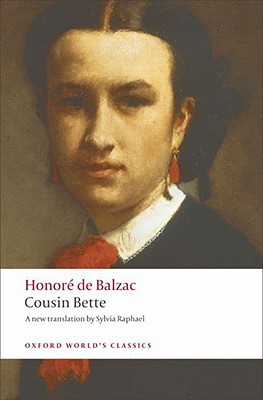
Cousin Bette by Honoré de Balzac

Cousin Bette Balzac is an author I have wanted to try for years but have kept putting off, partly because I thought he sounded intimidating and difficult to read and partly because he wrote so many books it was hard to know where to start! Then, last month I chose ten books at random from my Goodreads “to-read” shelf – and one of them was Cousin Bette, a novel I couldn’t even remember adding to my shelf in the first place, but which sounded very appealing. I obviously couldn’t put off reading Balzac any longer!

Cousin Bette (originally La Cousine Bette and sometimes translated as Cousin Betty) was published in 1846 and is set in 19th century Paris. The title character is Lisbeth – Bette – Fischer, a relation of the Hulot family who has always been jealous of her beautiful cousin Adeline. Plain, poor, and having turned down several marriage proposals, Bette is still unmarried at the age of forty-two. When she rescues a young Polish sculptor, Wenceslas Steinbock, from a suicide attempt and takes him under her wing, she is pleased to be able to tell everyone that she has a lover at last. Her happiness is shattered, however, when Adeline’s daughter, Hortense, falls in love with Wenceslas and marries him herself.

Bette vows to take revenge on the Hulot family and joins forces with Valerie Marneffe, her pretty young neighbour. Knowing that Adeline’s husband, the Baron Hulot, is a notorious womaniser and that Valerie is looking for a rich lover, Bette sees a way to ruin the Baron and destroy the rest of the family in the process.

I enjoyed Cousin Bette and I think it was a good choice for my first Balzac novel. I found it surprisingly easy to read and very entertaining, although I did need to concentrate to follow all the intricacies of the plot. The summary I have given above is only the beginning of the story; Bette is by no means the only character who plots and schemes and tries to cause trouble – and in fact, many of the misfortunes that befall members of the Hulot family are caused by their own personal weaknesses and flaws rather than the influence of others. Baron Hulot, for example, despite being one of the targets of Bette and Valerie’s cruelty, really only has himself to blame as he is unable to resist the temptation placed in his way.

I saw the three main female characters – Cousin Bette, Valerie Marneffe and Adeline Hulot – as representing three stereotypical views of 19th century women of different classes and social groups. Bette is the bitter, jealous middle-aged spinster, Valerie the selfish, manipulative beauty, and Adeline the faithful, loving wife who turns a blind eye to her husband’s many affairs. Any reader who is interested in gender roles and the portrayal of women in literature will find a lot to think about in Cousin Bette.

Before reading this novel I had no idea what the outcome of the story would be and I was kept in suspense until the end. Of course, I’m not going to tell you how it ends, but it’s not quite as simple as the ‘good’ characters being rewarded and the ‘bad’ ones being punished. It’s all very melodramatic – and all very bleak as well – but I enjoyed it and am looking forward to reading more Balzac. As he wrote more than one hundred books, I would love to know if you’ve read any of them and which ones you would recommend.

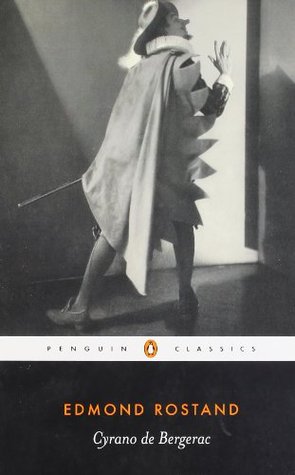
Cyrano de Bergerac by Edmond Rostand

Cyrano de Bergerac How many ways are there to insult a man with a big nose?

“Solicitous: ‘But sir, how do you drink? Doesn’t it trail in your glass?’
Or else descriptive: ‘It’s a rock, it’s a peak, it’s a cape…No, not a cape, it’s a peninsula!’
Inquisitive: ‘Do tell me, what is that long container? Do you keep pens in it, or scissors?’
Twee: ‘How darling of you to have built a perch for little birds to rest their tiny claws’.”

These are Cyrano de Bergerac’s own words about his own nose and although it might seem from this that he can see the funny side, he is actually very sensitive about it. Because of his appearance he believes no woman could ever find him attractive – especially not his beautiful cousin, Roxane, the woman he loves.

The handsome Christian is also in love with Roxane but is afraid that he doesn’t have the ability with words to impress her. Cyrano, who is a talented poet as well as a great swordsman and soldier, comes up with the perfect solution: he will write love letters to Roxane and send them in Christian’s name. Not only will this help to further Christian’s romance with Roxane, it will also give Cyrano a chance to express his own feelings. The plan is a success, but who is Roxane really falling in love with – the man who is writing the letters or the man she thinks is writing them?

Edmond Rostand’s French play Cyrano de Bergerac (subtitled An Heroic Comedy in Five Acts) was hugely successful when it was first performed in 1897. The audiences must have loved the same things that I did: the action, the romance, the combination of comedy and tragedy, and the swashbuckling hero. I’m not fortunate enough to have seen a stage version of this play (or any of the film versions either) but I’m sure it must be great fun to watch, with its swordfights, battle scenes and witty dialogue. I enjoyed reading it on the page, but it’s not quite the same as being able to see it performed!

Rostand’s inspiration for the play was a real person, the novelist, playwright and soldier Savinien de Cyrano de Bergerac, but only a few elements of his life are included in the play; the rest is imaginary. And what a great imagination Rostand had! There are so many memorable scenes, ranging from Cyrano fighting a duel while simultaneously composing a ballad, to Roxane standing on a balcony listening to Christian declare his love for her while Cyrano hides in the shadows telling him what to say, to the play’s tragic and emotional ending.

Rostand is credited with bringing the French word ‘panache’ into popular use (at least with the meaning we know today i.e. style and flamboyance). There are many examples of Cyrano’s panache throughout the play – and it is even his final word (although some translators give it the literal translation ‘white plume’). The edition I read was the Penguin Classics one with a recent translation by Carol Clark. I know this is not considered one of the better ones, so I do plan to read a different version of the play at some point. Any recommendations are welcome!

The Importance of Being Earnest by Oscar Wilde

The Importance of Being Earnest This is the second play I’ve read this month as part of my personal challenge to read the three on my Classics Club list during June. I’m really regretting my previous reluctance to read plays because it has meant that until now I’ve been missing out on some great ones like The Importance of Being Earnest. It was silly of me to keep avoiding this particular play, because I’ve enjoyed everything else I’ve read by Oscar Wilde (The Picture of Dorian Gray, The Canterville Ghost, A House of Pomegranates and two more of his short stories); why did I assume I wouldn’t enjoy this one too?

At the beginning of the play, Algernon Moncrieff is being visited at his London home by his friend, Jack Worthing, whom he has always known as Ernest. Jack is from Hertfordshire, where he is guardian to eighteen-year-old Cecily Cardew, whose grandfather found and adopted Jack as a boy. When Algernon finds a cigarette case inscribed to ‘Uncle Jack’ from ‘Little Cecily’, Jack is forced to admit that his name isn’t really Ernest – Ernest is a fictional brother he has invented so that he can escape from Hertfordshire from time to time with the excuse that his brother is in trouble and needs his help.

Algernon then confesses that he has also created an imaginary friend – an invalid called Bunbury who conveniently summons Algernon to his deathbed whenever he needs to get away from his responsibilities in London for a while. Leading double lives (which Algernon refers to as ‘Bunburying’) has so far been very successful for both men, but this is about to change when Algernon falls in love with Jack’s ward, Cecily Cardew, and Jack falls in love with Algernon’s cousin, Gwendolen – two women who are each determined to marry a man called Ernest.

Things quickly become very complicated from now on, with the action moving to Jack’s country estate where a series of misunderstandings, deceptions and mistaken identities follow. I don’t want to give away any more of the plot than I already have because I’m sure there are other people out there who still haven’t read or seen this play and I would hate to spoil the fun for you. And this is a fun play to read. I think Oscar Wilde’s famous humour and wit come across particularly well in the play format; even when reading it on the page it’s easy to imagine the lines being spoken aloud.

Some of the best lines go to Lady Bracknell, one of the ‘formidable aunt’ type characters you so often find in fiction. Although this is the first time I’ve read The Importance of Being Earnest in its entirety, I do remember reading the famous handbag scene at school. I was looking forward to reaching that part and fortunately it is in the first Act so I didn’t have too long to wait; it was lovely to finally be able to read it in its proper context!

There’s obviously a lot more I could have said about this wonderful play, about its themes, its characters and its use of language, but I hope you’ll forgive me for keeping this post short. I have another play to go and read!

Doctor Faustus by Christopher Marlowe

Dr Faustus As I mentioned in my post on May’s reading and my plans for June, I have challenged myself to read the three plays on my Classics Club list this month. They are The Importance of Being Earnest by Oscar Wilde, Cyrano de Bergerac by Edmond Rostand, and this one, Doctor Faustus by Christopher Marlowe.

I had several reasons for including this particular play on my list for the Classics Club, not least because it is one of the few plays (apart from the complete works of Shakespeare) that I actually have a copy of on my shelf. Not having studied English Literature at university, I feel there are whole areas of literature I’ve missed out on; I have read very few plays (again apart from Shakespeare) and almost no Elizabethan literature (yet again, apart from Shakespeare). It was obvious that I needed to venture away from Shakespeare! Also, and this may seem a silly reason, having come across Marlowe several times as a character in historical fiction I thought it was time I actually read some of his work.

Marlowe’s play, written in blank verse, is based on the German legend Faust which is about a man who sells his soul to the devil. Doctor Faustus is a scholar who believes he has reached the limits of all traditional types of knowledge – logic, law, medicine and divinity. When a friend tells him “The miracles that magic will perform Will make thee vow to study nothing else,” he decides to turn his attention to magic instead and begins by summoning the demon Mephastophilis. Through Mephastophilis, Faustus makes a deal with the devil Lucifer, the “arch-regent and commander of all spirits”: he will allow the devil to claim his soul in return for twenty-four years of service from Mephastophilis.

Having gained the powers he has dreamed of, Faustus fails to put them to good use, wasting them on practical jokes and frivolous magic tricks instead. Despite his pact with Lucifer the opportunity for repentance is still there, but Faustus repeatedly rejects the chance of salvation…until the twenty-four-year time period begins to draw to a close. Has he left it too late to be redeemed?

Doctor Faustus is thought to have first been performed in 1594 and published ten years later in a form now referred to as the A Text. A second version, known as the B Text was published in 1616 with extra lines and altered wording. It seems that there has been some controversy as to which is the closest to the play as originally written by Marlowe; the book I read (a New Mermaids edition) uses the A Text but also includes the additional scenes from the B Text as an appendix.

There are obvious lessons to be learned from Doctor Faustus – the corruption that can come with power, the dangers of wishing for what we do not have and seeking knowledge beyond our limits – and throughout the play we hear the thoughts of a Good Angel and an Evil Angel who fill the roles of the two conflicting sides of Faustus’ conscience. It’s also quite an entertaining story, although you have to remember that it was written to be performed and I think it’s probably a play that I would have enjoyed watching more than I enjoyed reading. There are some scenes, such as the one where the Seven Deadly Sins appear to Faustus, that I found difficult to visualise just from the text.

I’m not going to attempt a deep analysis of Doctor Faustus here, but will leave that to others who are more familiar than I am with Marlowe’s work and more comfortable discussing plays (novels are definitely my own comfort zone, which you may have guessed from my blog title). I’m pleased, though, to have finally read something by Marlowe – and such an important and influential play. As a side note, I hadn’t realised that the famous description of Helen of Troy as “the face that launched a thousand ships” came from this play.

My June play-reading project is off to a good start! I hope to have another one to tell you about next week.

A Country Doctor’s Notebook by Mikhail Bulgakov

A Country Doctors Notebook A Country Doctor’s Notebook is the book that was selected for me in the last Classics Club Spin. I was happy when I discovered that I would be reading this one, not only because it’s much shorter than most of the others on my Classics Club list, but also because I loved Bulgakov’s The Master and Margarita which I read four years ago in 2011. I knew this book was going to be very different from The Master and Margarita, but I hoped I would still enjoy it…and I did.

A Country Doctor’s Notebook is a collection of semi-autobiographical short stories originally written in Russian in the 1920s (the edition I read uses Michael Glenny’s English translation from 1975). Like the protagonist of this book, Mikhail Bulgakov was a ‘country doctor’. After graduating from Kiev University he became a physician and from 1916-1918 he worked at a small hospital near a remote village in the province of Smolensk.

The fictional doctor in the book, Vladimir Bomgard, is clearly based on Bulgakov himself and in the first story we see him as a young, newly-qualified doctor of twenty-four arriving at Muryovo Hospital, a full day’s drive from the nearest town. He is pleased to find that the hospital is clean and well equipped, but with no practical experience and nobody to turn to for advice (apart from a feldsher, or partly-qualified assistant, and two midwives) the thought of bearing sole responsibility for the lives of his patients terrifies him.

During his first weeks and months at Muryovo, the country doctor faces all sorts of problems for which his university education had completely failed to prepare him. With no electricity, no telephones, poor roads, the risk of being cut off from the world during snowstorms, and the ignorance of peasants regarding simple medical matters, life at Muryovo is primitive and isolated. Most of all, the young doctor lives in fear of encountering a strangulated hernia, a case of peritonitis or a difficult birth and he comes to dread hearing a knock on the door in the middle of the night.

“It’s not my fault,” I repeated to myself stubbornly and unhappily. “I’ve got my degree and a first class one at that. Didn’t I warn them back in town that I wanted to start off as a junior partner in a practice? But no, they just smiled and said, ‘You’ll get your bearings.’ So now I’ve got to find my bearings. Suppose they bring me a hernia? Just tell me how I’ll find my bearings with that?”

As the book progresses the doctor slowly begins to gain confidence and discovers that true knowledge comes with experience.

It was fascinating to read about conditions in a remote Russian hospital at the start of the twentieth century and the medical procedures and treatments that were used. I had a lot of sympathy for the doctor, being thrown in at the deep end with so little experience and being expected to operate on patients with no supervision and no advice other than illustrations in his textbooks. If you’re squeamish I should probably warn you that some of the operations he performs are described in full, gory detail (the tracheotomy particularly sticks in my mind). But this is also a book with a lot of humour and there are some very funny moments as the doctor panics, guesses and muddles his way through each crisis.

As I mentioned above, I read the Michael Glenny translation which I was quite happy with and found perfectly readable. I enjoyed all of the stories in A Country Doctor’s Notebook and I’m so pleased the Classics Spin motivated me to pick up this book at last.

The Eustace Diamonds by Anthony Trollope

The Eustace Diamonds Today is Anthony Trollope’s 200th birthday! When I saw that Karen of Books and Chocolate was hosting a special Trollope Bicentennial Celebration this month, I knew I wanted to take part and I knew exactly what I would be reading. Having read and enjoyed Trollope’s first two Palliser novels, Can You Forgive Her? and Phineas Finn, it made sense to continue with the third in the series – The Eustace Diamonds.

Unlike Trollope’s other set of six novels, the Chronicles of Barsetshire, which revolve around a cathedral town and the lives of the clergy, the Palliser novels have plots involving politics and featuring the Palliser family – the politician Plantagenet Palliser, his wife Lady Glencora, and his uncle, the Duke of Omnium. In The Eustace Diamonds, though, these three characters are pushed into the background. Our heroine this time (although, as Trollope himself tells us at the beginning of the book, ‘heroine’ is maybe not the right way to describe her) is Lizzie Greystock, who quickly becomes Lady Eustace when she marries the wealthy Sir Florian.

After less than a year of marriage, Sir Florian dies, leaving Lizzie a rich widow in possession of a valuable diamond necklace which she claims her husband had given to her before his death. However, the Eustace family lawyer, Mr Camperdown, insists that the diamonds belong to the Eustace estate and that Lizzie has no legal right to them. The question of the ownership of the necklace forms the central plot of the novel, as the people around Lizzie are forced to take sides. Her cousin Frank vows to support her no matter what, while Lord Fawn, who has recently proposed to her, is horrified by the scandal surrounding his fiancée and searches for a way out of the marriage.

Lizzie is selfish, she tells lies, she manipulates people and situations to her own advantage and her own aunt describes her as “false, dishonest, heartless, cruel, irreligious, ungrateful, mean, ignorant, greedy, and vile”. She is a difficult character to like (and I was sorry that Trollope doesn’t give her more redeeming features) but she is a fascinating character to read about and I loved following the twists and turns of her story.

But The Eustace Diamonds also follows other characters and other storylines. There’s Lucy Morris, a governess in the service of Lord Fawn’s mother, who is love with Lizzie’s cousin, Frank Greystock. Frank, however, is preoccupied with Lizzie and her ordeals, and it seems he is unable to give Lucy the commitment she deserves. And there’s also Lucinda Roanoke, a young woman with strong views of her own on the subject of marriage – views which don’t always agree with those of her aunt, Mrs Carbuncle.

I’m finding it difficult to decide exactly what I thought of The Eustace Diamonds. In some ways I loved it even more than the previous two Pallisers, but in others I found it the weakest of the three. I struggled a little bit with the amount of political detail in Phineas Finn, but in this book there is far less focus on politics. Instead, Trollope concentrates on relationships, on marriage, on the law, and on attitudes towards money, property and reputation. In the middle of the book, the dispute surrounding the jewels begins to go in a more sensational direction, which I did find interesting, but I couldn’t help thinking that this type of plot might have been better suited to an author like Wilkie Collins rather than Trollope.

At 800 pages I did think the book felt too long for the story that was being told. Most of Trollope’s novels are long, of course, but I’m not usually conscious of the length while I’m actually reading; this time I was. Despite being absorbed in the story, I found the plot very repetitive at times and the controversy over the ownership of the diamonds seemed to go round in circles for a while – maybe a result of the novel originally being published as a serial and needing to be drawn out over a long period of time.

I did enjoy The Eustace Diamonds overall, though – and can honestly say I haven’t read a Trollope novel yet that I haven’t enjoyed. Now I’m looking forward to catching up with Phineas Finn again in the fourth Palliser novel, Phineas Redux.

The League Of The Scarlet Pimpernel by Baroness Emmuska Orczy

The League of the Scarlet Pimpernel After reading The Scarlet Pimpernel a few years ago I was pleased to find that Baroness Orczy had written a whole series of Pimpernel books. I slowly (very slowly – this is only the third one I’ve read in three years) began to work my way through them in chronological order, but as I haven’t been particularly impressed by either this one or Sir Percy Leads the Band, I’m now wondering if I really want to read all of the others.

The League of the Scarlet Pimpernel was published in 1919 and is a collection of short stories, unlike the first two books I read which were both full-length novels. I don’t often choose to read short stories but as I’m also in the middle of some longer, heavier books at the moment, I thought this collection would be ideal for dipping into when I needed something lighter.

There are eleven stories in this book – all set during the French Revolution – and each one involves a family or group of aristocrats whose lives are in danger. It falls to Sir Percy Blakeney and his friends (known as the League of the Scarlet Pimpernel) to rescue them from the guillotine, often with the help of some clever disguises, cunning deceptions and daring rescue plans. Although all eleven stories are entertaining, they do become very repetitive, and once you’re familiar with the way Sir Percy works they are also very predictable.

Most of the stories are too short to have much of a plot and their main purpose just seems to be to highlight Sir Percy’s various masquerades and tricks, but there are a few stories that are longer and more complex. My favourite was probably the first one, Sir Percy Explains, in which our hero agrees to help rescue a little boy who has been captured by the revolutionary Jean Paul Marat. Almost all of the stories are written in the third person, but there are one or two with a first person narrator, which I liked because it added some variety to the book. How Jean Pierre met the Scarlet Pimpernel, narrated by the loyal servant of an impoverished noblewoman, was one of these and another of my favourites from this collection.

I was a bit disappointed that, given the title of this book, none of the other League members apart from Percy have a big part to play in any of the adventures. Tony and Ffoulkes make a few brief appearances, and one story deals with the subject of a traitor in the League, but that’s all. There’s no Marguerite either – Percy’s wife only has a one-sentence mention in one of the stories – but we do see a lot of the Pimpernel’s enemy, Citizen Chauvelin.

From what I’ve heard about the Scarlet Pimpernel series, the quality varies quite a lot from book to book. This one is worth reading, especially if you like short story collections, but it certainly doesn’t compare to the original novel. If I do continue to read the series, the next book I come to chronologically will be I Will Repay, which I’m hoping I’ll enjoy more than this one.