My Ántonia by Willa Cather

My Antonia Between now and December 2016 I am participating in the Women’s Classic Literature Event hosted by the Classics Club. There are many classic female authors whose work I’m looking forward to reading, but I decided to begin with a book by Willa Cather. I read my first (and until now, my only) Cather novel more than five years ago; it was The Professor’s House and, although I did like her writing, I wasn’t very impressed. I suspected, though, that it just wasn’t the right book for me and that I would enjoy a different one more. My Ántonia, probably Cather’s most well-known and well-loved novel, seemed the obvious choice for a second attempt.

First published in 1918, My Ántonia is narrated by Jim Burden, a lawyer, who is looking back on his childhood and his relationship with Ántonia Shimerda. Orphaned at the age of ten, Jim leaves his home in Virginia to live with his grandparents on their farm in Nebraska. Jim travels to Nebraska on the same train as the Shimerdas, a family of Bohemian immigrants who are hoping to build a new life for themselves on the plains and who will become the Burdens’ closest neighbours. Ántonia is only a few years older than Jim and a friendship soon forms between the two of them.

I loved the first part of the book, showing the struggles faced by a family of immigrants trying to adapt to a new country and a new lifestyle (the Shimerdas are completely unprepared for the harshness of their first winter in Nebraska). Written in the beautiful prose I remembered from The Professor’s House, there are some wonderful, vivid descriptions of the landscape, the sod houses and rough dugouts in which the pioneer families live, the tall prairie grasses and the changing seasons.

Later in the novel, Jim’s grandparents decide they are growing too old to work on the land any longer and the family move to Black Hawk, their nearest town. It’s not long before Ántonia also comes to town, to work as a housekeeper, and she and Jim renew their friendship for a while – but due to differences in background, gender and education, their lives eventually take them in very different directions. Although Jim and Ántonia grow apart over the years, both characters continue to cherish their childhood memories and their shared experiences of life on the Nebraska plains.

While Ántonia is the title character, the whole story is seen through Jim’s eyes and there are long sections, particularly in the second half of the book, where Jim is discussing his time at university or his relationship with Lena Lingard (another immigrant girl) and Ántonia is barely mentioned. However, it is when Ántonia is on the page that the story comes alive and I think this is why I enjoyed the book more at the beginning than I did towards the end.

I’m glad I gave Willa Cather a second chance and I’m sure I’ll be reading more of her books in the future. If anyone else is considering reading Cather for the Women’s Classic Literature Event, I would definitely recommend starting with My Ántonia!

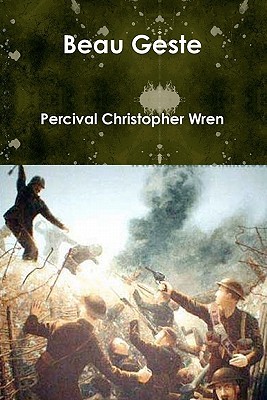
Beau Geste by P.C. Wren

Beau Geste When choosing what to read for Karen and Simon’s 1924 Club, I was pleased to find two unread books already on my shelf that were published in the required year: Precious Bane by Mary Webb and Beau Geste by Percival Christopher Wren. I do still want to read Precious Bane at some point (I’m curious to see what I think of it, having read some very mixed reviews), but I decided on Beau Geste instead as it sounded like a book I would be almost certain to enjoy.

Beau Geste is many things: an adventure novel set in North Africa; a tale of the French Foreign Legion; an Agatha Christie-style whodunnit. But if I was asked to describe it in one sentence, I would say that it’s a book for people who like puzzles.

It begins with a particularly fascinating and perplexing puzzle – the discovery by Major Henri de Beaujolais of a fort in the desert manned entirely by dead soldiers, their bodies strategically positioned around the walls and ramparts. Their commander is dead too, with a bayonet through his heart, a revolver in one hand and a letter in the other. Telling this story later to a friend, the Major is still trying to work out what could have happened at the fort and what the sequence of events could have been. His friend, however, is more interested in the contents of the letter in the dead officer’s hand: a letter which leads us to a second puzzle – the disappearance of a precious sapphire known as ‘the Blue Water’.

Before we can solve either of these two mysteries, we need to go back in time and meet the Geste brothers – Michael (nicknamed Beau because he is so good and honourable), his twin, Digby, and the youngest, John. The Gestes are orphans and live with their aunt, Lady Brandon, to whom the Blue Water belongs. All three brothers are present when the jewel disappears and all three decide to take the blame. One by one, they confess to the crime and run away to join the French Foreign Legion. Eventually they find themselves at the Fort of Zinderneuf in French North Africa, where Henri de Beaujolais stumbles upon the scenario described at the beginning of the book.

Most of the novel is narrated by John Geste and through his eyes we are given some fascinating insights into life in the Foreign Legion, where people from a mixture of backgrounds and nationalities live and work together. During their time in the Legion, John and his brothers form some lasting friendships but also witness treachery and betrayal as a group of their fellow soldiers begin to plan a mutiny. And this provides yet another puzzle, as John tries to decide who can and cannot be trusted, who knows about the mutiny and who does not.

This book was, obviously, published in 1924 and it does feel very dated now, particularly in its attitudes towards race and class (it’s definitely not what you could call politically correct). Many of the characters – for example, Hank and Buddy, two American cowboys who befriend the Geste brothers – feel like stereotypes or caricatures. It’s so much fun to read, though, that it’s easy enough to overlook any flaws; the only thing that did spoil the book slightly for me was a long section near the end which takes the story in a different direction – this didn’t really seem necessary and only delayed the resolution of the mystery.

1924-club I enjoyed Beau Geste as much as I expected to and was pleased to find that P.C. Wren wrote more books featuring some of the same characters. I’m looking forward to reading Beau Sabreur and Beau Ideal!

The Heart of Midlothian by Sir Walter Scott

The Heart of Midlothian In 2012 I read my first Walter Scott novel, Ivanhoe, and was surprised by how much I enjoyed it. Having found Scott less difficult to read than I’d expected, I decided to add another of his books to my Classics Club list and something drew me to this one – possibly memories of the Scottish football results being announced on the television on a Saturday afternoon (Heart of Midlothian is the name of an Edinburgh team).

The novel – which predates the football team, being published in 1818 – takes its title from the Old Tolbooth Prison in Edinburgh, which was in the heart of the county of Midlothian. Scott based his plot on two real historical events: the Porteous Riots of 1736 and the story of a young woman who walked all the way to London to obtain a royal pardon for her sister who had been wrongly charged with infanticide. In Scott’s version, the young woman’s name is Jeanie Deans and she lives on a dairy farm at St Leonard’s Crags with her father, Davie, a strict Cameronian (a Presbyterian faction).

Jeanie’s younger sister, Euphemia – known as Effie – is in the Tolbooth facing the death penalty, having been accused of giving birth in secret and murdering her newborn child. Jeanie is sure Effie is innocent, but with no witnesses to the pregnancy or the birth and no way to prove what happened to the baby, she is guilty in the eyes of the law. If Jeanie would only tell the court that she had known her sister was pregnant, Effie could be freed, but she is unwilling to tell a lie and instead she decides to go to London to ask Queen Caroline for a pardon. Armed with a letter of introduction to the Duke of Argyll and some money borrowed from an admirer, the Laird of Dumbiedikes, Jeanie sets off on foot to save her sister’s life.

The first half of the novel sets the scene, describing a riot that breaks out in Edinburgh during a protest over the hanging of two smugglers. When Captain John Porteous orders the city guard to fire into the crowd, causing the deaths of several people, he himself is imprisoned in the Tolbooth. The prison is then stormed by a mob and Porteous is lynched and killed. These events become entwined with Effie’s story and provide the historical backdrop for the novel. The second half of the book concentrates on Jeanie’s journey to London, which includes encounters with some characters we previously met in Scotland: George Robertson, the father of Effie’s child; and Meg Murdockson and her mentally ill daughter, Madge Wildfire, two women who could hold the key to the mystery of the missing baby.

Well, The Heart of Midlothian was not the relatively easy read that Ivanhoe was! I found it much more challenging, for several reasons. First, as the novel is set mainly in Scotland, the dialogue is written almost entirely in Scots. I wouldn’t normally have a problem with this, but added to the fact that the book was written in the early 1800s, it did slow down the pace of my reading quite a lot. I find that whenever a book uses a large amount of dialect – even one you’re familiar with – a little more effort is required to read it and that was definitely the case here. If you think you might struggle with the dialect, I would recommend choosing an edition of the book with a good glossary!

Also, unlike Ivanhoe, which is a medieval adventure story packed with sword fights, sieges, villainous knights and feuding noblemen, this is a very different type of novel. While Jeanie’s personal story was gripping, I have to admit I had very little interest in the long passages describing the religious situation in eighteenth century Scotland and the discussions between Jeanie’s father, Davie Deans, and his neighbours on their different moral beliefs. I also thought the plot relied too heavily on coincidence, with Jeanie meeting people from her own small community in Scotland hundreds of miles away in England – and I felt that the final few chapters of the book were unnecessary as the story had already reached a more natural ending point.

I did enjoy parts of The Heart of Midlothian, though. Jeanie is a strong heroine who behaves with honesty and integrity throughout the novel, and although some of her choices were frustrating, I did like her. There is a romantic interest for Jeanie too – the schoolmaster, Reuben Butler – but this only forms a small part of the story. I was also interested in the descriptions of eighteenth century life and the relationship between Scotland and England in the years following the union of 1707. And there are plenty of memorable scenes, from the storming of the Tolbooth near the beginning to Jeanie’s meeting with Queen Caroline, wife of George II, towards the end.

I certainly didn’t love this book the way I loved Ivanhoe, but I’ll still read more of Scott’s novels and will hope that the next one I pick up is more to my taste than this one was!

The Return of the Native by Thomas Hardy

The Return of the Native Egdon Heath, part of Hardy’s fictional Wessex, is a wild and haunting place, steeped in history and superstition. Many of the people who live and work there love the heath and appreciate its beauty, but there are some – including Eustacia Vye – who find the loneliness oppressive. Eustacia, who lives with her grandfather in an isolated cottage on the heath, is desperately looking for a way to escape and believes she has found it in Clym Yeobright.

Clym is the returning native of the title, home for Christmas from Paris where he has been working as a diamond merchant. Clym, who dislikes the diamond trade, is planning to stay at home and become a schoolmaster, but Eustacia sets her sights on marrying him in the hope that she can persuade him to take her back to Paris. After all, there is nothing to keep her on Egdon Heath now that her former lover, the innkeeper Damon Wildeve, has married Clym’s cousin, Thomasin.

Clym’s mother, Mrs Yeobright, is opposed to the idea of both marriages – her son’s with Eustacia and her niece’s with Wildeve – but although she reluctantly accepts Thomasin’s decision, a series of misunderstandings and disagreements damages her relationship with Clym and this will have tragic consequences.

I have mentioned five of the novel’s six main characters so far: the sixth is Diggory Venn, a reddleman (a seller of red ochre, which farmers use to mark their sheep). Diggory is in love with Thomasin and remains quietly devoted to her even after she marries Wildeve. The lives of these six people will draw closer together, with the actions of each one impacting on all of the others. For some, there will be a happy ending, but for others there will be only unhappiness and tragedy.

The Return of the Native was Thomas Hardy’s sixth published novel and first appeared as a serial in 1878. I’ve read almost half of his novels now and always enjoy my visits to Wessex and my glimpses of rural life in the 19th century. This book has a very memorable and atmospheric setting, with the heath itself being at the centre of the story. The way in which the lives of the characters are shaped by the heath is one of the driving forces of the plot, particularly as Clym and Eustacia have such different feelings about it:

Take all the varying hates felt by Eustacia Vye towards the heath, and translate them into loves, and you have the heart of Clym.

A common theme in Hardy’s novels is the progress of the industrial revolution and nostalgia for a way of life that, even in Hardy’s day, was rapidly disappearing. An example of this in The Return of the Native is the character of Diggory Venn, the reddleman, whose skin and clothes are stained with the red dye that he sells.

The traveller with the cart was a reddleman — a person whose vocation it was to supply farmers with redding for their sheep. He was one of a class rapidly becoming extinct in Wessex, filling at present in the rural world the place which, during the last century, the dodo occupied in the world of animals. He is a curious, interesting, and nearly perished link between obsolete forms of life and those which generally prevail.

We also meet some of the local people who live on Egdon Heath – many of whom work as furze (gorse) cutters. These characters provide some moments of comedy and also allow Hardy to explore some of the superstitions, customs and traditions of the region (one of the most memorable scenes occurs near the beginning of the book when dozens of bonfires are lit all around the heath).

As I mentioned above, not all of the characters in the novel are rewarded with a happy ending – but this is something you have to be prepared for with Hardy. The story does finish on a more positive note, although it was interesting to read the footnote at the end explaining that the ending was originally going to be slightly less positive and was changed during the serialisation of the novel.

I loved The Return of the Native, though not as much as some of the other Hardy novels I’ve read. I have one more to read on my Classics Club listThe Woodlanders – which I’m looking forward to reading.

The Odd Women by George Gissing

George Gissing - The Odd Women Published in 1893, George Gissing’s novel is based around the idea that there were at least half a million more women than men in Victorian England. As one of the characters in the story, Rhoda Nunn, explains:

“So many odd women – no making a pair with them. The pessimists call them useless, lost, futile lives. I, naturally – being one of them myself – take another view.”

Rhoda believes that it is possible for these ‘odd’ (that is, unmarried) women to lead lives that are both happy and useful. In partnership with her friend, Mary Barfoot, she runs an establishment in London where young middle-class women can learn typing and other secretarial skills that will enable them to earn a living if they remain single. Rhoda herself is now in her thirties and has no intention of marrying, but when Miss Barfoot’s cousin Everard comes to visit she is tempted to change her mind.

The Odd Women is also the story of Rhoda’s friends, the Madden sisters, faced with having to support themselves after the death of their father. With so few career choices available to them, the two elder sisters, Alice and Virginia, find work as a governess and a paid companion, while dreaming of opening their own school one day – a dream that is unlikely to ever become a reality. The youngest Madden girl, Monica, is working long hours in a draper’s shop and her future looks no brighter than her sisters’…until she receives a marriage proposal from Edmund Widdowson, a retired clerk much older than herself. Aware that this could be the only opportunity she gets, Monica jumps into marriage with a man she knows she doesn’t love.

When I first started to read The Odd Women, it seemed that Alice and Virginia were going to be the main focus of the novel, but that turned out not to be the case. Instead, the two elder Madden sisters quickly move into the background and we focus almost solely on the alternating storylines of Rhoda and Monica. Through the character of Rhoda, Gissing explores the views of a woman determined to resist marriage and make her own way in life, and through Monica he looks at the fate of a woman who chooses to marry simply because she is afraid of what her life will become if she stays single.

This is a fascinating novel and for a book written in the 1890s it feels very modern. With themes including feminism, marriage and the roles of women, it’s not the sort of book you would usually expect from a male Victorian author. It reminded me very much of Alas, Poor Lady by Rachel Ferguson. Both books show how women in Victorian/Edwardian society tended to be poorly prepared for an unexpected change in circumstances and how few options were open to them when they found themselves in need of employment.

I found this novel very readable, although the long discussions between Rhoda and Mary Barfoot did become a bit tedious at times and often felt more like lectures on feminism than believable conversations between two people (and I was disappointed that, while being so open-minded regarding unmarried middle-class women, they didn’t have the same sympathy for working-class women). Other than that, I enjoyed The Odd Women much more than I thought I would – although enjoyed is maybe not the right word to use, as this is really quite a bleak story. I would like to read more of George Gissing’s books, starting with New Grub Street, I think.

The Vicomte de Bragelonne by Alexandre Dumas

The Vicomte de Bragelonne This is the third Dumas novel to feature d’Artagnan and his three friends, Athos, Porthos and Aramis. Originally published in serial form as part of a much longer book, it is now usually split into three volumes of which The Vicomte de Bragelonne is the first and Louise de la Vallière and The Man in the Iron Mask are the others. As Dumas is one of my favourite authors I was fully expecting to love this book – and I did, although it was not quite as satisfying as the first two d’Artagnan novels – The Three Musketeers and Twenty Years After.

The first thing to say about The Vicomte de Bragelonne is that it is not really about the Vicomte de Bragelonne! He does appear near the beginning and again near the end, but his role in the story is not really any more significant than any number of other characters. The next thing I should say is that any reader hoping to find the four friends working together again in the spirit of “all for one and one for all” will be disappointed; we do see quite a lot of Athos, but Porthos and Aramis only come into the story very briefly towards the end.

So, what is this book about, then? Well, possibly because this is only one section of a longer work, it’s difficult to give a summary of the plot. The first half of the novel concentrates mainly on d’Artagnan and Athos who are working on two separate schemes both designed to restore Charles II to the throne of England. History tells us that the restoration would be accomplished – though not quite in the way described in this book, which is much more fun than what actually happened!

Later in the book we learn that Aramis and Porthos seem to be helping the Superintendent of Finances, Monsieur Fouquet, to build fortifications on the island of Belle-Île. We don’t find out exactly what they are up to, however, and this part of the story is left shrouded in mystery, presumably to be developed in the next two novels. Finally, there’s the storyline involving the title character, Raoul (the Vicomte), and his love for Louise de la Vallière.

The gaps between these three subplots are filled with lots of chapters detailing the political situation in France in the 1660s (particularly the death of Cardinal Mazarin and the rivalry between Fouquet and Louis XIV’s new Minister of Finance, Colbert) and the romantic intrigues of the French court (revolving around the King’s marriage and also his brother’s marriage to Charles II’s sister, Henrietta). All of this makes The Vicomte de Bragelonne a heavier, slower read than the previous two novels, but I didn’t find it boring at all – I love the way Dumas writes and I love French history, so I didn’t really mind the fact that there was less swashbuckling action and that we don’t see as much of d’Artagnan’s friends.

Of course, where history (or even geography) is concerned it can’t always be assumed that everything in a Dumas novel is completely accurate. I was amazed to find that in Dumas’ world the city of Newcastle had suddenly been transported from the River Tyne to the banks of the River Tweed sixty miles to the north! Dumas also tends to change dates or rearrange the sequence of events whenever the story calls for it as well, though I’m sure I wouldn’t have even noticed most of these alterations if I hadn’t been referring to the notes at the back of the book. I’m pleased to say, by the way, that the notes in the Oxford World’s Classics edition didn’t spoil any of the story – although I avoided the introduction just in case.

As The Vicomte de Bragelonne doesn’t stand alone as a complete novel and wasn’t originally intended to, there are a lot of things left unresolved at the end of the book, as you would expect. I’m looking forward to continuing the story soon with Louise de la Vallière!

Cousin Bette by Honoré de Balzac

Cousin Bette Balzac is an author I have wanted to try for years but have kept putting off, partly because I thought he sounded intimidating and difficult to read and partly because he wrote so many books it was hard to know where to start! Then, last month I chose ten books at random from my Goodreads “to-read” shelf – and one of them was Cousin Bette, a novel I couldn’t even remember adding to my shelf in the first place, but which sounded very appealing. I obviously couldn’t put off reading Balzac any longer!

Cousin Bette (originally La Cousine Bette and sometimes translated as Cousin Betty) was published in 1846 and is set in 19th century Paris. The title character is Lisbeth – Bette – Fischer, a relation of the Hulot family who has always been jealous of her beautiful cousin Adeline. Plain, poor, and having turned down several marriage proposals, Bette is still unmarried at the age of forty-two. When she rescues a young Polish sculptor, Wenceslas Steinbock, from a suicide attempt and takes him under her wing, she is pleased to be able to tell everyone that she has a lover at last. Her happiness is shattered, however, when Adeline’s daughter, Hortense, falls in love with Wenceslas and marries him herself.

Bette vows to take revenge on the Hulot family and joins forces with Valerie Marneffe, her pretty young neighbour. Knowing that Adeline’s husband, the Baron Hulot, is a notorious womaniser and that Valerie is looking for a rich lover, Bette sees a way to ruin the Baron and destroy the rest of the family in the process.

I enjoyed Cousin Bette and I think it was a good choice for my first Balzac novel. I found it surprisingly easy to read and very entertaining, although I did need to concentrate to follow all the intricacies of the plot. The summary I have given above is only the beginning of the story; Bette is by no means the only character who plots and schemes and tries to cause trouble – and in fact, many of the misfortunes that befall members of the Hulot family are caused by their own personal weaknesses and flaws rather than the influence of others. Baron Hulot, for example, despite being one of the targets of Bette and Valerie’s cruelty, really only has himself to blame as he is unable to resist the temptation placed in his way.

I saw the three main female characters – Cousin Bette, Valerie Marneffe and Adeline Hulot – as representing three stereotypical views of 19th century women of different classes and social groups. Bette is the bitter, jealous middle-aged spinster, Valerie the selfish, manipulative beauty, and Adeline the faithful, loving wife who turns a blind eye to her husband’s many affairs. Any reader who is interested in gender roles and the portrayal of women in literature will find a lot to think about in Cousin Bette.

Before reading this novel I had no idea what the outcome of the story would be and I was kept in suspense until the end. Of course, I’m not going to tell you how it ends, but it’s not quite as simple as the ‘good’ characters being rewarded and the ‘bad’ ones being punished. It’s all very melodramatic – and all very bleak as well – but I enjoyed it and am looking forward to reading more Balzac. As he wrote more than one hundred books, I would love to know if you’ve read any of them and which ones you would recommend.