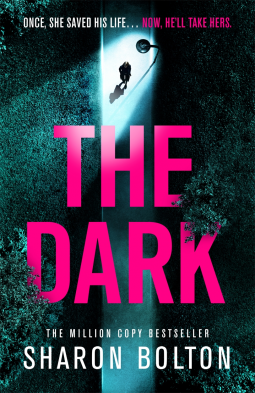
The Dark by Sharon Bolton

She’s back! After an eight year absence – during which time Sharon Bolton has written several excellent standalone crime novels – Lacey Flint has returned in possibly her darkest and most dangerous case yet. It’s the fifth book in the series and after such a long wait, I’m pleased to report that I think it’s as good, maybe even better, than the previous four.

In The Dark, Lacey is still working as a police constable for the Metropolitan Police Marine Unit, not yet ready to consider going back to her old role as a detective. When a baby is snatched from its parents and thrown into the River Thames, Lacey is there to prevent a tragedy, but the incident leaves the police and the public shocked and confused. Who would want to harm an innocent baby? They don’t have to wait long for an answer; it soon emerges that the attack was carried out by a newly formed terrorist group calling themselves MenMatter. The group believe that men’s rights are being pushed aside and that women’s freedoms need to be restricted so that ‘natural order’ can be restored. The abduction of the baby was just the first of several terrorist attacks aimed at gaining publicity for their cause.

As DCI Mark Joesbury and his team at the London Met race against time to discover who is behind MenMatter, on the streets of London tensions between men and women begin to grow. It seems the terrorists are succeeding at creating fear and division; nobody is safe, but with her heroics on the river Lacey appears to have made herself a particular target. As she and Joesburys’ team try to identify the leaders of the group, Lacey discovers that her own secrets are at risk of being exposed. Can she help bring the criminals to justice while also ensuring that Joesbury never learns the truth about her past?

The Dark has a very topical plot; I’m sure it must have been inspired by the debate surrounding the murder of Sarah Everard in the UK last year, when questions were raised over the safety of women on the streets, as well as other 21st century policing problems such as the use of the dark web to plan and launch terrorist attacks and the growing online community of ‘incels’ (involuntary celibates). The scenarios Bolton describes seem almost dystopian but also frighteningly believable and possible. However, she doesn’t try to paint all men as misogynistic or violent and fans of the series will be pleased to know that Mark Joesbury is as wonderful as ever!

As well as some heart-stopping dramatic sequences which really made me fear for some of the characters’ lives, the novel also has a mystery element, with the police trying to uncover the identity of the incel leader behind the attacks. I had my suspicions and was proved to be correct, but that didn’t take away any of the tension as I waited to see when Lacey and the others would come to the same conclusion! It was particularly fascinating to watch Georgie, one of Joesbury’s team, use her knowledge of psychology and language patterns to form theories about online identities.

Of course, one of the highlights of the Lacey Flint series is Lacey Flint herself! In this book, Lacey’s secretive nature makes her particularly vulnerable and leads her to make some decisions that at first seem stupid and reckless but are actually the result of her desperation to conceal the truth about her troubled past. I wonder if this really is the last book in the series this time; it has quite a satisfying ending but there are still plenty of loose ends that haven’t been tied up and I would love to read more. On the other hand, I also love Sharon Bolton’s standalones so will be very happy to read whatever she writes next!

If you’re new to this series, you might like to start with the first book – Now You See Me.

Thanks to Orion for providing a copy of this book for review via NetGalley.

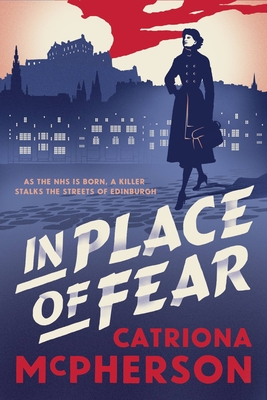
In Place of Fear by Catriona McPherson

Catriona McPherson is an author I’ve wanted to try for a while; I keep seeing her books on other blogs I follow and they always sound interesting. Her latest novel, In Place of Fear, turned out to be a good one for me to start with; it’s a fascinating historical mystery set in Edinburgh just after World War II.

It’s 1948 and Helen Crowther is about to start a new job as medical almoner for the newly formed National Health Service. Working alongside two doctors, Dr Deuchar and Dr Strasser, Helen will be making home visits to patients, giving them advice and ensuring that they get the help they need – a role similar to a modern-day social worker. She’s looking forward to the new job, but at the same time she knows there are going to be difficulties: first of all, she will have to convince the disbelieving public that healthcare under the new NHS really is free and they no longer need to worry about paying for their treatment; she also has to contend with the disapproval of her mother, who wishes she would get a job in a factory like other working class women. It comes as a relief when Dr Strasser offers Helen the upstairs flat in an empty building he owns, so that she and her husband, Sandy, can move out of her parents’ overcrowded house at last.

Helen’s marriage has not been a particularly happy one so far; Sandy has spent several years in a POW camp and since returning to Scotland has been struggling to cope with married life. Helen hopes the situation will improve now that they can be alone together, but just as she and Sandy are beginning to settle into their new home, she discovers the body of a young woman in the air raid shelter in the garden! The doctor is summoned and after examining the body he decides that it was suicide, but Helen is not convinced. Who is this young woman and how did she die? Helen is determined to find out, even though everyone else seems equally determined to cover up what has happened.

The mystery aspect of this novel takes a while to get started and never really becomes the main focus of the book until near the end when Helen begins to uncover some secrets that have remained hidden for several years. However, I thought it was a very intriguing mystery and although I had my suspicions as to who the culprit might be, I was unable to guess the other parts of the solution. Looking at other reviews of the book, it seems that a lot of readers were disappointed that the crime element wasn’t stronger but this didn’t really bother me as I was finding it so interesting to read about life in 1940s Edinburgh and the beginnings of the NHS. There’s also a heavy use of Scottish dialect which I suppose people will either like or they won’t, but I thought it added to the strong sense of time and place and I found it easy enough to follow what was being said.

A lot of time is spent on Helen’s visits to people in the community, particularly young mothers and those who are hoping to become mothers, so that she can advise them on diet and hygiene and make sure they are receiving the medical care they’re entitled to. I wasn’t familiar with the role of medical almoners before reading this book, so I found it fascinating to learn about what the job involved. Before 1948, the almoner would assess patients to decide how much they could afford to pay, but with the birth of a health service that was ‘free at the point of use’ this became unnecessary and the almoner could devote more time to actually helping the patients with their medical and welfare needs. However, Helen sometimes goes above and beyond what is required and sometimes she makes mistakes or is seen as interfering in things that are none of her business. It was watching her going about her daily work and trying to decide how to handle each difficult situation that I found particularly enjoyable, so it didn’t matter to me that the mystery was so slow to develop.

I would like to try more of Catriona McPherson’s books. If you’ve read any of them, please let me know which one I should read next!

Thanks to Hodder & Stoughton for providing a copy of this book for review via NetGalley.

This is book 24/50 read for the Historical Fiction Reading Challenge 2022.

In a Lonely Place by Dorothy B. Hughes

This is the book that was chosen for me to read in the recent Classics Club Spin – a result I was very pleased with, having loved two other novels by Dorothy B. Hughes, The Expendable Man and Ride the Pink Horse (two of my books of the year in 2020 and 2021 respectively).

Originally published in 1947, In a Lonely Place is set in Los Angeles just after World War II. Dix Steele, who had served as a fighter pilot in the Air Force, is staying in an apartment belonging to an old acquaintance, Mel Terriss, who has gone to Rio for a while. Like many young men who have returned from the war, Dix has been left damaged by his experiences and is taking advantage of the peace and quiet to finish writing his new crime novel. At least, that’s what he tells people. It is quickly made obvious to the reader that the writing is a cover for something else and that Dix is actually spending his time doing something very different.

Deciding to contact a wartime friend, Brub Nicolai, who also lives in LA, Dix is surprised to learn that Brub is now working as a police detective. Brub is delighted to renew their friendship, introducing Dix to his wife, Sylvia, and telling him about the case he is investigating – a series of stranglings that have been taking place across the city. Dix is envious of Brub’s close relationship with Sylvia, which serves as a constant reminder of his own sense of loneliness and isolation. When he meets Laurel Gray, a beautiful young actress who lives in his apartment building, it seems that he has a chance to form a new relationship of his own…if Laurel can avoid becoming the strangler’s next victim.

I had high hopes for this novel and it certainly didn’t disappoint! I’ve actually found it quite a difficult book to write about because I’m not sure what would be considered a spoiler and what wouldn’t. Having said that, there’s not really a lot of mystery involved; we know from very early in the book who the murderer is – the suspense is in waiting to find out how, if and when they will get caught. However, there are still a few surprises and some revelations that don’t come until later in the story. All three of the books I’ve read by Hughes have been so much more than just straightforward crime novels; she takes us right inside the minds of her characters and although they may be damaged, unhappy and not the most pleasant of people, she makes them feel believable and real, if not exactly sympathetic!

This book is wonderfully atmospheric – dark and tense and with the reader, like Dix, wondering who can be trusted and who knows more than they’re admitting to. It’s another great read and I’ll look forward to reading more by Dorothy B. Hughes.

This is book 28/50 read from my second Classics Club list

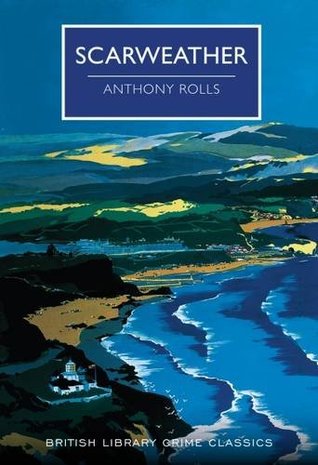
Scarweather by Anthony Rolls

I didn’t think I had anything suitable to read for Paula’s Reading Wales Month, then I discovered that Anthony Rolls (a pseudonym of Colwyn Edward Vulliamy) was a Welsh author born in Glasbury, Radnorshire in 1886. He wrote several crime novels under the Anthony Rolls name, two of which are available as British Library Crime Classics – and luckily I had one of them, Scarweather, on my TBR.

Originally published in 1934, Scarweather is narrated by John Farringdale, who is a young man of twenty-one when the story begins in 1913. Farringdale has always been close to his cousin Eric, so when Eric meets the famous archaeologist Professor Tolgen Reisby, he can’t wait to introduce Farringdale to him. Although Farringdale is proud to see his cousin on good terms with such a renowned and impressive man as the Professor, he feels uneasy about Eric’s obvious interest in Reisby’s young wife, Hilda. When an opportunity arises to visit the Reisbys himself at their home, Scarweather, in the north of England, he accepts the invitation and heads north, taking his friend, Frederick Ellingham, with him.

All appears to be well at Scarweather and Farringdale wonders whether he has been worrying unnecessarily, but Ellingham, being older and more perceptive than his friend, hints that the Professor may not be all he seems. And so when Eric disappears, believed to have been involved in a sailing accident, Ellingham decides to investigate. However, war soon breaks out in Europe, meaning that the investigation will take a lot longer than expected. We rejoin the characters fifteen years later, when it seems that the secrets of Scarweather are about to be revealed at last!

Scarweather is an unusual mystery novel, because there’s really no mystery at all. The solution is obvious to the reader from early on – in fact, Farringdale himself remarks once or twice that he supposes we’ve already guessed the truth. There are no clever twists, no real surprises and very little ‘detecting’. Ellingham and Farringdale are clearly a Holmes and Watson pairing, with Ellingham in the role of Holmes, but because we only see him through the eyes of Farringdale – who seems to be completely oblivious to everything that is going on – we don’t get a chance to watch any of his detective work or hear much about his theories until the very end of the book. And the ending, when it comes, seems very morally questionable.

Yet, despite all of this, I still think this book is worth reading, particularly if you’re more interested in archaeology than I am. Rolls’ writing really comes alive whenever he moves onto the subject of archaeologists and their work; this was obviously a passion of his and something he was very knowledgeable about. There’s also a strong sense of place: Scarweather is located in a remote coastal area and the harshness of the landscape and the sea makes the setting an atmospheric one. Even though knowing the solution to the mystery takes away all the suspense, there’s still a feeling of darkness and foreboding.

Although I didn’t love this book, I would be happy to read more by Anthony Rolls. The other book of his published as a British Library Crime Classic, Family Matters, sounds better than this one.

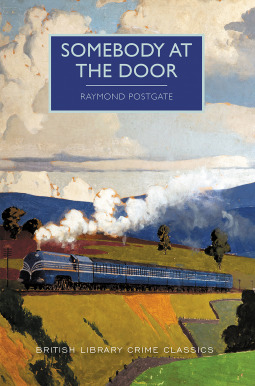
Somebody at the Door by Raymond Postgate

I loved Raymond Postgate’s Verdict of Twelve, but it has taken me a few years to get around to reading his other novel available as a British Library Crime Classic, Somebody at the Door. I wish I’d found time to read it sooner, as it’s another one I really enjoyed – with one or two reservations.

One evening in the winter of 1942, Councillor Henry Grayling travels home from London by train, bringing with him a large sum of money – the wages for the workers of the Barrow and Furness Chemistry and Drugs Company, which he is planning to distribute the next day. By the time he reaches his own front door, he has become seriously ill and dies later that night from what appears to be mustard gas poisoning. The money has disappeared, but was that the motive for his murder or could there be another reason? Suspicion falls on the other passengers who had shared his train carriage that evening and it is up to Inspector Holly to decide which of them did it and why.

This novel has a very similar structure to Verdict of Twelve. In that book, Postgate tells the stories of the twelve people who are serving on the jury for a murder trial, showing the effects of their backgrounds, experiences and prejudices on their decision-making. In Somebody at the Door, he explores the stories of the people on the train and how their paths had crossed with Grayling’s, giving them the motive and the opportunity to commit the crime. The book feels more like a collection of short stories than a conventional crime novel – although we do return briefly to Holly’s investigations now and then, the focus is much more on getting to know the personal history of each suspect rather than on watching the detective solve the mystery.

Some of the stories are very compelling in their own right, even if most of what we are told has very little relevance to the overall plot. I particularly liked the first one, about a young man who works for the Barrow and Furness Company and gets himself involved with a blackmailer, and the third one, which follows an attempt to help a refugee escape from Nazi Germany. The final story, however, about two people having an affair, didn’t interest me much at all – and unfortunately, this was one of the longest stories. This did spoil the book for me slightly, but after this final tale comes to an end we return to the Grayling murder again and things are wrapped up nicely.

I think what I liked best about this novel was the setting. Postgate writes about life in wartime Britain as only someone can who is actually living through it themselves (the book was published in 1943). Some of the characters’ stories are related directly to the war, such as the one about the refugee and another about a Corporal in the Home Guard, and the war is a constant presence in the novel as a whole, with references to bombing raids and the blackout.

I preferred Verdict of Twelve and would recommend starting with that one if you’re new to Raymond Postgate, but both books are entertaining and interesting reads as long as you don’t go into them expecting a traditional detective novel.

The Man in the Brown Suit by Agatha Christie

A new year means a new Agatha Christie reading challenge! After participating in all twelve monthly reads for Read Christie 2021, I’m not planning to do the same again this year – I do love Christie, but there are so many other authors I want to read too. However, I will still be dipping into Read Christie 2022 throughout the year whenever I’m tempted by the monthly theme. The topic for January is ‘A story inspired by Agatha’s travels’ and the suggested book is The Man in the Brown Suit, one that I hadn’t read before and that sounded quite appealing to me.

Published in 1924, this book is not part of the Poirot or Marple series, although it does feature another of Christie’s recurring characters, Colonel Race. Like They Came to Baghdad or The Secret Adversary, it’s more thriller than mystery; a murder does take place near the beginning, but this is only a starting point and not the main focus of the novel.

Most of the novel is narrated by Anne Beddingfield, the recently orphaned daughter of a famous archaeologist. Finding herself alone in the world, with a small inheritance to spend, Anne longs for an adventure to come her way so she can imitate the heroines of her favourite books and films. This wish becomes reality when she witnesses an accident in a London tube station and picks up a piece of paper dropped by the doctor who examines the victim. On this scrap of paper are some numbers and the words ‘Kilmorden Castle’; Anne is sure that these are clues and that she has found the adventure she’s been waiting for. When a woman is found dead the next day in the home of Sir Eustace Pedler, Member of Parliament, a man in a brown suit is suspected of the crime. Convinced that the two incidents are related, Anne deciphers the clues on the paper and boards a ship sailing to Cape Town, hoping to track down the brown-suited man.

Anne is a wonderful narrator and her intelligence, courage and quick wits mean that she is often – although not always – one step ahead of the villains. However, there’s also a second narrator and that is Sir Eustace Pedler. Sir Eustace’s narrative is interspersed with Anne’s and takes the form of a diary in which, in contrast with Anne, he describes his dislike of adventure, as well as his frustration with his annoying secretary Mr Pagett. The diary entries add a lot of humour to the story and I enjoyed hearing Sir Eustace’s voice now and then as a change from Anne’s.

Christie’s novels are always entertaining, but this is one I found particularly fun to read. Stolen diamonds, a revolution, travel through South Africa, a criminal mastermind known only as the ‘Colonel’…there’s such a lot happening and so many things to enjoy. The one aspect of the novel that I didn’t like was the romance between Anne and another character; I thought it seemed to come very suddenly out of nowhere and I was disappointed that Anne, being such a strong person in other respects, had the view that a woman should admire a man’s strength and prepare to be submissive.

Going back to the theme for this month’s read, this novel was inspired by a round-the-world trip taken by Agatha and her first husband Archie Christie in 1922. You can see the full list of categories for Read Christie 2022 at the bottom of the challenge page on the Agatha Christie website.

Ride the Pink Horse by Dorothy B Hughes

Ride the Pink Horse was the book chosen for me in the last Classics Club Spin and I have finished it just in time to write about it by the Spin deadline, which is this weekend. There were two reasons why I added this book to my Classics Club list in the first place. One was that I loved Dorothy B Hughes’ The Expendable Man and wanted to read more of her work; the other, I have to admit, was that I liked the title. Otherwise, I would probably never have picked this book up based on the description alone as it didn’t really sound like my usual sort of read. And that would have been a shame, as I thoroughly enjoyed it!

Ride the Pink Horse was published in 1946 and is set in Santa Fe during Fiesta, a festival commemorating the reconquest of New Mexico by the Spanish. The central character, known only as Sailor, was once ‘confidential secretary’ to Senator Willis Douglass (in reality, his job involved carrying out the corrupt senator’s dirty work for him) until the day the senator’s wife was murdered during what appeared to be an attempted robbery. Only Sailor and the Sen, as he calls him, know what really happened that day and Sailor is determined that if the Sen wants him to keep quiet then he will have to pay him for his silence. Sailor has followed the Sen to the Fiesta, planning to get as much money out of him as possible and then cross the border into Mexico to start a new life – but he hasn’t bargained for the appearance of McIntyre, a Chicago detective who is also on the senator’s trail in search of answers.

The first thing I should tell you about Ride the Pink Horse is that it’s not really a mystery, even though it’s currently being published as part of the Otto Penzler American Mystery Classics series. There’s a detective, but we don’t actually watch him doing any detecting because we see everything solely from Sailor’s perspective and Sailor already knows how the Sen’s wife was murdered. However, there’s still plenty of suspense as we are kept wondering whether Sailor will get what he wants from the Sen or whether he will drop his attempt at blackmail and tell McIntyre what he knows instead. The way in which the novel is written meant I honestly had no idea what would happen and which choices Sailor would make, so I found the ending both surprising and realistic.

The next thing I want to mention is the setting, which is wonderfully atmospheric. Santa Fe is not actually mentioned by name – Sailor, who is from Chicago, just refers to it as a ‘hick town’ – but it can be identified by the descriptions of the Fiesta and the festival traditions such as the burning of Zozobra, the wooden effigy of ‘Old Man Gloom’. Hughes creates an amazing sense of place and a feeling that, for Sailor, Fiesta is not a fun or exciting experience but a stifling, claustrophobic one – a trap from which there is no escape:

The whole town was a trap. He’d been trapped from the moment he stepped off the bus at the dirty station. Trapped by the unknown, by a foreign town and foreign tongues and the ways of alien men. Trapped by the evil these people had burned and the ash had entered into their flesh.

Sailor himself is not a very appealing or pleasant character, but as we learn more about his past – and his unhappy childhood, growing up in poverty with an alcoholic father – it becomes easier to have sympathy for him. One of his least attractive traits is his racism, so be warned that he uses offensive language to describe the Mexican and Native American people he meets during Fiesta. However, as he gradually befriends Pancho, a good-natured merry-go-round owner, and Pila, the young girl who rides the ‘pink horse’ of the title, there are signs that his attitude is beginning to change, as seen here in this conversation with McIntyre:

“…they don’t shove you around. They give you a smile. Even if you don’t talk their language they don’t shove you around. The way we shove them around when they come up to our town.”

“I know,” Mac said. “I’ve thought sort of along that line myself. We’re the strangers and they don’t treat us as strangers. They’re tolerant. Only they’re more than tolerant. Like you say, they’re friendly. They give you a smile not scorn.”

I loved this book and am so pleased it came up for me in the Classics Club Spin! I think The Expendable Man is still my favourite of the two, but I’m looking forward to reading more by Dorothy B Hughes; In a Lonely Place will probably be next.

This is book 25/50 read from my second Classics Club list