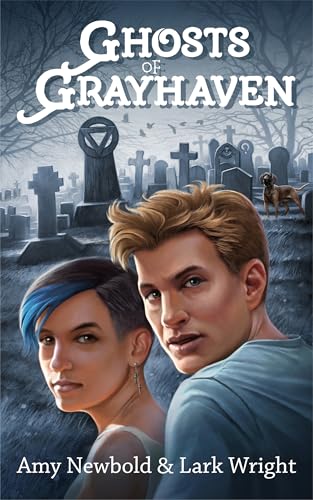
Ghosts of Grayhaven by Amy Newbold and Lark Wright

Some of you probably know Lark, who blogs at Lark Writes. She’s a blogger I’ve been following for many years so when she announced recently that she and her sister, Amy Newbold, had written and published a novella together I was interested in reading it.

The story begins with Mariah Moore arriving in the small town of Grayhaven in the Pacific Northwest with instructions from a client to complete a very unusual task. She has been asked to locate the burial place of Bartholomew Kane and perform a special ritual at his grave. Mariah has no idea why she needs to do this – it’s just a job to her and as long as she gets paid she doesn’t ask too many questions.

Zeb Raven has inherited the position of Keeper from his father. He’s responsible for protecting the graves in the cemetery – including the one that Mariah has been sent to find. When Mariah unknowingly releases a vengeful spirit from Bartholomew Kane’s grave, she and Zeb must work together to set the spirit to rest and rescue the people of Grayhaven from its evil.

Ghosts of Grayhaven is a supernatural story with a touch of romance. It could probably have been expanded into a longer book, but it’s also fine the way it is and I found it a quick, entertaining read. Mariah and Zeb are both engaging characters – I was particularly intrigued by Mariah’s job, doing unpleasant or dangerous tasks that her clients don’t want to do themselves, but Zeb’s work as the Keeper of the graves is also interesting. Cemeteries are always great settings, both for the spooky, ghostly atmosphere they can evoke and for what they can tell us about the history of a town and its families.

There’s also a third main character who joins Zeb and Mariah in their mission to save Grayhaven – Zeb’s dog, Moose, who plays a big part in the story. Lark has shared a picture on her blog of the Bavarian Mountain Scent Hound who inspired Moose. He was definitely my favourite character in the book! I think Amy and Lark can feel proud of what they’ve achieved with this novella and I hope they’ll be writing more.

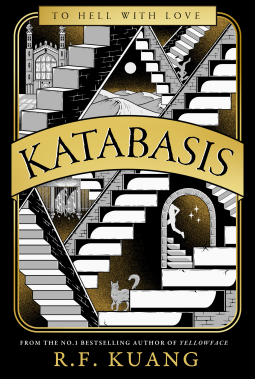
Katabasis by RF Kuang

Alice Law is an American PhD student who is studying Analytic Magick under the guidance of Professor Jacob Grimes at Cambridge University. Along with her equally brilliant rival, Peter Murdoch, Alice is considered the most gifted student in the department, but sometimes spells can still go wrong and she is horrified when Professor Grimes steps inside one of her pentagrams and is whisked away to hell. How will she finish her degree without Grimes to advise her? The only thing to do is to enter hell herself and bring him back.

A decision to go to hell is not something that should be taken lightly, particularly as the price of going and coming back again is half of a person’s remaining lifespan, but Alice feels she has no choice, especially as she was responsible for the disaster. However, she’s not at all pleased when Peter Murdoch insists on coming with her. She and Peter were once friends but their academic rivalry has driven them apart. Will they be able to work together to navigate their way through hell and rescue Professor Grimes?

RF Kuang is an author I keep seeing on other blogs I follow, but I’ve never tried one of her books myself until now. Whether this was the best one I could have started with I don’t know – the premise certainly sounded fascinating and there were plenty of things I enjoyed about the book, but overall it didn’t quite deliver for me. I think a big part of the problem is that I found Alice difficult to like; Peter was a more engaging character, but apart from some flashbacks to his early life, we don’t see much of the story through his eyes. Professor Grimes was even less sympathetic – the more I learned about him, the less I cared whether he was rescued or not and the weaker Alice’s motive for following him into hell became.

Hell is an unusual setting, although there have obviously been several classics set there, including Dante’s Inferno, which are referred to repeatedly throughout the book as Alice and Peter discuss the experiences of those who have visited the underworld before them. Kuang’s portrayal of hell draws on many different sources, including Dante with his circles based on various sins, and elements of Greek, Chinese and other mythologies. I particularly enjoyed reading about the Weaver Girl who presents Peter and Alice with a challenge to determine whether one, both or neither will cross the River Lethe, as well as their first encounters with Shades and creepy ‘bone-things’. I was a bit confused, though, because the entire underworld seems to be populated by students and magicians and as our protagonists wander through the ‘Eight Courts of Hell’, they find that one resembles a library and another a campus. Where did all the people from other walks of life go? Was there a separate hell for everyone else?

Katabasis (the title is from the Ancient Greek term for a descent into the underworld) falls firmly into the ‘dark academia’ subgenre as well as fantasy. As well as all the characters being academics and hell resembling a university, Alice and Peter also have lots of long, detailed discussions about algorithms, paradoxes and the science of magic. None of this interested me very much and I felt it slowed the story down, but I’m sure other readers will get more out of these sections than I did. One thing that did intrigue me was the time period in which the book is set. I assumed at first that it was a contemporary setting, but then came across lots of references to music, culture and scientific developments that seem to place the book in the late 1980s. It didn’t seem to have any actual relevance to the plot, so I’m curious to know why Kuang chose this particular period.

I’m pleased to have had the opportunity to try a book by Kuang at last, but based on this one I don’t think she’s an author for me.

Thanks to HarperVoyager for providing a copy of this book for review via NetGalley.
We’ll Prescribe You a Cat by Syou Ishida – #ReadingtheMeow2025

Translated by E. Madison Shimoda

Until now I seem to have avoided the current trend for Japanese novels with cute cat pictures on the cover. It wasn’t a deliberate decision to avoid them – that sort of book just doesn’t usually appeal to me. When I was looking for ideas for cat-related books to read for this year’s Reading the Meow, though, I thought this one sounded intriguing.

We’ll Prescribe You a Cat begins with Shuta Kagawa visiting the Nakagyō Kokoro Clinic for the Soul in Kyoto. Shuta’s unhappiness at work is causing him to suffer from stress and insomnia and he has decided to consult a psychiatrist. However, he quickly discovers that this is no ordinary clinic – first, it proves extremely difficult to find, hidden away down a narrow alleyway; then, instead of prescribing medication, Dr Nikké says something completely unexpected: “We’ll prescribe you a cat”. And with that, Shuta becomes the temporary owner of Bee, an eight-year-old female mixed breed – but will he manage to complete the course of ‘medication’ without any side effects and what will happen when it’s time to give the cat back?

Shuta’s story is the first of five that make up this novel, each one following a similar format with a character entering the Kokoro Clinic and, regardless of their symptoms, being prescribed a cat. The cat is a different one each time, each with his or her own personality and characteristics. Sometimes the cat is compatible with the client; sometimes it seems to cause more trouble and disruption, but in each case, when the prescription comes to an end, the person finds that their life will never be the same again.

Animal-assisted therapy is a legitimate form of therapy used by charities and mental health groups to treat a range of issues, allowing people to spend time with animals in a controlled environment. That’s what I had assumed this book would be about, so I was surprised to see Dr Nikké and his nurse, Chitose, simply handing the clients a cat in a carrier with some food and written instructions – no checks done to make sure the person had a suitable home for the cat, no questions asked about allergies or the needs of other family members. Then, at the end of the week or two week period, the cat is going to be handed back to the clinic and passed on to the next person. It seemed cruel and irresponsible. However, I quickly discovered that the book has a fantasy element – which grows stronger and more bizarre as it progresses – and I was probably taking things too seriously!

You may be wondering what the fantasy element is. Well, to begin with, the clinic itself is very unusual – sometimes it can be found and sometimes it can’t, depending on the person looking for it and how desperately they need to find it. There’s also something strange about Dr Nikké and Chitose, but I’m not going to say any more about that except that each of the five stories adds a little bit to our understanding of what is going on. Still, when I finished the book I felt that a lot of things were left unexplained or only partly answered. There’s a sequel, We’ll Prescribe You Another Cat, which will be available in English in September, but I’m not sure whether it will provide any more clarity or if it’s just another collection of similar stories. I don’t think I liked this one enough to want to read the sequel, but I did find it interesting and I enjoyed taking part in this year’s Reading the Meow with this book and Paul Gallico’s Jennie!

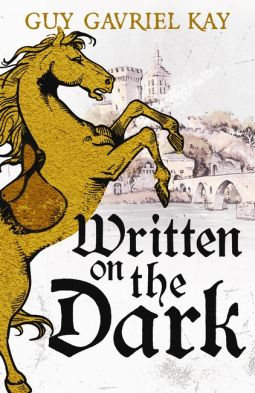
Written on the Dark by Guy Gavriel Kay

It seems to me that most moments in a life can be called interludes: following something, preceding something. Carrying us forward, with our needs and nature and desires, as we move through our time. It also seems to me that it is foolish to try to comprehend all that happens to us, let alone understand the world.

This is a beautiful historical fantasy novel loosely inspired by the life of the poet François Villon. It takes us to a world that will be familiar to Kay readers – a world with two moons, one blue and one white, where the three main religions are Asharite, Jaddite and Kindath, corresponding to Islam, Christianity and Judaism – but where his most recent novels have been set in thinly disguised versions of Venice, Dubrovnik and Constantinople, this one takes place in Ferrieres, based on medieval France.

On a freezing cold night in the city of Orane, the young poet Thierry Villar steps out of the tavern in which he’s been staying to find that he is surrounded by armed horsemen. He’s convinced that he’s going to be arrested – desperate for money, Thierry had become embroiled in a plot to rob a sanctuary – but to his surprise, he is escorted through the streets to where a man lies dead, brutally stabbed. This is the Duke de Montereau, one of the most powerful noblemen in Ferrieres and the younger brother of King Roch, who is struggling to rule due to mental illness. In return for not arresting Thierry, the provost of Orane asks him to help discover who murdered the Duke by listening to gossip in the city’s shops and taverns.

If you know your French history, you may have guessed that King Roch is based on King Charles VI, nicknamed ‘the Mad’ due to his episodes of mental instability and a belief that he was made of glass. Montereau, then, is a fictional version of the King’s brother, the Duke of Orléans, who was assassinated in 1407. Other people and incidents in the novel can also be connected to real characters and events from the Hundred Years’ War, which adds an extra layer of interest to the story if you’re familiar with this period of history. If not, it doesn’t matter at all since, as all the names have been changed, the book can also be read as a work of pure fiction.

Written on the Dark is a shorter novel than is usual for Kay and feels more tightly plotted than his other recent books, with a stronger focus on the main character and fewer diversions into the stories of minor characters. This probably explains why I thought this book was more enjoyable than the last two or three. Although I know nothing about the real François Villon so can’t say how his story may correspond with Thierry Villar’s, I found Thierry a likeable character; he has his flaws and sometimes makes mistakes, but this just makes him feel more relatable and human. An overarching theme of the book (and of Kay’s work in general) is the idea that even people who are considered ordinary or insignificant can play a key role in important events and influence not only their own fate but the fates of many others.

The fantasy aspect of the novel is limited mainly to the alternate version of France and to a mysterious character known as Gauvard Colle who can communicate with the ‘half-world’. There are also some surprising twists where things like the Battle of Agincourt and the story of Joan of Arc don’t go in quite the direction you would expect! I loved this one and am looking forward to reading his earlier book inspired by medieval France, A Song for Arbonne, which is one of a small number of Kay novels I haven’t read yet.

Thanks to Hodderscape for providing a copy of this book for review via NetGalley.
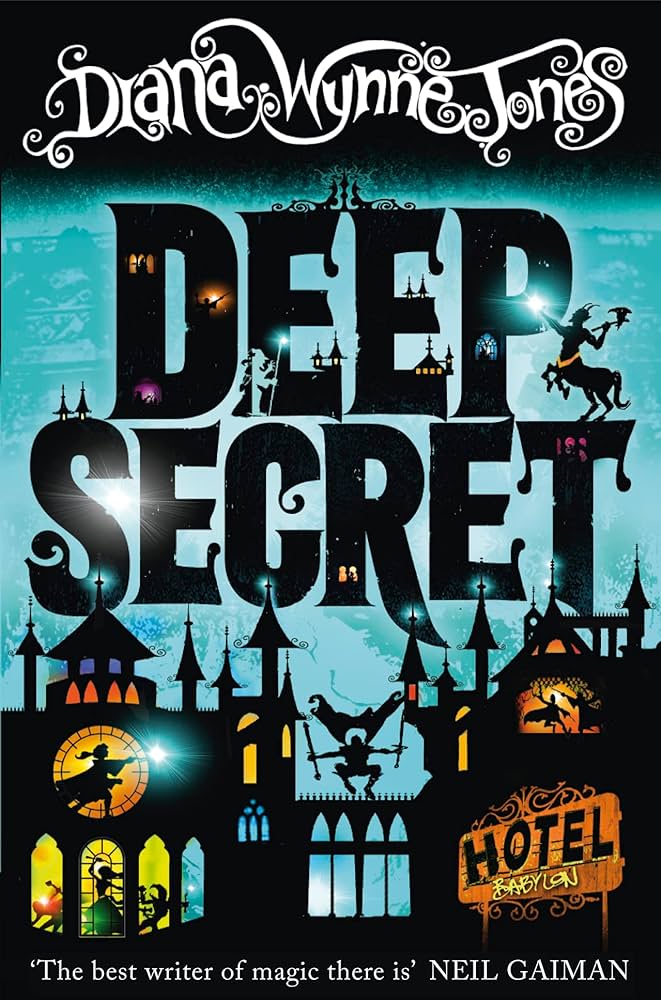
Deep Secret by Diana Wynne Jones – #MarchMagics2024

Diana Wynne Jones is not an author I’ve ever read or been particularly interested in reading – for some reason I’ve always just assumed I wouldn’t like her, although I should have learned by now not to make assumptions like that! #MarchMagics is a reading event hosted by Chris of Calmgrove to celebrate the work of both Diana Wynne Jones and Terry Pratchett, so I decided this would be a good opportunity to finally try one of her books. I chose Deep Secret, which is marketed as one of the few books she wrote for adults.

First published in 1997, Deep Secret is set in a multiverse shaped like infinity (a figure eight laid on its side) and made up of a collection of worlds which are either ‘Ayewards’, where magic is accepted and practiced, or ‘Naywards’, meaning they are more cynical towards magic. Early in the novel we learn that Earth is currently a Naywards planet and it’s the job of Rupert Venables to nudge it in an Ayewards direction. Rupert is a Magid, a powerful magician responsible for maintaining the balance of positive and negative magic in the multiverse and he is one of the novel’s two main narrators.

At the beginning of the novel, Rupert’s mentor Stan, an older Magid, is dying and on his deathbed gives Rupert the task of recruiting a replacement. Armed with a list of five new Magid candidates, located all over the globe, Rupert sets out to track them down and decide which has the most potential. Before he can make much progress, however, he is summoned to the Koryfonic Empire, a world which is situated across the twist in the middle of the infinity symbol, where another difficult mission awaits – the Emperor has been killed in an explosion, leaving no known heir. It’s believed that he does have several living children, but their identities and whereabouts are a mystery. Rupert must try to find them before the situation leads to the downfall of the Empire

A large part of the novel is set during a Fantasy and Science Fiction convention at a hotel, where Rupert manages to gather together all five of the Magid candidates. I’ve never been to one of these conventions myself, but I could tell Diana Wynne Jones was having fun describing the chaotic nature of the event, some of the colourful characters who attend it and the confusing, maze-like layout of the hotel (which becomes even more confusing when an evil presence begins weaving its spell). The world-building is very impressive, merging together the fantasy land of the Koryfonic Empire with its emperors and centaurs, the normality of daily life in Bristol, where a lot of the story takes place, and the craziness of the hotel, which is almost a whole separate world in itself.

One of the five possible new Magids on the list Rupert is given is Maree Mallory; it quickly becomes obvious from the way she is given so much more attention than the other four that she is likely to be the one Rupert recruits. Their relationship doesn’t get off to the best of starts and the way she is introduced into the story makes her difficult to like at first, but I warmed to her as the book went on and we started to see things from Maree’s perspective as well as Rupert’s. I also liked her relationship with her teenage cousin, Nick (who I think also narrates the companion novel to this one, The Merlin Conspiracy, which I haven’t read yet).

This is described as an adult book, maybe because there are a few references to sex, but I’m sure it would be suitable for young adults as well and the age of the protagonists (Maree and Rupert are in their twenties and Nick is fourteen) does make it feel as though it’s aimed at younger readers. As my first experience of reading Diana Wynne Jones, it was very enjoyable and I’m sure I’ll read more at some point.

The Fox Wife by Yangsze Choo

The famous scholar Ji Yun, who was obsessed with foxes, said: Humans and things are different species, and foxes lie between humans and things; darkness and light take different paths, and foxes lie in between darkness and light.

Like Yangsze Choo’s previous two novels, The Ghost Bride and The Night Tiger, The Fox Wife is a fascinating blend of history, fantasy and folklore. It takes as its premise the idea that fox spirits, who play a large role in Chinese and Japanese mythology, really exist and can take on the appearance of human beings.

Beginning in Manchuria in the winter of 1908, one thread of the novel follows Bao, an elderly private detective who has been called in to investigate the death of a young woman. The woman’s body was found frozen in the doorway of a restaurant and people are already starting to whisper that she was lured to her death by foxes. Ever since he visited a shrine to a fox god as a child, Bao has been blessed, or maybe cursed, with the ability to detect truth from lies. Now, he hopes he can use that gift to find out what happened to the woman found dead in the cold.

In chapters that alternate with Bao’s, we meet Snow, or Ah San, a white fox spirit who is searching for the man she blames for the death of her daughter two years earlier. Snow has taken the form of a human woman and joined the household of a Chinese medicine seller. In her position as maid, she is able to accompany the family on a trip to Japan where she hopes for an opportunity to take her revenge.

At first, the two threads of the novel are very separate; Bao’s story is written in the third person and focuses on his investigations, with some flashbacks to his childhood; Snow’s narrative is in first person, giving it a more intimate feel. Eventually, their paths begin to converge, producing some interesting plot twists and revelations. We also find that there’s not just one fox in this story, but who are the others and what is their relationship with Snow? It takes a long time for everything to unfold and for a while in the middle of the book I thought it was starting to drag, but the pace does pick up again towards the end.

My knowledge of Chinese folklore is sadly very limited, so I enjoyed learning more about the significance of fox spirits, their characteristics and powers, and some of the myths and folktales that have been told about them. With the novel being set partly in Japan as well as in China, we also see how similar myths and legends about foxes cross over into Japanese culture. It’s all very fascinating, and whenever my attention was starting to wane due to the slow, meandering plot, there would be another passage about foxes that would grab my interest again.

I had mixed feelings about The Fox Wife, then, but I’m pleased to have had the opportunity to learn something new! It’s definitely worth considering this one – and Yangsze Choo’s others – if you have any interest in Chinese myth.

Thanks to Quercus Books for providing a copy of this book for review via NetGalley.
Book 6/50 for the Historical Fiction Reading Challenge 2024

Throne of Jade by Naomi Novik

Throne of Jade is the second book in Naomi Novik’s Temeraire series set during an alternate version of the Napoleonic Wars where domesticated dragons are used for aerial warfare. It’s been a long time since I read the first book, Temeraire – in fact, I was shocked to discover that it’s been eight years! – but I found that I could pick up the story again without too much trouble and will try not to wait so long before starting the third one.

If you’re not a fan of fantasy and are put off by the mention of dragons, I can reassure you that the dragons are the only real fantasy element in these books (at least in the two that I’ve read) and they feel much closer to the seafaring historical novels of Patrick O’Brian than anything else. In Novik’s series, dragons have existed for centuries and by the time of the Napoleonic Wars in the early 19th century they have become an accepted part of the armed forces of many countries around the world. The dragons are intelligent creatures, capable of human speech, and form strong bonds with their human handlers.

In the first novel, we were introduced to Will Laurence, a former Royal Navy Captain who becomes the handler of Temeraire, a dragon who hatches from an egg found on a captured French ship. Having trained together for service in Britain’s Aerial Corps, Laurence and Temeraire develop a close friendship, but when it emerges that Temeraire is one of a rare breed – a Chinese Celestial – it seems that they may have to be separated. Celestials are supposed to be reserved for royalty and the Chinese had intended Temeraire to be a gift for Napoleon. As Throne of Jade opens, a group of envoys have arrived from China to recover their rare dragon. Due to Temeraire’s bond with Laurence, the envoys agree to allow Laurence to accompany them back to China with the dragon and the Navy provides a dragon transport vessel, HMS Allegiance, for the voyage.

In 1805, when the novel is set, it takes many months to sail from Britain to China. This means that most of the story takes place at sea on board the Allegiance, which gives the book a transitional feel with the sense that you’re always waiting for the destination to be reached so that the plot can finally pick up pace. That’s not to say that nothing happens during the journey, because it does – there are encounters with the enemy, storms and sickness, and several possible attempts on Laurence’s life – but I did feel that it was very drawn out and I was pleased when the ship eventually arrived on the shores of China.

As with the first book, the writing style and language are suitable for the setting, with none of that inappropriately modern dialogue that can pull you out of the time period. Although the addition of the dragons and the Aerial Corps obviously means that a large part of the story is fictional, real historical events are still playing out in the background. During the voyage, Laurence and his companions receive news of the French victory at the Battle of Austerlitz and the death of the Prime Minister, William Pitt the Younger.

The long period spent at sea does allow for more character development and for some interesting conversations between Laurence and Temeraire in which Laurence begins to see things from Temeraire’s point of view and to understand how much he has taken for granted regarding the feelings and sensibilities of dragons. He also starts to discover that the Chinese people treat their dragons very differently than the British – and once in China, these differences become more obvious and pronounced. Even if he’s allowed to, will Temeraire want to return to Britain with Laurence after experiencing another way of life? I won’t tell you what happens, although knowing that there are another seven books in the series after this one does take away a lot of the suspense in that respect. Black Powder War is next and I’m looking forward to reading it, hopefully not after another break of eight years!

This is book 13/20 of my 20 Books of Summer 2023

This is book 34/50 for the 2023 Historical Fiction Reading Challenge.