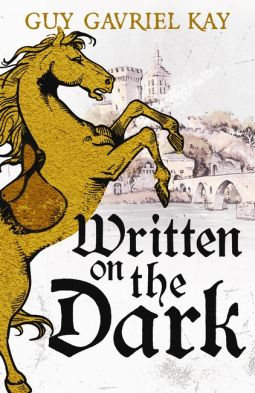
Written on the Dark by Guy Gavriel Kay

It seems to me that most moments in a life can be called interludes: following something, preceding something. Carrying us forward, with our needs and nature and desires, as we move through our time. It also seems to me that it is foolish to try to comprehend all that happens to us, let alone understand the world.

This is a beautiful historical fantasy novel loosely inspired by the life of the poet François Villon. It takes us to a world that will be familiar to Kay readers – a world with two moons, one blue and one white, where the three main religions are Asharite, Jaddite and Kindath, corresponding to Islam, Christianity and Judaism – but where his most recent novels have been set in thinly disguised versions of Venice, Dubrovnik and Constantinople, this one takes place in Ferrieres, based on medieval France.

On a freezing cold night in the city of Orane, the young poet Thierry Villar steps out of the tavern in which he’s been staying to find that he is surrounded by armed horsemen. He’s convinced that he’s going to be arrested – desperate for money, Thierry had become embroiled in a plot to rob a sanctuary – but to his surprise, he is escorted through the streets to where a man lies dead, brutally stabbed. This is the Duke de Montereau, one of the most powerful noblemen in Ferrieres and the younger brother of King Roch, who is struggling to rule due to mental illness. In return for not arresting Thierry, the provost of Orane asks him to help discover who murdered the Duke by listening to gossip in the city’s shops and taverns.

If you know your French history, you may have guessed that King Roch is based on King Charles VI, nicknamed ‘the Mad’ due to his episodes of mental instability and a belief that he was made of glass. Montereau, then, is a fictional version of the King’s brother, the Duke of Orléans, who was assassinated in 1407. Other people and incidents in the novel can also be connected to real characters and events from the Hundred Years’ War, which adds an extra layer of interest to the story if you’re familiar with this period of history. If not, it doesn’t matter at all since, as all the names have been changed, the book can also be read as a work of pure fiction.

Written on the Dark is a shorter novel than is usual for Kay and feels more tightly plotted than his other recent books, with a stronger focus on the main character and fewer diversions into the stories of minor characters. This probably explains why I thought this book was more enjoyable than the last two or three. Although I know nothing about the real François Villon so can’t say how his story may correspond with Thierry Villar’s, I found Thierry a likeable character; he has his flaws and sometimes makes mistakes, but this just makes him feel more relatable and human. An overarching theme of the book (and of Kay’s work in general) is the idea that even people who are considered ordinary or insignificant can play a key role in important events and influence not only their own fate but the fates of many others.

The fantasy aspect of the novel is limited mainly to the alternate version of France and to a mysterious character known as Gauvard Colle who can communicate with the ‘half-world’. There are also some surprising twists where things like the Battle of Agincourt and the story of Joan of Arc don’t go in quite the direction you would expect! I loved this one and am looking forward to reading his earlier book inspired by medieval France, A Song for Arbonne, which is one of a small number of Kay novels I haven’t read yet.

Thanks to Hodderscape for providing a copy of this book for review via NetGalley.

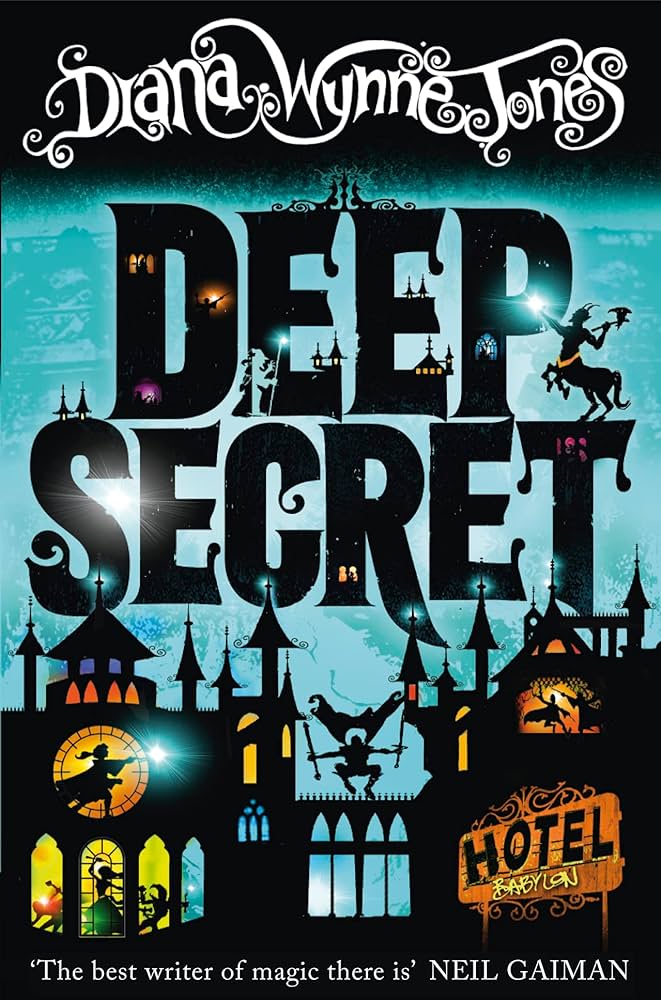
Deep Secret by Diana Wynne Jones – #MarchMagics2024

Diana Wynne Jones is not an author I’ve ever read or been particularly interested in reading – for some reason I’ve always just assumed I wouldn’t like her, although I should have learned by now not to make assumptions like that! #MarchMagics is a reading event hosted by Chris of Calmgrove to celebrate the work of both Diana Wynne Jones and Terry Pratchett, so I decided this would be a good opportunity to finally try one of her books. I chose Deep Secret, which is marketed as one of the few books she wrote for adults.

First published in 1997, Deep Secret is set in a multiverse shaped like infinity (a figure eight laid on its side) and made up of a collection of worlds which are either ‘Ayewards’, where magic is accepted and practiced, or ‘Naywards’, meaning they are more cynical towards magic. Early in the novel we learn that Earth is currently a Naywards planet and it’s the job of Rupert Venables to nudge it in an Ayewards direction. Rupert is a Magid, a powerful magician responsible for maintaining the balance of positive and negative magic in the multiverse and he is one of the novel’s two main narrators.

At the beginning of the novel, Rupert’s mentor Stan, an older Magid, is dying and on his deathbed gives Rupert the task of recruiting a replacement. Armed with a list of five new Magid candidates, located all over the globe, Rupert sets out to track them down and decide which has the most potential. Before he can make much progress, however, he is summoned to the Koryfonic Empire, a world which is situated across the twist in the middle of the infinity symbol, where another difficult mission awaits – the Emperor has been killed in an explosion, leaving no known heir. It’s believed that he does have several living children, but their identities and whereabouts are a mystery. Rupert must try to find them before the situation leads to the downfall of the Empire

A large part of the novel is set during a Fantasy and Science Fiction convention at a hotel, where Rupert manages to gather together all five of the Magid candidates. I’ve never been to one of these conventions myself, but I could tell Diana Wynne Jones was having fun describing the chaotic nature of the event, some of the colourful characters who attend it and the confusing, maze-like layout of the hotel (which becomes even more confusing when an evil presence begins weaving its spell). The world-building is very impressive, merging together the fantasy land of the Koryfonic Empire with its emperors and centaurs, the normality of daily life in Bristol, where a lot of the story takes place, and the craziness of the hotel, which is almost a whole separate world in itself.

One of the five possible new Magids on the list Rupert is given is Maree Mallory; it quickly becomes obvious from the way she is given so much more attention than the other four that she is likely to be the one Rupert recruits. Their relationship doesn’t get off to the best of starts and the way she is introduced into the story makes her difficult to like at first, but I warmed to her as the book went on and we started to see things from Maree’s perspective as well as Rupert’s. I also liked her relationship with her teenage cousin, Nick (who I think also narrates the companion novel to this one, The Merlin Conspiracy, which I haven’t read yet).

This is described as an adult book, maybe because there are a few references to sex, but I’m sure it would be suitable for young adults as well and the age of the protagonists (Maree and Rupert are in their twenties and Nick is fourteen) does make it feel as though it’s aimed at younger readers. As my first experience of reading Diana Wynne Jones, it was very enjoyable and I’m sure I’ll read more at some point.

The Fox Wife by Yangsze Choo

The famous scholar Ji Yun, who was obsessed with foxes, said: Humans and things are different species, and foxes lie between humans and things; darkness and light take different paths, and foxes lie in between darkness and light.

Like Yangsze Choo’s previous two novels, The Ghost Bride and The Night Tiger, The Fox Wife is a fascinating blend of history, fantasy and folklore. It takes as its premise the idea that fox spirits, who play a large role in Chinese and Japanese mythology, really exist and can take on the appearance of human beings.

Beginning in Manchuria in the winter of 1908, one thread of the novel follows Bao, an elderly private detective who has been called in to investigate the death of a young woman. The woman’s body was found frozen in the doorway of a restaurant and people are already starting to whisper that she was lured to her death by foxes. Ever since he visited a shrine to a fox god as a child, Bao has been blessed, or maybe cursed, with the ability to detect truth from lies. Now, he hopes he can use that gift to find out what happened to the woman found dead in the cold.

In chapters that alternate with Bao’s, we meet Snow, or Ah San, a white fox spirit who is searching for the man she blames for the death of her daughter two years earlier. Snow has taken the form of a human woman and joined the household of a Chinese medicine seller. In her position as maid, she is able to accompany the family on a trip to Japan where she hopes for an opportunity to take her revenge.

At first, the two threads of the novel are very separate; Bao’s story is written in the third person and focuses on his investigations, with some flashbacks to his childhood; Snow’s narrative is in first person, giving it a more intimate feel. Eventually, their paths begin to converge, producing some interesting plot twists and revelations. We also find that there’s not just one fox in this story, but who are the others and what is their relationship with Snow? It takes a long time for everything to unfold and for a while in the middle of the book I thought it was starting to drag, but the pace does pick up again towards the end.

My knowledge of Chinese folklore is sadly very limited, so I enjoyed learning more about the significance of fox spirits, their characteristics and powers, and some of the myths and folktales that have been told about them. With the novel being set partly in Japan as well as in China, we also see how similar myths and legends about foxes cross over into Japanese culture. It’s all very fascinating, and whenever my attention was starting to wane due to the slow, meandering plot, there would be another passage about foxes that would grab my interest again.

I had mixed feelings about The Fox Wife, then, but I’m pleased to have had the opportunity to learn something new! It’s definitely worth considering this one – and Yangsze Choo’s others – if you have any interest in Chinese myth.

Thanks to Quercus Books for providing a copy of this book for review via NetGalley.

Book 6/50 for the Historical Fiction Reading Challenge 2024

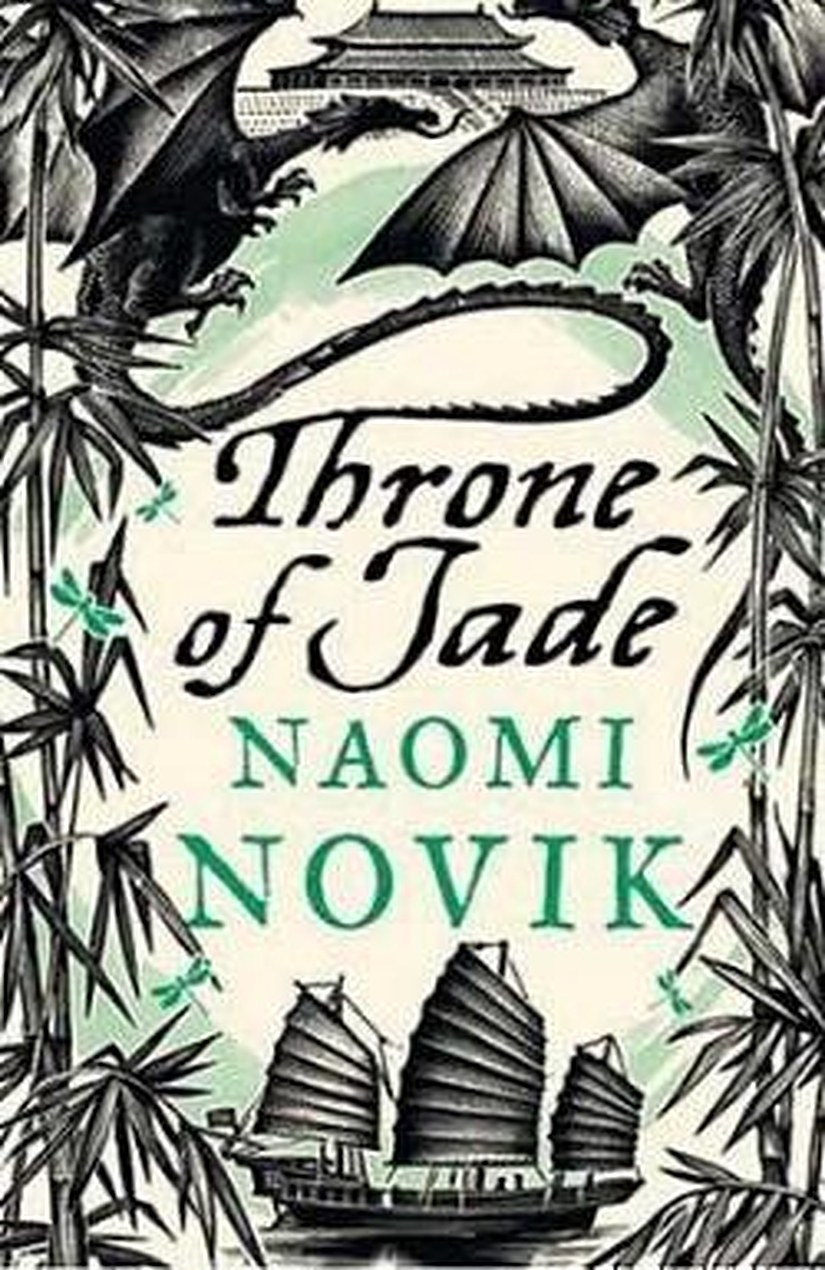
Throne of Jade by Naomi Novik

Throne of Jade is the second book in Naomi Novik’s Temeraire series set during an alternate version of the Napoleonic Wars where domesticated dragons are used for aerial warfare. It’s been a long time since I read the first book, Temeraire – in fact, I was shocked to discover that it’s been eight years! – but I found that I could pick up the story again without too much trouble and will try not to wait so long before starting the third one.

If you’re not a fan of fantasy and are put off by the mention of dragons, I can reassure you that the dragons are the only real fantasy element in these books (at least in the two that I’ve read) and they feel much closer to the seafaring historical novels of Patrick O’Brian than anything else. In Novik’s series, dragons have existed for centuries and by the time of the Napoleonic Wars in the early 19th century they have become an accepted part of the armed forces of many countries around the world. The dragons are intelligent creatures, capable of human speech, and form strong bonds with their human handlers.

In the first novel, we were introduced to Will Laurence, a former Royal Navy Captain who becomes the handler of Temeraire, a dragon who hatches from an egg found on a captured French ship. Having trained together for service in Britain’s Aerial Corps, Laurence and Temeraire develop a close friendship, but when it emerges that Temeraire is one of a rare breed – a Chinese Celestial – it seems that they may have to be separated. Celestials are supposed to be reserved for royalty and the Chinese had intended Temeraire to be a gift for Napoleon. As Throne of Jade opens, a group of envoys have arrived from China to recover their rare dragon. Due to Temeraire’s bond with Laurence, the envoys agree to allow Laurence to accompany them back to China with the dragon and the Navy provides a dragon transport vessel, HMS Allegiance, for the voyage.

In 1805, when the novel is set, it takes many months to sail from Britain to China. This means that most of the story takes place at sea on board the Allegiance, which gives the book a transitional feel with the sense that you’re always waiting for the destination to be reached so that the plot can finally pick up pace. That’s not to say that nothing happens during the journey, because it does – there are encounters with the enemy, storms and sickness, and several possible attempts on Laurence’s life – but I did feel that it was very drawn out and I was pleased when the ship eventually arrived on the shores of China.

As with the first book, the writing style and language are suitable for the setting, with none of that inappropriately modern dialogue that can pull you out of the time period. Although the addition of the dragons and the Aerial Corps obviously means that a large part of the story is fictional, real historical events are still playing out in the background. During the voyage, Laurence and his companions receive news of the French victory at the Battle of Austerlitz and the death of the Prime Minister, William Pitt the Younger.

The long period spent at sea does allow for more character development and for some interesting conversations between Laurence and Temeraire in which Laurence begins to see things from Temeraire’s point of view and to understand how much he has taken for granted regarding the feelings and sensibilities of dragons. He also starts to discover that the Chinese people treat their dragons very differently than the British – and once in China, these differences become more obvious and pronounced. Even if he’s allowed to, will Temeraire want to return to Britain with Laurence after experiencing another way of life? I won’t tell you what happens, although knowing that there are another seven books in the series after this one does take away a lot of the suspense in that respect. Black Powder War is next and I’m looking forward to reading it, hopefully not after another break of eight years!

This is book 13/20 of my 20 Books of Summer 2023

This is book 34/50 for the 2023 Historical Fiction Reading Challenge.

The Summer Tree by Guy Gavriel Kay

Having read most of Guy Gavriel Kay’s more recent novels, I decided it was time to go back to the beginning and read his earliest work, The Fionavar Tapestry, a fantasy trilogy published between 1984 and 1986. I had been warned that this was very different from his later books, and now that I’ve read the first volume, The Summer Tree, I would agree, but I was pleased to find that I enjoyed it anyway.

The Summer Tree begins with five Canadian students – Kevin Laine, Paul Schafer, Kimberly Ford, Jennifer Lowell and Dave Martyniuk – attending a lecture by Professor Lorenzo Marcus at Toronto University. After the lecture, the Professor invites the five of them back to his hotel, where he reveals to them that his true identity is Loren Silvercloak, a mage from the land of Fionavar. His High King, Ailell of Brennin, is celebrating his fiftieth year on the throne, and Loren has been sent to our world to bring five guests to the celebrations. Once in Fionavar, however, the five find themselves caught up in the politics of this other land and discover that each of them will have a part to play in the upcoming battle against the evil god Rakoth Maugrim, the Unraveller.

I was already familiar with Guy Gavriel Kay’s incredible worldbuilding from his other books – the way he plunges the reader straight into fully formed landscapes based on thinly disguised versions of real historical settings (such as China’s Song Dynasty in River of Stars or medieval Spain in The Lions of Al-Rassan). The worldbuilding is just as strong in this novel, but although he does draw on the mythology of our own world (particularly Celtic and Norse), this time he relies much more heavily on Tolkien and traditional high fantasy. That’s not surprising as Kay did work with Tolkien’s son Christopher on the editing of Tolkien’s posthumous book The Silmarillion. And so, in The Summer Tree we have Loren Silvercloak in the role of Gandalf the Grey, Rakoth Maugrim who resembles Sauron, an exiled Dwarf king, and the Elf-like lios alfar and their counterparts the svart alfar. There’s also a CS Lewis influence, I think, as there’s a character with the name Maugrim in the Narnia books and the Fionavar city of Paras Derval made me think of Narnia’s Cair Paravel.

With such a vast and complicated world to explore, Kay gives each of his five main characters individual storylines, taking them to different areas of Fionavar and allowing them to interact with different groups and tribes. For example, Dave Martyniuk becomes separated from the others early on and spends most of the novel getting to know the Dalrei, a plains-dwelling tribe of hunters, while Kim Ford discovers that she has the powers to become a Seer. However, I felt that some of the characters lacked depth and the novel as a whole feels less mature and polished than his later books.

I didn’t love The Summer Tree, but I liked it enough to want to continue with the second book in the series, The Wandering Fire – and as this one ended on a cliffhanger I probably shouldn’t wait too long before picking the next one up! I also still have A Song for Arbonne and The Sarantine Mosaic left to read, although at this point I’ll be surprised if anything surpasses Tigana as my favourite book by Kay.

This is book 4/20 of my 20 Books of Summer 2023

The Ghost Theatre by Mat Osman

The Ghost Theatre, Mat Osman’s second novel, is the story of two young people who meet on the rooftops of Elizabethan London. One of them is Shay, a teenage girl who dresses as a boy and belongs to a community of bird-worshippers. As the novel opens, Shay has released some caged birds from captivity in a shop and is being chased by the angry owner; with the instincts of a bird herself, she flees upwards to the roof and here she has her first encounter with Nonesuch. Taking his name from Henry VIII’s grand palace, Nonesuch claims to be the abducted son of a great lord, forced into performing at the Blackfriars Theatre, dressing as a woman to play leading female roles such as Cleopatra.

As Shay begins to fall in love with Nonesuch, she helps him to create the Ghost Theatre, a troupe of young actors who stage special plays in secret locations all over London. But it is another talent of Shay’s – her ability to tell fortunes – that brings her to the attention of Queen Elizabeth I and leads her into danger.

Mat Osman is the brother of the author and TV presenter Richard Osman and also the bassist in the British rock band Suede. I haven’t read his first novel, The Ruins, and had no idea what to expect from this one, but I can tell you it’s a very unusual book – not purely historical fiction but not quite fantasy either. It’s set in a city we can recognise as the London of the late Elizabethan period – there are outbreaks of plague, attempted rebellions, references to popular Elizabethan sports such as cock-fighting and bear-baiting – but there are also some imagined elements. As far as I know there was no community of Aviscultans living in Birdland and predicting the murmurations of starlings!

I have to be honest and say that this book wasn’t really for me. Perhaps because of the blend of alternate history with real history, it didn’t have the strong period feel I prefer – the dialogue was too modern, for example. I also found it quite difficult to focus on the plot; the imagery and descriptions were lovely but slightly distracting and sometimes I read several pages without really absorbing any of the words. If I had to compare this book to anything, it would be Megan Campisi’s The Sin Eater, another novel set in an alternate Elizabethan world and which I had some similar problems with. Incidentally, there is a sin eater in Osman’s novel too, although only mentioned in passing!

It would seem that Osman’s own love of music has influenced this story, with a lot of emphasis placed on the power of song, performing on stage and entertaining an audience. The novel as a whole is imaginative, creative, dreamlike and completely original. I wish I had been able to enjoy it more, but the right reader will love it.

Thanks to Bloomsbury Publishing for providing a copy of this book for review via NetGalley.
This is book 16/50 read for the 2023 Historical Fiction Reading Challenge.

Assassin’s Fate by Robin Hobb

It’s been almost nine years since I decided to read Assassin’s Apprentice, the first book in Robin Hobb’s sixteen-volume fantasy sequence following the adventures of FitzChivalry Farseer, his friend the Fool, and the people of Bingtown and the Rain Wilds. Not being a big reader of fantasy, I wasn’t sure what to expect, but I trusted the opinions of the fellow bloggers who had recommended it – and I loved it! I went on to read the other books in the individual trilogies and quartets that make up the sequence: the Farseer Trilogy, the Liveship Traders Trilogy, the Tawny Man Trilogy, the Rain Wild Chronicles and, finally, the Fitz and the Fool Trilogy. Assassin’s Fate is the final book in this final trilogy, bringing the entire series to a close.

Naturally, I can’t really discuss the last of sixteen books without spoiling certain aspects of the fifteen previous ones, so be warned! If you haven’t read any of these books yet, I strongly recommend starting at the beginning, with Assassin’s Apprentice – and I hope you’ll enjoy your journey through Robin Hobb’s world as much as I did. This particular novel, though, hasn’t become a favourite and even now, more than a week after I finished it I can’t really decide how I felt about it.

Assassin’s Fate picks up the story from the previous book, Fool’s Quest, with Fitz and his companions heading for the distant city of Clerres in pursuit of the people who have captured his young daughter, Bee. As well as Fitz, the party consists of the Fool, in his female guise of Amber, the trainee assassin Spark, Chade’s illegitimate son Lant, and the stableboy, Per. Fitz is convinced that Bee is dead and their mission is one of vengeance only, but Amber senses that she is still alive. Either way, now that they have embarked on their journey, they need to reach Clerres as quickly as possible and passage has been arranged on the liveship Paragon.

The story of Fitz’s journey alternates with chapters narrated by Bee as she describes her ordeal at the hands of her captors, led by the evil Dwalia. I’ve had mixed feelings about Bee throughout this trilogy – on the one hand, I like her as a character and I can see that her viewpoint allows us to witness things that Fitz does not and so fills in the gaps in the story; on the other, having spent the Farseer and Tawny Man trilogies solely inside Fitz’s head, I would have preferred to continue like that. I often find that I start to lose interest slightly when a long series or saga begins to move on to the next generation and the older characters I have grown to love start to take a back seat. In this book, the earlier Bee chapters felt drawn out and repetitive, although later on, when she and her captors arrived in Clerres, I found her story much more compelling.

A bigger problem for me was the amount of time spent on characters from the Liveship Traders and Rain Wilds novels. As this is the book that wraps up the whole sequence, it’s understandable that Hobb would want to give us a chance to say our farewells to the characters from those books as well as the Farseer ones, but I felt that they came to dominate the story too much. I was happy to see Paragon again and his captains Althea and Brashen, but I had no interest in their son Boy-O or in Kennitson of the Pirate Isles. Instead, I would have preferred more interactions between Fitz and the Fool (not Amber, as I shared Fitz’s dislike of her), more communication with Verity, which was hinted at in the previous book but not followed through, and while we were saying our goodbyes to various characters, I would have liked a better send-off for Chade.

I probably sound as though I didn’t enjoy this book much at all, but that’s not true! I did find plenty of things to like, such as the dramatic scenes within the walls of Clerres, the roles of Nighteyes and Motley the crow, and the final few chapters which, despite not being quite the ending to Fitz’s story I would have chosen, still made me cry. I’m just slightly disappointed that so much of this final novel was devoted to characters and storylines I didn’t feel very invested in. I’m sure people who loved the Liveship and Rain Wilds books more than I did will feel much more satisfied with it.

I’m not sure whether any of Robin Hobb’s other books appeal to me (she has also written as Megan Lindholm) but I’m pleased to have read these ones as overall, apart from a few that have been less successful, I’ve thoroughly enjoyed them.