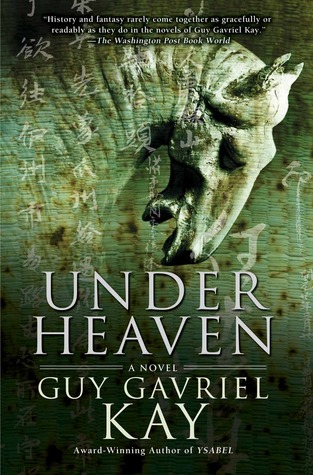
Under Heaven by Guy Gavriel Kay

I am looking forward to reading Guy Gavriel Kay’s new novel, A Brightness Long Ago, which will be published in May, but before starting that one I wanted to finally read a different book by Kay which has been on my shelf unread for a few years now. That book is Under Heaven, the first of two novels (the second is River of Stars) inspired by two different Chinese dynasties, Tang and Song.

Kay writes a type of historical fantasy where the emphasis is usually more on the historical than the fantasy. With most of his novels, I at least have a little bit of familiarity with the period on which his setting is based (Renaissance Italy, medieval Spain, the Vikings etc) but the setting of Under Heaven – a fictionalised Tang China – is one I’ve never read about before and of which I have absolutely no knowledge. That made this particular book a slightly more challenging read for me than the others I’ve read by Kay, but it has also left me wanting to know more about the real history of China during this period.

In the book, China is referred to as Kitai, with Tagur (Tibet) to the west. The novel opens with Shen Tai travelling to the battle site of Kuala Nor, where his father, an army general, once led the Kitan to victory against the enemy Taguran. Now his father is dead and Tai plans to spend the two year mourning period laying to rest the bones of the forty thousand dead, both Kitan and Taguran. It seems an impossible task, but Tai is determined to try anyway:

There were too many. It was beyond hope to ever finish this: it was a task for gods descending from the nine heavens, not for one man. But if you couldn’t do everything, did that mean you did nothing?

To acknowledge his efforts, the Empress of Tagur, once a Kitan princess, promises him two hundred and fifty magnificent Sardian horses as a reward – but Tai is not as delighted as you might expect him to be at receiving such a lavish gift. As he knows, ‘You gave a man one of the Sardian horses to reward him greatly. You gave him four or five of those glories to exalt him above his fellows, propel him towards rank – and earn him the jealousy, possibly mortal, of those who rode the smaller horses of the steppes.’ Imagine the danger a man could be in who possesses not just four or five but two hundred and fifty of these legendary animals! This is a life-changing moment for Tai and on his return journey to the imperial capital of Xinan he finds that he has become the centre of attention, with various factions at court all vying to take possession of the horses for themselves. These include An Li, a powerful military leader; Wen Zhou, the Prime Minister; and Wen Jian, the ‘Precious Consort’ of the elderly Emperor Taizu.

In a parallel storyline, Tai’s sister Li-Mei is being sent north beyond the Long Wall to Bogü (possibly Mongolia) where she is to marry the son of the Bogü leader. Marriage to a barbarian is not what Li-Mei had in mind for herself, but a chance to escape this fate comes when she is rescued by the mysterious Meshag, who takes her across the steppes on a journey as eventful and dangerous as Tai’s.

Kay’s female characters are always strong and interesting and I enjoyed following Li-Mei’s story as much as Tai’s. I’ve already mentioned Wen Jian, the emperor’s consort, who is a match for any of the men when it comes to manoeuvring her way through court politics, but my favourite of the women in the novel is Wei Song, the Kanlin warrior who is sent to protect Tai and takes her duties very seriously, even if it means putting her own life at risk. Of the male characters, apart from Tai himself, I particularly liked Bytsan sri Nespo, his Taguran friend who brings him the message about the Sardian horses, and Sima Zian, the famous poet who accompanies him to Xinan and becomes one of the few men he can trust.

Poetry runs through the novel, as does superstition, myth, legend and political intrigue – but there are only one or two small elements that you could really describe as fantasy (mainly at the beginning, with the ghosts of Kuala Nor – ‘outside in all seasons, moonlit nights and dark, as soon as the sun went down’). Most of the other Guy Gavriel Kay novels I’ve read are set in a world with one white moon and one blue, but the world of Under Heaven has only one (he makes a point of telling us that the poet Sima Zian has often dreamed of having another moon to write about). I’m curious to know why he decided to set this one in a different world to the others, especially as we were back to the two moons again in his most recent book, Children of Earth and Sky.

I will have to find out more about the Tang Dynasty and the An Shi Rebellion, but I’m also looking forward to reading River of Stars which is set four hundred years later, during the Song Dynasty. First, though, on to A Brightness Long Ago!

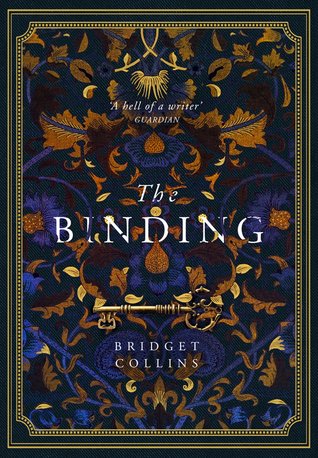
The Binding by Bridget Collins

With its attractive cover and intriguing premise, I hoped for great things from The Binding, but sadly it was not to be. I could tell almost from the beginning that it was probably not the right book for me, but I continued anyway, hoping it would get better – and it did. For a while in the middle I found myself enjoying it…but by the time I reached the end my feelings had turned to disappointment again and I wished I had followed my first instincts and stopped reading early on. For the right reader, though, I think this will probably be the great read it promised to be, so don’t let me put you off if you like the sound of the book!

The Binding is set in an unspecified time period, but there were clues that pointed to the late 19th century. Most of the action takes place in and around Castleford, a town in West Yorkshire, but it really could be anywhere. I’m sure the vagueness is deliberate because, as you’ll see, the world of The Binding is not quite the same as our own.

The novel begins with young Emmett Farmer receiving a summons to take up an apprenticeship as a bookbinder. He is reluctant to go – because he doesn’t want to leave his parents, his sister and the family farm, and also because he has always been told that books are dangerous and should be avoided – but it seems he is to be given no choice in the matter. Arriving at Seredith’s isolated bindery in the countryside, he learns from her the art of producing beautiful leather-bound books. But the real skill is involved in creating the contents…

Binders have a talent for drawing out unhappy or painful memories from people’s minds and trapping them between the covers of a book. With their memory wiped clean that person can then move on with the rest of their life, while the secrets of their past remain locked away in a vault. It’s a fascinating ability, but one which is open to abuse. What if one of these books falls into the wrong hands? What if someone is forced to have their memories bound because someone else wants them to forget? It’s a fascinating concept and the novel explores many of the equally fascinating issues that arise from it.

The book was divided into three sections and I think this structure caused some of the problems. In the first third of the book, we learned very little about Emmett even though he was our narrator and protagonist. His background was not really described in any detail, his relationships with his family and then with Seredith didn’t feel fully developed and I couldn’t even have told you what sort of personality he had. When the middle section of the story began to unfold, I understood why so much had been concealed from us and I was pleased to finally begin learning more about Emmett and the other characters – but by that time it was too late for me to feel the connection to them that I would have liked to have felt from the beginning.

I also think I’d had the wrong expectations for this book. I thought there would be a stronger fantasy element and that the concept of binding would play a bigger part in the story than it actually did. Instead, I couldn’t help feeling that the binding was only really there to provide a sort of framework for a romance between Emmett and another character. It’s disappointing because I think there was a lot of potential here and a lot of other intriguing ways that the binding idea could have been used. I’m sure there will be other readers who love this book, particularly those who enjoy young adult romances, but it just wasn’t quite right for me.

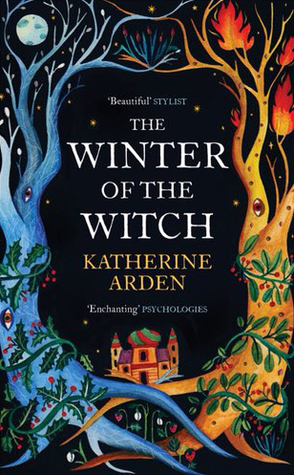
The Winter of the Witch by Katherine Arden

The Winter of the Witch is a wonderful, magical read and the perfect conclusion to Katherine Arden’s Winternight trilogy which combines Russian fairy tales, history and folklore with an atmospheric and wintry medieval setting. I loved the previous two books, The Bear and the Nightingale and The Girl in the Tower, so I went into this one with high hopes and high expectations – and I’m happy to say that I thought it was the best of the three. You may be wondering whether it’s necessary to read the books in order; my answer would be yes, as I think you will definitely get more out of the story if you start at the beginning.

As the novel opens, Moscow is on fire and blame has fallen on Vasilisa Petrovna. With a furious mob calling for her to be burned as a witch, Vasya manages to escape with the help of the magical beings only she and one or two others can see. However, her freedom comes at a cost and, as part of the bargain, an evil spirit is unleashed into the world once more. This could have serious implications for Vasya’s cousin, Grand Prince Dmitrii Ivanovich, who is already facing the threat of the Tatar commander Mamai and his Golden Horde. As the Tatars advance into the land of Rus’, Vasya must enlist the help of the chyerti – her demon friends and enemies – in a final attempt to save her family, her country and its people.

Like the first two books, The Winter of the Witch is steeped in Russian mythology and fairy tale. In this book we are reacquainted with characters who appeared earlier in the trilogy and we meet another selection of fascinating beings from Russian myths too. These include the upyr (monstrous vampire-like creatures) and the famous Baba Yaga. Of the other new characters, I was particularly fond of Ded Grib – but will leave you to discover more about him for yourself when you read the book! Vasya also follows a magical pathway through the enchanted realm of Midnight, a journey which provides some of the most thrilling moments in the book. My favourite of the novel’s many threads, though, involves Vasya’s romance with a certain frost demon called Morozko…

The reason I find the relationship between Vasya and Morozko so compelling is precisely because it’s completely unconventional. Morozko is not human and doesn’t always react or behave like a human; to him, Vasya’s actions sometimes seem illogical and difficult to understand – yet they love each other for who they are, and each accepts whatever the other is willing and able to give.

Another aspect of the book (of all three books, actually) that I like is the theme of conflict between old and new as the ancient beliefs and traditions are swept aside by the spread of Christianity. We have seen from the beginning of the trilogy how the power of the chyerti is fading as the people forget the old ways, turning away from their household spirits such as the domovoi and turning instead to men like Konstantin, the Christian priest with whom it is safe to say Vasya has never seen eye to eye. Vasya’s task in this novel is to persuade everyone – chyerti and human, Christian and pagan – to work together to defend Rus’. It will all come to a head at Kulikovo on the Don River, as the opposing armies prepare for a battle which will prove whether or not our heroine has been successful…

This really is a great end to the trilogy; the beautiful, powerful writing took me through a whole range of emotions and I had tears in my eyes at the loss of a favourite character early in the book. I also love the fact that, despite all the fantasy elements, so much of the story has its foundations in Russian history. I’m sorry to have to leave Vasya and her friends behind, but I will look forward to whatever Katherine Arden writes next.

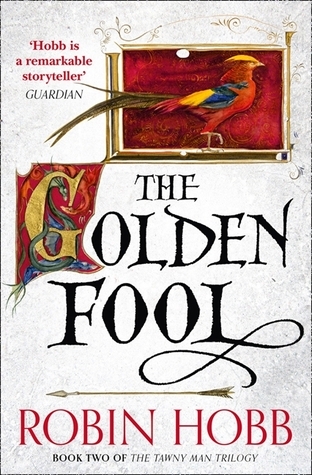
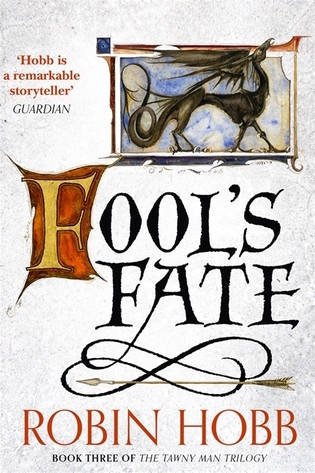
Thoughts on finishing The Tawny Man Trilogy (The Golden Fool and Fool’s Fate)

After reading Fool’s Errand a few months ago, I knew I didn’t want to wait too long before reading the other two books in Robin Hobb’s Tawny Man Trilogy; on the other hand, I didn’t want to read them too quickly because then it would all be over and I wouldn’t have them to look forward to anymore (I’m sure I’m not the only one who feels that way about long-anticipated books). Once I started reading The Golden Fool, though, I had to keep going until I’d reached the end of the trilogy. I cared too deeply about the characters to abandon them while I read other books.

Before I go any further, I will give my usual advice that if you are new to Robin Hobb, the place to start is the Farseer Trilogy, which begins with Assassin’s Apprentice. After that, you should read The Liveship Traders Trilogy – it’s not completely necessary but I strongly recommend it as it will give you a better understanding of the world Hobb has created – and then move on to Fool’s Errand. If you have not yet read all of those books, you will come across spoilers for them in the rest of this post (it would be impossible for me to avoid them).

First, The Golden Fool. As the middle book in the trilogy, this one is neither as tightly plotted as the first nor as epic as the third. Its main function seems to be to tie up some of the storylines begun in the first book (such as Laudwine and the Piebalds), while setting the scene for the quest that will form the basis of the final book. The foundations of this quest are laid during negotiations for Prince Dutiful’s betrothal to an Outislander princess, the Narcheska Elliania. Dutiful’s mother, Queen Kettricken, intends this marriage to form a lasting alliance between the Six Duchies and the Outislands, but it seems that things aren’t going to go quite as smoothly as she’d hoped. Before the Narcheska will agree to marry the prince, she insists that he will have to prove himself worthy…by bringing her the head of the black dragon Icefyre, who lies in a glacier on a distant ice-covered island.

To help Dutiful prepare for his mission, Fitz – still posing as Tom Badgerlock, servant to the nobleman Lord Golden (the Fool) – reluctantly agrees to take on the role of Skillmaster, tutoring the prince in the Farseer magic known as the Skill. The importance of creating a coterie for Dutiful – a circle of those gifted in the Skill who will offer support and strength to the prince – is clear, but at present Fitz has other things on his mind. His adopted son, Hap, is in love with a girl from Buckkeep Town whose parents strongly disapprove of the match, and Hap risks losing his apprenticeship as a result. Meanwhile, his daughter Nettle, with whom he is linked through the Skill, is being visited in her dreams by a blue dragon; Kettricken and Chade want her brought to the safety of Buckkeep Castle and raised as befits a Farseer heir, but Fitz disagrees…

Worst of all, the friendship between Fitz and the Fool, which has endured for so many years, comes under threat when a delegation from Bingtown arrives. Among them is a certain woman called Jek, who will be remembered by readers of the Liveship Traders, and who seems to be under a misapprehension about the Fool. And this is one of several points in the novel where I was glad I had resisted the temptation to go straight from the Farseer Trilogy to the Tawny Man – this particular scene would have made far less sense otherwise. Even with my understanding of what it was all about, I found this a difficult and uncomfortable scene to read – it’s never nice to see people who care so much about each other hurting each other so badly.

Fool’s Fate picks up the story in the middle of the preparations for Dutiful’s journey to the Outislands where he must hunt down and behead the dragon Icefyre. Along with his old mentor Chade, and the difficult but strongly-Skilled Thick, Fitz is accompanying the prince on his voyage but insists that the Fool, who has predicted his own death on the icy island of Aslevjal, must stay behind. Can the future really be changed as easily as that – or will fate refuse to be defied?

This is the book where the significance of everything we’ve learned in the previous eight novels regarding dragons, Elderlings, White Prophets and Catalysts finally starts to become clear and I found the ‘quest’ element of the novel more compelling than the one in the final Farseer novel, Assassin’s Quest – although, having said that, there are some direct links between the two and, remembering that earlier quest, I enjoyed the brief glimpses we are given of Girl on a Dragon and Verity as Dragon! This is such a visual book too; some of the scenes involving Icefyre, the glaciers of Aslevjal and the Elderling ruins beneath the ice are described so vividly, I almost felt as though I was watching them unfold on film. We also see both the Skill and the Wit being used in new and fascinating ways.

As the final book in the Tawny Man Trilogy and, until the publication of the Fitz and the Fool Trilogy in 2014 (which I still have to look forward to), the final book about Fitz, there are a lot of loose ends to tie up and a lot of ongoing storylines to be resolved. I think whether or not you will be satisfied with these resolutions will depend on how you feel about the characters concerned. Although one of Fitz’s relationships is given a happy ending, it comes at the expense of at least two others – and because I had felt much more closely engaged with the latter two characters than with the former, I found it a very bittersweet conclusion to Fitz’s story.

As usual, coming to the end of one of Robin Hobb’s trilogies has left me feeling bereft. I’m planning to start her Rain Wild Chronicles soon, but I’m wondering where the novella The Wilful Princess and the Piebald Prince fits in and whether I should maybe read that first.

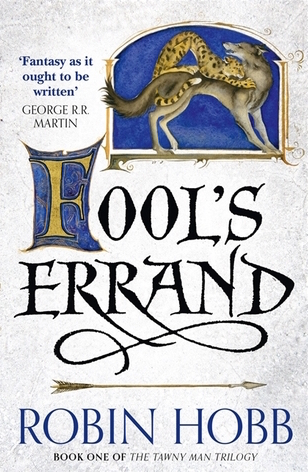
Fool’s Errand by Robin Hobb

As regular readers of my blog will know, it’s not very often that I read fantasy, yet Robin Hobb’s books have been some of my favourite reads of the last few years. In 2014 I discovered the Farseer Trilogy and then, last year, I moved on to her second trilogy, the Liveship Traders – set in the same world, the Realm of the Elderlings, but in a different part of that world and with different characters and storylines. Fool’s Errand is the first book in yet another trilogy – The Tawny Man – which leaves the liveships behind and returns to the story of FitzChivalry Farseer.

If you haven’t read the Farseer trilogy yet, you really need to do so before starting Fool’s Errand. It’s important to understand Fitz’s background, his relationships with other characters, and the magic and history of the world he inhabits, otherwise I think you’ll be very confused!

Anyway, Fool’s Errand begins fifteen years after the events of Assassin’s Quest, with Fitz living in a remote cottage in the countryside, far away from his former home in Buckkeep, having made the decision to stay out of the politics and intrigues which continue to surround the Farseer family. He has taken the name Tom Badgerlock and is leading a quiet life with his adopted son, Hap, and his wolf Nighteyes, with whom he shares a special bond, as his only companions. Then, unexpectedly, he receives a visit from Chade, his old mentor and instructor in the art of assassination. Chade tries, but fails, to persuade Fitz to return to Buckkeep to teach the magic known as the Skill to the young Prince Dutiful.

This visit is closely followed by another: this time from the Fool, who has matured from the pale boy of fifteen years ago into an elegant young man with golden hair and skin. The two quickly settle back into their old friendship, but even the Fool is unable to convince Fitz to come back with him to Buckkeep. It is only when Fitz receives shocking news regarding Prince Dutiful that he agrees to return to court and offer his assistance. The Prince has disappeared, just days before his betrothal ceremony, and Chade believes that Fitz is the only person who can find him. Did Dutiful run away or was he kidnapped? Could he have become the target of a carefully planned plot? And how is all of this connected with the little hunting-cat the Prince received recently as a gift?

Although I did enjoy the three Liveship Traders novels I read last year, it was wonderful to be reacquainted with Fitz and the other Farseer characters again. I don’t regret having taken the time to read the Liveship Traders, as it means I picked up on a few things in Fool’s Errand – such as the name of the Fool’s horse and a visit to a certain island – which wouldn’t have meant much to me otherwise, but I definitely prefer the world of the Six Duchies. I think this particular novel might even by my favourite by Robin Hobb so far. It feels more tightly plotted than any of the others, with the focus on one mission – to find Prince Dutiful and return him to Buckkeep – and with a slightly smaller cast of characters too, concentrating mainly on the very close relationships Fitz has with the Fool and with Nighteyes. It’s also a very moving book, with one particular scene that made me cry – even though I’d known from the beginning that it was going to happen sooner or later, I still wasn’t prepared for it!

Now that I’ve remembered how much I love reading about Fitz and his friends, I’m sure it won’t be long before I pick up the second book in the trilogy, The Golden Fool.

This is book 10/20 of my 20 Books of Summer.

Tomorrow by Damian Dibben

There are two things which make the narrator of Tomorrow one of the most unusual I have ever encountered. One is that he is over two hundred years old. The other is that he is a dog. We all know how loyal dogs can be, but this dog takes his loyalty to exceptional levels. Having been separated from his master, the chemist Valentyne, in 1688, our narrator has spent two centuries sitting patiently outside the church in Venice where they parted.

“If we lose one another,” Valentyne had told him, “wait for me on the steps. Just here, by the door.” The dog has no doubt that he and Valentyne will be reunited one day and so he sits obediently by the door and waits. Then, one day in 1815, he catches a glimpse of Vilder, a man whose path has crossed many times with Valentyne’s…and he sets off in pursuit, sure that this is the clue which will lead him to his master.

Tomorrow is a book that raises questions immediately. What has happened to Valentyne? How have he and his dog lived for so many years? Who is Vilder and what is his connection with Valentyne? All of these questions are answered eventually, as the story moves backwards and forwards in time, alternating between the dog’s search for his master in 19th century Venice and his memories of their early days travelling Europe together.

Their adventures take them from 17th century London to the court of Versailles and the battlefield of Waterloo and along the way they meet kings and queens, famous poets and musicians and great military leaders. Valentyne falls in love and the dog forms some special relationships too – with Sporco, a puppy he finds abandoned in Venice, and with a female dog called Blaise. However, this is where they discover that living forever is not much fun when it means having to watch your loved ones grow old and die.

I do like the idea of writing from the point of view of a canine narrator and I can appreciate both the opportunities this must give an author and also the restrictions. The dog in Tomorrow is a real dog, despite his apparent immortality – he is not a magical, talking dog and although he listens and reports on the human conversations around him he cannot take part himself. On the other hand, he is so intelligent and his internal thought processes and logic feel so human that there were times when I could almost forget that he was a dog. I’m not sure that I found all of this entirely successful, but it was certainly imaginative and different.

Finally, in case you’re wondering, the dog does have a name but I haven’t mentioned it here as it is only revealed near the end of the book and I thought it was a nice surprise!

Thanks to Michael Joseph for providing a copy of this book for review via NetGalley.

The Girl in the Tower by Katherine Arden

I enjoyed The Bear and the Nightingale when I read it almost exactly a year ago and I remember my excitement on discovering that it was actually the first in a planned trilogy. We haven’t had to wait too long for the second book, The Girl in the Tower, and I’m pleased to say that I loved it even more than the first.

Katherine Arden’s books are a wonderful mixture of history, folklore and fairytales with an atmospheric and wintry Russian setting. If you haven’t read The Bear and the Nightingale yet, I would highly recommend starting with that one – and I should warn you that there may be spoilers for the first book in the rest of this post.

At the beginning of The Girl in the Tower, our heroine Vasilisa Petrovna (Vasya) is fleeing her childhood village of Lesnaya Zemlya. Despite her efforts to rescue the villagers from a great evil, the way in which her father and stepmother died has caused Vasya to be branded a witch, regarded with suspicion and distrust. Accompanied by her magnificent stallion Solovey, Vasya sets off on a journey across northern Rus’ to Moscow, home of her sister Olga – a journey which will be filled with danger as Vasya encounters a group of bandits sweeping across the countryside burning villages and kidnapping children. First, though, she must pay a visit to Morozko, the frost-demon, in his fir-grove deep in the forest…

This novel has a much wider geographical scope than the previous one, in which the action takes place almost entirely in and around Lesnaya Zemlya. I liked this aspect of the book; medieval Moscow is an interesting setting and, with Olga’s family close to the Grand Prince, Dmitrii Ivanovich, we are given some insights into the political situation during this period of Russian history. At the time of the story, the Rus’, as it was known then, is still part of the domain of the Great Khan and the Golden Horde, but with their influence weakening as the Grand Prince grows in power, it seems that things could be about to change.

I was also pleased to see Vasya reunited with her siblings, not just Olga but also their brother Sasha, who is now a priest. Sadly, her relationships with both Olga and Sasha are very strained, partly because of what happened in Lesnaya Zemlya, for which Vasya is unable to give an adequate explanation, and also because of her behaviour on arriving in Moscow, which they consider unladylike and inappropriate. To the modern reader, Vasya is a wonderful character – brave, independent and rebellious – but her refusal to conform to the 14th century ideal of what a woman should be leads her into a great deal of trouble. In contrast, Olga has accepted her place in society and expects her young daughter, Marya, to follow the same course in life. Marya, though, appears to have other ideas!

I’ve said very little so far about the fantasy elements of the novel. We don’t see very much of the household spirits who played such an important part in The Bear and the Nightingale, but there are some appearances by intriguing new figures from Russian myth including the Firebird – and another, more sinister, character whose name I won’t give here so as not to spoil anything! I also enjoyed Vasya’s interactions with her magical horse, Solovey, who has begun to form a personality of his own. Last, but certainly not least, there’s Morozko, frost-demon and god of the dead.

There were hints in the previous book of a possible romance between Vasya and Morozko, and in this book their relationship is developed further. It’s definitely not a conventional love story and because of who Morozko is and the role he has to play in Russian folklore, he has a tendency to come and go throughout the novel. It’s frustrating but it worked for me and I found myself looking forward to the scenes they shared. I loved The Girl in the Tower – and the good news is that the third book in the trilogy, The Winter of the Witch, is expected this August!

Thanks to Ebury Publishing for providing a copy of this book for review via NetGalley.

This book counts towards this year’s What’s in a Name? Challenge: A title containing the word ‘the’ used twice.