The Help by Kathryn Stockett

As I’ve mentioned before, I always find it difficult to write about a book that so many people have already read. I feel as if there’s nothing new I could possibly say and that nobody will want to hear about it yet again anyway (which I know is not true – there is no book that absolutely everybody in the world has read, however much it sometimes seems that way). But at least I’ve read The Help now and can see why it’s been getting so much attention. And I have to agree with all the bloggers who’ve been giving this book such glowing reviews because it really does deserve it.

The Help is told in the form of alternating narratives by three women living in Jackson, Mississippi during the early 1960s. Two of them, Aibileen and Minny, are black women working as maids, or ‘helps’, for white families. The third is Eugenia Phelan, nicknamed Skeeter because she’s ‘long and leggy and mosquito-thin’. In contrast to the first two narrators, Skeeter is a white woman from a rich family. Skeeter dreams of becoming a writer and convinces Aibileen and Minny to help her write a book throwing new light on the life of a black maid in Jackson.

I loved all three of the narrators, who were each given very different and distinctive voices of their own. I thought it was impressive that Stockett could write so convincingly from the perspectives of three such different people. The intelligent, dignified Aibileen was a lovely, engaging narrator and probably my favourite. But Minny was an equally captivating character – she was outspoken and funny and in some ways felt the most real. I liked Skeeter too but found that she didn’t come to life for me as vividly as the other two. I found it hard to believe that she hadn’t noticed how cruel and prejudiced her best friends were until she reached the age of twenty two (and also hard to believe that she would have been friends with people like them in the first place).

The Help is a powerful and thought-provoking read which raises a number of issues relating to various aspects of racial discrimination, segregation and the Civil Rights Movement, though I’m happy to leave it to people with more knowledge of these subjects to discuss them in the depth they deserve. Judging it purely on its merits as a novel, this was one of the most enjoyable books I’ve read this year. I was alternately enraged by the prejudice and injustice the black maids were forced to endure, amused by the antics of Minny and the other characters, intrigued by the well-meaning but very eccentric Celia Foote, and filled with loathing for Hilly Holbrook, one of the vilest characters ever!

The Seas by Samantha Hunt

If you’ve been following this year’s Orange Prize for Fiction, it probably won’t have escaped your attention that the shortlist was announced on Tuesday (following the earlier announcement of the longlist last month). I don’t necessarily have any plans to read all of the books on either list, but am picking out the ones that sound appealing or that I can get hold of easily. The Seas is one of the longlisted titles that didn’t make the shortlist. This book (which was Samantha Hunt’s first) was originally published in 2004, but became eligible for the Orange Prize after being published in the UK last year.

Ever since she was a little girl and her father told her she was a mermaid, the unnamed narrator of The Seas has felt different from everyone else in her town. Now, at the age of nineteen there are two main influences on her life: one is her love for Jude, an older man who has recently returned from fighting in Iraq. The other is the lonely, oppressive atmosphere of the town itself – a town so far north ‘the highway only goes south’ – and the sea that surrounds it.

There is a lot of this kind of sadness here. It slips in like the fog at night. The fog that creeps out of the ocean to survey the land that one day she thinks will eventually be hers.

This is not the type of book I usually choose to read, but sometimes it’s good to take a risk and try something a bit different. And The Seas is certainly different! As well as being a strange and unusual novel, it’s also a surprisingly short one. In just 200 pages, Samantha Hunt manages to cover a number of topics such as the Iraq War, post traumatic stress disorder and mermaid mythology – as well as creating some interesting minor characters, including the narrator’s grandfather, a retired typesetter who is busy working on a new dictionary – yet I never felt that the author had tried to pack too much into too few pages, which proves that sometimes a book doesn’t have to be long in order to say everything it needs to say.

Although there didn’t seem to be much of a plot and I wasn’t sure where everything was leading, I enjoyed the first half of the book and was pulled into the narrative by the quality of the beautiful, dreamlike prose, filled with wonderful ocean imagery. It wasn’t enough to hold my attention right to the final page, though, and towards the end of the book I started to lose interest. Sadly there were too many things about this book that didn’t quite work for me, but overall I thought it was an impressive debut novel.

The News Where You Are by Catherine O’Flynn

Frank Allcroft, the central character in this novel by Catherine O’Flynn, is a local celebrity. He can be seen on television every evening presenting the regional news – or ‘the news where you are’. Amongst the never-ending stream of missing dogs, charity fundraisers and other typical ‘local news’ reports, there’s the occasional item that affects Frank more deeply. These tend to be the stories that deal with deaths and disappearances: the stories about old people found dead in their own homes with nobody having noticed that they were missing. To ensure that their deaths don’t go unnoticed, Frank has started leaving flowers outside their houses and attending their funerals – where he is often one of the only mourners.

There are many important people in Frank’s life, including his depressed elderly mother Maureen, his ambitious co-presenter Julia, his wife Andrea and their little girl, Mo. But equally important are the people who are no longer there: Frank’s friend and fellow TV presenter, Phil Smethway, for example, who was killed in a hit-and-run accident. And his father, Douglas, an architect who died when Frank was young and whose buildings are now being demolished one by one.

This book addresses lots of interesting issues – coping with ageing, adjusting to change and progress, the pressures of being a celebrity – but overall it was a bit too slow for me. The problem I had was that the first 100 pages just felt like a very long introduction to the characters, with no real plot to speak of. Eventually, a mystery began to emerge when Frank decided to investigate the connection between Phil Smethway’s death and the death of one of Phil’s old friends, Michael Church, and at this point I started to find the story more compelling. So, as long as you’re not expecting something fast-paced and thrilling this is an enjoyable enough book with likeable characters (I particularly loved Mo). I did really like the way Catherine O’Flynn writes and am looking forward to reading What Was Lost, which I’ve heard is better than this one.

Moon Tiger by Penelope Lively

The famous historian Claudia Hampton is dying. From her hospital bed she tells the nurse that she is going to write a history of the world: “A history of the world…and in the process, my own”.

Penelope Lively’s Moon Tiger won the Booker Prize in 1987 and yet it’s not a book that I’ve ever heard much about. Maybe it’s a good thing I didn’t know anything about it, as I would otherwise probably have felt too intimidated by the thought of reading it and might never have picked it up. And that would have been a shame because although it was certainly a complex, challenging book, it was also one that I found very rewarding and I didn’t regret the time and effort I put into reading it.

I really wanted to love Moon Tiger. And I did love parts of it. The whole book is beautifully written (I particularly liked the final chapter) and I found myself constantly marking passages I wanted to remember. The only problem I had was that the story was too fragmented for me. The narration jumps from third person past tense to first person past tense to third person present tense – as well as back and forth in time. Eventually I began to really appreciate how well-structured the story actually was, but unfortunately it didn’t start to work for me until I was halfway through the novel.

As Claudia explains at the beginning of the book she is taking a ‘kaleidoscopic’ view of history. One idea leads to another with only very tenuous connections between them. The most tiny and innocent things that happen in the hospital (a conversation with the nurse about God, a poinsettia plant brought in by her sister-in-law) trigger memories which lead to other memories and then other memories…

Sometimes the narrator also changes very abruptly, so that we see the same scene from two different perspectives. This made things even more confusing, but did help build up a full, balanced picture of Claudia. And Claudia is not the most likeable of people. I loved her as a character – she’s fascinating and unconventional – but not as a person. At first I couldn’t understand her animosity towards her sister-in-law, Sylvia, and I was frustrated that she wasn’t more loving to her daughter, Lisa. The reasons for her behaviour are revealed only very slowly as the story progresses and the secrets of Claudia’s past come to light. This gave the novel some suspense and mystery, as not everything was obvious from the beginning and a lot of things didn’t fall into place until near the very end. I still couldn’t actually like Claudia, but at least I could understand her better.

I did like the way Claudia talked about history and how she was able to relate historical events to events from her own past. To Claudia, history is a personal subject – she writes her history books for the general public, in language that they can understand. And just as it would be difficult to write a history of the entire world in strictly chronological order, the story Penelope Lively tells in Moon Tiger is not chronological either.

Where the book really comes into its own is in Claudia’s recollections of Egypt when she was working in Cairo as a war correspondent during World War II. The descriptions of Egypt are vivid and realistic, the type that could only be written by someone familiar with the country (as Penelope Lively was). It’s in these sections that we begin to see a softer side of Claudia – and in case you were wondering, this is also when we finally learn what a Moon Tiger is!

I still find it hard to say what I thought about this book. I was impressed by it, but did I actually enjoy it? No, not really – but it was certainly one of the most interesting and unusual books I’ve read this year.

South Riding by Winifred Holtby

I read South Riding in February and managed to finish it just in time to watch the recent BBC adaptation. I’m glad I was able to read the book before watching the series as I like to be able to form my own images of the characters before seeing someone else’s interpretation of them. I also think if I hadn’t read the book first I would have found some parts of the adaptation quite confusing.

I first came across Winifred Holtby in Vera Brittain’s Testament of Youth (she and Brittain were close friends) but this is the first time I’ve read any of her work. South Riding, as well as being a wonderful story, is also a realistic and insightful portrait of a community, which reminded me of Middlemarch by George Eliot. It also shares some plot elements with Jane Eyre – one of the main characters even remarks on this herself!

So what is the book actually about? Well, it’s about Sarah Burton who is appointed headmistress of Kiplington High School for Girls and who begins to fall in love with troubled gentleman farmer Robert Carne. It’s also about Lydia Holly, the brightest girl in the school, who is forced to abandon her education and stay at home to look after her younger siblings after their mother dies in childbirth. And it’s about…no, I won’t tell you any more – South Riding is about so many different things I would rather leave you to discover them for yourself. But at the centre of all these storylines is the South Riding council, which makes the important decisions that affect the lives of every character in the book. And there are a lot of characters! When I first opened the book and saw the huge character list at the front, I was slightly overwhelmed: would I be able to keep track of who was who?

The answer is yes, because every one of them is well drawn and memorable. I really admired Sarah Burton. She was a woman who thought she could make a difference and she was prepared to take action to make things happen. But even some of the minor characters (such as Miss Sigglesthwaite, the nervous science teacher and Lily Sawdon, the innkeeper’s invalid wife) get their turn in the spotlight and I was very impressed that Holtby was able to give such a large number of very different characters so much depth. They all feel like real, believable people, people you might live or work with in real life.

Another aspect of the book I enjoyed was the portrayal of Yorkshire in the 1930s. Holtby paints vivid pictures and images, from the crowded streets and alleys of Kingsport to ‘The Shacks’, a cluster of huts and converted railway carriages where the poorest families live. The ‘South Riding’ doesn’t actually exist – the North, East and West Ridings are the three historic subdivisions of Yorkshire – but the setting feels completely realistic (Holtby apparently used the East Riding, where she grew up, as her inspiration).

I admit that South Riding hadn’t previously sounded very interesting to me and I hadn’t expected to love it as much as I did. It was a book I looked forward to returning to every day and I was sorry when I reached the final page.

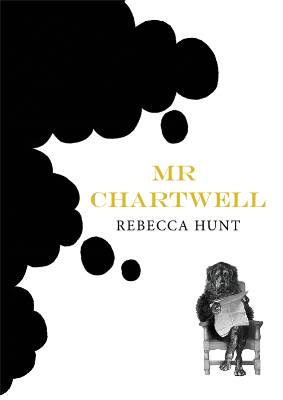
Mr Chartwell by Rebecca Hunt

It’s a well-known fact that British Prime Minister Winston Churchill experienced periods of depression which he referred to as ‘the black dog’. Just a metaphor, of course, but what if the black dog was real? Rebecca Hunt has used this idea as her inspiration for one of the most bizarre books I’ve read for a long time!

It begins with the 89-year-old Churchill waking up one morning in 1964 to find that he’s not alone in the room; someone – or something – is sitting in the opposite corner. Later that morning, librarian Esther Hammerhans is preparing to welcome the new tenant who’s going to be renting her spare room. When she opens the door and is confronted by a huge black dog who introduces himself as Mr Chartwell, Esther is shocked but agrees to let him have the room. He needs to stay in the area for a few days, he says, while he’s visiting a client. But what is Mr Chartwell’s job and who is his mysterious ‘client’?

If you’re going to read Mr Chartwell you need to be prepared to keep an open mind and just accept that one of the protagonists is a dog or you’re not going to get very far with this book! I thought bringing the ‘black dog’ of depression to life was a wonderful idea. Mr Chartwell, or Black Pat as he calls himself, is a fascinating character (and not just because he’s a huge talking dog). He’s manipulative and controlling but sometimes behaves in a more dog-like manner and can even be quite charming and likeable. But although the reader knows what the dog represents (and Churchill knows it too, having been well acquainted with him for many years) Esther has no idea what’s going on and is completely in the dark as to why Mr Chartwell has chosen her house to visit.

Another interesting aspect of the book is that there are little details of Churchill’s life incorporated into the plot, both directly and indirectly. Some of the things he says in the book are based on things that the real Churchill was quoted as saying. And even the dog’s name, Chartwell, was the name of the Churchill family home in Kent.

I loved the opening chapters of this book but started to lose interest a little bit as I got further into the story. The overall tone was quite light (which I know it was probably intended to be) but I think it would have worked better for me if it had been more serious in places and if Mr Chartwell had been portrayed as a less likeable character. The first half of the book in particular is very whimsical, though it does turn darker towards the end where Hunt starts to explain the significance of some of the metaphors and how they relate to depression. Overall though, I thought this was an impressive debut novel and I’ll be looking out for more Rebecca Hunt books in the future.

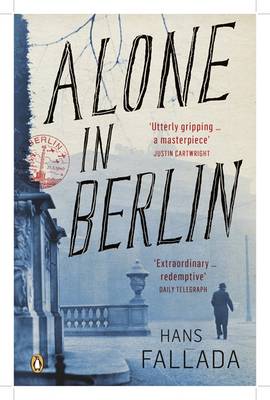
Alone in Berlin by Hans Fallada

“Mother! The Führer has murdered our son. Mother! The Führer will murder your sons too. He will not stop till he has brought sorrow to every home in the world.”

Otto Quangel writes these words on a postcard one Sunday afternoon in 1940, drops it in a crowded building the next day and waits for someone to find it. And in this way, a quiet married couple from Berlin begin their campaign of resistance to World War II.

I’ve been very lucky so far with my reading choices in 2011. Alone in Berlin (published in the US as Every Man Dies Alone) is yet another one that I thoroughly enjoyed. This book has been on my wish list since I noticed it had been translated for the first time and published as a Penguin Classic, and I’m so glad it lived up to my expectations. Not only is it a wonderful story but it’s also important historically as an anti-Nazi novel written by a German and published in 1947, just after the end of World War II.

The book is based on the true story of Otto and Elise Hampel, whom Hans Fallada renamed Otto and Anna Quangel. Fallada was given the Gestapo’s files on the Hampels and was able to draw on this information as part of his research for Alone in Berlin. Before I read this book I knew nothing about the Hampels and their postcard campaign, so I found the plot completely suspenseful, exciting and full of surprises – it was truly unputdownable, the kind of book where I knew as soon as I started reading that I was going to love it.

From the first page we are drawn straight into the action with postwoman Eva Kluge delivering a telegram to Otto and Anna Quangel, informing them that their son has been killed. Meanwhile in the apartment below, the Nazi Persicke family are celebrating the news of the capitulation of France, whilst Frau Rosenthal, the elderly Jewish woman who lives on the fourth floor, is forced to go into hiding after her husband is taken away by the Gestapo.

Devastated by his son’s death and appalled by the Nazi regime, Otto buys some blank postcards and devises a simple scheme which he hopes will raise awareness of Hitler’s atrocities and encourage other German citizens to join the resistance. On the surface, Otto is our hero, the man with the courage to stand up to Hitler, the man who refuses to join the Party although doing so is ruling him out of promotion at work. And yet Otto is not a conventional fictional hero. He comes across as cold and distant and not particularly likeable – but I could understand the reasons for him distancing himself. He was not frightened for himself, but afraid that his actions would endanger anyone associated with him, particularly his beloved Anna who insists on helping him with the postcards despite the risks involved.

The middle section of this book becomes a sort of cat-and-mouse game with Inspector Escherich of the Gestapo attempting to catch the mystery postcard writer. Escherich is a very shrewd and intelligent detective who is able to make clever deductions based on the tiniest clues – almost a brutal, sinister version of Sherlock Holmes – and I was kept in suspense wondering if Otto would give himself away.

But there are so many other things going on in this book. We also meet Enno Kluge, Eva’s husband, whose main ambition is to stay out of the army on health grounds and fill his days with gambling and drinking. Then there’s Trudel Baumann, who was once engaged to the Quangels’ son, and is opposing the war in her own way; Baldur Persicke the Hitler Youth Leader who puts Hitler and the Party before even his own father; and Kuno-Dieter, a teenage boy who flees Berlin for the countryside.

I wasn’t expecting this book to be so easy to read. The writing is clear and direct, getting straight to the point and allowing us to concentrate on the rapidly moving plot. I was concerned that my unfamiliarity with German war-time politics might be a problem, but I needn’t have worried. I had no problem understanding any part of the book. The focus is not on the politics but on the people and their lives. I went through a whole range of emotions while reading this book: fear (for Otto and Anna, for Trudel, for Frau Rosenthal, even at times for Enno); anger (at the Gestapo and the whole system of ‘justice’); and sadness, of course.

Alone in Berlin is a moving and inspirational story about two people standing up for what they know is right. I would highly recommend it if you enjoy reading World War II fiction and would like to view things from a different perspective and also if you enjoy novels that are both gripping and heartbreaking. Don’t let the 600+ pages put you off – I became so absorbed in the story I didn’t even notice the length!