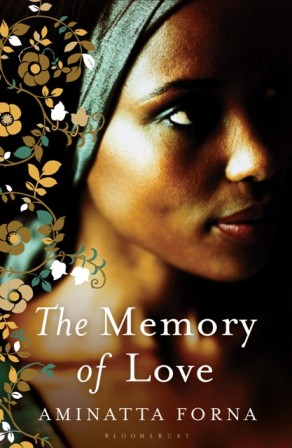
The Memory of Love by Aminatta Forna

Adrian Lockheart is a British psychologist working in Freetown, the capital city of Sierra Leone. For ten years the country has been torn apart by civil war and a large percentage of the population have been left suffering from post-traumatic stress disorder. Adrian’s job is to help people cope in the aftermath of the war. One man, who set fire to people’s houses during the war is now haunted by the smell of burning meat. Another woman is showing symptoms of fugue – a rare condition which occasionally causes her to disappear from her everyday life and turn up in another place miles away from her home. But Elias Cole is the patient Adrian spends the longest with and who intrigues him more than any of the others.

Elias Cole is an elderly retired professor who is dying of lung disease and he relates to Adrian his memories of the woman he once loved: her name was Saffia and she was married to a fellow academic, Julius Kamara. As Adrian learns more about Elias and his relationships with both Saffia and Julius during the period of political unrest in the late 1960s, it becomes clear that Elias’s story may have an effect on Adrian’s own life. We also meet Kai Mansaray, a young surgeon at the hospital where Adrian works, who has been left traumatised by the war and is suffering from insomnia and recurrent nightmares. He and Adrian become friends but their friendship comes with its own set of obstacles that need to be overcome.

The Memory of Love is the first book I’ve read set in Sierra Leone. One of the great things about fiction is that it gives us the opportunity to learn about countries that we may otherwise have gone through our whole lives knowing very little about. The descriptions of life in Sierra Leone are beautifully written: the sights and sounds, the trees and flowers, the colours of the sky. I didn’t know anything about the history and politics behind the civil war but it wasn’t really necessary to have any prior knowledge – and even after finishing the book I didn’t feel I’d really learned much about the war itself. But what the book does do, and does very well, is show the effects the war had on the personal lives of the population, particularly the fear and uncertainty people felt, not knowing who they could and couldn’t trust.

I wish I could say I had loved this book, but I didn’t. It was extremely well written but after about 100 pages I was bored. I put the book aside for a few days and then picked it up again. This time I managed to finish it, but it still seemed to take forever to read. And towards the end, when the various threads of the story began to come together it all seemed a bit too convenient – too predictable, too many coincidences. But the fact that I didn’t enjoy this book probably says more about me as a reader than it does about The Memory of Love as a novel. It was too detailed and descriptive for me and I found it very, very slow. I do seem to be in the minority though, so maybe you’ll have better luck with it than I did!

Life of Pi by Yann Martel

I always feel a bit apprehensive when reading a book like Yann Martel’s Booker Prize-winning Life of Pi which has been read by so many people and seems to divide opinion so much. Would I love it or would I hate it? I was actually expecting to hate it, since I did try to read it a few years ago and gave up after a couple of chapters. After deciding to give the book a second chance and making it to the end this time, I was surprised to find that I had the exact opposite reaction – I loved it and was completely captivated by it from start to finish. Now I’m annoyed with myself for waiting so long before giving it another try!

Pi Patel’s father runs the Pondicherry Zoo, so Pi has grown up surrounded by animals. However, this still doesn’t prepare him for what happens when he and his family decide to emigrate to Canada, taking several of their animals with them to be traded to other zoos. When they are shipwrecked in the middle of the Pacific Ocean, Pi finds himself trapped in a lifeboat with a hyena, a zebra, an orangutan – and a Bengal tiger called Richard Parker.

I remember that when I first tried to read Life of Pi I struggled to get through the opening chapters, but this time I found them much more interesting. Not much actually happens in this early section of the book, but the scene is set for the rest of the story. We learn a lot about animals and how they are treated in zoos. We also see how Pi explores various religions and the benefits of each, before deciding to be a Christian, Muslim and Hindu all at the same time. But it wasn’t until the shipwreck scene and Pi’s subsequent discovery of the tiger sharing his lifeboat that I really became absorbed in the story. The account of Pi’s battle for survival and his relationship with Richard Parker makes for fascinating and compelling reading. It’s hard to believe that a story which takes place mainly within the confined space of a small lifeboat can be so enthralling!

Which brings me to the final section of the book. At first I hated the way the book ended and I did feel cheated – I expect a lot of readers have felt the same way, which will be one reason for the love/hate divide – but then I found that I couldn’t stop thinking about it and how clever it was. I have rarely come across a book with such a thought-provoking and ambiguous ending. I’m so glad I decided to give Life of Pi a second chance, as after my first attempt at reading it I had thought it just wasn’t for me.

Have you ever been surprised by a book after giving it another chance?

Rule Britannia by Daphne du Maurier

I love Daphne du Maurier; whenever I pick up one of her books I know I’m guaranteed a good read. Although this one was not as good as some and I can certainly understand why it’s one of her less popular books, it still kept me gripped for all 300+ pages. I’m pleased I can say that because, having read other opinions on this book, I was concerned that it might be the first du Maurier novel that I wouldn’t like.

Published in 1972 her final novel, Rule Britannia, imagines that the UK has broken away from Europe to form an alliance with the US. This new nation will be known as USUK. The first twenty-year-old Emma knows about this is when she wakes up one morning to find that the tranquil corner of Cornwall where she lives is now under American occupation – there’s an American warship in the harbour, American marines stationed in the area and roadblocks on the routes leading in and out of the town. Already the Queen is visiting the White House and the President is preparing to come to Buckingham Palace. Despite reassurances from the government that the formation of USUK is essential for Britain’s economic and military stability, Emma’s family, friends and neighbours begin to grow increasingly concerned about the exact nature of the alliance and the effect it will have on their previously peaceful lives.

It can’t happen here, thought Emma, it can’t happen here, that’s what people in England have always said, even in wartime when they were bombed, because they were all together on their own ground. Not any more.

Although the story unfolds from Emma’s perspective, the real heroine of the story is her seventy-nine-year-old grandmother, Mad (short for Madam – unless I missed it, we aren’t told her real name), who is a retired actress. Mad and Emma live together with Mad’s six adopted boys whose ages range from three to nineteen, all of whom have suffered some form of tragedy in their early lives. Mad, even in her old age, is a strong-minded, independent woman who is determined to defend her home and family no matter what, and she plays an important part in Cornwall’s resistance to the occupying forces. But although Mad and her family believe they have been invaded, I should point out that we’re told the majority of British people are very happy with the alliance and that it’s only a small percentage of the population who are rebelling against it.

As with most Daphne du Maurier novels, this one does have some suspenseful and unsettling moments. I know from my past experience of her work that nothing is ever quite as it seems and I was wondering what surprises and twists she might have in store for the reader – but unfortunately I found the way the book ended slightly disappointing because I felt there was a lot more she could have done with the story. Another thing I didn’t like was the fact that one of Mad’s adopted sons, three-year-old Ben who happens to be black, appeared to have been included simply as an excuse to make racist jokes. The book was a product of the 1970s I suppose, but these comments are offensive rather than funny. These negative points, along with the overall strangeness of the book, stopped me from enjoying it as much as I’ve enjoyed her other books. It doesn’t compare to her best work and if you’re new to Daphne du Maurier I would suggest starting somewhere else.

A Word Child by Iris Murdoch

Iris Murdoch is not a writer I’m very familiar with. A few years ago I read her Booker prize-winning novel, The Sea, The Sea, but have never investigated her other books. And so I’d like to thank Open Road Media for making A Word Child available through Netgalley and re-introducing me to Murdoch’s work.

The ‘word child’ of the title is Hilary Burde, our narrator.  Following an unhappy childhood Hilary’s future prospects looked bleak, until he discovered a passion for words and languages and embarked on a promising academic career at Oxford. However, when we first meet Hilary at the beginning of the novel, he is working as a low grade civil servant in London. We don’t know at first why he left Oxford, but we are given hints that he had been involved in some kind of scandal there – and when Gunnar Jopling, a figure from his past, comes to work in Hilary’s office building, everything starts to become clear.

The book has an interesting structure, with each chapter headed by a day of the week. Hilary has tried to establish order and routine in his life by having certain things that he always does on certain days of the week (dinner with friends on Thursday, visiting his sister on Saturdays, for example) and the novel follows him as this monotonous cycle of events is gradually thrown into disarray. Murdoch’s writing never becomes over descriptive or flowery, yet she manages to convey vivid images of the stations on the London Underground, the yellow fog that hangs over the Thames, the Peter Pan statue in Kensington Gardens. She also gives an amusingly accurate portrayal of daily office life, where Hilary is relentlessly teased by two of his colleagues, and there are other moments of humour involving Hilary’s lodger, Christopher.

Hilary himself is not an easy character to like. He controls every aspect of his sister Crystal’s life and the way he behaves towards his poor girlfriend, Thomasina, is even worse. And yet I could still empathise with him at times because his dysfunctional relationships and desperate attempts to stay in control are signs of the unhappiness and inner turmoil from which he’s suffering. I really wanted Hilary and the other main characters to have a happy ending and although I’m obviously not going to tell you whether they did or not, I did think the ending was stunning: dramatic, surprising and very satisfying.

I enjoyed this book very much and loved Murdoch’s insights into topics such as redemption, forgiveness and moving on after a tragedy. It was such a surprise because I wasn’t expecting something so accessible and readable. I’d recommend A Word Child to anyone who may be wondering where to begin with Iris Murdoch.

Room by Emma Donoghue

It’s been more than a month since I read this book but it has taken me until now to find the inspiration to post about it. That’s not to say that I didn’t enjoy the book, but as I’ve said before I find it difficult to write about a book that has attracted so much attention and already been raved about by such a lot of people.

I’m sure most of you will already have seen so many reviews of Room that you won’t need a synopsis, but for those of you who do, the plot can be summarised very quickly. The story is narrated by Jack, a five-year-old boy who has spent his whole life living with his mother in a converted shed measuring eleven foot square. His mother had been kidnapped seven years ago and Jack was born in captivity. He has no idea that a world exists outside Room and apart from Ma and Old Nick, the man who is keeping them captive, he has never seen another human being.

The story could have been very harrowing, but I was surprised to find it was less upsetting than I thought. There are a lot of aspects of the plot that are very disturbing and uncomfortable to read about but there are also some positive things that come out of the story: the strong mother/son bond, for example, and the way Jack’s mother uses her imagination to keep him busy and entertained. Being told from a five-year-old’s point of view, there’s nothing very graphic but there are always dark undercurrents beneath the surface. The trauma of Ma’s kidnapping and the abuse she suffered at the hands of Old Nick are only lightly touched on; we know they happened but aren’t given many details because those are things Jack is too young to really understand.

When I first started reading I found Jack’s narration very irritating and I had an awful feeling I was going to have to abandon the book after a few pages. Luckily though, it seemed that I just needed to get used to it. Once I got further into the story I didn’t have a problem with Jack’s voice and even stopped noticing his unusual language after a while. I can see why Donoghue chose to use a child narrator to show the situation through the innocent eyes of a child born into such an unnatural environment. Jack doesn’t know that a different way of life is possible so is quite content with how things are and when Ma finally decides to ‘unlie’ and tell him about Outside, he finds it almost impossible to believe that such a place really exists. His mother was of course fully aware of what had happened and it would have been interesting to have read the same story from her perspective as well, but of course it would then have been a completely different and probably much more traumatic book.

I’m not sure this is a book I would want to read again, but it did keep me completely gripped and I’m glad I’ve finally read it, as it hadn’t really appealed to me when everyone seemed to be reading it last year.

Have you read Room? Do you think I would like any of Emma Donoghue’s other books?

The Tiger’s Wife by Téa Obreht

As you may know, the winner of the 2011 Orange Prize for Fiction will be announced on 8th June. I’ve read three of the six books from this year’s shortlist but I’ve been so far behind with my reviews this year that I haven’t yet posted on any of them – even though it’s now been a while since I finished reading them. I’m beginning to catch up now so hopefully I’ll be posting my thoughts on all three books this week. As for the other three shortlisted books, I would still like to read them eventually.

The Tiger’s Wife, Téa Obreht’s first novel, was one of the Orange titles I was most looking forward to reading and although I did enjoy it, I felt that it didn’t quite fulfil its promise. There were parts of the book that I loved, but I thought the story was made up of too many separate elements that in my opinion never really came together as a whole.

Set in an unnamed Balkan nation, The Tiger’s Wife is an unusual mixture of myth, magic and reality. The main thread of the story follows Natalia, a doctor who is on a goodwill mission to inoculate the children at an orphanage in the fictional town of Brejevina. When Natalia discovers that her beloved grandfather has died, not at home with her grandmother as might be expected, but in a village not far from the orphanage where she is headed, she decides to investigate and find out what he was doing there.

Interspersed with Natalia’s story are accounts of important events in her grandfather’s life and some of the Balkan folk-tales she remembers him telling her. One of these is the story of an escaped tiger living near a remote village in the mountains and a young deaf-mute woman said to be the tiger’s wife; another involves Darisa the bear hunter. I particularly enjoyed reading about the grandfather’s encounters with the ‘deathless man’, a mysterious individual who can predict the deaths of other people without ever dying himself. However, some of these tales were so long and involved that by the time we returned to the present day storyline I found it difficult to pick up where we had left off. And to be honest, I found Natalia’s grandfather and his magical stories a lot more interesting than the character of Natalia herself.

Although the country in which the book is set is never named and any towns and villages that are mentioned are fictional, it’s not difficult to tell that we’re reading about the former Yugoslavia. The city in which Natalia lives is referred to only as ‘The City’ but is probably Belgrade. But despite the anonymity of the setting, Obreht still conveys a great sense of place through her wonderfully descriptive writing.

I can see why this book has been getting so many accolades, but for me, I think it may have been a little bit too ambitious and the disjointed structure of the book stopped me from loving it as much as I had hoped to. The ending of the book left me feeling confused and with the impression that all the separate threads of the story hadn’t been adequately pulled together. If only the author could have found a way to weave the various parts of the novel into a more coherent story The Tiger’s Wife had the potential to be an excellent book, and I’m looking forward to seeing what Téa Obreht does next.

Touch by Alexi Zentner

In Touch, the debut novel by Alexi Zentner, we follow the story of three generations of one family who live and work in Sawgamet, a small Canadian mining and logging town. Our narrator, Stephen, has just returned to Sawgamet after a long absence because his mother is dying. Back in his childhood home Stephen becomes lost in memories – and shares some of those memories with the reader. Foremost in Stephen’s thoughts is the day his grandfather, Jeannot, came back to the town after disappearing for many years and announced that he had come to “raise the dead”.

With tales of sea witches and creatures that live in the forest, dogs that sing and golden caribou, the line between fantasy and reality often becomes blurred. I’m not always a fan of magical realism but it is done perfectly here, and so is the non-linear narrative which moves seamlessly between past and present.

Sawgamet is one of the most vivid settings I’ve encountered in a book for a long time. I could picture Jeannot’s cabin and mill, the miners panning for gold in the river, the suffocating blankets of snow that buried the landscape during the long cold winters. Enchanting and magical one minute, dark and threatening the next, the atmosphere Zentner created was wonderful. His writing is beautiful and elegant and there are some haunting images that have stayed in my mind even after finishing the book.

As a debut novel I thought Touch was hugely impressive and I’ll certainly be looking out for more work by this author in the future.