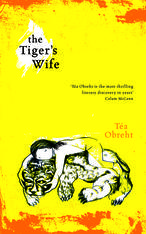
Swamplandia! by Karen Russell

Swamplandia! is an alligator-themed amusement park in the Everglades run by Chief Bigtree, his wife, Hilola, and their three children. For years tourists have been flocking to the park to see the star attraction: Hilola Bigtree and her alligator-wrestling act. The fortunes of the Bigtree family start to change, however, when Hilola dies of cancer – and then a rival theme park called World of Darkness opens on the mainland nearby and the downfall of Swamplandia! is complete.

Swamplandia! first came to my attention when it appeared on the Orange Prize longlist. Not having read anything by Karen Russell before I didn’t know what to expect from this book but was intrigued by the unusual setting and subject. And at first I loved the originality and quirkiness of the story. I loved reading about the Swamplandia! theme park (complete with Swamp Café and Bigtree Family Museum), the alligator-wrestling and the other details of the Bigtree family’s life on the island. After a while the novelty started to wear off, but luckily the characters were strong enough to keep me interested.

The three Bigtree children all have an innocence that makes them likeable and endearing characters. It’s understandable in a way, as they haven’t had the most conventional of childhoods. They’ve been homeschooled on the island and the only other children they’ve really come into contact with have been tourists visiting the park. After their mother’s death, each of the three tries in their own way to cope with what has happened, unable to rely on their father who is reluctant to accept that his beloved park is in trouble and who fails to be there for his family when they need his support.

Osceola, the elder sister, announces that she’s in love with a dead man – and begins ‘dating’ him via séances and possessions. Ossie’s ghostly romance seemed ridiculous at first, but was actually quite a poignant and moving story. Her brother, seventeen-year-old Kiwi, runs away from Swamplandia! quite early in the story and goes to work on the mainland in an attempt to earn money to solve his family’s financial problems. But it’s Ava, as the youngest girl, who is particularly vulnerable. It’s Ava’s narration (including some disturbing scenes involving a ‘journey to the underworld’ with a stranger who calls himself the Bird Man) that gives the book an underlying darkness, with some moments of real sadness and heartbreak.

I loved the chapters narrated by Ava and I was also interested in Ossie’s storyline, but whenever the action switched to Kiwi’s adventures on the mainland, I quickly got bored. I can see why the Kiwi sections were included, as a way of lightening the mood of the book and to show how his childhood growing up in the swamps left him completely unequipped for life on the mainland, but to me they just didn’t fit with the rest of the book and I would rather have stayed with Ava’s narration. This was potentially a great book but the uneven plot let it down.

The Echo Chamber by Luke Williams

The Echo Chamber is narrated by Evie Steppman who was born in Lagos in 1946. Evie has always considered herself to have a remarkable sense of hearing – she even remembers listening to her father telling her stories while she was still in the womb – but now that she’s getting older she can’t hear as well as she used to. Sitting in her attic in Scotland surrounded by diaries, maps, postcards and other items from her past, Evie decides that it’s time to write the story of her life.

This is an interesting and unusual book which encourages the reader to think about sound in a new way. It made me really appreciate the everyday sounds that we take for granted.

At first I found it difficult to form an emotional connection with Evie as a person. There were other characters that I found more interesting – I was particularly fascinated by the character of Evie’s grandfather, Mr Rafferty, a watchmaker who tried to create a clockwork replica of his late wife. And so I appreciated the inclusion of two chapters in which we get the chance to read Evie’s lover’s diary; seeing her through someone else’s eyes gave an extra dimension to her character. I also enjoyed the chapters which dealt with Evie’s childhood in Nigeria during the final years of British rule.

The Echo Chamber is written in a number of different formats – diary entries, question and answer sessions, stories-within-stories – and although I’m not sure this really worked for me it did add to the originality of the book. I didn’t find it an easy read, but as a debut novel I think Luke Williams can be proud to have come up with something so different and imaginative.

Alas, Poor Lady by Rachel Ferguson

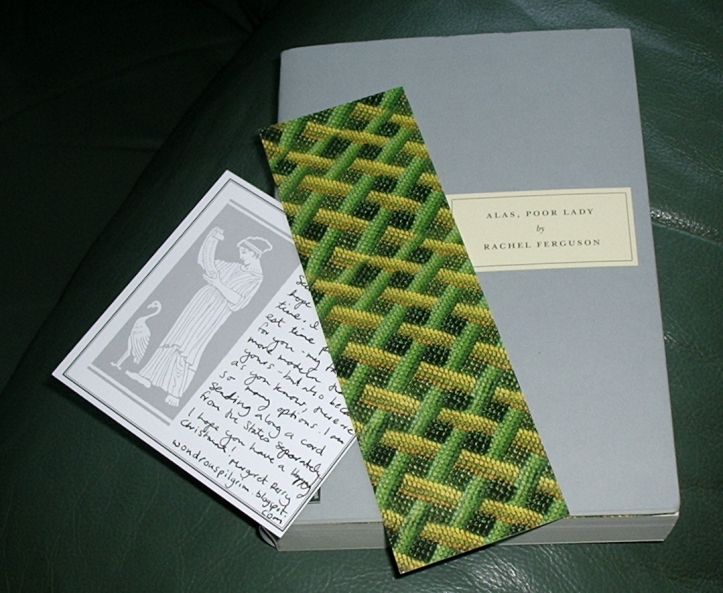
This is the book that I received for Christmas from my Persephone Secret Santa, Margaret of Ten Thousand Places. Choosing a book for another person is never easy, but of all the titles published by Persephone Margaret managed to select one that was perfect for me. Thank you, Margaret!

Alas, Poor Lady tells the story of one London family, the Scrimgeours, over a period of more than sixty years, from the Victorian era through to the 1930s. Captain and Mrs Scrimgeour have eight children – seven are girls and only one, the youngest, is a boy – and we get to know all of them, some better than others. We watch as they grow up and try to find their place in society – a society designed to cater only for men and, to a lesser extent, for married women. For a woman who stayed single (whether by choice or not) her options in life were very limited.

Three of the Scrimgeour girls marry and leave home early in the story, though they do reappear from time to time. Of the other four, Mary is the eldest sister still living at home and is portrayed as the stereotypical ‘spinster’, a quiet, sensible woman who can usually be found reading a book and who has never really been expected to get married. Agatha decides to follow a different route after it starts to look likely that she, like Mary, is also going to remain single – but will this really lead to happiness? What Queenie really wants is to get a job, but after considering several possible career paths is forced to come to a disappointing conclusion. And finally there’s Grace, the youngest sister, who through no fault of her own finds herself facing poverty and in the uncomfortable position of becoming a burden to her family.

Although the focus of the book is on the seven girls, it’s interesting to see how their brother, Charlie, is also under pressure to conform to society’s expectations of how a boy should behave. In some ways, he doesn’t really have any more freedom to be himself than his sisters do. His father is furious with him when he discovers him playing with Grace’s doll, for example, instead of his own toy soldiers.

Another thing I liked was the amount of information we are given on everyday life in the 19th and early 20th centuries. Although the Captain keeps insisting he’s ‘not a rich man’ and worrying about money, the Scrimgeours are evidently a very wealthy family with a large house and servants. It was interesting to see how their way of life changed over the years as a result of poor financial decisions and changing economics.

I loved this book but I know it won’t appeal to everyone. It’s slow and detailed, doesn’t have a lot of plot, and it did seem to take me a long time to read it. And yet without anything really ‘happening’ there’s still so much going on in this book that this post could easily have been twice as long as it is.

So, for anyone with an interest in feminism and the differing roles of men and women in society, I can’t recommend Alas, Poor Lady highly enough. Although my favourite Persephone so far is still Little Boy Lost (largely due to the emotional impact it had on me) this one is now a close second.

The Help by Kathryn Stockett

As I’ve mentioned before, I always find it difficult to write about a book that so many people have already read. I feel as if there’s nothing new I could possibly say and that nobody will want to hear about it yet again anyway (which I know is not true – there is no book that absolutely everybody in the world has read, however much it sometimes seems that way). But at least I’ve read The Help now and can see why it’s been getting so much attention. And I have to agree with all the bloggers who’ve been giving this book such glowing reviews because it really does deserve it.

The Help is told in the form of alternating narratives by three women living in Jackson, Mississippi during the early 1960s. Two of them, Aibileen and Minny, are black women working as maids, or ‘helps’, for white families. The third is Eugenia Phelan, nicknamed Skeeter because she’s ‘long and leggy and mosquito-thin’. In contrast to the first two narrators, Skeeter is a white woman from a rich family. Skeeter dreams of becoming a writer and convinces Aibileen and Minny to help her write a book throwing new light on the life of a black maid in Jackson.

I loved all three of the narrators, who were each given very different and distinctive voices of their own. I thought it was impressive that Stockett could write so convincingly from the perspectives of three such different people. The intelligent, dignified Aibileen was a lovely, engaging narrator and probably my favourite. But Minny was an equally captivating character – she was outspoken and funny and in some ways felt the most real. I liked Skeeter too but found that she didn’t come to life for me as vividly as the other two. I found it hard to believe that she hadn’t noticed how cruel and prejudiced her best friends were until she reached the age of twenty two (and also hard to believe that she would have been friends with people like them in the first place).

The Help is a powerful and thought-provoking read which raises a number of issues relating to various aspects of racial discrimination, segregation and the Civil Rights Movement, though I’m happy to leave it to people with more knowledge of these subjects to discuss them in the depth they deserve. Judging it purely on its merits as a novel, this was one of the most enjoyable books I’ve read this year. I was alternately enraged by the prejudice and injustice the black maids were forced to endure, amused by the antics of Minny and the other characters, intrigued by the well-meaning but very eccentric Celia Foote, and filled with loathing for Hilly Holbrook, one of the vilest characters ever!

The Seas by Samantha Hunt

If you’ve been following this year’s Orange Prize for Fiction, it probably won’t have escaped your attention that the shortlist was announced on Tuesday (following the earlier announcement of the longlist last month). I don’t necessarily have any plans to read all of the books on either list, but am picking out the ones that sound appealing or that I can get hold of easily. The Seas is one of the longlisted titles that didn’t make the shortlist. This book (which was Samantha Hunt’s first) was originally published in 2004, but became eligible for the Orange Prize after being published in the UK last year.

Ever since she was a little girl and her father told her she was a mermaid, the unnamed narrator of The Seas has felt different from everyone else in her town. Now, at the age of nineteen there are two main influences on her life: one is her love for Jude, an older man who has recently returned from fighting in Iraq. The other is the lonely, oppressive atmosphere of the town itself – a town so far north ‘the highway only goes south’ – and the sea that surrounds it.

There is a lot of this kind of sadness here. It slips in like the fog at night. The fog that creeps out of the ocean to survey the land that one day she thinks will eventually be hers.

This is not the type of book I usually choose to read, but sometimes it’s good to take a risk and try something a bit different. And The Seas is certainly different! As well as being a strange and unusual novel, it’s also a surprisingly short one. In just 200 pages, Samantha Hunt manages to cover a number of topics such as the Iraq War, post traumatic stress disorder and mermaid mythology – as well as creating some interesting minor characters, including the narrator’s grandfather, a retired typesetter who is busy working on a new dictionary – yet I never felt that the author had tried to pack too much into too few pages, which proves that sometimes a book doesn’t have to be long in order to say everything it needs to say.

Although there didn’t seem to be much of a plot and I wasn’t sure where everything was leading, I enjoyed the first half of the book and was pulled into the narrative by the quality of the beautiful, dreamlike prose, filled with wonderful ocean imagery. It wasn’t enough to hold my attention right to the final page, though, and towards the end of the book I started to lose interest. Sadly there were too many things about this book that didn’t quite work for me, but overall I thought it was an impressive debut novel.

The News Where You Are by Catherine O’Flynn

Frank Allcroft, the central character in this novel by Catherine O’Flynn, is a local celebrity. He can be seen on television every evening presenting the regional news – or ‘the news where you are’. Amongst the never-ending stream of missing dogs, charity fundraisers and other typical ‘local news’ reports, there’s the occasional item that affects Frank more deeply. These tend to be the stories that deal with deaths and disappearances: the stories about old people found dead in their own homes with nobody having noticed that they were missing. To ensure that their deaths don’t go unnoticed, Frank has started leaving flowers outside their houses and attending their funerals – where he is often one of the only mourners.

There are many important people in Frank’s life, including his depressed elderly mother Maureen, his ambitious co-presenter Julia, his wife Andrea and their little girl, Mo. But equally important are the people who are no longer there: Frank’s friend and fellow TV presenter, Phil Smethway, for example, who was killed in a hit-and-run accident. And his father, Douglas, an architect who died when Frank was young and whose buildings are now being demolished one by one.

This book addresses lots of interesting issues – coping with ageing, adjusting to change and progress, the pressures of being a celebrity – but overall it was a bit too slow for me. The problem I had was that the first 100 pages just felt like a very long introduction to the characters, with no real plot to speak of. Eventually, a mystery began to emerge when Frank decided to investigate the connection between Phil Smethway’s death and the death of one of Phil’s old friends, Michael Church, and at this point I started to find the story more compelling. So, as long as you’re not expecting something fast-paced and thrilling this is an enjoyable enough book with likeable characters (I particularly loved Mo). I did really like the way Catherine O’Flynn writes and am looking forward to reading What Was Lost, which I’ve heard is better than this one.

Moon Tiger by Penelope Lively

The famous historian Claudia Hampton is dying. From her hospital bed she tells the nurse that she is going to write a history of the world: “A history of the world…and in the process, my own”.

Penelope Lively’s Moon Tiger won the Booker Prize in 1987 and yet it’s not a book that I’ve ever heard much about. Maybe it’s a good thing I didn’t know anything about it, as I would otherwise probably have felt too intimidated by the thought of reading it and might never have picked it up. And that would have been a shame because although it was certainly a complex, challenging book, it was also one that I found very rewarding and I didn’t regret the time and effort I put into reading it.

I really wanted to love Moon Tiger. And I did love parts of it. The whole book is beautifully written (I particularly liked the final chapter) and I found myself constantly marking passages I wanted to remember. The only problem I had was that the story was too fragmented for me. The narration jumps from third person past tense to first person past tense to third person present tense – as well as back and forth in time. Eventually I began to really appreciate how well-structured the story actually was, but unfortunately it didn’t start to work for me until I was halfway through the novel.

As Claudia explains at the beginning of the book she is taking a ‘kaleidoscopic’ view of history. One idea leads to another with only very tenuous connections between them. The most tiny and innocent things that happen in the hospital (a conversation with the nurse about God, a poinsettia plant brought in by her sister-in-law) trigger memories which lead to other memories and then other memories…

Sometimes the narrator also changes very abruptly, so that we see the same scene from two different perspectives. This made things even more confusing, but did help build up a full, balanced picture of Claudia. And Claudia is not the most likeable of people. I loved her as a character – she’s fascinating and unconventional – but not as a person. At first I couldn’t understand her animosity towards her sister-in-law, Sylvia, and I was frustrated that she wasn’t more loving to her daughter, Lisa. The reasons for her behaviour are revealed only very slowly as the story progresses and the secrets of Claudia’s past come to light. This gave the novel some suspense and mystery, as not everything was obvious from the beginning and a lot of things didn’t fall into place until near the very end. I still couldn’t actually like Claudia, but at least I could understand her better.

I did like the way Claudia talked about history and how she was able to relate historical events to events from her own past. To Claudia, history is a personal subject – she writes her history books for the general public, in language that they can understand. And just as it would be difficult to write a history of the entire world in strictly chronological order, the story Penelope Lively tells in Moon Tiger is not chronological either.

Where the book really comes into its own is in Claudia’s recollections of Egypt when she was working in Cairo as a war correspondent during World War II. The descriptions of Egypt are vivid and realistic, the type that could only be written by someone familiar with the country (as Penelope Lively was). It’s in these sections that we begin to see a softer side of Claudia – and in case you were wondering, this is also when we finally learn what a Moon Tiger is!

I still find it hard to say what I thought about this book. I was impressed by it, but did I actually enjoy it? No, not really – but it was certainly one of the most interesting and unusual books I’ve read this year.