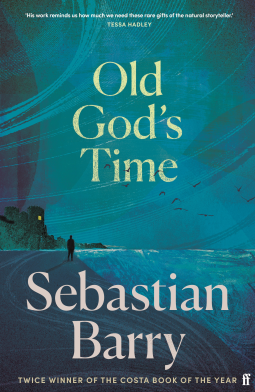
Old God’s Time by Sebastian Barry – #ReadingIrelandMonth23

Sebastian Barry is one of my favourite Irish authors; he writes beautifully and I’ve loved some of his previous books – in fact, the only one I’ve read that I didn’t like much was Days Without End, mainly because the subject (army life in the American West during the Indian Wars) didn’t really appeal to me. His new novel, Old God’s Time, has a very different setting – Ireland in the 1990s – and I hoped it would be another good one.

Old God’s Time is the story of Tom Kettle, a recently retired police detective who lives in the annex of a castle in Dalkey, a coastal resort to the southeast of Dublin. The castle overlooks the Irish Sea and Tom is finding some contentment in the quietness and solitude of his retirement…until, one day, two younger policeman arrive at his door. They are reopening an historic case Tom worked on in the 1960s and they want to hear his thoughts on it.

Forced to confront moments from his past that he would have preferred to forget, Tom begins to remember. He remembers his beloved wife June and his two children Joseph and Winnie, all now dead, in separate tragic incidents. He remembers his career as a detective and his time in the army. And he remembers that terrible, disturbing thirty-year-old case, linked to one of the darkest episodes in Ireland’s recent history.

When I first read the blurb for this book, it sounded like a crime novel, but being familiar with Sebastian Barry’s work, I knew it would probably be something quite different! In fact, the crime element is pushed into the background until much later in the book, and instead we spend time inside Tom’s head, watching him go about his daily business while memories fleet in and out of his mind, almost at random. The memories don’t come to him chronologically, but in a haphazard, disordered way and sometimes it is unclear whether he is even remembering things accurately. This doesn’t make for easy reading and I spent the first half of the novel feeling very confused. ‘Stream-of-consciousness’ writing is not my favourite style at the best of times and although it does usually work for me in Barry’s novels, I wasn’t won over until the second half of the book. From that point, I was gripped.

The story that does eventually unfold in Old God’s Time is very sad and very grim. It’s a subject that is painful and difficult to read about, but it’s one that needs to be discussed and not ignored. My heart broke for Tom, June and the other characters, but at the same time it’s not a completely miserable book and the beautiful descriptions of the Irish landscape provide a bit of respite from the sadness of the story. I didn’t like this book as much as The Secret Scripture or On Canaan’s Side, but it’s a powerful novel and one I’m pleased I read.

Thanks to Faber & Faber for providing a copy of this book for review via NetGalley.

I’m counting this towards Reading Ireland Month 2023, hosted by Cathy at 746 Books.

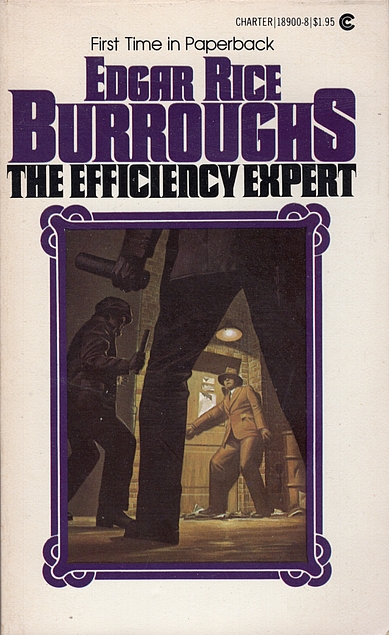
The Efficiency Expert by Edgar Rice Burroughs

Edgar Rice Burroughs is not an author I’ve ever considered reading; neither his Tarzan series nor his John Carter of Mars books have ever appealed and I hadn’t thought to look into what else he had written. The Efficiency Expert was suggested by one of my blog readers (thank you, Cheryl!) and it proved to be an excellent recommendation. The book was published in 1921 and seems to be one of only a few novels Burroughs wrote about ordinary people leading ordinary lives.

Jimmy Torrance is in his final year at university when he discovers that, having devoted his time to football, baseball and boxing instead of his studies, he is now in danger of failing his course. After working hard for the rest of the semester, he manages to get his diploma and ‘would have graduated at the head of his class had the list been turned upside down’. Unimpressed, his father orders him to come home before he can acquire any more debt, but Jimmy heads for Chicago instead, determined to get a good job and make his father proud of him.

Arriving in Chicago, Jimmy begins to look for work but soon finds that his college education counts for nothing without any experience. Forced to accept that nobody is going to employ him as an office boy, let alone the general manager’s position he had hoped for, he embarks on a series of increasingly embarrassing jobs including selling ladies’ hosiery in a department store and working as a waiter in a disreputable nightclub. Eventually, just as he reaches his lowest ebb, he is offered the position of ‘efficiency expert’ in a factory. Things seem to be looking up at last – but when he notices a discrepancy in the company’s accounts, he must decide whether to act and risk losing the only good job he’s ever had.

The first half of the book is entertaining and quite amusing as Jimmy stumbles from one disastrous job to another, while repeatedly encountering two young women who are mystified to find him serving at tables one day and driving a milk wagon the next. Jimmy is very naïve when he first arrives in Chicago, assuming that as a graduate he will be able to walk straight into any job, and his story will resonate with other young people who have had to work their way up from the bottom. I admired him for not asking his rich family and friends for help, which would have made things easier for him, but it’s this same sense of pride and integrity that results in him losing or leaving job after job.

Jimmy makes two new friends in Chicago – a pickpocket and safe-breaker known as the Lizard, and Little Eva, a prostitute he meets during his nightclub job – both of whom become better people due to their association with Jimmy. There’s a clear message here that decent people can be found in all walks of life and nobody is beyond redemption if they are only given a chance. The more privileged characters in the book (or some of them anyway) are not shown in such a good light! There’s a romantic element to the story too, with Jimmy having three possible love interests. The one he ends up with is neither the one I’d hoped for nor the one I’d expected, but at least that means the book isn’t completely predictable!

After Jimmy starts working as an efficiency expert, the story takes a different turn and the book becomes more of a thriller than the light comedy it had seemed at the beginning. It’s exciting for a while, but I thought it fell apart slightly at the end, with characters who had become inconvenient to the plot being too easily disposed of and loose ends tied up too neatly. Still, this book was fun to read and although I’m still not drawn to Tarzan or the science fiction novels, I’m pleased to have found an Edgar Rice Burroughs book that I did want to read and did enjoy.

If you have trouble finding a copy of this book, it’s available through Project Gutenberg.

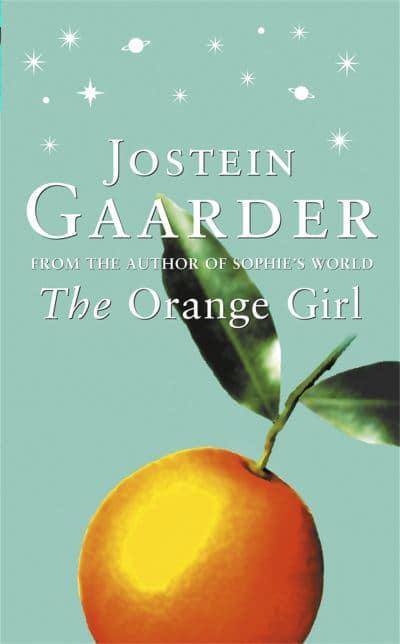
The Orange Girl by Jostein Gaarder (tr. James Anderson) – #NordicFINDS23

What is this great fairytale we live in and which each of us is only permitted to experience for such a short time? Maybe the space telescope will help us to understand more of the nature of this fairytale one day. Perhaps out there, behind the galaxies, lies the answer to what a human being is.

It’s been years since I last read anything by Jostein Gaarder! I loved Sophie’s World and The Solitaire Mystery, which I read around the time they were published in English in the mid-1990s, but although I read a few more of his books after that I found them disappointing in comparison and didn’t explore any of his later work. This month, Annabel is hosting her second Nordic FINDS event, celebrating literature from Finland, Iceland, Norway, Denmark and Sweden, and I thought it would be a good opportunity to try one of the Gaarder novels I never got round to reading.

First published in Norwegian in 2003 and translated into English by James Anderson the following year, The Orange Girl is narrated by Georg Røed, a fifteen-year-old boy whose father, Jan Olav, died eleven years earlier. Georg’s mother has married again and had another child and Georg gets on well enough with both, but he has never stopped wondering about the father he can barely remember. One day, Georg’s grandmother finds a letter written by Jan Olav before his death and addressed to Georg, intended for his son to read when he was old enough to understand it. The Orange Girl includes Jan Olav’s letter in full, interspersed with Georg’s reaction to it and the lessons he learns from it.

In the letter, Jan Olav tells the story of a young woman he meets in Oslo in the 1970s. He comes to think of her as ‘the Orange Girl’ because when he sees her for the first time on a tram, she is wearing an orange dress and carrying a large bag of oranges. When the tram stops, she disappears, leaving Jan Olav desperate to find her again. As the weeks and months go by, he becomes obsessed with tracking down the mysterious Orange Girl and discovering her true identity. Who is she? Why did she need so many oranges? And why is it important for Georg to hear her story so many years later?

On the surface, The Orange Girl is a quick, easy read. Being narrated by a teenage boy, it’s written in simple language (Georg actually feels more like a ten or eleven-year-old than a fifteen-year-old), and like many of Gaarder’s novels, it would be perfect for younger readers. The story of the Orange Girl is entertaining and amusing – particularly when Jan Olav creates a series of imaginary scenarios to explain the huge bag of oranges! I would have liked to have been given a stronger sense of place as Jan Olav follows the girl from Oslo to Seville and back again, but it wasn’t that sort of book; it’s concerned mainly with plot and ideas rather than setting.

However, anyone who has read any of Gaarder’s other books will know that they always contain a philosophical element, and this one is no different. Georg and his father share an interest in the Hubble Space Telescope, which leads to a lot of discussion of the expanding universe and the place of human beings within it. The book also raises the question of whether, if you knew before you were born that you would die early and have all your happiness taken away, would you still choose to be born at all? These are clearly the things Gaarder really wanted to write about here, and the Orange Girl story is just a way of illustrating these philosophical points.

I haven’t been left wanting to immediately search out the rest of Gaarder’s novels, but I did find this one quite enjoyable and am glad I picked it up for Nordic FINDS.

Wild Strawberries by Angela Thirkell

Wild Strawberries is the second book in Angela Thirkell’s Barsetshire series and the book chosen for me in the last Classics Club Spin. I had mixed feelings about the first book, High Rising, which I read nearly two years ago, but still wanted to try this one as I knew it was about a different set of characters and I thought I might get on better with it.

Published in 1934, this book introduces us to the Leslie family who live at Rushwater, their estate in West Barsetshire. The family consists of Henry Leslie and his absentminded wife, Lady Emily, their two sons John and David, and their daughter Agnes, who is married to Robert Graham and has three young children. There was also another son, the eldest, who died in the Great War, and his sixteen-year-old son Martin is now the heir to Rushwater and lives with his grandparents. As the novel opens, Robert Graham has gone to South America on business so Agnes and the children are spending the summer with the Leslies and so is a niece of Robert’s, Mary Preston.

This probably all sounds straightforward enough to you, but for some reason it took me ages to remember who was who and I wished I had drawn a family tree at the beginning! Anyway, once I started to settle into the story and get to know the characters, I found it quite enjoyable. The plot mainly revolves around Mary Preston and the question of which of the Leslie men she’ll marry – David or John. David, the younger brother, is charming but selfish and thoughtless (he promises to bring Mary the ‘wild strawberries’ of the title, then forgets them), while John is quiet, kind and considerate. I knew which of them I wanted her to choose but Thirkell keeps us in suspense until the end of the book!

There’s also a subplot involving a French family, the Boulles, who move into the vicarage for the summer. Keen for Martin to improve his French, the Leslies arrange for him to study with the Boulles’ children, but instead he becomes involved in a plot to restore the French monarchy. Meanwhile, the lovely but irritating Agnes spends the entire book fussing over her children, and Mr Holt, an acquaintance of Lady Emily’s who talks about nothing but gardens and his titled friends, keeps imposing himself on the family, oblivious to the fact that nobody wants him there.

I enjoyed this book once I got into it; although it doesn’t have much more substance than High Rising, I found it funnier and can see now why people praise Thirkell for her humour and wit. There are also touches of poignancy when the Leslies remember their lost son, killed in the war, and when John, who is a widower, grieves for Gay, his late wife. Some of the characters, such as Mr Holt and the Boulles, are clearly there for comedy purposes, but the family themselves, annoying as some of them were, felt realistic to me. I liked John and Martin, while I found Mary’s infatuation with David, who treats her carelessly, frustrating but all too believable. I should mention, though, that there are a few instances of racism, mainly in the first half of the book, that even though I’m used to it in books of this era, I found more jarring than I normally would.

I still haven’t been completely won over by Angela Thirkell but I liked this better than the first book and will probably continue with the series at some point. However, the third book is about Tony, the teenage boy from High Rising whom I found almost unbearable, so I don’t know what I’ll think of that one!

This is book 35/50 read from my second Classics Club list.
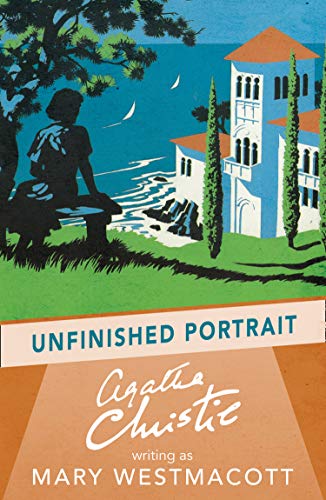
Rhododendron Pie by Margery Sharp – #DeanStreetDecember

This month, Liz of Adventures in Reading, Running and Working from Home is hosting Dean Street Press December. Margery Sharp’s first novel, Rhododendron Pie, had been out of print for years and was notoriously difficult to find before being reprinted by Dean Street Press in 2021. As I’ve previously enjoyed some of her other books I decided to read it for this month’s event.

First published in 1930, Rhododendron Pie is the story of Ann Laventie, who grows up in the Sussex countryside with her parents and two older siblings. The Laventies are a wealthy and accomplished family who consider themselves intellectual, artistic and refined; their neighbours, however, see them as cold and snobbish. Ann herself doesn’t fit in with the rest of the family – unlike her brother Dick, a sculptor, and sister Elizabeth, a writer, she hasn’t yet discovered where her own talents lie and doesn’t believe herself to be special or superior in any way. The more time she spends with the Gayfords, the large, cheerful, down-to-earth family who live nearby, the more she becomes aware of how different her own home life is.

The title of the book refers to the tradition in the Laventie household of presenting the children with birthday pies filled not with fruit but with inedible flowers. Aesthetically beautifully and appreciated by the rest of the family, but not by Ann:

“Every year she has hoped against hope, and every year the lovely inedible petals have cheated her. For she has a fundamental, instinctive conviction that they are out of place. Flowers are beautiful in gardens…and in houses, of course…but in a pie you want fruit. Apples. Hot and fragrant and faintly pink, with lots of juice…and cloves. She wished there had been apples in her pie.”

Although Ann loves her family and admires their intellectual brilliance, it’s her secret longing for the ordinary, conventional things in life that drives the story forward. When Dick and Elizabeth move to London and Ann goes to visit them there, her knowledge and experience of the world widens and she becomes more aware of what she really wants and what will make her happy.

It took me a while to get into this book, but once I did it was very enjoyable. I loved Ann and found it interesting to watch the internal conflict play out between her true nature and the values and prejudices that have been instilled into her as a result of her upbringing. Although there’s some romance in the book – Ann has two very different love interests and it’s quite easy to predict which one she’ll choose! – it never really becomes the main focus and is just one aspect of the story, along with the exploration of intellectual snobbery, the class system and the difficulties of finding your place in the world.

As I’d hoped, this was a good choice for Dean Street December and I’ll see if I have time for another book before the end of the month.

The Winter is Past by Noel Streatfeild

Noel Streatfeild is an author I loved as a child but I’ve never tried any of her adult books until now. There are plenty to choose from but I decided on her 1940 novel The Winter is Past (although here in the UK, winter is currently very much with us – we’ve had snow, ice and freezing temperatures all week, where I am!). It occurred to me after I started reading that I should probably have saved this book for next year’s 1940 Club – it’s worth keeping this one in mind if you’re wondering what to read for that event.

Anyway, The Winter is Past begins by introducing us to the Laurence family, who have lived at Levet, a beautiful English country house, since the 18th century. The current head of the family, Bill Laurence, has brought his new wife, Sara, home to Levet for the first time, but it immediately becomes clear that she’s not going to fit in. Nannie, who nursed several generations of Laurence children and is still an important part of the household, disapproves of Sara’s background as an actress – and when Bill’s upper-class mother Lydia comes to stay, Sara feels even more out of place. After suffering a miscarriage, she decides that her marriage is not working and that she needs to get away for a while, but with the outbreak of World War II she is forced to stay at Levet and make the best of things.

Another family whose lives have been thrown into turmoil by the war are the Vidlers. While Mr Vidler stays at home in London, his wife and their three young children – Rosie, Tommy and baby Herbert – are evacuated and taken in by the Laurences. Life at Levet comes as a culture shock for the working-class Vidlers, but they do their best to adapt, with varying success! When the cold weather arrives and the house is cut off from the village by snow, this disparate group of people will have to work together to get through the winter.

I loved this book; it’s very character-driven but with just enough plot to keep the story moving forward. I always find it fascinating to read books set during the war that were actually written before the war was over – it puts a very different perspective on things, when neither the characters nor the author have any idea how long it will last or how bad things are going to get. What little plot there is deals with the events of the winter of 1939-40 and although the book ends with another five years of war still to come, there’s already a sense that the lives of the characters have changed irrevocably and the way of life each of them has always known is disappearing forever.

My favourite characters were Mr and Mrs Vidler who, despite not leading a privileged life like the Laurences, possess things that money can’t buy – love, happiness and contentment – and rather than feeling inferior to Sara, Lydia and the others, look on them with sympathy and pity. The children, in the countryside for the first time, have more mixed emotions; they aren’t too pleased about the regular baths and formal mealtimes, but Tommy is captivated by the thought of making things grow in the garden and Rosie is amazed to discover that real ducks don’t wear sailor suits like Donald! It’s not surprising that Streatfeild writes about children so convincingly, considering she’s better known as a children’s author, but her adult characters are well developed too, even if some of them are difficult to like. She does come close to stereotyping with the maid Irene who has what we would probably call learning difficulties today, but that’s my only criticism and she does make up for it by giving Irene a heart of gold.

This was the perfect book to read in December, with snow on the ground outside, and I’m looking forward to reading more of Streatfeild’s adult novels next year. If you’ve read any of them let me know which ones you would recommend!

Small Things Like These by Claire Keegan – #NovNov22

I hadn’t really considered reading this book until my post on the HWA Crown Awards for Historical Fiction, when several of you commented that you had read and loved it. Around the same time, it was shortlisted for the Booker Prize and again I saw a lot of praise for it, so when I saw how short it was (128 pages in the edition pictured here) I thought I would give it a try for this year’s Novellas in November.

Small Things Like These is set in a small town in Ireland during the winter of 1985. The weather has turned cold and frosty and Bill Furlong, coal and timber merchant, finds his deliveries very much in demand, with customers desperate to heat their homes. Seeing how his friends and neighbours are struggling, Bill knows how lucky he is to have his own business and to be happily married with five lovely children.

Just before Christmas, Bill delivers coal to the local convent and discovers a girl locked in the coal shed, worrying about her hungry baby. Bill is left greatly disturbed by this encounter, particularly as he himself was the child of a single mother and if it hadn’t been for the kindness of his mother’s employer who helped to care for them both, they might also have been sent to a convent. His wife, Eileen, advises him not to get involved, but Bill continues to feel uneasy about the girls working in the convent laundry and the way the nuns are treating them. He knows he will eventually have to make a decision – but what will it be?

This is a quiet but powerful story, with the details of daily life in a small Irish community beautifully described. It didn’t feel like the 1980s to me, though – if I hadn’t known I would have thought it was set at least a few decades earlier. Maybe that was intentional, as some stories really are timeless. Considering how short the book is, Bill’s character is fully developed and his emotional dilemma is portrayed in depth.

Before reading this book, I had never read anything about the Magdalene Laundries, which were run by convents and were really homes for unmarried mothers and ‘fallen women’. There were allegations of women being beaten, punished and treated as slaves and although the last of these laundries closed in 1996, the Irish government didn’t issue an apology until 2013. Through Bill Furlong’s story Keegan explores the question of complicity and whether by staying silent when we know something is wrong we can be held partly responsible. This aspect of the book reminds me of A History of Loneliness by John Boyne, which looks at another scandal within the Catholic Church.

Not for the first time, though, I’ve come to the end of a hugely popular book feeling that although I liked it and found a lot to admire, I didn’t manage to love it the way everyone else did. In this case I think I just wanted a little bit more. It ended quite abruptly just as I was getting really interested in it and I would have liked to have known what happened to the characters next. I’m sure other readers will have thought it was the perfect length and ended in exactly the right place! Still, I’m looking forward to reading more by Claire Keegan and will think about reading Foster for next year’s Novellas in November.