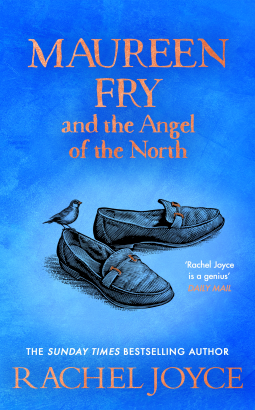
Maureen Fry and the Angel of the North by Rachel Joyce – #NovNov22

Almost ten years ago I read Rachel Joyce’s first novel, The Unlikely Pilgrimage of Harold Fry, in which a man sets out to walk almost the entire length of England, from his home in Devon to a hospice in Berwick-upon-Tweed, to visit an old friend who has been diagnosed with cancer. A second book followed – The Love Song of Miss Queenie Hennessy, written from the friend’s perspective – but I didn’t read that one. Maureen Fry and the Angel of the North is the final part of the trilogy and I wondered whether I would struggle with it because of not having read the middle book first, but luckily that wasn’t the case.

At only 133 pages, Maureen Fry is a short, quick read but contains an entire journey, both physical and psychological. This time, though, it’s not Harold who is making the journey, but his wife, Maureen. It’s been several years since Queenie Hennessy’s death but the garden she created in Embleton on the Northumberland coast has become a tourist attraction. Hearing that the garden contains a memorial to her own son, David, who committed suicide, Maureen decides to go and see it for herself. It’s something she wants to do alone so, leaving Harold behind, she prepares to head north – not on foot like her husband, but by car.

I found the title of the book intriguing because the obvious reference is to the Angel of the North, Antony Gormley’s sculpture of the same name that stands on a hill overlooking the A1 in Gateshead, just south of Newcastle upon Tyne. I was at Newcastle College on the day it was erected in 1998 and remember watching from the tenth-floor window! Maureen Fry does see the Angel as she drives past, but it’s only mentioned briefly and there are several other possible meanings of the title (although I won’t tell you who or what the other Angels of the North could be). The US version doesn’t refer to angels in the title at all and is simply Maureen, just in case anyone thinks they are two different books!

Maureen’s journey is very different from Harold’s, not just because she chooses to drive instead of walk but also because she has a very different personality. While her husband was easy to like, she is not. She’s rude, unpleasant and unlike Harold, who made new friends during his pilgrimage, Maureen seems to make only enemies. It took me a long time to warm to her at all, but eventually I began to understand the reasons for her behaviour. For such a short book, there’s a lot of emotion within its pages as Maureen begins to face up to the grief she’s been trying to suppress for so many years.

If you’re new to this trilogy, I would definitely recommend reading Harold’s story before Maureen’s. I didn’t feel that I’d missed anything essential by not having read Queenie’s, but I would like to go back and read it now anyway – as well as all the other Rachel Joyce books I still haven’t read!

Thanks to Doubleday for providing a copy of this book for review via NetGalley.

I’m counting this book towards Novellas in November hosted by 746 Books and Bookish Beck.

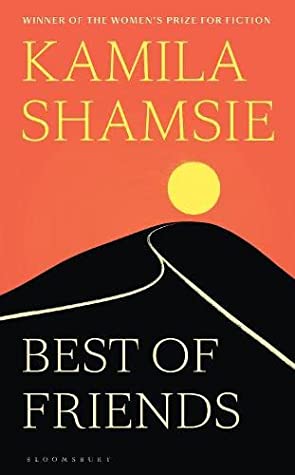
Best of Friends by Kamila Shamsie

It’s been seven years since I read Kamila Shamsie’s A God in Every Stone and although I did find it interesting and always intended to try more of her work, until I picked up Best of Friends earlier this month it had remained the only one of her books I’d read. I knew almost as soon as I started to read Best of Friends that it was going to be my favourite of the two novels as I felt an immediate connection with the characters that I didn’t in the other book.

Best of Friends is the story of a female friendship and how it endures, changes and evolves over a period of forty years. We first meet Zahra Ali and Maryam Khan as teenage girls in Karachi, Pakistan in 1988. The two come from very different backgrounds – Maryam has had a sheltered and privileged childhood and as her grandfather’s favourite, she expects to one day inherit the family business, Khan Leather. Zahra, on the other hand, is the daughter of a television cricket commentator who has found himself under suspicion for refusing to support General Zia’s military dictatorship. As a result, Zahra works hard at school and tries to stay out of trouble. Despite their different family lives and priorities, the two girls have become very close friends.

I loved the first half of the book; I’ve read very little about Pakistan during that period and I enjoyed getting to know the two girls and watching them go about their daily lives. The fourteen-year-old Maryam and Zahra have the same hopes, dreams, concerns and problems that many young women will be able to relate to, whenever and wherever they grew up – the changes in their bodies with the onset of puberty, their first relationships with boys, worries over homework and exams, and finding small ways to rebel against their parents. The political situation in Pakistan is also explored, culminating in the 1988 election victory of Benazir Bhutto. It is during a party celebrating this democratic triumph that Zahra and Maryam experience a terrifying incident that changes the course of their lives.

The novel then jumps forward by three decades to 2019 and we discover that Zahra and Maryam are both now living in London where they have each become hugely successful in their chosen careers. They are still best friends but have found themselves at opposite ends of the UK political spectrum with opposing views on topics like immigration, technology and government surveillance. These tensions increase when a figure from their past comes back into their lives and we begin to wonder whether their friendship can survive.

The second half of the book didn’t interest me as much as the first. The 1980s Pakistan setting felt much more vivid and real to me than the modern day London one did and I found both characters more likeable as teenagers than they were as the adults they became. It also seemed to me that some of the situations Shamsie put them in were deliberately contrived in order to create conflict between them, rather than things that would have arisen naturally. Still, I liked the ending, which I found both ambiguous and believable, and I was intrigued by the central idea that perhaps when we’ve known someone all our lives we still see them as the person they used to be instead of the person they are now.

Have you read anything by Kamila Shamsie? Which of her books should I read next?

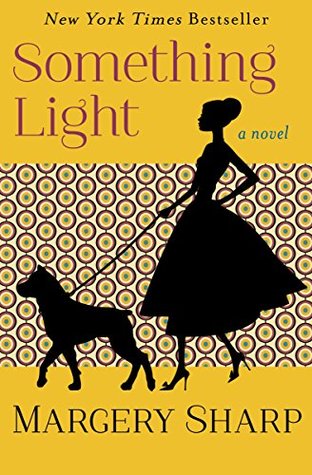
Something Light by Margery Sharp

This was one of the books from my 20 Books of Summer list, which I did actually read before the September deadline although I didn’t manage to post my review in time. First published in 1960, as the title suggests, it’s a light read.

Our heroine, Louisa Datchett, is a thirty-year-old single woman who lives alone in a tiny London flat – so tiny that she can ‘turn on a tap, fill a kettle, light a gas ring and reach down the coffee tin, all without moving her feet’. Louisa has never married, but that doesn’t mean she doesn’t like men – she does like them and has plenty of male friends, all of whom have a habit of coming to her with their problems. In fact, she’s been so busy solving men’s problems that she has barely had time to think about herself – and there certainly hasn’t been time for any romance in her life.

Being a ‘modern’ woman, Louisa hasn’t previously felt that having a husband was in any way essential and has established a career for herself as a dog photographer. This unusual job has provided lots of interesting opportunities for Louisa, but she’s finding that it’s not a reliable way of paying the rent! One morning, having bought an extra yogurt from the milkman for the starving musician next door and worried about her friend, Hugo, who has bronchitis, it occurs to Louisa that it would be nice to have someone taking care of her for a change!

The rest of the book follows Louisa’s attempts to find a husband, each one more disastrous than the one before. First she sets her sights on Freddy Pennon, a wealthy older man whom she met the previous year in Cannes while photographing an Italian film star’s poodles. When this ends in failure, she decides that perhaps a steady, dependable man would be a better option – or maybe a widowed family man looking for a stepmother for his children. Fortunately, Louisa has enough sense to see that none of these relationships are likely to work…but just as she gives up hope of ever meeting a suitable husband, one appears where she had least expected to find him!

Louisa could be seen as quite a contradictory character; on the one hand she is an independent and capable woman who lives on her own and supports herself financially through work, while on the other she sets herself the old-fashioned goal of finding a husband no matter what. It also seems a bit unfair on the men she targets, who have no idea that they are being lined up for marriage. However, she goes about this in such a good-natured way, making sure nobody gets hurt by her actions, that you can’t help liking her and hoping she’ll get what she wants in the end.

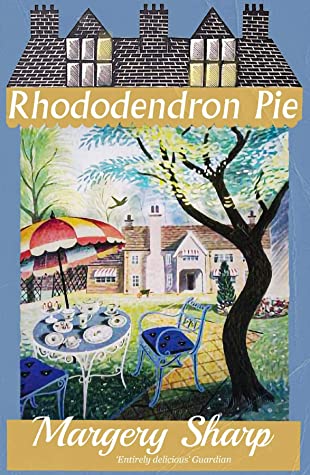
The overall story is quite predictable and I could easily predict who Louisa would end up with as soon as he made his first appearance, but each separate episode in the novel has its own little twist, which keeps things interesting. This isn’t one of my favourite Margery Sharp books (so far that would be Britannia Mews or The Flowering Thorn) but it’s an entertaining read and sometimes ‘something light’ is just what you need.

A Pin to See the Peepshow by F. Tennyson Jesse

I first came across a mention of the 1922 Thompson–Bywaters case when I read The Paying Guests by Sarah Waters several years ago and discovered that it was part of the inspiration for the novel. F. Tennyson Jesse’s A Pin to See the Peepshow was listed in the acknowledgments and I immediately wanted to read it. However, that was 2014 and it has taken me until 2022 to actually do it! The good thing about waiting this long is that the book has recently been reissued by the British Library as part of their Women Writers series and that’s the edition I read, complete with a very insightful new afterword by Simon Thomas of Stuck in a Book.

A Pin to See the Peepshow was first published in 1934 and begins just before the First World War. Julia Almond is sixteen years old and a typical schoolgirl, infatuated with one of her teachers, fiercely protective of her beloved dog, Bobby, and longing for some excitement to brighten up her humdrum existence. Starting work in a fashionable dress shop after leaving school gives her a glimpse of the sort of world she would like to inhabit, but it also makes her situation at home, where she is forced to share a bedroom with a much younger cousin, seem even more unbearable. Rushing into marriage with her parents’ friend, Herbert Starling, in the hope of finding the freedom she craves, Julia quickly discovers that she has made a terrible mistake. She doesn’t love Herbert and knows she never will, but divorce seems to be out of the question and she can see no other way of escape.

Several years into her marriage, Julia meets the much younger Leonard Carr and at last experiences the passion and romance she has always dreamed of. The two begin an affair and soon Leonard – or Leo, as Julia prefers to call him – is putting pressure on her to prove that she loves him and leave her husband. Julia knows that Herbert will never let her go and that she can’t afford to lose the security her marriage provides, but Leo won’t accept this and eventually decides to take matters into his own hands…

I loved this book, although I had expected the crime element to play a bigger part; the section of the novel based on the events of the Thompson-Bywaters case only takes up around 100 pages out of 464. The rest of the book is really a character study of Julia Almond and an exploration of the world in which she lives. Jesse spends a lot of time building this up, but I never felt that a word was wasted – every detail seemed necessary in order for us to understand the circumstances that led to the actions of the characters later in the book. Julia herself is not a particularly likeable character, but it would be difficult not to have at least some sympathy for her as her only ‘crime’ is to be constantly striving towards a happier life for herself and dreaming of things that are always just out of reach. This is illustrated by the metaphor of the toy peepshow she stares into as a schoolgirl and finds herself glimpsing a fantasy land:

The walls and lid of the box gave to it the sense of distance that a frame gives to a picture, sending it backwards into another space. Julia stared into the peepshow, and it was as though she gazed into the depths of a complete and self-contained world, where she would go clad in snow-shoes and furs, and be able to tame savage huskies and shoot bears; a world of chill pallor, of an illimitable white sky, both only saved from a cruel rigour by the rosy all-pervading light.

The events that unfold towards the end of the book are tragic for everyone involved, but are particularly unfair for Julia, who is judged by the standards of the time. Her position in society places her at a disadvantage and as Jesse points out, if Julia had only belonged to either a higher class or a lower one, her situation could have been very different. This is a fascinating novel and now I’ll have to read E.M. Delafield’s Messalina of the Suburbs, which is based on the same case!

This is book 10/20 from my 20 Books of Summer list.

This is also book 30/50 from my second Classics Club list.
The Venice Train by Georges Simenon (trans. Ros Schwartz)

This is one of Georges Simenon’s many psychological thrillers, which he described as romans durs or ‘hard novels’. I’ve read two of his others – The Man from London and The Strangers in the House – and have enjoyed both, so was looking forward to reading this one. First published in 1965 as Le Train de Venise, it has just been reissued by Penguin Classics in a new English translation by Ros Schwartz.

The novel begins with Justin Calmar boarding a train in Venice to return to his home in Paris after a family holiday. His wife and two young children will follow in a few days’ time. During the journey, another passenger engages Justin in conversation and he finds himself agreeing to deliver a briefcase to an address in Lausanne when the train stops at the station there. However, things don’t go according to plan and Justin ends up returning to Paris with the case still in his possession. Unable to resist the temptation, he breaks the locks and looks inside…and what he finds there will change his life forever.

I won’t say too much more about the plot because I wouldn’t want to spoil the suspense of wondering what is inside the case and what Justin will decide to do with it. This is a very short book (176 pages in the paperback version) and for the first half, the tension builds and builds. It would have made a perfect Alfred Hitchcock film! It’s not a crime novel, however, so don’t go into it expecting one; the mystery is never fully explained or resolved, it ends abruptly and we are left with lots of unanswered questions. The events on the train are simply a starting point for Simenon to explore the psychological effects on Justin Calmar as he battles with nerves, guilt and paranoia, lying to his wife and his friends and finding that each lie leads to another.

The second half of the book isn’t quite as strong as the first and I do wish we’d had answers to at least some of those questions, but this is a fascinating and compelling story – my favourite by Georges Simenon so far.

Although I was slightly disappointed that only the first few pages of the book are actually set in Venice – the rest either on the train or in Paris – I wasn’t too disappointed because Paris is, of course, a great setting as well. And as Thyme for Tea and Readerbuzz are hosting their annual Paris in July event this month, the timing couldn’t be better!

Thanks to Penguin Classics for providing a copy of this book for review via NetGalley.

Summerhills by D.E. Stevenson

Summerhills, first published in 1956, is the second book in D.E. Stevenson’s Ayrton family trilogy which began with Amberwell. I knew it had been a few years since I read the first book but was shocked to find that it was actually more than six years! I was worried that I’d left it so long I would struggle to get back into the story, but that turned out to not be a problem; although I could barely remember what happened in Amberwell, Stevenson provides enough of a recap in the opening chapters that I could easily pick up all the threads again.

The book begins with Roger Ayrton, now an officer in the Army, returning to his family home in Scotland for a visit. The house, Amberwell, is where Roger and his brothers and sisters grew up before the outbreak of World War II and it still holds a special place in his heart. Some of the family have moved on, but Amberwell is still home to Roger’s stepmother and his younger sister Nell, who has been taking care of his son, Stephen, since his wife’s death. Stephen is now eight years old and Roger thinks it’s time he was sent away to school, but Nell objects, wanting him to stay close to home. As there are no suitable schools near Amberwell, Roger comes up with what he thinks is the perfect plan – he’ll open a school of his own!

At first it seems that the creation of the school – which becomes known as Summerhills – is going to be the main focus of the book, but the plot soon branches off into several different directions. Roger finds himself unexpectedly falling in love, as does Nell, while his youngest sister, Anne, whose first marriage ended unhappily is trying to move on from her traumatic past and has become housekeeper to an elderly neighbour. A new cook arrives at Amberwell, adding a touch of humour to the story, and there’s also a new governess, Georgina Glassford, who enjoys running and is always looking for someone to time her mile. Although most of the main characters in the book are very likeable, I did find their treatment of Georgina very unkind, particularly as their dislike of her seems to be based on the fact that she wears trousers and gets up early to exercise.

I enjoyed the glimpse of life in post-war Scotland – even though the lifestyles of the Ayrton family seem largely unchanged thanks to Roger receiving a large inheritance on his wife’s death, all around them other once-wealthy families are having to sell their country houses as they can no longer afford to maintain them or pay for servants. This is how Roger manages to acquire a large house to convert into a school (of course there’s no question of an Ayrton boy being sent to an ordinary day school – it must be a boarding school – and there’s no mention of the girls being allowed to go either). At least he does promise to charge reduced fees so that less fortunate boys can attend and gives the job of headmaster to his friend Arnold Maddon (one of my favourite characters), who has lost a foot during the war and has been struggling to find work.

I would have liked Anne’s storyline to have had a proper conclusion – it was left very open-ended – and I was sorry that we saw very little of the other Ayrton sister, Connie, and nothing at all of their brother Tom, who has become a doctor. There’s also a strange subplot in the middle of the book where Roger goes to Rome in search of Aunt Beatrice; I couldn’t really see the point of this as it didn’t have much relevance to the rest of the novel. Still, Stevenson’s writing style is so readable that even pointless episodes like this are quite enjoyable. There is a third novel, Still Glides the Stream, which is described as the final book in the Ayrton trilogy, but seems to be about a completely different family. Have any of you read that one?

This is book 5/20 from my 20 Books of Summer list.

Shadow Girls by Carol Birch

Having enjoyed two of Carol Birch’s earlier novels – Orphans of the Carnival and the Booker Prize nominated Jamrach’s Menagerie – I decided to try her new book, Shadow Girls. I enjoyed this one too, but it’s a very strange novel and not quite what I’d expected!

From the blurb, I had thought this was going to be a ghost story, but for the first half of the book at least, it’s much more of a ‘school story’. Our narrator, Sally, is a fifteen-year-old girl growing up in 1960s Manchester and the time and place are vividly evoked with references to the music, films, fashion and culture of the decade woven into the narrative. Like most girls her age, then and now, Sally’s life revolves around schoolwork and spending time with her friends and her boyfriend, and this is the focus of the first section of the book. Through Sally’s eyes we get to know her best friend, Pamela, a rebellious troublemaker nobody else likes, and their ‘enemy’ Sylvia Rose, a girl from a posh background who is a talented classical singer. She also describes her feelings for Rob, her first serious boyfriend, whom she is starting to have doubts about.

The supernatural element of the story isn’t introduced until surprisingly late in the novel, when Sally has a mysterious encounter with Sylvia that will haunt her for the rest of her life. The pace picks up from this point and it does become the ghost story I had expected – in fact, it’s quite a creepy one, particularly as, like many good ghost stories, it’s never completely clear which of Sally’s experiences are real and which are in her mind.

Despite not much happening for half of the book, I found it all very absorbing and was pulled into Sally’s world from the first page. I’m not sure whether so much build up was really necessary, but I enjoyed it anyway and found the book so difficult to put down that I ended up reading most of it in one day. Now I’m interested in reading Carol Birch’s previous ghost story, Cold Boy’s Wood. Has anyone read that one – or any of her other books?

Thanks to Head of Zeus for providing a copy of this book for review via NetGalley.