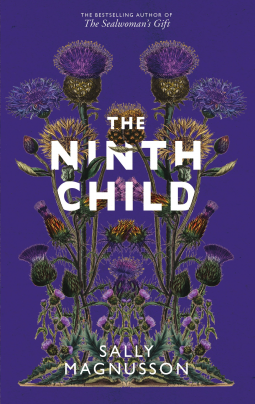
The Ninth Child by Sally Magnusson

I enjoyed Sally Magnusson’s first book, The Sealwoman’s Gift (with one or two reservations), so I had been looking forward to reading her next one, The Ninth Child, which sounded very different but equally interesting. However, although some aspects of it certainly are fascinating, there are other parts that I struggled with and on the whole I think I preferred The Sealwoman’s Gift.

The Ninth Child is set in Scotland in the 19th century and tells the story of the construction of the Loch Katrine Waterworks, an engineering scheme designed to provide clean water to the people of Glasgow. The story is told from the perspectives of several characters associated with the scheme, the main one being doctor’s wife Isabel Aird. Having suffered several miscarriages during her six years of marriage, Isabel is depressed and unhappy, a state of mind which is not improved when her husband, Alexander, informs her that they will be moving to the Trossachs where he will be involved in the building of the new waterworks.

As a doctor, Alexander believes that the recent outbreaks of cholera in Glasgow are caused by the contaminated water supply, so he is looking forward to doing something that can really make a difference to people’s lives. Isabel accompanies him, reluctantly at first, but as she settles into her new home she finds comfort in walking in the countryside by the loch, especially when she begins to believe she is receiving messages from her lost children. It is during one of these walks that she meets the Reverend Robert Kirke, a man said to have been taken by the fairies two hundred years earlier. Are the stories about Robert true – and if so, why has he returned to the land of the living and what is his interest in Isabel?

The novel is written from the perspectives of several different characters: Isabel herself; Robert Kirke; Kirsty, the wife of one of the men working at Loch Katrine; and, surprisingly, Prince Albert, who is staying at Balmoral with Queen Victoria and preparing to appear at the official opening of the new waterworks. Unfortunately, the transitions from one character’s narrative to another are not very smooth and sometimes I couldn’t immediately tell who was narrating (something which wasn’t helped by the poor formatting of the NetGalley copy I was reading and will presumably have been improved in the finished version). The Victoria and Albert storyline felt unnecessary and out of place to me, but the others all added something different and complemented each other well, with Robert and Kirsty’s stories steeped in Scottish folklore and “the hills and the hollows and the brown peat moors and the ancient mounds of the Sìthichean – that’s fairies to you.”

Robert Kirke was a real person – an Episcopalian minister who lived from 1644 to 1692 and was the author of The Secret Commonwealth of Elves, Fauns and Fairies, which was later published by Sir Walter Scott. Legends arose after Kirke’s death saying that he had been spirited away to fairyland after revealing their secrets and this is the basis of the story Sally Magnusson creates for him in The Ninth Child. I loved this aspect of the novel, which reminded me in some ways of James Hogg’s Private Memoirs and Confessions of a Justified Sinner, but I couldn’t help feeling that this magical, fantastical tale didn’t really belong in the same book as the much more realistic and factual story of the Loch Katrine Waterworks. Lots of fascinating ideas found their way into the pages of The Ninth Child, but in the end I felt that it didn’t quite work either as fantasy or historical fiction.

Thanks to John Murray Press for providing a copy of this book for review via NetGalley.

The Familiars by Stacey Halls

After enjoying Stacey Halls’ The Foundling earlier this year, I decided to read her previous book, The Familiars. It didn’t sound as original as The FoundlingThe Familiars is about the Pendle Witch Trials and I’ve read quite a few other books about witches – but I hoped it would still be interesting.

The novel is set in 1612, in Lancashire in the northwest of England, and is narrated by Fleetwood Shuttleworth, mistress of Gawthorpe Hall. Fleetwood is seventeen years old, in love with her husband, Richard, and pregnant with his child; this should be a happy time for her, but instead Fleetwood is filled with dread. This is her fourth pregnancy and all of her previous three have ended in a miscarriage – and, more worrying still, she has discovered that Richard has been hiding a letter from a doctor warning that if his wife became pregnant again neither she nor the baby would survive.

A chance meeting in the woods one day with Alice Gray, a young midwife, gives Fleetwood new hope. Alice seems to know a lot about herbs and remedies and what is needed to bring about a healthy birth, so Fleetwood asks her to join the household at Gawthorpe Hall until the child is born. Just having Alice around makes her feel better and she is sure that this time she will give birth to the son and heir Richard so desperately wants. 1612, however, is a dangerous time for women who are seen as ‘different’ in any way, and when a group of suspected witches are arrested Alice is one of those accused. Fleetwood vows to do whatever she can to help her friend, but will she be able to save her before it’s too late?

I think The Foundling is the better of Stacey Halls’ two novels, but I did still enjoy this one. As I’ve said, I’ve read other books on similar subjects – for example, Beth Underdown’s The Witchfinder’s Sister, Katherine Howe’s The Lost Book of Salem and Helen Steadman’s Widdershins – but this is the first one I’ve read specifically focusing on the Pendle Witch Trials. I was interested to learn that most of the characters in the book are based on real people, including Fleetwood Shuttleworth herself, the ‘witches’ and the men responsible for arresting them and arranging the trials. In her author’s note at the end, Stacey Halls explains which parts of the story stick to the historical facts and which are fictional.

Although the witches are obviously an important element of the novel, we don’t see as much of them as I had expected. Because the story is written entirely from Fleetwood’s perspective, a lot of the action – including the so-called acts of witchcraft, the arrest of the witches and the trials – takes place elsewhere and Fleetwood hears about these things from other people rather than witnessing them for herself. That’s one of the limitations of a first person narrative, I suppose, and it wasn’t really a problem as I found Fleetwood’s personal story quite engaging anyway. I liked her from the beginning and could really feel her fear and anxiety over her pregnancy and her frustration at not being able to do more to help Alice and the other witches.

I’ll be looking out for any future novels from Stacey Halls, but if you have any other books to recommend on the Pendle witches, please let me know which ones.

The Lost Boys of London by Mary Lawrence

This is the fifth book in a series of historical mysteries set in the Tudor period and featuring the character of alchemist’s daughter Bianca Goddard. I don’t think it’s essential to read all of the books in the series in order; I started with the fourth one, The Alchemist of Lost Souls, and had no problems in picking up the threads of the story and following the plot.

As The Lost Boys of London opens, Bianca’s husband John is away fighting in Scotland for Henry VIII, leaving Bianca in London, devoting her time to preparing herbal remedies in her ‘room of Medicinals and Physickes’. In the past, Bianca’s skills as a herbalist have led to her assisting Constable Patch with his investigations, and having played a part in solving several previous mysteries, her help is required again when a young boy is found hanging from the exterior wall of a church.

Finding a rosary wrapped around the boy’s neck marked with a set of initials, it seems there could be a religious motive for the murder, and this appears to be confirmed when a second boy is found under similar circumstances at another church. Bianca is determined to do whatever she can to find the murderer before he or she kills again – and she has a personal reason for wanting to do so as quickly as possible. Her own young friend, Fisk, who is about the same age as the other boys, has gone missing and Bianca is afraid that he could become the next victim.

I enjoyed this book more than The Alchemist of Lost Souls. I thought the mystery was stronger and more interesting, with its exploration of topics such as religious conflict, the rivalries between the clergy of various churches, and child poverty in Tudor London. Also, although the previous book included some magical realism elements, which didn’t entirely work for me, there didn’t seem to be anything like that in this one and I thought that was a good decision as the plot was strong enough without it. As well as following Bianca’s investigations in London, there are some chapters describing John’s adventures as a reluctant soldier in the Scottish borders during the war known as the ‘Rough Wooing’ and this added some variety to the novel, taking us away from London now and then to see what was going on elsewhere.

Sometimes the language used is not right for the setting (English houses don’t have ‘stoops’, for example) and I found that a bit distracting, but otherwise the atmosphere is convincing enough and it’s always interesting to read about the lives of ordinary, working-class people in the Tudor period as a change from all of the books dealing with the royal court. Oh, and I love Bianca’s cat, Hobs!

This is apparently the final book in the Bianca Goddard series. I received a copy for review via NetGalley.

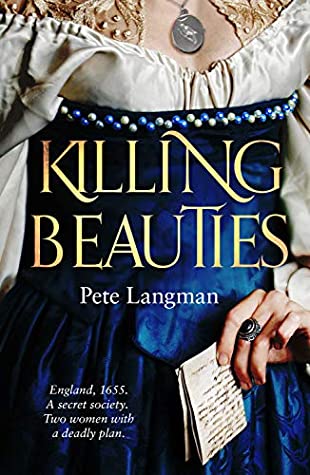
Killing Beauties by Pete Langman

Set in England during the Interregnum, the period between the execution of Charles I in 1649 and the restoration of Charles II in 1660, Pete Langman’s Killing Beauties tells the story of two female spies – or she-intelligencers, as they were known. Female spies played an important role in the intelligence networks of the time and the two women who feature in this novel, Susan Hyde and Diana Jennings, are based on real people.

The story begins in August 1655. With England under the rule of the Lord Protector Oliver Cromwell, the future Charles II – who is in exile awaiting the day when he can return to claim his throne – has entrusted Susan and Diana with a difficult and dangerous mission. Their task is to infiltrate the household of Cromwell’s Secretary of State John Thurloe in the hope of extracting secrets that will help them to undermine the Protectorate. However, Thurloe is also Cromwell’s spymaster, with a large and powerful network of his own. Will the women be able to obtain the information they need before their true identities are revealed?

Killing Beauties is a fascinating novel from the point of view of learning what was involved in the secret services of the 17th century: how they were organised and structured; the disguises, code names and terminology they used; how they gathered their intelligence; and the methods they used to keep their correspondence private – it was particularly interesting to read about the clever and intricate art of letterlocking! It’s such a shame that the contributions of the women who worked for these secret societies have been largely ignored and forgotten. The real Susan Hyde was completely overshadowed by her own brother Edward, the Earl of Clarendon, whose book, The History of the Rebellion, doesn’t even mention her.

Pete Langman has stated that the inspiration for his novel was Nadine Akkerman’s Invisible Agents: Women and Espionage in Seventeenth-Century Britain, which refers to both Susan and Diana, but as there is a limit to how much is actually known about them, particularly Diana, he has had to use some imagination to fill in the gaps. According to Akkerman’s book, Susan Hyde was postmistress for the secret royalist society of the Sealed Knot, and she carries out this role in Langman’s novel as well as trying to gain the trust of John Thurloe in order to obtain intelligence. Susan is portrayed as a sensible, practical person who takes her work very seriously, fully aware of the danger she is in – and I admired her, but I have to admit I found her a little bit bland. Diana, in contrast, is lively, daring and much more fun to read about, even if her loyalties are sometimes in question…

Diana had her fingers crossed as she spoke. It was something she did a lot, crossing her fingers as she spoke. Sometimes even Diana was unsure when she was lying, and at such times she had long ago decided that it was best to assume that she was.

For various reasons Diana virtually disappears from the story in the middle of the book and we don’t see as much of her as I would have liked. However, there’s a large cast of other characters to get to know, some of whom I’m assuming are fictional but others who definitely really existed: for example, Isaac Dorislaus, the Dutch scholar recruited to examine the correspondence passing through Cromwell’s ‘Black Chamber’, and Samuel Morland, one of Thurloe’s spies, who was also a mathematician and inventor.

I can’t really say that I loved this book; I found the plot unnecessarily complex and on occasions a bit difficult to follow, which admittedly could have been because I wasn’t paying enough attention, although I don’t think so. I also thought the book felt longer than it really needed to be, which meant the pace seemed to drag at times. Still, it was good to get some insights into the fascinating world of 17th century espionage and to have the vital contributions of female spies highlighted. At the end, it seemed as though things were being set up for a sequel, so despite having one or two problems with this book I would be happy to read another by Pete Langman.

A Thousand Ships by Natalie Haynes

“Just as I promised him: this was never the story of one woman, or two. It was the story of all of them. A war does not ignore half the people whose lives it touches. So why do we?”

This is the book I had expected Pat Barker’s The Silence of the Girls to be. A retelling of the events surrounding the Trojan War written from the perspective of not just one or two but many of the women who had a role to play in the war and its aftermath – and going beyond the Iliad, the Aeneid and the Oresteia to tell the stories the men didn’t tell.

From Penthesilea, the Amazon queen, to Cassandra the prophet; from Thetis, the sea nymph and mother of Achilles, to Gaia, the personification of Mother Earth; from Iphigenia, cruelly sacrificed on what should have been her wedding day, to Creusa, who wakes in the night to find the city of Troy in flames – just think of a woman from Greek mythology and she is probably here, in this book!

The stories of some of the women are told quite briefly, while others are given more time and attention; some appear only once but others recur again and again throughout the novel. Interspersed between these stories are a series of letters from Penelope to her absent husband, Odysseus, the tone growing increasingly hurt and frustrated as tales of his heroic escapades begin to reach her while the man himself appears to be in no hurry to return home to his wife. And holding all the other threads of the novel together are short sections of commentary by Calliope, the muse of epic poetry, who is providing guidance to a blind poet who wants to tell the story of Troy:

Men’s deaths are epic, women’s deaths are tragic: is that it? He has misunderstood the very nature of conflict. Epic is countless tragedies, woven together. Heroes don’t become heroes without carnage, and carnage has both causes and consequences. And those don’t begin and end on a battlefield.

This is an ambitious novel but, for me, it mostly works. I say mostly because there were times when I found the structure confusing – the stories are not presented in chronological order and jump around in time so that a chapter set after the fall of Troy is followed by a chapter set at the beginning of the war – but I’m happy to admit that I am in no way an expert on Greek mythology and readers with more knowledge probably wouldn’t have a problem. I’m not really sure of the reason for the non-linear structure, though – obviously the stories must have been carefully arranged in a certain order but to me they felt very random. Also, because there are so many different narrators, many of whom made their voices heard only for a few pages before disappearing from the novel completely, it was difficult to form any kind of emotional connection with them. Still, there are some I found more memorable than others: Cassandra, doomed to constantly ‘watch the shock on people’s faces, when precisely what she had predicted – and they had ignored – came true’; Hera, Athene and Aphrodite fighting over the golden apple inscribed with the words ‘For the most beautiful’; and the sad story of Laodamia, devoted to a bronze statue of her lost husband.

Although A Thousand Ships felt more like a collection of short stories than a novel, I enjoyed reading it and am now wondering whether I should try Natalie Haynes’ previous Greek retelling, The Children of Jocasta.

Thanks to Mantle for providing a copy of this book for review via NetGalley.
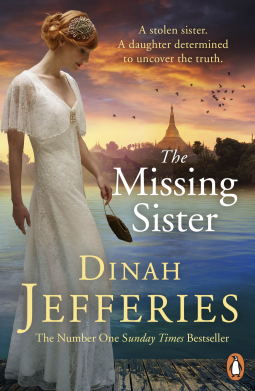
The Missing Sister by Dinah Jefferies

So far, the novels of Dinah Jefferies have taken me to India, Malaya, Ceylon and French Indochina. Now, with The Missing Sister, I have had the opportunity to visit Burma. Known as Myanmar today, the novel is set in 1936 when Burma is still a British colony – although unrest is growing and there are signs that independence might not be far away. It is to Burma that Belle Hatton has come in search of answers to a mystery that has haunted her family for more than twenty years.

Taking a job as a singer in a luxury hotel in the capital city of Rangoon, Belle uses her spare time to hunt for clues that may explain the disappearance of her parents’ baby daughter, Elvira, in January 1911. Belle herself has grown up in England, unaware that her elder sister ever existed, but now that both of her parents are dead, she has discovered a newspaper clipping describing the day Elvira, only three weeks old, vanished from the Hattons’ garden in Rangoon. Although it was all so long ago, Belle is determined to find out what really happened and whether Elvira could possibly still be alive.

As with all of Dinah Jefferies’ novels, the location is beautifully described and although I’ve never been to Burma/Myanmar it was easy to picture the lively, bustling streets of Rangoon (now Yangon), the opulent temples and pagodas, and the scenery Belle sees when, later in the book, she travels upriver to Mandalay. Another common feature of Jefferies’ books tends to be a portrayal of different cultures existing, often uneasily, side by side in the final years of the British Empire (or in the case of The Silk Merchant’s Daughter, the French Empire). This book contains a vivid description of a violent riot between the Burmese and the Burmese Indians, but otherwise I was a bit disappointed that Belle has little involvement with the local people and their struggles, sticking mainly to the British community and focusing on her search for Elvira.

The mystery element of the novel is slightly predictable and although I didn’t guess exactly what had happened to Belle’s sister, I wasn’t at all surprised by the ending of the book. Along the way, Belle is offered help from two very different men – Edward, a British government official, and Oliver, an American journalist – but when she starts to receive anonymous warnings, she is unsure which, if either of them, she can trust. This time, I did guess correctly – but I did have a few doubts as it wasn’t completely obvious.

There was one other aspect of the book that interested me: a storyline set several years earlier and following the story of Belle’s mother, Diana, and how she copes with the tragic disappearance of Elvira. When suspicion falls on Diana herself, she and her husband leave Burma and return to England where, sadly, their marriage starts to break down under the stress of their ordeal. Diana doesn’t receive the support she deserves and decisions are made that will affect not only her own future but also her youngest daughter Belle’s. Diana’s story is told in the form of short chapters interspersed with Belle’s, which means we don’t spend a lot of time with her, but the little glimpses we are given of her life and the way she is treated by her husband are very sad.

This isn’t one of my favourite Dinah Jefferies novels, but I’m looking forward to her next one The Tuscan Contessa, which is out later this year and will be the first she has written not to be set in Asia.

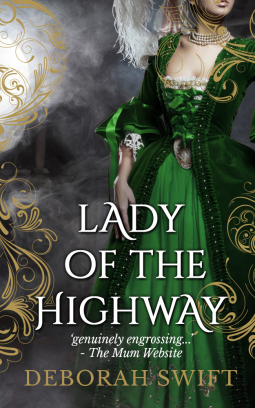
Lady of the Highway by Deborah Swift

This is the third book in Deborah Swift’s Highway trilogy set in 17th century England in the aftermath of the civil war. All three novels revolve around the character of Kate Fanshawe, who is loosely based on the legendary highwaywoman known as ‘The Wicked Lady’. The books do all stand alone to a certain extent, but reading them in order makes much more sense. The first volume, Shadow on the Highway, is written from the perspective of Abigail Chaplin, a maid in Kate’s household, while the second, Spirit of the Highway, is the story of Abigail’s brother, Ralph, who becomes Kate’s lover. Now, in Lady of the Highway, we finally get to hear Kate’s own point of view.

Following the events of the previous two novels, poor Kate has very little left in her life. Her husband, Thomas Fanshawe, and her cruel, overbearing stepfather, Simon, are still away from home, having been on the losing side in the recent wars – and although Kate is not too unhappy about that, she is struggling to continue with life at Markyate Manor on her own. Impoverished and desperate, she can expect little support from her neighbours, who have no sympathy for a woman from a family of defeated Royalists. Her beloved Ralph is gone, although she still feels his presence all around her, and to make matters worse, Abigail is ill and there is no money for medicine. When an attempt to seek help from her friends in the Digger community doesn’t go quite as planned, it seems that Kate has no choice but to take to the highways again…

The Highway novels are aimed at young adults but have plenty to offer an adult reader too. This book is as enjoyable and interesting as the previous two, although it’s also quite relentlessly sad and tragic; nothing at all seems to go right for Kate and she meets with rejection, anger and hostility everywhere she turns. Sometimes she deserves it – she is not the most loveable of characters and, for me, Abigail is the real heroine of the series – but often the cruelty she receives seems unnecessary and disproportionate. I think that’s maybe one of the areas where the book lacks the depth I would expect in an adult novel; there are good characters and there are bad characters but not much in between and no real explanation as to why the villains are so villainous.

Despite the titles of the books, the action we see on the highway – when Kate, out of desperation, goes out armed with her pistols in search of rich travellers – is only one small aspect of the story. Other topics that have been covered in the previous two novels and developed further in this one include the work of the Diggers, who believe that land should belong to everyone and not be bought, sold or enclosed, and what it is like to be a deaf person living in the 17th century. There’s a little bit of romance in this book too, not for Kate but for Abigail – and although I found it very predictable, I was pleased with the outcome! I liked the way the story was resolved for Kate too…both a sad and a happy ending at the same time.

I enjoyed all three books in this trilogy, including this one. I thought it was a good idea to use a different narrator for each book – first Abigail, then Ralph and finally Kate – as it meant they could each tell the part of the story most relevant to them and give three different perspectives on the same period of history. If you read these books hoping to learn more about the real Katherine Fanshawe (or Ferrers, as she is often known by her maiden name), however, bear in mind that the details of the legend are very hazy – it is not clear how and when she died, for example, and there is no evidence that Ralph actually existed, although his name is usually linked with Kate’s. The historical notes at the end of each novel give some guidance and for a different approach to the ‘Wicked Lady’ legend you may like to read The Silvered Heart by Katherine Clements too.