The Goddess and the Thief by Essie Fox

The Goddess and the Thief “A diamond. A curse. An obsession.” These are the words on the front cover of Essie Fox’s third novel and they give us a good idea of the type of story we can expect to find inside. The Goddess and the Thief is a Victorian Gothic novel (like the previous two books by this author – The Somnambulist, which I’ve read, and Elijah’s Mermaid, which I haven’t) and combines a complex plot with an atmospheric setting and a sense of mystery.

The novel begins in colonial India, where a little girl called Alice Willoughby is growing up in the care of her beloved ayah, Mini, having lost her mother in childbirth. Alice loves India – she loves the warmth, the vivid colours, the stories Mini tells of Parvati and Shiva – and is heartbroken when her father decides to take her back to England to live with her Aunt Mercy. Alice is lonely and miserable in her new home and finds Mercy cold and uncaring. Things become even worse when she discovers that her aunt is a medium and that she will be forced to take part in Mercy’s fraudulent séances and other spiritualist activities.

Alice’s life reaches another turning point when she and Mercy meet the mysterious Lucian Tilsbury, a man who has recently returned from India and is planning to involve the two women in an elaborate scheme…a scheme revolving around the Koh-i-Noor diamond, the famous jewel claimed by the British at the end of the Anglo-Sikh war. Some say the diamond is cursed and others that it is blessed, but one thing that is certain is that it exerts a strange power over everyone who comes into contact with it.

You may be thinking that this sounds like The Moonstone, but while there are some similarities with the Wilkie Collins mystery, this is a very different book and the story surrounding the diamond took some surprising twists and turns which I definitely wasn’t expecting! I was particularly intrigued by the occasional appearances of Queen Victoria and the Maharajah Duleep Singh, two people for whom the Koh-i-Noor has a very important significance.

The scenes set in India at the beginning of the book were among my favourites and I was sorry when we left India behind for the gloom of Aunt Mercy’s house in Windsor. The mood of the novel then becomes increasingly dark and oppressive and I was pleased that tales of the Hindu gods and of Alice’s life in Lahore continued to be woven into the plot. I liked Alice as a central character and enjoyed following her adventures, while also feeling afraid and worried for her as she found herself betrayed, badly treated and unsure of whom to trust.

My only problem with The Goddess and the Thief was that there were certain passages which I found confusing and difficult to follow, partly because the use of opium played a role in the story, which meant that the boundaries between reality and unreality often became blurred. I appreciate that this was done intentionally, to make Alice’s situation even more frightening, but it was the one aspect of the novel that didn’t work very well for me. Of course, it could have been my own fault for not concentrating hard enough!

Having enjoyed both this book and The Somnambulist (this one slightly more than the first, I think), I will have to read Elijah’s Mermaid soon!
The Edge of Dark by Pamela Hartshorne

The Edge of Dark I enjoy reading time-slip novels; I love the sense of the supernatural, the atmosphere of mystery and suspense, and the intertwining of two lives – one past and one present. Pamela Hartshorne has written three novels of this type (the other two are Time’s Echo and The Memory of Midnight) but this one is the first I’ve had the opportunity to read. I found it an entertaining, compelling and genuinely eerie read and I’m now looking forward to going back and reading her earlier novels.

The Edge of Dark is the story of Roz Acclam who, at the beginning of the novel, is preparing to start a new job as Events Director at Holmwood House, a recently restored Elizabethan building in York. This is not the first time Roz has been to York; she lived there as a small child until most of her family died in a fire and she was adopted by an aunt in London. She remembers nothing of the fire or her tragic childhood, but almost as soon as she arrives in York, memories begin to come flooding back – the only problem is, they are not her own memories but those of another woman who lived more than four hundred years earlier.

The Edge of Dark is also the story of Jane, the eldest daughter of a butcher who lived in York in the 1500s. Jane’s father is planning ambitious marriages for both of his girls and Jane soon finds herself married off to the handsome, wealthy Robert Holmwood. Joining her new husband at Holmwood House, she discovers that married life is not quite what she’d expected and she begins to long for a child of her own. But Jane’s desire to be a mother eventually grows so strong that she makes a promise she could live to regret.

As Roz tries to settle into her new job the flashbacks into Jane’s life become more frequent and she begins to question why she is having these experiences. Is Holmwood House haunted? Are Jane’s ordeals in the past somehow connected with Roz’s own problems in the present? And what really happened the night the Acclams’ house was set on fire?

Usually when I read a novel set in two time periods I find that I prefer one over the other – as I love historical fiction it tends to be the one set in the past. With this book, Roz’s story and Jane’s are so closely linked that it’s difficult to separate them; the transitions between past and present felt smooth and natural and I could easily become immersed in the lives of both women. Roz and Jane are both strong characters, but there are other interesting characters in each time period too. While some feel less developed than others, the two I found most memorable are (in the present) Helen, a jealous colleague who tries to cause trouble for Roz at work, and (in the past) Margaret Holmwood, Jane’s scheming mother-in-law.

I also liked the fact that the novel is set in York, a city I have visited many times and am quite familiar with. It was obvious that the book was written by an author who knows York, its streets and its buildings very well! Something else I found interesting was seeing what goes into opening a new tourist attraction to the public. I would have liked to have read more about Roz’s work – it sounded fascinating.

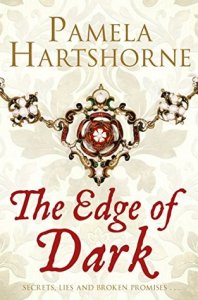
I realise I’ve come to the end of this review and haven’t mentioned the significance of the beautiful Tudor necklace on the front cover of the book, but I need to leave something for future readers to discover for themselves!

Thanks to Pan Macmillan for providing a copy of this book for review.

Jakob’s Colours by Lindsay Hawdon

Jakobs Colours There are many, many novels which deal with the subject of the Jewish Holocaust, but in Jakob’s Colours Lindsay Hawdon explores another very important but largely forgotten piece of wartime history – the Gypsy Holocaust.

Beginning in Austria in 1944, she introduces us to an eight-year-old boy called Jakob. Part Roma and part Yenish, Jakob’s world has been torn apart by the horrors of war. He is running for his life across the Austrian countryside, and as he runs, he clings to his father’s words: “Don’t be afraid, Jakob. See the colours”.

But Jakob’s is not the only story to be told here. We also go back in time to the 1920s where we get to know Jakob’s mother, Lor, and learn of her troubled childhood in England. Later, in a Swiss hospital, Lor meets Yavy, the gypsy who becomes Jakob’s father, and we follow their relationship from its beginnings up to the point where Jakob finds himself alone and on the run.

Jakob’s Colours is very different from any other World War II novel I’ve read – a real accomplishment when you consider the sheer number of books set in this period. I previously knew nothing at all about the fate of the gypsies during the war (like most people, when I think of the Holocaust I tend to think of the Jews) so it’s great to have been given this opportunity to learn something new. However, I struggled with the structure of the novel. The story constantly moves back and forth in time, with each chapter titled either This Day, Before or Long Before, which I found quite confusing and difficult to follow. It felt disjointed and it meant that I never became as fully immersed in the lives of the characters as I would have liked.

I’m disappointed that I wasn’t able to love Jakob’s Colours, especially as the historical background is so fascinating and the subject matter so poignant. It was definitely my problem with the jumping around in time that prevented me from loving it; I’m sure I would have enjoyed the book a lot more if only the story had been told in chronological order. I did still find a lot of things to admire, though – the writing is very poetic and quite beautiful in places, and I liked the colour imagery that runs throughout the novel.

Most of all, I liked the concept that however bad things become we need to continue to hope and to look for the good things in life…to see the colours.

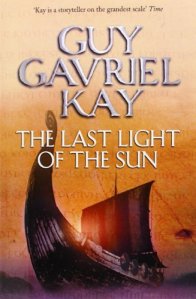
The Last Light of the Sun by Guy Gavriel Kay

The Last Light of the Sun I’m hoping to read Guy Gavriel Kay’s Under Heaven soon for the Once Upon A Time challenge, but first I need to tell you about another of his novels which I read a few weeks ago: The Last Light of the Sun.

This is the third book I’ve read by Kay and like the other two (Tigana and The Lions of Al-Rassan) it is set in a fantasy world that closely resembles a real historical one. A blue moon and a white moon shine in the sky, faeries wait to claim the souls of the dead, and ancient magical forces lurk in the forest, yet the world portrayed in The Last Light of the Sun can easily be identified as Northern Europe in the time of the Vikings, the Anglo-Saxons and the Celts.

In this re-imagined land, the Vikings have been renamed the Erlings, the Anglo-Saxons have become the Anglycn and the Celts have been transformed into the Cyngael. While the Erlings are sea-raiders who inhabit the islands in the far north, the Anglycn live in what is surely the country we now know as England, and the Cyngael live to the west, presumably in Wales. These lands of the Cyngael, on the western edge of the known world, are the last to see the light of the setting sun – and also form the final outpost of the new religion of Jad, the sun god.

Throughout the novel, we follow the adventures of three groups of characters from each of the three cultures I’ve described above. First, we meet Bern Thorkellson, a young Erling who has lost his lands and his freedom as a result of his father being exiled for murder. Desperate to escape and build a new life for himself, Bern joins a raiding party heading for the Anglycn shores. Meanwhile, in the Cyngael lands, two young princes called Alun and Dai happen to be spending the night at the home of a rival Cyngael warrior, Brynn ap Hywll, when it is attacked by another group of Erling raiders. Finally we get to know the family of the Anglcyn king, Aeldred, who has been trying to unite his people against the threat of the Erlings.

To describe the plot in any more detail would be difficult as it does become quite complex as the lives of each of these characters become entwined with all of the others. The author doesn’t really ‘take sides’ or favour one of the three cultures over the other two – perspectives and points of view are balanced fairly between the three and there are good people and bad within each group. Feuds and rivalries are formed, but so are friendships and loyalties as Erling, Anglcyn and Cyngael find that they need to adapt to a changing world.

One thing Kay does in this book, which I’m not sure I really like, is to occasionally leave his main characters behind for a while to explore the life of a completely new character who enters the novel for a few pages and then disappears, never to be mentioned again – as Kay himself describes it: “At the margins of any tale there are lives that come into it only for a moment. Or, put another way, there are those who run quickly through a story and then out, along their paths.” I can understand the reasons for this – to show us what is going on away from the central plot and the central characters – but I did find it slightly distracting.

This is a beautifully written novel, though, and as well as being an entertaining story, it’s also very thought-provoking in places. I particularly liked these two quotes:

“It happens this way. Small things, accidents of timing and congruence: and then all that flows in our lives from such moments owes its unfolding course, for good or ill, to them. We walk (or stumble) along paths laid down by people and events of which we remain forever ignorant. The road someone else never took, or travelled too late, or too soon, means an encounter, a piece of information, a memorable night, or death, or life.”

“A hard truth: that courage can be without meaning or impact, need not be rewarded, or even known. The world has not been made in that way. Perhaps, however, within the self there might come a resonance, the awareness of having done something difficult, of having done…something.”

I’ve loved all three of the Guy Gavriel Kay novels I’ve read so far and am looking forward to reading his others, beginning with Under Heaven. Have you read any of his books, and if so do you have a favourite?

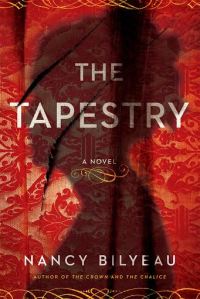
The Tapestry by Nancy Bilyeau (with giveaway)

The Tapestry The Tapestry is the third book in Nancy Bilyeau’s wonderful Joanna Stafford trilogy, which is set in Tudor England and follows the adventures of a former Dominican novice whose life has been torn apart with the dissolution of the monasteries. I loved both of the previous books in the series – The Crown and The Chalice – and had been looking forward to reading this one for more than two years. I’m pleased to be able to say that it was worth the wait!

When we first met Joanna Stafford in The Crown, she was Sister Joanna, a novice nun at Dartford Priory. With the priory under threat of closure by Henry VIII and Thomas Cromwell, Joanna became embroiled in a quest to find the legendary crown of Athelstan. Then, in The Chalice, she learned of her role in a mysterious prophecy and found herself caught up in another dangerous plot. As The Tapestry begins, Joanna is hoping to avoid any more involvement in quests and conspiracies. All she wants to do is settle down to a peaceful life in Dartford, weaving her tapestries and caring for her cousin’s little boy, Arthur. Unfortunately, people more powerful than herself have other plans for Joanna…

It seems that Joanna’s tapestries have come to the attention of King Henry VIII, who summons her to Whitehall Palace with a special commission. Almost as soon as she arrives at court, however, she discovers that her life is still in danger. Someone in the palace is spying on her – but who and why? Meanwhile, Joanna’s close friend Catherine Howard has also come to court and it is thought that the King is about to make her his fifth wife. Remembering the fates of Henry’s previous wives, Joanna is determined to do whatever she can to protect her friend as well as herself.

Like the first two Joanna Stafford novels, this is an exciting and compelling story. There are so many books set in the Tudor period that it must be difficult to find a new way to approach the subject, but this is exactly what Nancy Bilyeau has done here. I would describe these books as historical thrillers, as they are not exactly mysteries in the traditional sense – although they do all have an element of mystery in them, in this case the question of who is trying to harm Joanna. What really makes them stand out for me is Joanna herself; she’s such an interesting character, being both a former nun and also a member of the Stafford family – a niece of the late Duke of Buckingham and therefore related to the King himself.

As usual, the historical background has been well researched and some of the important events of the period are incorporated into the story, including Henry VIII’s fourth and fifth marriages to Anne of Cleves and Catherine Howard, and the downfall of Thomas Cromwell. We get some insights into what is going on elsewhere in Europe too, first through the character of the artist Hans Holbein who befriends Joanna at Whitehall, and later when Joanna embarks on a journey across Germany, a land badly affected by famine and unrest.

The Tapestry is not a romance, but there are two men who have been possible love interests for Joanna since book one – the former Dominican friar and apothecary Edmund Sommerville and constable Geoffrey Scovill. I have enjoyed watching Joanna’s relationships with both Edmund and Geoffrey develop throughout the three novels and in this final book Joanna has an important choice to make which will bring this thread of the series to a conclusion.

If you’re new to these books I would recommend reading The Crown and then The Chalice before you pick up The Tapestry; that way you’ll be able to follow Joanna’s story from the beginning. I have loved the whole trilogy and am sorry to have reached the end of Joanna’s adventures now, but I’ll look forward to reading whatever Nancy Bilyeau writes next!

The Tapestry: US Publication Date: March 24 2015; UK Publication Date: April 24 2015

The Tapestry blog tour

I read The Tapestry as part of the Historical Fiction Virtual Book Tour. Please see the tour schedule for details of more reviews, interviews and guest posts.

Giveaway

Now here’s your chance to win one of three signed hardcover copies of The Tapestry.

You can enter the giveaway here: https://gleam.io/iyF4a/the-tapestry

Rules:
Giveaway starts on March 16th at 12:01am EST and ends at 11:59pm EST on April 3rd.
Giveaway is open to residents in North America and the UK.
You must be 18 or older to enter.
Winners will be chosen via GLEAM on April 4th and notified via email.
Winners have 48 hours to claim prize or new winner is chosen.

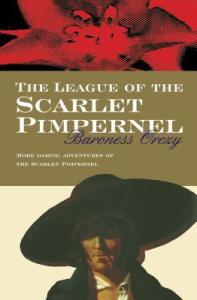
The League Of The Scarlet Pimpernel by Baroness Emmuska Orczy

The League of the Scarlet Pimpernel After reading The Scarlet Pimpernel a few years ago I was pleased to find that Baroness Orczy had written a whole series of Pimpernel books. I slowly (very slowly – this is only the third one I’ve read in three years) began to work my way through them in chronological order, but as I haven’t been particularly impressed by either this one or Sir Percy Leads the Band, I’m now wondering if I really want to read all of the others.

The League of the Scarlet Pimpernel was published in 1919 and is a collection of short stories, unlike the first two books I read which were both full-length novels. I don’t often choose to read short stories but as I’m also in the middle of some longer, heavier books at the moment, I thought this collection would be ideal for dipping into when I needed something lighter.

There are eleven stories in this book – all set during the French Revolution – and each one involves a family or group of aristocrats whose lives are in danger. It falls to Sir Percy Blakeney and his friends (known as the League of the Scarlet Pimpernel) to rescue them from the guillotine, often with the help of some clever disguises, cunning deceptions and daring rescue plans. Although all eleven stories are entertaining, they do become very repetitive, and once you’re familiar with the way Sir Percy works they are also very predictable.

Most of the stories are too short to have much of a plot and their main purpose just seems to be to highlight Sir Percy’s various masquerades and tricks, but there are a few stories that are longer and more complex. My favourite was probably the first one, Sir Percy Explains, in which our hero agrees to help rescue a little boy who has been captured by the revolutionary Jean Paul Marat. Almost all of the stories are written in the third person, but there are one or two with a first person narrator, which I liked because it added some variety to the book. How Jean Pierre met the Scarlet Pimpernel, narrated by the loyal servant of an impoverished noblewoman, was one of these and another of my favourites from this collection.

I was a bit disappointed that, given the title of this book, none of the other League members apart from Percy have a big part to play in any of the adventures. Tony and Ffoulkes make a few brief appearances, and one story deals with the subject of a traitor in the League, but that’s all. There’s no Marguerite either – Percy’s wife only has a one-sentence mention in one of the stories – but we do see a lot of the Pimpernel’s enemy, Citizen Chauvelin.

From what I’ve heard about the Scarlet Pimpernel series, the quality varies quite a lot from book to book. This one is worth reading, especially if you like short story collections, but it certainly doesn’t compare to the original novel. If I do continue to read the series, the next book I come to chronologically will be I Will Repay, which I’m hoping I’ll enjoy more than this one.

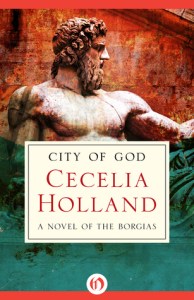
City of God by Cecelia Holland

City of God Since 1966 Cecelia Holland has written over thirty novels, most of them historical fiction, and some are now being re-released in ebook format by Open Road Integrated Media. As I’ve never read any of her work before, I was pleased to receive a copy of her 1979 novel, City of God, via NetGalley.

City of God is set in Rome at the beginning of the sixteenth century and, as the subtitle suggests, it is A Novel of the Borgias. With the former Rodrigo Borgia now Pope Alexander VI, the Borgia family already wield a large amount of influence in Rome, but the Pope’s illegitimate son, the condottiero Cesare Borgia, is now turning his attention to conquering the rest of the Italian city states. Cesare, known as Duke Valentino, has a reputation for being cruel and ruthless and even as he plots and schemes his way to power, his enemies are conspiring against him.

We see all of this through the eyes of Nicholas Dawson, secretary to the Florentine ambassador to Rome. Raised at a Spanish monastery after his English parents died in Pamplona, Nicholas is a man who seems to have no real connection or loyalty to any particular country or city. This makes him an ideal target for Valentino, who has his eye on Florence and needs a spy within the Florentine embassy. Nicholas has already been secretly rewriting the ambassador’s dispatches to suit his own political views – will betraying Florence to the Borgias be the next step?

As this is the first Cecelia Holland novel I’ve read I didn’t know what to expect – and I was quite surprised. This is a book with a very dark and claustrophobic atmosphere and the writing is completely unromantic, focusing firmly on the political machinations of Nicholas and the Borgias and the intrigue of the Papal Court.

I didn’t find this an easy book to read, but that’s because I’m not very familiar with the Borgias or the history of Rome in this period and Holland does seem to assume that the reader has some previous knowledge. She doesn’t spend much time explaining the negotiations, alliances and conflicts between Spain, France and the various Italian city states, but expects us to already understand the politics involved. I do like historical fiction that makes me think and that encourages me to look things up for myself so I can learn about the period, but I did wish I had known more about the subject before I started!

The characters in City of God are very unlikeable. The book doesn’t challenge the popular view of the Borgias as scheming and corrupt – Alexander is a Pope who gambles and who has mistresses and children, while Cesare is brutal and unscrupulous and Lucrezia, his sister, is the subject of gossip and suspicion – and the people around them are not much better. I found nobody to sympathise with or to admire, not even Nicholas. This wasn’t a big problem, though, as I can often still enjoy a book without liking the characters – and at least they were interesting.

Nicholas himself is a fascinating, complex character but it’s never obvious where his loyalties lie or if he even has any at all. He appears to be motivated by self-interest, ambition and the desire for power, and he enjoys using his brains to give advice to the Borgias and to act independently of the Ambassador. I’m not sure I ever fully understood what Nicholas was trying to do, but something that happens right at the end of the book made me think again about what he was hoping to achieve. Nicholas is also a gay man living in a time when it is dangerous to be openly homosexual and this adds another layer to the novel. His relationship with a young man called Stefano is an important aspect of the plot (though don’t expect a great love story, as even this part of the novel is free of romance and sentiment).

City of God was an interesting and unusual read; I didn’t love it but I do want to try another of Cecelia Holland’s books as I think I might prefer one with a different setting. Now that more of her books are being made available again I’ll have plenty to choose from!

I’m counting this book towards Week 3 of the Forgotten Histories Reading Challenge – Read a book with an LGBT protagonist.