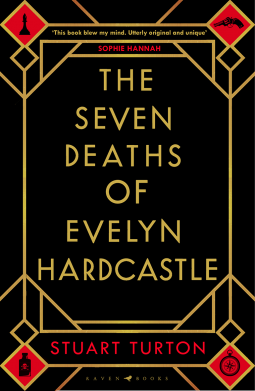
The Seven Deaths of Evelyn Hardcastle by Stuart Turton

I can’t even begin to imagine how much time and effort must have gone into the writing of this novel! I’ve never read anything like it before and I hardly know how to begin to describe it. It has all the elements of a classic murder mystery – but there’s a clue in the title: the same murder happens not just once but seven times.

The novel opens with a man waking up in a forest with no memory of who he is or how he came to be there. He has the name ‘Anna’ in his mind, although he has no idea who Anna might be. Hearing a woman scream, he rushes to help but is stopped by a stranger who pushes a compass into his pocket and whispers ‘East’. Following these instructions, he finds his way out of the woods and into the grounds of nearby Blackheath House, where the situation becomes even more bizarre. He discovers that he is a doctor called Sebastian Bell and that he is a guest at Blackheath where the Hardcastle family are throwing a party to mark the nineteenth anniversary of their son’s death.

All through the long and bewildering day which follows, Bell tries to make sense of what is happening, only to end up more confused than ever. Eventually, he is approached by a man wearing the costume of a Plague Doctor, who appears to have some of the answers. It seems that the Hardcastles’ daughter, Evelyn, is going to be murdered later that night and Bell’s task is to solve the murder. Should he fail, he will have the chance to live through the day again…but this time he will be someone else. Eight days and eight different ‘host bodies’; if at the end of that time he can provide a solution, he will be allowed to leave Blackheath. If not, he will go back to day one and the whole sequence will begin again…as it already has, many times before.

Everything I’ve said so far is explained to our narrator early in the novel. Once he begins waking up as the other hosts, however, things quickly become very complicated, with new clues and pieces of information coming to light on almost every page. I won’t say any more about the story itself, then, other than in general terms. I won’t even tell you who the other hosts are, as part of the fun is in wondering who the narrator is going to be next. Each host, though, has different strengths and weaknesses and is connected to the murder in a different way. It’s fascinating to see how each of them alone sees only a small part of the picture, and the truth only begins to emerge when all of their collective experiences and observations are taken into account.

This is an incredibly clever novel and so intricately plotted I have no idea how Stuart Turton managed to keep track of it all. Although it’s a long book, my recommendation is to read it in as few sittings as possible so you can try to hold on to all the threads of the story in your head. If your experience is anything like mine you’ll quickly become so engrossed that you won’t want to stop anyway. And experience is the right word for it. This doesn’t feel like a normal novel at all. It reminded me in some ways of one of those ‘choose your own adventure’ books I loved as a child where you could make choices that led to different routes through the story. That’s how I felt as the narrator lived through the same events again and again, trying to decide what he did wrong last time.

The novel is written in the first person present tense – a style I usually dislike but which is used very effectively here. It gives the reader a sense of being dropped directly into the middle of the action and sharing the narrator’s panic and disorientation. I don’t think it would have worked had it been written any other way. I thoroughly enjoyed this unusual and wonderfully imaginative novel!

Thanks to Raven Books for providing a copy of this book for review via NetGalley.
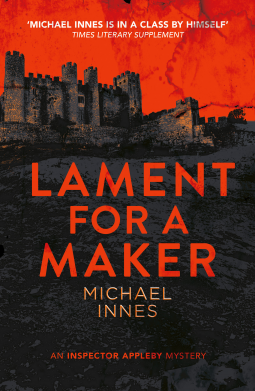
Lament for a Maker by Michael Innes

After reading Hamlet, Revenge! recently, I have been wanting to read more by Michael Innes, so I was pleased to find his next Inspector Appleby mystery, Lament for a Maker, available through NetGalley. Having read the previous book in the series I thought I knew what to expect from this one, but I was wrong – this book has a very different feel and structure and despite being published in 1938, it’s not a typical Golden Age mystery novel at all.

The title is taken from a 16th century Scottish poem by William Dunbar (the word maker, also spelled makar, means a poet or court poet). The Latin refrain Timor mortis conturbat me – fear of death disturbs me – is repeated throughout the poem and sets the tone for Innes’ novel.

This is such a complex, convoluted mystery it’s difficult to know where to begin, but the best place to start is probably with the crime itself – assuming that a crime has actually been committed, of course! Ranald Guthrie, the miserly laird of Erchany Castle has been killed falling from the ramparts of his own tower on a cold winter night, but was he pushed, was it an accident or could it have been a suicide attempt? If it was murder, then the culprit seems obvious: Neil Lindsay, the young man who wants to marry Ranald’s niece and whose family have been feuding with the Guthries for generations. There is much more to the situation than meets the eye, however, and as the story unfolds more suspects and possible scenarios begin to emerge.

The novel is written from the perspectives of five different characters who each take it in turns to narrate their part of the story. My favourite was the first, Ewan Bell, a shoemaker who lives in Kinkeig in Scotland. It is Ewan who sets the scene, introduces us to the other main characters in the novel and describes the events leading up to Guthrie’s death – all in his own distinctive voice, complete with plenty of Scots dialect!

“If an unco silence had fallen upon nature with the snow those weeks there were plenty of human tongues in Kinkeig to make good the deficiency. The less work always the more gossip, and there must have been even more claiking than usual about the meikle house.”

The second narrator is Noel Gylby, a young Englishman who appeared in Hamlet, Revenge! He is visiting Erchany Castle with his American girlfriend and immediately his narration (which takes the form of letters) has a very different feel from Ewan Bell’s:

“Diana darling: Leaves – as Queen Victoria said – from the Journal of my Life in the Highlands. Or possibly of my Death in the Lowlands. For I don’t at all know if I’m going to survive and I don’t know – I’m kind of guessing, as my girl-friend here says – where I am.”

And there are several more! Lots of authors have written books with multiple narrators but I haven’t come across many (apart from Wilkie Collins) who actually succeed in giving each narrator a unique voice of their own. This is one of the best attempts I’ve read for a while. It’s not just the style and structure which make this such an enjoyable novel, though; the mystery itself is also a good one, with twist following upon twist as the end of the book approaches.

As for Inspector Appleby himself, he doesn’t appear until two thirds of the way through the book when the mystery is already half solved and theories have been suggested. Although the novel is clearly set in the 1930s, there are times when both the story and the book itself feel as though they belong to a much earlier period (it reminded me very strongly of The Master of Ballantrae by Robert Louis Stevenson and it seems I’m not the only one to make that connection). This makes me wonder whether Innes may really have wanted to write a historical mystery but couldn’t as he needed to make it part of the Appleby series. That would explain why Appleby makes such a late appearance, almost as an afterthought.

Anyway, I loved this one. Thanks to Ipso Books for the review copy.

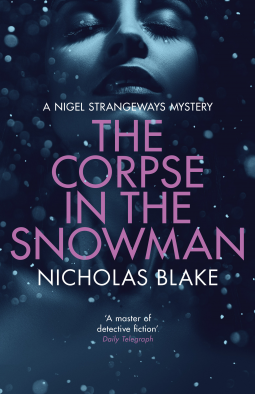
The Corpse in the Snowman by Nicholas Blake

Nicholas Blake was a pseudonym of the Poet Laureate Cecil Day-Lewis under which he wrote a series of mystery novels featuring the private investigator Nigel Strangeways. It seems there are sixteen in the series, published between 1935 and 1966, which is good news for me as The Corpse in the Snowman is my first and I enjoyed it so much I will certainly be reading more of them!

This book is set in winter, as you will have guessed from the title – and yes, there is a snowman and yes, there’s a dead body hidden inside it. We know this from the very first chapter, but what we don’t know is whose body it is and how it has come to be in such a strange and macabre hiding place. To find out what is going on, we have to go back several weeks to the moment earlier in the winter when Nigel and Georgia Strangeways arrive at Easterham Manor in Essex, home of the Restorick family. They have been invited by Clarissa Cavendish, an elderly cousin of Georgia’s who lives on the estate and who has become convinced that there is something badly wrong at the Manor.

Clarissa’s fears are proved correct when, the day after the Strangeways’ arrival, the beautiful Elizabeth Restorick is found dead in her bedroom. It looks like a suicide, but Nigel is sure it is murder – and with a large party of guests gathered at Easterham for the festive season, there are plenty of suspects to choose from.

All the elements of a classic mystery novel are here – a country house cut off by snow; a locked room murder; an amateur detective working alongside the local police; family secrets, clues and red herrings – but a lot of attention is also given to themes such as drugs and drug addiction (with some interesting insights into the attitudes of the time). Published in 1941, the war is in the background but doesn’t really have any influence on the story; it’s set in those early days of the war when not much seemed to be happening and apart from a reference to blackout curtains and Nigel’s complaint at having to travel to Essex in wartime on an old woman’s whim, it is barely mentioned at all.

Although Nigel Strangeways is very ordinary as far as literary detectives go (there’s nothing to make him stand out amongst the Poirots, Campions and Wimseys of the genre), I did like him and will be happy to spend more time in his company. I was intrigued by mentions of his wife Georgia’s past career as an explorer; she doesn’t have a very big part to play in the novel, but I enjoyed what we do see of her. As for the other characters, there are a good variety of them within the Restorick household, ranging from an author who is in love with Elizabeth to a doctor whose speciality is ‘nervous disorders’ in women. I particularly loved Clarissa Cavendish, who is obsessed with the Georgian period and speaks of it as ‘in my day’ as if she had actually been alive at the time.

I am so pleased to have discovered Nicholas Blake and I’m sure I’ll be trying another of his books soon!

Note: This book has also been published as The Case of the Abominable Snowman.

Thanks to Ipso Books for providing a copy of this book for review via NetGalley.
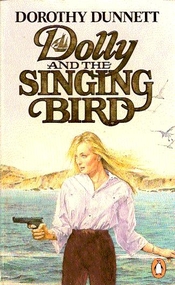
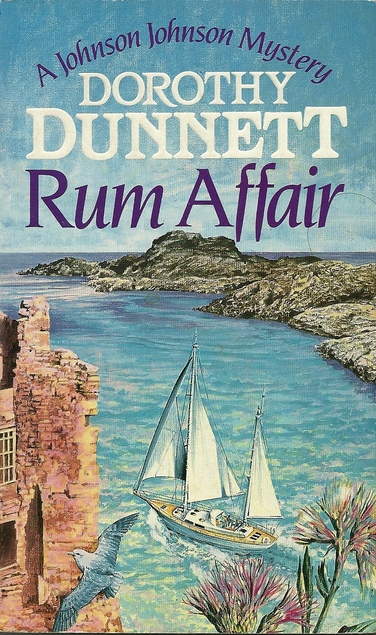
Rum Affair by Dorothy Dunnett – #1968Club

I am, after all, the only really photogenic coloratura soprano alive. My only problem, just about then, was in staying alive.

It’s been a while since I read my first of Dorothy Dunnett’s Johnson Johnson mysteries and this week’s 1968 Club (hosted by Simon and Karen) seemed the perfect opportunity to read another one. Rum Affair – originally titled Dolly and the Singing Bird and then The Photogenic Soprano – was the first in the series to be published (in 1968 obviously), although Tropical Issue, the other one I’ve read, was the first chronologically.

Dunnett is better known for her historical novels, some of which have recently been reissued, but the seven books in her mystery series have contemporary settings. They are each narrated by a different young woman and all feature the portrait painter Johnson Johnson and his yacht Dolly.

Rum Affair opens with Tina Rossi, a Polish-Italian opera singer, arriving in Scotland where she is due to give two performances at the Edinburgh Festival. During a break in her schedule, she has arranged to meet her lover, Kenneth Holmes, at his friend’s Rose Street flat. However, there’s no sign of Kenneth – just a card with the three handwritten words, “Darling, I’m sorry”. Searching for clues to explain his absence, Tina opens a wardrobe door to reveal the body of a man, a stranger, who has been shot in the chest. When the police unexpectedly arrive, making enquiries about a robbery in the neighbourhood, she quickly makes the decision to conceal what has happened – to try to save her own reputation, she tells us, and Kenneth’s.

Instinct is a marvellous thing, I dare say; but I prefer to use my good sense. You, perhaps, with a strange man lying dead at your feet would have welcomed the police with an exhibition of nervous relief. I, on the other hand, kept my head.

On the same night, Tina’s path crosses for the first time with that of Johnson, who is staying nearby. Tina is immediately intrigued by Johnson, a mysterious man who wears bifocals and introduces himself as “thirty-eight. Painter. London. On holiday.” When Johnson invites her to join him on a yacht race to the Isle of Rum, she is quick to accept. Rum is where Kenneth is currently based, working on a highly sensitive project for his employers, although she doesn’t admit this to Johnson. However, it seems that Johnson has a reason of his own for wanting Tina to sail with him on board Dolly – and it’s not just so that he can paint her portrait!

I won’t go into any more detail regarding the plot because I wouldn’t like to inadvertently give too much away and spoil the mystery – and I don’t want to say much more about Tina Rossi either as I’m finding that part of the fun of reading the Johnson novels is in getting to know the woman who is narrating the story. What I will say is that Tina is very different from Rita Geddes of Tropical Issue and that their narrative voices reflect their different personalities and backgrounds (while I liked Rita immediately, I never connected with Tina at all, but I suppose you can’t like every character in every book). As for Johnson himself, even though I have now read two books in this series, he is still very much an enigma to me. Of course, we only see him through the eyes of the narrators so we only know what they choose to tell us and are reliant on their observations and interpretations of his character, which may not always be correct or true.

I also found the setting interesting; the race in which Johnson and Tina are participating takes them around the west coast of Scotland, visiting several islands of the Inner Hebrides, of which Rum is one.

In the summer night, the Inner Hebrides lay all about us, black on the indigo sea. Above us, the uninterrupted sky stretched, a light, dense ultramarine, its ghostly clouds and small, sharp white stars suspended over the bright winking lights, near and far, of a constellation of lighthouses, and the grey, dimly voyaging waves here below.

I particularly enjoyed the scenes set at Fingal’s Cave on the island of Staffa!

Although I don’t think these books come close to the brilliance of Dunnett’s Lymond or Niccolò series, or King Hereafter, they are still quite enjoyable in a different way. I am looking forward to reading the rest and meeting the other five narrators.

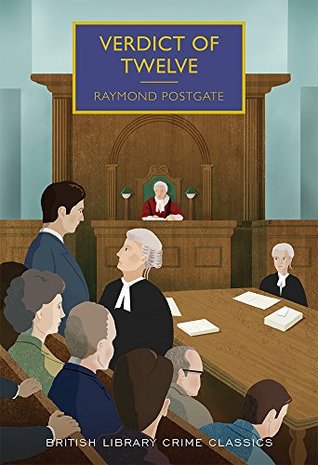
Verdict of Twelve by Raymond Postgate

A woman is on trial for murder and a jury is being sworn in to decide her fate. A jury of twelve men and women selected at random from all walks of life, each of whom has an interesting story of his or her own. Verdict of Twelve (1940), one of the British Library Crime Classics series, is as much about the jury as it is about the crime, which makes it an unusual and fascinating novel.

The book is divided into three main sections. In the first, we are introduced to each member of the jury as they step forward one by one to take their oaths. With an academic, a religious fanatic, a servant, a Greek restaurant owner and an encyclopedia salesman among them, many areas of society are represented and these twelve very different people must find a way to work together to reach what they believe to be the correct verdict.

The second part of the novel (which begins about a third of the way into the book) describes the crime itself. We are given some background information on the accused woman and then an account of the events which led up to the murder. I don’t think I can go into any detail without spoiling things, so I will just say that it is an intriguing mystery, very dark at times but with some humour at others. Although there are only a few suspects it is difficult to decide from the available evidence (which is largely circumstantial) exactly what happened and whether the jurors’ verdict should be guilty or not guilty.

Next, we watch the trial take place, listen to the witnesses and then join the jurors as they discuss the case and try to reach agreement. Finally a short epilogue lets us know whether we – and the jury – came to the right conclusion. It’s an interesting structure and one which I thought worked very well. Knowing the personal background of each juror before the trial begins helps us to see how their individual prejudices and experiences affects their reasoning when it comes to considering the evidence and making a decision. Some find that they have sympathy for the accused and some for the victim; as the reader, I felt that I was almost in the position of a thirteenth juror – and as I disliked one of the characters so much I found that I was also reacting emotionally rather than objectively.

My only slight criticism is that the first section of the book, in which the jury is introduced, is quite uneven. A few of the characters, particularly Victoria Atkins and Arthur Popesgrove, are fully fleshed out in what are almost self-contained short stories, while some of the others have only one or two pages devoted to them. As each juror has one twelfth of the input into the final decision, I’m not sure why we needed to know so much more about some of their backgrounds than others. Apart from this, I really enjoyed Verdict of Twelve – highly recommended for all lovers of classic crime!

Thanks to Poisoned Pen Press for providing a copy of this book for review via NetGalley.
This is book #6 for the R.I.P XII challenge.

Heartstone by CJ Sansom

As part of my Reading the Walter Scott Prize project, I knew that I would, at some point, need to read CJ Sansom’s Heartstone, which was shortlisted for the prize in 2011. Knowing that it was the fifth book in a series, though, and not having read any of the previous ones, I decided to start at the beginning with Dissolution and take my time working through them all. This was a good decision as I have thoroughly enjoyed the whole series – and now that I’ve finally read Heartstone, I won’t be stopping here but will be going on to read the sixth book, Lamentation, as well.

Like the earlier novels, this one is set in Tudor England and narrated by the hunchbacked lawyer Matthew Shardlake. It’s 1545 and with news of a huge French fleet about to cross the Channel, England is preparing for invasion. On Henry VIII’s orders, an army is being raised and warships including the Great Harry and the Mary Rose are getting ready for action in the harbour of Portsmouth. Meanwhile, Shardlake is also heading for the south coast on his latest mission for Catherine Parr, the Queen.

It has been claimed that “monstrous wrongs” have been committed against a young ward of court, Hugh Curteys, by his guardian Sir Nicholas Hobbey, and the Queen wants Shardlake to investigate. Accompanied, as always, by his assistant and clerk Jack Barak, Shardlake sets off on the journey from London to Hampshire, falling in with a company of soldiers on the way. On arriving at the Hobbey estate, it is obvious that there is something not quite right – but with Hugh insisting that he is not badly treated, how will Shardlake ever find out what is going on?

As if this wasn’t enough, Shardlake also has a second mystery to look into. In the previous novel, Revelation, he met Ellen Fettiplace, a woman who has been confined to the Bedlam for many years. With his work for the Queen taking him close to the village where Ellen grew up, he decides to do some investigating of his own in the hope of finding out what happened to her all those years ago and how she ended up in the asylum.

Poor Matthew; things just don’t run smoothly for him in this book and he is forced to acknowledge that he has been too “full of righteousness” – not a bad thing for a lawyer to be, you might think, but it does seem that he spends a lot of time trying to help people who really don’t want to be helped. Like Barak (who is desperate to get home in time to see the birth of his child), I found him quite frustrating with his refusal to leave things alone and take note of the warnings he is given, but of course that is what makes him feel so real and so human.

As I said, I’ve enjoyed all of the books in this series and this one is no exception. It isn’t my favourite, though, mainly because I felt that it was much longer than it really needed to be and that there was too much padding while Shardlake and Barak moved backwards and forwards between one location and another without anything happening to advance the plot. It didn’t help that I guessed the solution to one of the mysteries early in the book (probably because I have read a few other books recently with similar twists, and not because it was made particularly easy to guess) and had to wait a very long time for Shardlake to work it out for himself!

One thing I always love about the Shardlake novels is Sansom’s wonderful, vivid depiction of life in Tudor England. In this book, we are dropped right into a country making preparations for war (an unpopular and expensive war), and we learn a lot about the weapons and armour that are used, how men are recruited into the army and the training they undergo, as well as being treated to a long, dramatic description of the sinking of the Mary Rose at the Battle of the Solent. At the end of the novel, Sansom provides a detailed historical note in which he gives more information on the background to the story and separates fact from fiction.

Although I didn’t love Heartstone as much as some of the other books in the series, it was still a great read and I’m looking forward to joining Matthew Shardlake again soon in Lamentation.

This is book #5 for the R.I.P XII challenge.

As Chimney Sweepers Come to Dust by Alan Bradley

In this, the seventh book in Alan Bradley’s Flavia de Luce series, our twelve-year-old detective is sent away to boarding school in 1950s Canada, having been banished from her family home at the end of the previous novel. If you have never read a Flavia mystery before, this is probably not the best place to start; I would recommend reading at least a few of the earlier ones first, particularly the sixth, The Dead in Their Vaulted Arches, so that you will understand the reasons for her banishment and the choice of this particular Canadian school.

Anyway, back to As Chimney Sweepers Come to Dust. Almost as soon as Flavia arrives at Miss Bodycote’s Female Academy in Toronto, she stumbles upon yet another dead body – or rather, this one stumbles upon Flavia when it falls down the chimney in her room, having been dislodged by another girl who has climbed up to hide from a teacher. Why is there a dead body up the chimney? Who is it? Could it be one of the three missing girls who have all disappeared from the Academy over the last year or two? Flavia doesn’t know, but she’s determined to find out!

This is the first book in the series not to be set at Buckshaw, the de Luce ancestral home in the English village of Bishop’s Lacey. I have always found the setting to be part of the charm of these books, so although it was nice to have a change, I did find myself missing Father, Feely, Daffy, Dogger and everyone else from Buckshaw. There are plenty of new characters in this book to take their places – including an enigmatic and intimidating headmistress and a chemistry teacher who has been on trial for murder – but none of them felt as well drawn as the characters in the previous novels.

Still, I always enjoy a school setting because it brings back memories of the school stories I loved as a child, such as Enid Blyton’s Malory Towers and St Clare’s books. Maybe Alan Bradley liked that sort of story too and wanted an opportunity to write one of his own; otherwise I’m not sure I really see the point in moving Flavia out of her usual setting. I had expected the storyline involving the Nide, which was introduced in the last book, to be advanced in this one, but actually we learn very little more about it – and what we do learn just made me more confused!

I was pleased to find that this book had a much stronger mystery element than the previous one and although some parts of the mystery didn’t feel fully resolved at the end, it was nice to see Flavia back to making her lists of suspects and searching for clues. Finally, don’t Alan Bradley’s books have great titles? This one is taken from Shakespeare’s Cymbeline: “Golden lads and girls all must, As chimney-sweepers, come to dust”. The title of the next one, Thrice the Brinded Cat Hath Mew’d, is also Shakespeare-inspired. I’m looking forward to reading it – despite not liking the last two books as much as the earlier ones, I do still enjoy spending time with Flavia!

This is Book #2 for my R.I.P. XII challenge.