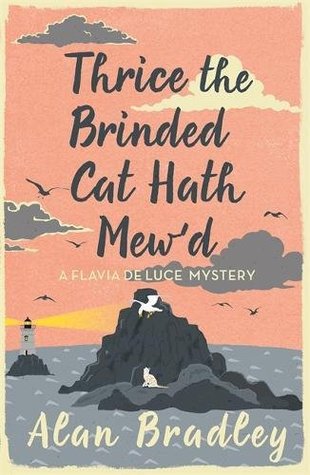
Thrice the Brinded Cat Hath Mew’d by Alan Bradley

In this, the eighth book in the Flavia de Luce mystery series, Flavia is back in England following her adventures at Miss Bodycote’s Female Academy in Canada, which are described in the previous novel As Chimney Sweepers Come to Dust. If you haven’t yet met Flavia I would recommend starting at the beginning with The Sweetness at the Bottom of the Pie; it’s not essential, as this one does stand alone as a murder mystery, but I think you’ll get more out of it if you already know Flavia and understand her family background.

At the beginning of Thrice the Brinded Cat Hath Mew’d (Alan Bradley’s books always have great titles), twelve-year-old Flavia returns to Buckshaw, the de Luce ancestral home, hoping for a warm welcome. Instead, the household feels strangely subdued and quiet. The reason for this becomes clear when Flavia learns that her father is seriously ill in hospital. Desperate to go and see him immediately, she is disappointed to be told that Father needs to rest and her visit will have to wait until the next day. The thought of staying in the house with her two unpleasant sisters Feely and Daffy and her annoying little cousin Undine is unbearable, so Flavia hops on to Gladys, her trusty bicycle, and goes out for a ride.

Calling at the home of her friend, the vicar’s wife, Flavia agrees to take a message to Roger Sambridge, an elderly woodcarver. Finding Roger’s door unlocked, she enters the house – only to discover the body of the woodcarver hanging upside down behind the bedroom door. Apart from a cat, there’s no sign that anyone else has been inside the room. It seems that Flavia has stumbled upon another mystery to solve…

This book is definitely an improvement on the previous one; I hadn’t really liked Flavia being taken out of her usual environment, so I was pleased to have her back at Buckshaw, riding Gladys and conducting experiments in her beloved chemistry laboratory. I was disappointed, though, that we didn’t see her interacting more with the other members of the de Luce household. Before she left for school in Canada at the end of the sixth book, there seemed to be hints that her relationships with Feely and Daffy (Ophelia and Daphne, in case you’re wondering) could be about to turn a corner, but in this book they barely speak to each other. I was also surprised that the Nide, the secret society which played a part in the plots of the last two novels, was only referred to once or twice – not that I’m complaining as I wasn’t very keen on that particular plot development anyway.

Although Flavia has only aged by a year or two since the beginning of the series, she does feel more mature now and is more daring in the methods of investigation she chooses to use. However, she is still only twelve and I found it unconvincing that she would really have been able to do some of the things she does in the novel (such as posing as a biographer in a meeting with a publisher). On the other hand, Flavia has always been unusual for her age, which is part of the charm of these books. I did enjoy watching her solve the crime and although I guessed one or two of the twists, I didn’t guess everything.

This is, I think, the second Flavia novel to be set at Christmas, but unlike the other one (I Am Half-Sick of Shadows), it doesn’t have a very festive atmosphere – which is understandable, with Father so ill in hospital. The last page of the book wasn’t really what I was expecting and I am now looking forward to reading the next one, The Grave’s a Fine and Private Place, to see what Alan Bradley has in store next for Flavia and her family.

I am counting this book towards the R.I.P. XIII challenge (category: mystery)

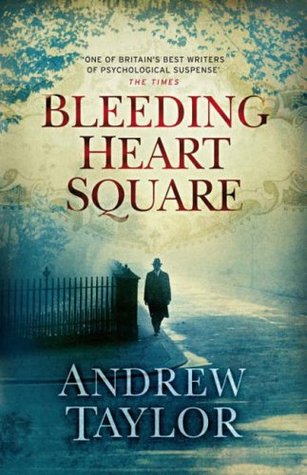
Bleeding Heart Square by Andrew Taylor

Andrew Taylor is one of my favourite authors of historical mysteries and after reading his latest one, The Fire Court, earlier this year, I remembered that I still had Bleeding Heart Square to read.

The novel opens in London in 1934 with Lydia Langstone, stepdaughter of the wealthy Lord Cassington, walking out on her violent and brutal husband. Armed with her copy of Virginia Woolf’s A Room of One’s Own, Lydia heads straight for Bleeding Heart Square, home to her father, Captain Ingleby-Lewis. The Captain isn’t entirely respectable and neither is the address, but Lydia doesn’t care – she just needs somewhere to stay until she can build a new, independent life for herself.

Another new resident of Bleeding Heart Square is Rory Wentwood, a young man who has recently returned from India to find that his girlfriend, Fenella, is no longer interested in marrying him. Rory still cares about Fenella, though, and when he hears about the disappearance of her aunt, Philippa Penhow, several years earlier, he decides to uncover the truth. The house at Bleeding Heart Square had belonged to Miss Penhow until she signed it over to the current owner, Joseph Serridge, before supposedly going to live in America. Rory has his doubts and has taken a room in the house so that he can investigate further.

When a number of foul-smelling parcels addressed to Mr Serridge begin to arrive at Bleeding Heart Square, the residents are both disgusted and intrigued. The packages contain rotten hearts neatly wrapped in brown paper and are obviously intended as a message to Mr Serridge – but who is sending them and why? What really happened to Philippa Penhow? And why is a policeman watching the house? Lydia teams up with Rory to try to find the answers, while doing her best to avoid her abusive husband.

Bleeding Heart Square is a mystery novel, but it is also a fascinating portrayal of life in 1930s London, with a particular focus on the rise of the fascism movement in Britain. One of the most memorable scenes in the book involves a meeting of the British Union of Fascists which descends into chaos when a few brave voices dare to question the party’s policies and are forcibly removed by Oswald Mosley’s black-shirted supporters. I found this aspect of the book interesting because of course with World War II on the horizon, fascism would soon become forever associated with Hitler and Mussolini and not something decent people would want to be part of – but here we see respectable people taking Mosley’s views seriously and considering giving him their support. It’s frightening to think of how different things could have been, and also still frighteningly relevant today.

Despite the 1930s setting, however, I thought the plot and the characters seemed much more suited to the Victorian period – there was a definite Dickens influence and in fact Bleeding Heart Yard appears in Little Dorrit. If you removed the fascism storyline, the rest of the novel could easily have been set in the 19th century; I was taken by surprise every time somebody got into a car as I felt it should have been a horse and carriage!

I liked both Lydia and Rory and found their personal stories so interesting that the central mystery felt almost secondary – although I was intrigued from the start by the brief diary entries and the comments by an unknown narrator that open every chapter. What will we learn from the diary and who is the narrator talking to? The ending of the book, in which the truth is revealed, was unexpected, but maybe there were clues from the beginning if I had been paying more attention!

Bleeding Heart Square isn’t my favourite of Andrew Taylor’s books – that would be The American Boy – but I did enjoy it and now that I’ve read all of his historical mysteries I’m wondering which of his other books I might like. Any recommendations are welcome!

This book counts towards the R.I.P. XIII challenge (category: mystery).
I am also counting it towards the What’s In a Name? challenge – a book with a shape in the title.

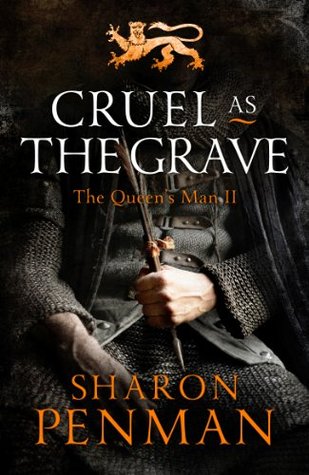
Cruel as the Grave by Sharon Penman

This is the second book in Sharon Penman’s Justin de Quincy mystery series set in medieval England. I liked but didn’t love the first one, The Queen’s Man, which is why it has taken me a while to get round to continuing, but I’m pleased to report that I found Cruel as the Grave a stronger and more enjoyable book. You could start with this one if you wanted to – there are some recurring characters but it works perfectly well as a standalone mystery.

In this book, set in 1193, Justin de Quincy, illegitimate son of the Bishop of Chester, is investigating the murder of Melangell, a young Welsh girl found dead in a London churchyard. The main suspects are the two sons of a wealthy merchant – the handsome, favoured eldest son, Geoffrey Aston, and his bitter, envious, younger brother Daniel. The Aston family are expecting Justin to clear the boys’ names, but as he delves deeper into the circumstances surrounding Melangell’s death, he is not sure he will be able to do that. The more he learns about the girl, a poor pedlar’s daughter, the more he begins to feel an affinity with her and he becomes determined to bring her killer to justice no matter what.

Meanwhile, two other brothers are also causing problems for Justin. The King of England, Richard I – the Lionheart – has been captured by the Duke of Austria and handed over as a prisoner to the Holy Roman Emperor. His mother, Eleanor of Aquitaine, is looking for a way to free him from captivity. In Richard’s absence, his younger brother John is plotting to take the crown for himself and has seized control of Windsor Castle. As Justin has assisted Eleanor in the past, she turns to him again for help.

Justin’s two missions are quite separate – one having implications for the whole country and the other much more intimate, affecting only a small number of people – but there are some parallels, such as the relationship between Geoffrey and Daniel resembling the one between Richard and John. The two storylines alternate throughout the book, but plenty of time is devoted to each one and I found them both interesting. As a murder mystery it is more tightly plotted than the first book in the series and although the culprit turned out to be the person I had suspected almost from the beginning, I still enjoyed watching the truth unfold.

Penman is better known for her long, sweeping historical novels such as Here Be Dragons and The Sunne in Splendour. Her mystery novels are much shorter, quicker reads but they still immerse the reader in the medieval period, giving us enough information to set the story in its historical context without going into a huge amount of detail. Justin himself, although perfectly likeable, continues to be slightly bland and forgettable, but the characters around him are strong and vibrant; his relationship with the queen’s lady, Claudine, is particularly intriguing and develops further in this book. I also loved Penman’s portrayal of the future King John – charismatic, complex and unpredictable:

Unlike Durand, John was not hostile. He seemed curious, almost friendly, as if welcoming a distraction midst the monotony of the siege. The Prince of Darkness. Justin wondered suddenly if John knew about Claudine’s private jest. He suspected that John would have been flattered, not offended. He must not let down his guard with this man. John could as easily doom him with a smile as with a curse.

I’ll think about reading the other two books in the series next time I’m in the mood for a medieval murder mystery, but first I really need to read The Reckoning, the final book in her Welsh Princes Trilogy, which I’ve had on my shelf since finishing the previous one, Falls the Shadow!

I am counting this book towards the R.I.P XIII Challenge (category: mystery).

The Lady Agnès Mystery Volume 1 by Andrea Japp – #WITMonth

I hadn’t made any plans for taking part in Women in Translation Month, but when I came across this book which had almost disappeared into the black hole of my Kindle, I decided to join in. Andrea Japp is a French crime novelist and this, the first volume of her Lady Agnès Mystery (originally published in 2006), has been translated into English by Lorenza Garcia. Japp herself is also a translator and produced the French translations of Patricia Cornwell’s Kay Scarpetta novels, which I think makes her a perfect choice for Women in Translation.

There are actually two books included in this volume – The Season of the Beast and The Breath of the Rose – but they do not stand alone and although they can be bought separately, there is not much point in reading one without the other. Together, the two books tell the story of Lady Agnès de Souarcy, a young widow living in 14th century France with her eleven-year-old daughter Mathilde and ten-year-old Clément, a servant’s child whom she has raised as her own son. Left with only a small dowry to live on, Agnès is struggling financially and reliant on the support of her half-brother, Eudes de Larnay. Unfortunately she and Eudes have always had a difficult relationship and when Inquisitors arrive in the area to hunt down heretics, Eudes sees this as the perfect opportunity to rid himself of his troublesome sister.

Agnès may have some powerful enemies but, unknown to her, she also has some powerful friends who are prepared to do everything they can to protect her from the horrors of the Inquisition. But is there any connection with the murders that have been carried out on Agnès’s land – dead bodies which have been discovered with the letter A marked on the ground beside them – and with the poisoning of several nuns at nearby Clairets Abbey? It seems that all of these things must be linked..but how?

The Lady Agnès Mystery is a book with many layers. First, there’s the richness of the historical setting. Set in the Perche region of France in 1304, the story takes places at a time of religious conflict and of power struggles between King Philip IV the Fair, his various advisers and their rivals, and the two religious orders, the Knights Templar and the Knights Hospitaller. We meet characters who belong to each of these groups and are given a range of different views and perspectives. It’s exactly the same period of history as I’ve previously read about in Maurice Druon’s Accursed Kings series and I loved revisiting it here. If you’re not familiar with this period, though, it shouldn’t be a problem; everything you need to know to understand the story is clearly explained in the text – and if you do want to know more, there are several appendices at the back of the book which provide definitions, explanations and brief biographies of historical figures.

This is not a dry, heavy read, though. There’s always something happening – a clandestine meeting in a dark tavern, a coded message being deciphered or a hidden room being explored, not to mention the vivid scenes depicting Agnès’s ordeals at the hands of the Inquisitors. My favourite aspect of the book was the mystery surrounding the deaths of the nuns…I particularly enjoyed watching the apothecary nun Sister Annelette using her knowledge of plants and herbs to try to catch the murderer.

So far so good. However, there is another storyline involving the Knights Templar, a secret prophecy and a missing manuscript which didn’t really interest me at all. I thought there was already enough going on with Agnès’s personal story and the murder mystery…and I’m sure I’m not the only one who finds it difficult to read this sort of storyline without making comparisons with The Da Vinci Code.

Volume 1 ends, not on a cliffhanger exactly, but with some of the many plot threads still unresolved. I would like to know what happens next to Lady Agnès and her family, and I would love to see more of the nuns of Clairets Abbey, but I have a feeling Volume 2 will be dominated by the prophecy storyline. Will I read it? At the moment I don’t think so, but I could change my mind.

Appleby’s End by Michael Innes

I’ve read quite a few of Michael Innes’ Inspector Appleby mysteries now; I think this is my sixth, and although I enjoyed it more than my last one, The Daffodil Affair, it doesn’t compare to my two favourites, Hamlet, Revenge! and Lament for a Maker. While I love the imaginativeness of his plots, some of them are a bit too bizarre and outlandish for me, and this is one of them.

The novel opens with Inspector John Appleby falling into conversation with a man sitting opposite on the train. His name is Everard Raven, an eccentric lawyer and writer of encyclopedias who is on his way home to his family’s country estate, Long Dream Manor. When Appleby discovers that he has made a mistake with the train timetable and won’t be able to reach his own destination until the following day, Everard offers to give him a room for the night at Long Dream. Meanwhile, they have been joined by the other members of the Raven family – Everard’s brothers, Luke and Robert, and two younger cousins, Judith and Mark – who are also returning home. They all disembark from the train together at a station which, to Appleby’s surprise, happens to be called Appleby’s End.

The eventful journey is not over yet, however. The horse-drawn carriage which has been sent to transport them from the station to Long Dream Manor gets stuck crossing a river and Appleby and Judith Raven find themselves separated from the rest of the party. Making their own way back to the house, they make a gruesome discovery – the head of one of the family servants half-buried in a snowdrift. When Appleby begins to investigate, he uncovers a possible connection between the servant’s death and a series of strange happenings in a nearby village. Strangest of all is the fact that these occurrences closely resemble plots from the long-forgotten works of Ranulph Raven, the late father of Everard, Luke and Robert. Can Ranulph’s novels really be starting to come true?

The story quickly becomes more and more surreal, as Appleby encounters a woman who believes she is a cow, animals turning into marble statues and rumours of witchcraft and magic. There are characters with names like Heyhoe and Rainbird and villages called Snarl, Drool, Sneak and Linger. At the heart of the novel there is an interesting and clever mystery taking place, but, for me, it gets lost beneath the sheer ridiculousness of it all. I’m sure it was intended to be a parody of rural life, and I could see some similarities with Cold Comfort Farm at times, but the humour didn’t really work for me. The only other notable thing to say about this book is that Appleby falls in love – I think. It’s not a particularly romantic romance – although he and his love interest do spend a night in a haystack together, which leads to a proposal of marriage.

Based on what I’ve read so far, all of Michael Innes’ novels do seem to be a bit quirky, but I prefer the ones that are slightly more serious. I’ll continue to read his books but I hope the next one I pick up will be a better choice for me.

A Morbid Taste For Bones by Ellis Peters #1977club

This week, Karen of Kaggsy’s Bookish Ramblings and Simon of Stuck in a Book are hosting another of their clubs where bloggers read and write about books published in one particular year. The chosen year this time is 1977 and although at first I thought I might have problems finding anything I wanted to read from that year, it turned out I had two suitable books already. One of them was A Morbid Taste for Bones, the first book in Ellis Peters’ Cadfael mystery series. I’ve been meaning to read this series for years, so 1977 Club seemed like the perfect opportunity to begin!

A Morbid Taste for Bones is set in the spring of 1137 and we first meet Brother Cadfael in the gardens of Shrewsbury Abbey tending the herbs with the assistance of two younger monks, John and Columbanus. John is a down-to-earth, practical young man, although Cadfael doubts whether he has a true vocation for the religious life, while Columbanus is starting to make a name for himself with his visions and dramatic ‘falling fits’. Returning from a trip to St Winifred’s Well in Gwytherin, North Wales, Columbanus claims that the saint has appeared to him, saying that her bones are being neglected by the people of Gwytherin and that she would like to be moved to Shrewsbury Abbey where more pilgrims will be able to visit her. Cadfael can’t help thinking that this seems very convenient, as Prior Robert has been considering ways to attract pilgrims to the Abbey and obtaining the bones of a saint would be the perfect solution!

As a Welshman, Cadfael is chosen as one of a small party of monks to travel into Wales and bring the saint’s relics back to Shrewsbury. However, when they reach Gwytherin they are met with resistance from the local people who don’t want to lose Winifred, especially not to England. Tensions rise and when a murder takes place in the woods, Cadfael works with the victim’s daughter to try to find the killer before an innocent man is accused.

I enjoyed my first Cadfael novel and part of the reason for that was because I really liked the character of Cadfael himself, with his mixture of warmth and intelligence, tolerance and imagination. Having entered the monastery later in life, he has a sort of worldliness that helps him to understand the feelings and motivations of people in the ‘outside world’. This allows him to have some sympathy for Brother John, who is struggling to reconcile his faith with other temptations, and also for Sioned, the young woman from Gwytherin whose father’s murder forms the mystery aspect of the novel.

I loved the way Peters portrays life in a small Welsh community: the village hierarchy, the farming of the land, what people did for entertainment, and most of all, how they felt about monks from England coming to take away the remains of a Welsh saint against their will. I was interested to learn, after finishing the book, that this was based on historical fact and Winifred’s relics really were taken from Wales to Shrewsbury Abbey where they remained until the dissolution of the monasteries in the reign of Henry VIII.

I don’t want to give the impression that this is a heavy or dry historical novel, though, because it isn’t – I found it entertaining and very readable. I already knew I liked Ellis Peters’ writing because I read one of her Cadfael short stories in a Christmas anthology last year, but I think her style is better suited to a full-length novel than it is to the shorter form and I enjoyed this much more. It’s also a good example of how to write a murder mystery without including an excessive amount of violence or unnecessarily graphic descriptions. A good choice for 1977 Club and a promising start to a new series for me!

~

I should have another 1977 book to tell you about later in the week, but for now here are a few older reviews I have posted of books published in that year:

The Brethren by Robert Merle
The Mauritius Command by Patrick O’Brian
Golden Bats and Pink Pigeons by Gerald Durrell
Gildenford by Valerie Anand

The Fire Court by Andrew Taylor

This is the second in Andrew Taylor’s new historical mystery series set during and after the Great Fire of London. The first book, The Ashes of London, set in 1666, deals with the Fire itself and the devastation it causes, as well as introducing us to our protagonists – James Marwood, son of a Fifth Monarchist, and Cat Lovett, daughter of a regicide involved in the execution of King Charles I. It’s not completely necessary to have read The Ashes of London before beginning The Fire Court as they both work as standalone mysteries, but I would still recommend it.

In The Fire Court, we watch as London begins to rebuild in the aftermath of the Great Fire. With so much of the city destroyed, so many homes and businesses burned to the ground, there’s a lot of rebuilding to be done! Naturally, this gives rise to disputes between landlords and tenants, and disagreements as to how land should be redeveloped and who is responsible for paying for it. A special court is established to deal with all of this: the Fire Court.

At the beginning of the novel, James Marwood’s elderly father dies after falling beneath the wheels of a wagon in a London street, but not before he has time to tell James about a horrific discovery he made in one of the chambers of the Fire Court – the body of a murdered woman, with blood on her yellow gown. At first, Marwood dismisses these claims as the ramblings of an old, ill man, but when he begins to investigate he comes across some clues which suggest that maybe his father was telling the truth after all.

Marwood wants to find out more, but it seems that his employers – Joseph Williamson, the Under-Secretary of State, and William Chiffinch, Keeper of the King’s Private Closet – would prefer him to leave things alone. He can’t walk away now, though; he’s already much too deeply involved. Others have become caught up in the mystery too, among them Cat Lovett who, following the events of the previous novel, is now living in the household of her cousin Simon Hakesby, the architect – and another young woman, Lady Jemima Limbury, whose marriage, it appears, is based on lies and deceit. All of these people have a part to play in the mystery that unfolds and none of them know who to trust.

I enjoyed The Ashes of London, but I thought The Fire Court was even better. The plot was a complex, interesting one and with the focus on lawyers and court cases, it reminded me at times of CJ Sansom’s Shardlake novels, which I love. Being the second book in the series, I felt that both main characters – Marwood and Cat – are starting to feel more fully developed now. I sympathised with Marwood’s conflicting feelings for his father and the dilemma he faces when he is forced to choose between his two masters, Williamson and Chiffinch. As for Cat, she continues to be in a dangerous position should her true identity be discovered, so she has taken the name Jane Hakesby and is pretending to be her cousin’s servant. In her situation, you would think it would be a good idea to keep a low profile, but with her courageous and fiery personality, she does nothing of the sort! I really like the way the relationship between Marwood and Cat is progressing; it has taken a while, but they are beginning to trust each other and work together.

There are some interesting secondary characters in this book too, ranging from Marwood’s servant, Sam, who lost a leg in the wars against the Dutch, to the sinister Lucius Gromwell, in whose room the murdered woman was found. I particularly enjoyed reading about Jemima Limbury: her background and lifestyle are very different from Cat’s but the situation in which she finds herself is no easier to endure.

I’m looking forward to reading more books about James Marwood and Cat Lovett – and am assuming that there are going to be more, as they are being marketed as ‘a series’ which would suggest that there won’t just be two! Meanwhile, I still need to read my copy of Bleeding Heart Square, the only historical mystery by Taylor that I still haven’t read!