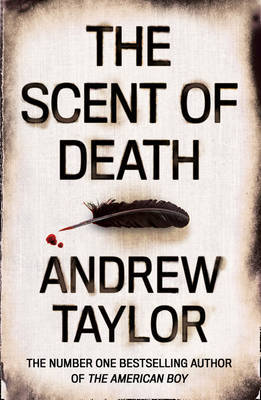
The Scent of Death by Andrew Taylor

The Scent of Death I’ve been looking forward to reading this book, having enjoyed some of Andrew Taylor’s previous novels, including The American Boy (An Unpardonable Crime in the US), so I was pleased to find that The Scent of Death was a similar type of historical mystery, though set in a different time and place.

The story begins in 1778, during the American War of Independence. Our narrator, Edward Savill, is an English clerk who has been sent to Manhattan (an area still under British rule at that time) to investigate the compensation claims of Loyalists who have been dispossessed of their property. Before Savill’s ship even arrives in the port, he sees a dead body being lifted out of the water. Soon another body is discovered – the body of Mr Pickett, a man who has connections with the Wintours, the family Savill will be staying with during his time in New York.

While Savill worries about the people he has left behind in England – his cold, distant wife and his beloved daughter – he also finds himself becoming embroiled in the lives of the Wintour family. As he gets to know Judge Wintour, his invalid wife and his beautiful daughter-in-law Arabella, whose husband is missing in action after the Battle of Saratoga, he starts to suspect they are covering up some secrets. Who killed Mr Pickett and why? Whose is the child Savill hears crying in the night? And what is the mysterious ‘box of curiosities’ he has heard so much about?

One of the things I like about Andrew Taylor’s historical novels is that he makes a real effort to use language appropriate to the time period throughout both the dialogue and the narration. I read a lot of historical fiction and there are a surprising number of authors who make no attempt to do this at all; there are very few who do it as convincingly as Taylor. He doesn’t use any jarring modern words or phrases and it all adds to the atmosphere and authenticity of the story, so that I could almost believe Edward Savill really was an 18th century English gentleman narrating his adventures to us. Remembering that this novel is set in the 1770s, we are also given a range of different opinions on slavery rather than the author just projecting 21st century views onto all of his characters, which would have been unrealistic.

As with Taylor’s other novels, you can never be sure which characters can and can’t be trusted. From Mr Townley and his clerk, Mr Noak, who nursed Savill through his seasickness on the long voyage from England, to the enigmatic Arabella Wintour herself, some of these people turn out to be friends and others enemies. I didn’t actually like any of them apart from Savill himself, but that wasn’t a problem at all – I’m sure we weren’t supposed to like them and were intended instead to get a feel for the hostility and suspicion Savill encountered everywhere he went.

The vivid, atmospheric settings are another strong point of Taylor’s novels. I don’t have much knowledge of the American Revolutionary War and Taylor does such a great job of portraying life in New York during this period: the variety of different people, including soldiers, spies, refugees and slaves, who had made the city their home; the overwhelming heat of summer and the intense cold of winter; and all the danger and intrigue of a city at war. Savill’s investigations take him into the heart of Canvas Town, an area of slums where many of the city’s criminal gangs have settled after it was destroyed by fire, and also away from New York, to the ruins of Arabella’s family plantation, Mount George.

But this was not a perfect book: while parts of it were exciting and absorbing (especially Savill’s journey into the dangerous, lawless ‘Debatable Ground’) and the short chapters made it easy to keep reading, the story moved forward very slowly and at almost 500 pages it felt too long – although admittedly it would be hard to see what could have been taken out. I did enjoy it, though, and while I did come close to solving the mystery, there were still some surprises and plot twists towards the end of the book. So, this was not my favourite Andrew Taylor book and unlike The American Boy will not be one of my books of the year, but it was definitely still worth reading and I hope it’s true that we are going to meet Edward Savill again in a future novel.


The Poisoned Island by Lloyd Shepherd

The Poisoned Island In June 1812 the Solander returns to London from a voyage to Tahiti financed by Sir Joseph Banks of the Royal Society. The ship is carrying a cargo of rare and exotic plants destined for the Kew Gardens. But why is Banks so interested in one particular specimen? Could there have been another motive behind the voyage?

When one of the Solander’s crew is found dead under suspicious circumstances, the magistrate John Harriott and Constable Charles Horton of the Thames River Police begin to investigate. Soon more murders take place – and when he learns that all of the victims were members of the crew, Horton must find out how the deaths could be connected with the recent trip to Tahiti.

I’ve been looking forward to this since I read Lloyd Shepherd’s first novel, The English Monster, last year. When you loved an author’s debut novel there’s always the worry that their next book might be a disappointment, but that was definitely not a problem here because I thought The Poisoned Island was even better than The English Monster! Both novels are complete stories in themselves and it’s not necessary to read them in order, but they do have a few things in common. They each explore the darker side of the British Empire, trade and colonialism (it seemed clear to me that one of the messages of The Poisoned Island is a warning against the dangers of exploiting a country for its resources), they both involve the Royal Society, and there are also some recurring characters, including Harriott and Horton of the River Police.

It’s interesting to see how Horton uses methods of crime-solving that in 1812 are new and innovative. Instead of merely watching and observing or relying on witness statements, he is actively investigating the crimes, looking for clues, searching for evidence, interviewing suspects and trying to find motives. This arouses the suspicion and dislike of London’s other police constables and magistrates but Harriott has faith in him and can see the value of his detection methods. Horton’s wife, Abigail, makes a few brief appearances in the novel too and I thought she had the potential to be a great character. The fact that Abigail was so underused was the only thing that disappointed me about this book; she’s intelligent, courageous and with her interest in natural science I had expected her to play a bigger part in the story.

Interspersed with the main storyline are some chapters set in Tahiti (or Otaheite as it was known at the time) following the adventures of a young Tahitian prince and showing us what happened to the island when Europeans first arrived bringing guns, alcohol and disease with them. But while The English Monster was a dual time period novel with alternating chapters set in different centuries, The Poisoned Island concentrates on Horton and Harriott’s London with only a few flashbacks to an earlier time. Although the murder mystery forms the central plot, there’s also a lot of historical detail that helps to bring the Regency period to life. And I enjoyed learning about the Kew Gardens, the process of collecting and studying botanical specimens, and the work of Joseph Banks’ librarian, the botanist Robert Brown. I’m hoping there will be more Harriott and Horton novels, but if not I will still look forward to whatever Lloyd Shepherd writes next.

I received a review copy of The Poisoned Island from the publisher

The White Cottage Mystery by Margery Allingham

The White Cottage Mystery I love reading detective novels from the Golden Age but I’m very aware of the number of authors from that era I still haven’t tried and until now, Margery Allingham was one of them. This is the first of her books that I’ve read but I’m now definitely interested in reading more of them. I understand The White Cottage Mystery was her first detective story, originally serialised in the Daily Express in 1927 before being published as a book the following year, and though it does have the feel of an early effort I still enjoyed it.

The mystery begins with Jerry Challoner driving through a small village in Kent one afternoon when he notices a young girl struggling to carry a heavy basket. Stopping his car, he offers to help, but shortly after dropping the girl off at her home, The White Cottage, he hears the sound of a gunshot. After learning that Eric Crowther, from the neighbouring house, the Dene, has been murdered inside The White Cottage, Jerry calls his father, Detective Chief Inspector W.T. Challoner of Scotland Yard. When W.T. arrives on the scene he interviews the family and servants who live both in the cottage and the house next door and discovers that the dead man was an unpleasant, blackmailing bully. There are plenty of people who have a motive for killing Crowther and who openly admit to wanting him dead, but W.T. and Jerry must decide which, if any of them, is the murderer.

Even though a murder is involved, there’s no graphic violence or anything too gruesome in this book, and the focus is on W.T’s attempts to solve the mystery. Written and set in the 1920s, W.T. uses old-fashioned methods of crime solving – looking for clues and questioning suspects – and his investigations uncover family secrets, blackmail and even connections to a secret society of thieves. The plot is not especially original but there’s still some suspense and a big twist near the end that took me by surprise – I would never have guessed who the murderer actually was and I can see why it took W.T. such a long time to figure it out.

The White Cottage Mystery is really more of a novella than a novel, short enough to be read in just a few sittings, but the plot was resolved satisfactorily and I felt that it didn’t really need to be any longer. Now that I know what Margery Allingham’s writing is like I think I’m going to enjoy exploring her other novels!

I received a copy of The White Cottage Mystery from Bloomsbury Reader via Netgalley.

The Beggar King by Oliver Pötzsch

The Beggar King It’s 1662 and the Schongau hangman, Jakob Kuisl, is travelling to Regensburg to visit his sister Lisbeth who has sent him a message saying she is seriously ill. Arriving in the city, Jakob discovers that he has walked into a trap: his sister and her husband are found dead in their bathhouse and Jakob is arrested on suspicion of murder. Imprisoned and tortured, he awaits his execution in one of the city’s dungeons.

Jakob’s daughter, Magdalena, vows to help her father and sets off to Regensburg with her lover, doctor’s son Simon Fronwieser. As they begin to investigate, Magdalena and Simon meet a variety of characters including a Venetian ambassador, a raftsman, a brewmaster – and the city’s community of beggars and thieves, led by Nathan the Wise, the ‘Beggar King’ of the title. They must decide who can and cannot be trusted and come up with a plan to rescue Magdalena’s father before it’s too late.

The Beggar King is the third in a series of historical mystery/thrillers following the adventures of 17th century Bavarian hangman Jakob Kuisl and his daughter Magdalena. The first two in the series are The Hangman’s Daughter and The Dark Monk; I haven’t read either of these but starting with the third book was not really a problem as this was a complete story in itself and not dependent on things that had happened in the previous books. If I had read the others I might have got more out of the story, as there were relationships that had obviously been developing over the course of the series, but I was still able to follow what was happening easily enough.

There were things that I liked about The Beggar King and the fast-paced, action-packed story did keep me entertained, but I don’t think I will be looking for any of the others in the series. The problem I had with the book was the language used in the dialogue. Would people in the 1660s really have called each other ‘lowlife drifters’ and would they have said something like “Just my luck that I wind up in the hands of a quack like you”? A lot of the terms and phrases that were used just sounded wrong to me. I’m aware that the book has been translated into English from its original German, so it’s hard to tell how much of this is down to the original text and how much to the translation, but when I read historical fiction I like to feel that I’ve been transported back in time and because of the dialogue I did not get that feeling at all with this book. As well as the language being too modern, the way some of the characters thought and behaved also felt too modern and I found it particularly difficult to believe in Magdalena as a realistic 17th century woman.

What I did enjoy was all the information we are given on the living conditions and medical history of the time, things I always find interesting to read about. Magdalena’s lover Simon is a ‘medicus’ (physician) and she herself is training to be a midwife. Jakob Kuisl also has some medical skills – it seems that the town hangman did much more than just carry out executions and was also involved in operating the instruments of torture during the interrogation of prisoners, and ironically, was responsible for tending the prisoners’ injuries after he had finished torturing them. In this way, the hangman gained a good knowledge of human anatomy and physiology.

I also loved the setting and the descriptions of the Bavarian village of Schongau and the city of Regensburg on the River Danube where most of the action takes place. I haven’t read much, if anything, about Germany in the 17th century and I enjoyed the author’s note at the end which takes us on a journey through Regensburg and tells us more about some of the places mentioned in the novel.

Inappropriate dialogue is something that often irritates me in historical fiction, but I know not everyone will be bothered by it. Looking at other reviews of The Beggar King, it does seem that the general opinion is overwhelmingly positive and a fourth book is already on its way!

I received a review copy of this book from the publisher via Netgalley

Envious Casca by Georgette Heyer

Envious Casca “Joseph, having lived for so many years abroad, hankered wistfully after a real English Christmas. Nathaniel, regarding him with a contemptuous eye, said that a real English Christmas meant, in his experience, a series of quarrels between inimical persons bound to one another only by the accident of relationship, and thrown together by a worn-out convention which decreed that at Christmas families should forgather.”

It’s Christmas Eve and at Lexham Manor the family and friends of Nathaniel Herriard are gathering for a Christmas party arranged by the old man’s brother, Joseph. The guests include Nat’s nephew Stephen and his fiancée Valerie, his niece Paula and her playwright friend Willoughby Roydon, a distant cousin, Mathilda Clare, and a business partner, Edgar Mottisfont. Putting up decorations as the snow falls outside, Joseph is looking forward to a good old-fashioned family Christmas. Unfortunately Nat doesn’t like the festive season, doesn’t want to have a party, and finds himself arguing with almost everyone present – which means that when he is found stabbed to death in his room later that evening there are plenty of suspects, all with motives for wanting him dead. The problem, as Inspector Hemingway quickly discovers, is that Nat’s door was locked from the inside. How could the murderer have entered a locked room? What happened to the murder weapon? And where could Aunt Maud’s library book, The Life of the Empress of Austria, have disappeared to?

I have read some of Heyer’s historical novels and loved most of them, but this is the first of her contemporary mysteries I’ve read (contemporary for the time in which they were published, that is – 1941 in this case). I had no idea which one to start with, but when I came across Envious Casca in the library and saw that it was set at Christmas, it seemed the perfect choice for a December read.

I wasn’t sure I was going to like this book at first. It took me a while to really get into the story and it didn’t help that most of the characters were completely unsympathetic. I have rarely read a novel with so many nasty, rude, unpleasant characters and I couldn’t think of anything worse than being a guest at the Herriards’ party, even without a murder taking place! From the obnoxious, sarcastic Stephen and the haughty butler Sturry to the cantankerous, bad-tempered Nathaniel, they were all so annoying I was surprised only one murder was committed. I did understand, though, that it was vital to the plot that the group of people gathered at the house disliked each other and that there had been so much friction and conflict directly before the murder. The clashing personalities did lead to some very funny conversations and situations too – the scene where everyone assembles in the drawing room to listen to Roydon read his play, for example.

The story really picked up for me after Inspector Hemingway was called in from Scotland Yard. I didn’t find Hemingway a very interesting character in comparison to other fictional detectives and I felt I never really got to know him or anything about his background, but I still enjoyed following his investigations and his discussions with his assistant, Sergeant Ware. I was quite proud of myself because I worked out how the murder was committed long before Hemingway did and my suspicion as to the identity of the murderer was proved to be right too. Luckily this didn’t take away any of the pleasure of reading the book and it was still fun looking out for more clues that might confirm I had the right solution. As a classic locked-room mystery with lots of suspects, red herrings and an English country house setting, it was maybe not a very original novel but the plot was well constructed and interesting. I liked the way the title of the book cleverly relates to the story too (if you don’t know what it means, wait until you’ve read the book before looking it up).

As my first introduction to Heyer’s mysteries, I enjoyed this one and am looking forward to reading the others.

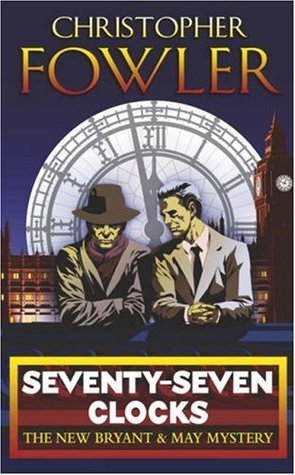
Seventy-Seven Clocks by Christopher Fowler

This is the third book in Christopher Fowler’s Bryant and May series following the investigations of two elderly detectives, Arthur Bryant and John May, who work for London’s “Peculiar Crimes Unit”. The first in the series, Full Dark House, looked back at their first mystery in the unit’s early days during World War II, while the second, The Water Room, was a fascinating mystery set in the present day and involving London’s system of underground rivers. This third instalment takes us back to 1973, when Britain was facing a winter of strikes and blackouts.

Seventy-Seven Clocks begins with two unusual incidents. The first is the death of a lawyer in the lobby of the Savoy Hotel, believed to be caused by a snake bite, and the second involves a man dressed in Edwardian clothing who runs into the National Gallery and damages a valuable painting. When more bizarre murders, accidents and abductions follow, Bryant and May discover that most of the victims are members of a large, rich family, the Whitstables. As they begin to investigate, the two detectives uncover a connection between the family and a Victorian secret society. Meanwhile, the receptionist at the Savoy Hotel, a seventeen-year-old girl called Jerry Gates decides to do some detective work of her own – but it seems that Jerry might have reasons of her own for disliking the Whitstables.

The solution to the mystery is both ingenious and completely ridiculous, but that has been the case with all three of the Bryant and May mysteries I’ve read and I’ve found that it doesn’t matter to me. In fact, the unusual and implausible plots are one of the reasons this series is so much fun to read and so different from anything else I’ve read. The other reason, of course, is that Bryant and May themselves are such wonderful characters. I find myself liking the character of Arthur Bryant more and more with every book. I love the way he refuses to leave no stone unturned or discount any possible theory, however unlikely it might seem. John May, being Bryant’s opposite in so many ways, is his perfect complement. One of the big differences between the two detectives is that May is willing to move forward and embrace new technology, while Bryant in many ways is still living in the past. As May says, “You find comfort in darkness. I prefer the world brightly lit; there’s so much more to see”.

The role of darkness and light is one of the themes explored during the story, but there were so many other things involved in this book I was slightly overwhelmed by it all! Pre-Raphaelite art, Gilbert and Sullivan societies, Victorian guilds (the Worshipful Company of Watchmakers), the British class system, the invention of electric light, and lots of other interesting topics and pieces of trivia. Christopher Fowler’s knowledge of London’s history is so impressive. Every time I come to the end of a Bryant and May book I feel that I’ve really learned something new.

If I have a criticism of this book, it’s that at nearly 500 pages it felt longer than it really needed to be, and I didn’t find Jerry’s storyline very interesting. It didn’t add much to the main plot in my opinion and could almost have been left out entirely. I thought the story was complex enough without it.

Oh, and if you’re new to Bryant and May and wondering if you need to read the series in the correct order, I would say it’s not necessary at all. It’s my personal preference to read a series in order if possible, but with these books each of the three mysteries I’ve read so far stand alone and are complete stories in themselves. I didn’t like this one quite as much as Full Dark House or The Water Room but I still enjoyed it and am looking forward to reading more Bryant and May soon.

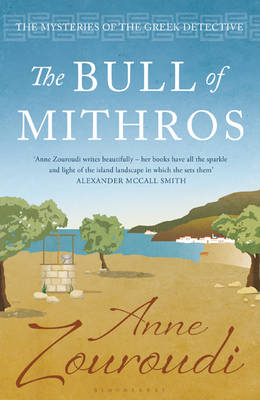
The Bull of Mithros by Anne Zouroudi

This is the sixth title in Anne Zouroudi’s “Greek Detective” mystery series. I haven’t read any of the five previous novels but that wasn’t a problem at all as this one worked perfectly as a standalone mystery.

The story is set on the small Greek island of Mithros, where the peace and tranquillity of island life is broken when a man is robbed and another killed by the escaping thieves. Seventeen years later, a boat appears in the bay and a stranger is thrown overboard. Until he can provide identification he is forced to stay on the island, where several of the islanders begin to recognise him. Is he connected in some way to the crime that took place all those years earlier? Soon another man arrives on the island of Mithros – this is Hermes Diaktoros, who has come to investigate. But where has he come from and who is he working for?

Hermes Diaktoros is a fascinating and unusual detective, a character shrouded in mystery. His name suggests a connection with Greek mythology (Hermes was the messenger of the gods) and there is definitely something slightly otherworldly about him. We learn very little about his past and he never reveals the identity of his employers either. He is referred to throughout the story as ‘the fat man’, which I thought might be irritating at first but it actually wasn’t. Despite him being such an enigmatic character (or maybe because of it) I really liked the fat man. He also reminded me in some ways of Poirot and in fact I think this series might appeal to Agatha Christie readers.

The pace of the story is gentle and relaxed, but not too slow. It also has a beautiful, atmospheric setting and would be the perfect book to take with you if you’re planning to visit a Greek island this summer! I enjoyed meeting Hermes Diaktoros for the first time and I didn’t feel I was at any disadvantage because of not having read the other novels first. Now that I’ve discovered this series I’d definitely like to read the earlier books and see how the fat man solved his previous five mysteries.

I received a review copy of The Bull of Mithros from Bloomsbury via Netgalley