Envious Casca by Georgette Heyer

Envious Casca “Joseph, having lived for so many years abroad, hankered wistfully after a real English Christmas. Nathaniel, regarding him with a contemptuous eye, said that a real English Christmas meant, in his experience, a series of quarrels between inimical persons bound to one another only by the accident of relationship, and thrown together by a worn-out convention which decreed that at Christmas families should forgather.”

It’s Christmas Eve and at Lexham Manor the family and friends of Nathaniel Herriard are gathering for a Christmas party arranged by the old man’s brother, Joseph. The guests include Nat’s nephew Stephen and his fiancée Valerie, his niece Paula and her playwright friend Willoughby Roydon, a distant cousin, Mathilda Clare, and a business partner, Edgar Mottisfont. Putting up decorations as the snow falls outside, Joseph is looking forward to a good old-fashioned family Christmas. Unfortunately Nat doesn’t like the festive season, doesn’t want to have a party, and finds himself arguing with almost everyone present – which means that when he is found stabbed to death in his room later that evening there are plenty of suspects, all with motives for wanting him dead. The problem, as Inspector Hemingway quickly discovers, is that Nat’s door was locked from the inside. How could the murderer have entered a locked room? What happened to the murder weapon? And where could Aunt Maud’s library book, The Life of the Empress of Austria, have disappeared to?

I have read some of Heyer’s historical novels and loved most of them, but this is the first of her contemporary mysteries I’ve read (contemporary for the time in which they were published, that is – 1941 in this case). I had no idea which one to start with, but when I came across Envious Casca in the library and saw that it was set at Christmas, it seemed the perfect choice for a December read.

I wasn’t sure I was going to like this book at first. It took me a while to really get into the story and it didn’t help that most of the characters were completely unsympathetic. I have rarely read a novel with so many nasty, rude, unpleasant characters and I couldn’t think of anything worse than being a guest at the Herriards’ party, even without a murder taking place! From the obnoxious, sarcastic Stephen and the haughty butler Sturry to the cantankerous, bad-tempered Nathaniel, they were all so annoying I was surprised only one murder was committed. I did understand, though, that it was vital to the plot that the group of people gathered at the house disliked each other and that there had been so much friction and conflict directly before the murder. The clashing personalities did lead to some very funny conversations and situations too – the scene where everyone assembles in the drawing room to listen to Roydon read his play, for example.

The story really picked up for me after Inspector Hemingway was called in from Scotland Yard. I didn’t find Hemingway a very interesting character in comparison to other fictional detectives and I felt I never really got to know him or anything about his background, but I still enjoyed following his investigations and his discussions with his assistant, Sergeant Ware. I was quite proud of myself because I worked out how the murder was committed long before Hemingway did and my suspicion as to the identity of the murderer was proved to be right too. Luckily this didn’t take away any of the pleasure of reading the book and it was still fun looking out for more clues that might confirm I had the right solution. As a classic locked-room mystery with lots of suspects, red herrings and an English country house setting, it was maybe not a very original novel but the plot was well constructed and interesting. I liked the way the title of the book cleverly relates to the story too (if you don’t know what it means, wait until you’ve read the book before looking it up).

As my first introduction to Heyer’s mysteries, I enjoyed this one and am looking forward to reading the others.

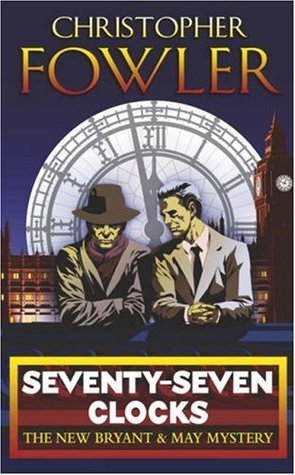
Seventy-Seven Clocks by Christopher Fowler

This is the third book in Christopher Fowler’s Bryant and May series following the investigations of two elderly detectives, Arthur Bryant and John May, who work for London’s “Peculiar Crimes Unit”. The first in the series, Full Dark House, looked back at their first mystery in the unit’s early days during World War II, while the second, The Water Room, was a fascinating mystery set in the present day and involving London’s system of underground rivers. This third instalment takes us back to 1973, when Britain was facing a winter of strikes and blackouts.

Seventy-Seven Clocks begins with two unusual incidents. The first is the death of a lawyer in the lobby of the Savoy Hotel, believed to be caused by a snake bite, and the second involves a man dressed in Edwardian clothing who runs into the National Gallery and damages a valuable painting. When more bizarre murders, accidents and abductions follow, Bryant and May discover that most of the victims are members of a large, rich family, the Whitstables. As they begin to investigate, the two detectives uncover a connection between the family and a Victorian secret society. Meanwhile, the receptionist at the Savoy Hotel, a seventeen-year-old girl called Jerry Gates decides to do some detective work of her own – but it seems that Jerry might have reasons of her own for disliking the Whitstables.

The solution to the mystery is both ingenious and completely ridiculous, but that has been the case with all three of the Bryant and May mysteries I’ve read and I’ve found that it doesn’t matter to me. In fact, the unusual and implausible plots are one of the reasons this series is so much fun to read and so different from anything else I’ve read. The other reason, of course, is that Bryant and May themselves are such wonderful characters. I find myself liking the character of Arthur Bryant more and more with every book. I love the way he refuses to leave no stone unturned or discount any possible theory, however unlikely it might seem. John May, being Bryant’s opposite in so many ways, is his perfect complement. One of the big differences between the two detectives is that May is willing to move forward and embrace new technology, while Bryant in many ways is still living in the past. As May says, “You find comfort in darkness. I prefer the world brightly lit; there’s so much more to see”.

The role of darkness and light is one of the themes explored during the story, but there were so many other things involved in this book I was slightly overwhelmed by it all! Pre-Raphaelite art, Gilbert and Sullivan societies, Victorian guilds (the Worshipful Company of Watchmakers), the British class system, the invention of electric light, and lots of other interesting topics and pieces of trivia. Christopher Fowler’s knowledge of London’s history is so impressive. Every time I come to the end of a Bryant and May book I feel that I’ve really learned something new.

If I have a criticism of this book, it’s that at nearly 500 pages it felt longer than it really needed to be, and I didn’t find Jerry’s storyline very interesting. It didn’t add much to the main plot in my opinion and could almost have been left out entirely. I thought the story was complex enough without it.

Oh, and if you’re new to Bryant and May and wondering if you need to read the series in the correct order, I would say it’s not necessary at all. It’s my personal preference to read a series in order if possible, but with these books each of the three mysteries I’ve read so far stand alone and are complete stories in themselves. I didn’t like this one quite as much as Full Dark House or The Water Room but I still enjoyed it and am looking forward to reading more Bryant and May soon.

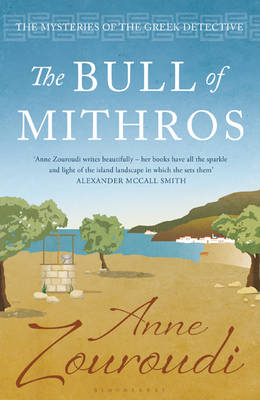
The Bull of Mithros by Anne Zouroudi

This is the sixth title in Anne Zouroudi’s “Greek Detective” mystery series. I haven’t read any of the five previous novels but that wasn’t a problem at all as this one worked perfectly as a standalone mystery.

The story is set on the small Greek island of Mithros, where the peace and tranquillity of island life is broken when a man is robbed and another killed by the escaping thieves. Seventeen years later, a boat appears in the bay and a stranger is thrown overboard. Until he can provide identification he is forced to stay on the island, where several of the islanders begin to recognise him. Is he connected in some way to the crime that took place all those years earlier? Soon another man arrives on the island of Mithros – this is Hermes Diaktoros, who has come to investigate. But where has he come from and who is he working for?

Hermes Diaktoros is a fascinating and unusual detective, a character shrouded in mystery. His name suggests a connection with Greek mythology (Hermes was the messenger of the gods) and there is definitely something slightly otherworldly about him. We learn very little about his past and he never reveals the identity of his employers either. He is referred to throughout the story as ‘the fat man’, which I thought might be irritating at first but it actually wasn’t. Despite him being such an enigmatic character (or maybe because of it) I really liked the fat man. He also reminded me in some ways of Poirot and in fact I think this series might appeal to Agatha Christie readers.

The pace of the story is gentle and relaxed, but not too slow. It also has a beautiful, atmospheric setting and would be the perfect book to take with you if you’re planning to visit a Greek island this summer! I enjoyed meeting Hermes Diaktoros for the first time and I didn’t feel I was at any disadvantage because of not having read the other novels first. Now that I’ve discovered this series I’d definitely like to read the earlier books and see how the fat man solved his previous five mysteries.

I received a review copy of The Bull of Mithros from Bloomsbury via Netgalley

Sacrilege by S.J Parris

Sacrilege is the third in a series of historical mysteries set in Tudor England and featuring Giordano Bruno, a former monk who left his monastery in Italy to escape the Inquisition. Bruno is now in London working as a spy for Queen Elizabeth I’s Secretary of State and ‘spymaster’, Sir Francis Walsingham. At the beginning of Sacrilege, he is reunited with Sophia, a girl he met in a previous instalment of the series. Sophia has run away from her home in Canterbury after being accused of murdering her husband, Sir Edward Kingsley, and she wants Bruno to help clear her name.

Bruno agrees to travel to Canterbury with Sophia where he hopes to uncover the truth about Kingsley’s death and discover the real murderer, but he also has another reason for visiting the city: Walsingham has asked him to investigate rumours of a Catholic plot against the Queen. But soon after his arrival there’s another death and Bruno finds himself caught up in a conspiracy involving the remains of St Thomas Becket, the former Archbishop of Canterbury who was murdered in the cathedral centuries earlier.

If you’re new to this series it would probably be better to start at the beginning with Heresy, and read the books in order. I haven’t read the previous two novels and although I was able to follow the plot of this one without too many problems, I did feel I was missing out on some important background information. The novel is narrated in the first person by Giordano Bruno, but I felt I never really got to know him, which could be partly due to the fact that I started in the middle of the series. I thought he was likeable enough, but not really the charismatic narrator the blurb had promised.

I didn’t know anything about Bruno before reading this book, but he was a real person, an Italian philosopher, mathematician and astronomer. It was interesting to read about him after finishing the novel and discover how much of his back story given in the book was based on the known facts about his life. We do meet some of the better known historical figures of the Elizabethan period too (Francis Walsingham and Sir Philip Sidney, for example) but although they do have a role to play, during most of the story they are kept in the background while the focus is on Bruno and his investigations.

The actual mystery storyline was interesting and complex. Although things did move forward at quite a fast pace, there were also a lot of long descriptive passages and I found I had to really concentrate on these because they sometimes contained clues and information that were vital to the plot. The novel appears to have been well researched and I thought the atmosphere of 16th century Canterbury, the city and the cathedral, was evoked quite well, but it all felt just a bit too modern to be completely convincing. I did enjoy Sacrilege but I don’t think I liked it enough to want to read more books in this series.

The Deathly Portent by Elizabeth Bailey

The Deathly Portent is the second in a series of historical mystery novels featuring Ottilia Fanshawe (also known as Lady Fan). The first in the series is The Gilded Shroud, but it’s not necessary to have read that one first as this is a complete story in itself.

The story is set in England during the Georgian period. Ottilia and her husband Lord Francis are riding home from a visit to Ottilia’s godmother when their coach breaks down near the village of Witherley. When they send their groom to look for the village blacksmith, they discover that Duggleby the blacksmith has been the victim of a murder – and that Cassie Dale, a young woman who has been branded a witch, is being blamed for it.

Ottilia has recently solved a mystery involving her husband’s family and is confident that she will be able to solve this one too. Believing Cassie Dale to be innocent, she begins to investigate in the hope of finding the real murderer and clearing Cassie’s name, but things soon start to become more dangerous than she had expected.

As soon as I started reading this book it reminded me in many ways of a Georgette Heyer novel – the time period, the language, the characters’ names, the dialogue – and so I wasn’t surprised to read that Heyer is one of Elizabeth Bailey’s influences. The appeal of this book for me was really the historical setting and the characters, though I did enjoy watching the mystery unfold too. There were lots of possible suspects, all with different motives for wanting Duggleby dead, and I was kept guessing until the truth was revealed at the end of the book.

One of the reasons I enjoy historical or vintage mysteries is that in the past we obviously didn’t have all the scientific methods of crime-solving that we have today and so detectives had to rely on making careful observations, hunting for clues, and talking to suspects and witnesses. And so Ottilia spends a lot of time getting to know the various residents of the village, listening to gossip and trying to make deductions from what she learns.

I loved Ottilia and Francis as a couple – they are both very easy to like and some of my favourite scenes were the ones in which they both appear together. Ottilia is a strong, intelligent character with a real enthusiasm for detective work and her husband is very supportive, although he can’t help worrying about her, particularly when he thinks she’s putting her life at risk unnecessarily. I’ll be interested to see how their relationship develops in any future novels in this series.

The events of the first Lady Fan novel, The Gilded Shroud, were referred to a few times in this book but not so much that I felt the previous novel had been spoiled. I will probably go back and read it at some point as I enjoyed meeting Lady Fan and would like to see how she solved her first mystery.

I received a copy of The Deathly Portent from the author for review.

Towards Zero by Agatha Christie

Towards Zero is one of only a few Agatha Christie novels to feature the detective Superintendent Battle. There’s no Poirot or Miss Marple in this one (although there is a TV adaptation – which I haven’t seen – where Miss Marple does appear) but even without them I thought this was an excellent murder mystery novel that deserves to be more popular. The story revolves around the murder of an elderly woman, Lady Tressilian, who has invited a group of guests to her seaside home at Gull’s Point.

With this novel, Christie takes a slightly different approach to normal. Instead of beginning with a murder and then following the detective’s attempts to solve it, she chooses to spend half the book describing the backgrounds of the characters, some seemingly unconnected episodes from their pasts, and the sequence of events that lead to the murder finally being committed and the murderer’s objective being achieved (what one of the characters refers to as ‘Zero Hour’).

“I like a good detective story,” he said. “But, you know, they begin in the wrong place! They begin with the murder. But the murder is the end. The story begins long before that – years before sometimes – with all the causes and events that bring certain people to a certain place at a certain time on a certain day.”

So by the time the murder takes place halfway through the book, the characters are quite well-developed and we know a lot about each of the possible suspects. Could the murderer be the tennis player, Nevile Strange, one of Lady Tressilian’s guests? Or his beautiful wife, Kay? Or could it be his first wife, Audrey, who happens to be visiting at the same time? Maybe it’s Thomas Royde, who is secretly in love with Audrey – or Ted Latimer, a friend of Kay’s. And what about Mary Aldin, Lady Tressilian’s companion?

I thought the mystery was a difficult one to solve and I think I suspected all of the above people at some point in the story! I thought I’d figured it out once or twice but was proved wrong and there were at least two big plot twists towards the end of the book that took me by surprise. Looking back, there were plenty of clues, but plenty of red herrings too.

Towards Zero is atmospheric, very cleverly plotted, and although it’s not one of my favourite Agatha Christie novels it’s still one that I would highly recommend.

The Gods of Gotham by Lyndsay Faye

New York City, 1845: When Timothy Wilde loses everything in a fire that destroys a large part of Manhattan, his brother Valentine helps him get a job as a ‘copper star’ in New York’s newly formed police force. Due to his knowledge of ‘flash’, a slang spoken largely by criminals, Timothy is assigned to the Sixth Ward, one of the city’s most notorious areas where crime rates are high and where racial and religious tensions are increasing with the influx of Irish immigrants fleeing the potato famine.

Timothy is unenthusiastic about his new job until one night when he’s walking home from work and a ten-year-old girl runs into him, covered in someone else’s blood. Soon Tim finds himself on the trail of a child killer and discovers that he has an unexpected talent for detective work.

I must admit that when I received a copy of The Gods of Gotham from the publisher, I wasn’t sure this was going to be the type of book I would enjoy. Well, I couldn’t have been more wrong, because I loved it! I could tell from the first page that I liked the writing style and by the end of the first chapter I knew I was going to like the narrator too. But the thing I enjoyed most about The Gods of Gotham was the wonderful setting. Every time I picked up this book and started to read I felt I had left the modern world behind for a while and was actually there, walking through the streets of 19th century New York, which is the highest praise I can give to any historical fiction novel. I’ve read so many books set in Victorian London, and it made a nice change to read one set in New York during the same period.

We also meet lots of strong, interesting characters – Mercy Underhill, the reverend’s daughter and the woman Timothy loves; Bird Daly, the little Irish girl he met in the street at the start of the novel; and Silkie Marsh, who runs the brothel at the centre of the murder investigations. And at the heart of the story is the relationship between Tim and his brother Valentine. Timothy himself is easy to like but he isn’t perfect and has enough flaws to make him a believable character. Although he doesn’t always interpret things correctly, he’s intelligent, observant and compassionate. Val is a very different type of person – tough, aggressive, addicted to morphine and drinking – but by the end of the book we learn that there’s more depth to Val than there seemed to be at first.

The use of flash is something that you will probably either love or hate – personally I thought it added to the atmosphere of the book and made the dialogue feel lively and fun. I was surprised to find that I was already familiar with some of the words and it was interesting to see how many of them have now come into everyday use. But there were other words and phrases that meant nothing to me and so the glossary at the front of the book (based on George Washington Matsell’s Vocabulum, or The Rogue’s Lexicon) was very helpful, especially at first!

For me, the actual crime plot was secondary to the setting, the atmosphere and the characters but it was still good enough to keep me guessing until the truth was finally revealed. The Gods of Gotham was something different and original – I loved it and was pleased to discover that there’s going to be a sequel!

I received a review copy of this book from Headline Review.