Speaking from Among the Bones by Alan Bradley

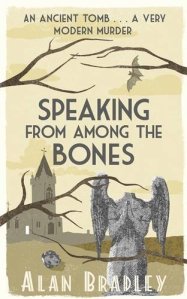
Speaking from Among the Bones Speaking from Among the Bones is Alan Bradley’s fifth novel featuring the wonderful Flavia de Luce. Flavia’s intelligence, her passion for chemistry (particularly poisons), and the fact that she is still only eleven years old makes her one of the most fascinating and unusual detectives in fiction. The series is set in the 1950s in the small English village of Bishop’s Lacey where Flavia lives with her father and two sisters, Ophelia and Daphne, at the family’s ancestral home, Buckshaw. In each book Flavia investigates a murder mystery, torments (and is tormented by) her sisters, conducts experiments in her chemical laboratory, and desperately searches for information about the mother she has never known.

Flavia’s fifth adventure begins as she excitedly awaits the removal of St Tancred’s bones from his tomb in the church crypt to commemorate the five-hundredth anniversary of his death. She is hoping to be the first person in Bishop’s Lacey to see the saint’s bones, but what she eventually discovers when the tomb is opened is something quite different: the body of the church organist, Mr Collicutt, who had disappeared a few weeks earlier. Who murdered him and what was their motive? And why is he wearing a gas mask? These are the questions Flavia must try to answer – hopefully before Inspector Hewitt solves the mystery first! Accompanied by her trusty old bicycle, Gladys, Flavia begins to search for clues, but as well as making some discoveries regarding the organist’s death and the possible identity of his killer, she also starts to uncover some of the secrets of her mother’s past.

I’ve enjoyed every book in the series so far, but I think this one might be my favourite (either this or the Christmas-themed one, I am Half-Sick of Shadows). As I’ve mentioned in my previous Flavia reviews, I love this series because I love Flavia, the supporting characters, and the setting of Bishop’s Lacey. The actual murder mysteries are not usually very complex or difficult to solve and are not the attraction of these books for me, but I thought this was an improvement on the previous ones. It was tightly plotted with lots of clues, suspects and red herrings and during her investigations Flavia finds herself crawling through underground tunnels, entering secret locked rooms, encountering a wooden effigy that appears to have started weeping blood in the church, and discovering that she is not the only amateur detective in Bishop’s Lacey!

While Flavia is still just eleven and has only aged slightly over the course of the series, I do think we’ve seen her grow up and mature since the first book. There has been development with some of the other characters too, particularly Ophelia (Feely) and Daphne (Daffy), Flavia’s two sisters, who are not quite as horrible to Flavia in this book as they have been previously – or maybe Flavia is just learning to deal with them better. Also in this book, their father is continuing to have financial difficulties, forcing him to consider putting Buckshaw up for sale and this shared trauma helps to bring the whole family together for once. By ‘family’ I’m including the servants, Mrs Mullet and Dogger. Dogger is a great character and a true friend to Flavia – I like him more and more with every book!

If you’re new to this series, beginning with book five probably wouldn’t be a problem, but if possible I would recommend starting with the first one, The Sweetness at the Bottom of the Pie, and enjoying all of Flavia’s adventures in order. This is the only one to finish with a cliffhanger ending, which means I now can’t wait to read the sixth book, The Dead in Their Vaulted Arches!

The Strange Fate of Kitty Easton by Elizabeth Speller

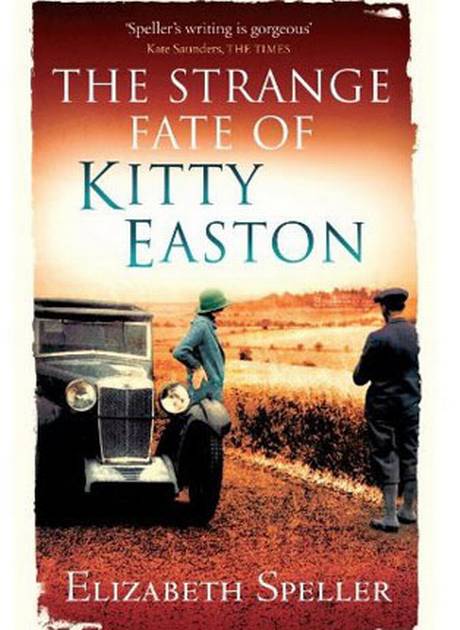
Kitty Easton I first met Laurence Bartram two years ago when I read The Return of Captain John Emmett, a mystery novel set in 1920s England. The Strange Fate of Kitty Easton is the sequel. In this book, Laurence’s friend William Bolitho, an architect, has asked Laurence to join him in the village of Easton Deadall. Easton Deadall lost many of its young men in the First World War and William has agreed to design a memorial window for the small church at Easton Hall. As an expert on churches and their renovations, Laurence’s help and advice is needed.

During the journey to Easton Deadall, Laurence learns about the disappearance of Digby and Lydia Easton’s five-year-old daughter, Kitty, several years earlier. Kitty went missing from her bed one night but her body was never found and her fate is still unknown. Since Kitty’s disappearance, the Easton family have continued to suffer; Digby was killed in the war, Lydia has become seriously ill and the relationship between Digby’s two surviving brothers, Julian and Patrick, is strained and tense.

After a slow start in which Elizabeth Speller introduces us to the characters, describes their tragic history and paints a portrait of a small English village trying to recover from the devastation of war, a mystery begins to develop. Another child disappears on a family trip to London to see the British Empire Exhibition and when a murder is committed in Easton Deadall, Laurence is sure both of these incidents are connected to the disappearance of Kitty Easton all those years ago.

I enjoyed this book almost as much as the previous one. The plot was well constructed with some interesting twists and lots of family secrets that are slowly revealed to the reader, but although I’ve referred to the book as a ‘mystery novel’ once or twice in this post, and in many ways it is a mystery novel, it’s also much more than that. The fate of Kitty Easton really only forms a small part of the story.

While reading both of the Laurence Bartram books, I have been impressed by the amazing sense of time and place the author creates. These books don’t just feel like pieces of historical fiction written in the modern day and set in the past – they almost feel as if they could really have been written in the 1920s. As with The Return of Captain John Emmett, my favourite thing about this book was the way it explores so many different aspects of the Great War and reminds us that although the war may have ended in 1918, its consequences were still being felt all over the world for many years afterwards.

There are lots of interesting characters to get to know too (I was particularly intrigued by the story of the youngest Easton brother, Patrick, resented by his family for abandoning them during the war after being excused from fighting on health grounds). The only thing that disappointed me slightly was that until we reach the final chapters of the book, Laurence seems to be on the outside watching and observing rather than taking an active role in the story. I do like Laurence but as the central character of a series I find him a bit bland and it would be nice to see his own personality coming through more strongly.

The way this book ended leaves plenty of scope for a third in the series and I hope there is going to be another one, though I notice that Elizabeth Speller has a new book due out in November with different characters, set during the Battle of the Somme.

The Doctor of Thessaly by Anne Zouroudi

The Doctor of Thessaly This is the third in Anne Zouroudi’s ‘Mysteries of the Greek Detective’ series following the investigations of Hermes Diaktoros, also known as ‘the fat man’. This appears to be a series that can be read in any order – I read the sixth book, The Bull of Mithros, first and then this one and haven’t had any problems; each novel is a complete story in itself. What the books do have in common is the character of the fat man, a theme based on one of the seven deadly sins and a beautiful Greek setting.

The Doctor of Thessaly is set in Morfi, a village on one of the Greek islands. The story begins with the discovery that the village doctor, Louis Chabrol, has been blinded in an attack that took place the night before his marriage to Chrissa Kaligi, the younger of two middle-aged sisters. This crime couldn’t have happened at a worse time, as the people of Morfi and their ambitious new mayor are preparing for a visit from a government minister.

Luckily, our hero, the enigmatic Hermes Diaktoros of Athens, has just arrived in Morfi and when he learns of the attack he begins to investigate. As he moves around the village speaking to witnesses, listening to gossip and collecting evidence he starts to build up a clearer picture of what has happened – and when he eventually discovers who is responsible for the crime, he dispenses his own form of justice.

I thought this was a better book than The Bull of Mithros, though I did like them both. I loved the atmospheric setting of Morfi, a quiet Greek village untouched by tourism or modern technology (it’s not clear when these books are supposed to be set, which I’m sure is intentional – it could be any time in the second half of the 20th century) and I enjoyed meeting the people who live there. I mentioned that each of the books in this series is based around one of the seven deadly sins. This one has a theme of ‘envy’ which is very appropriate as there are many people in Morfi who could be accused of this sin, from Chrissa’s bitter and resentful sister, Noula, to the group of four jealous, spiteful men who are determined to spoil things for the new mayor.

The fat man continues to be a mysterious, elusive character. Is it a coincidence that he has the name of a Greek god? Who are the higher authorities he claims to represent? And why is he so obsessed with keeping his white tennis shoes clean? These things were as much a mystery when I read the sixth book as they were reading this third book, so unless the truth about his identity and background are going to be revealed at the end of the series it seems that we are going to be left to make up our own minds about Hermes Diaktoros. I do like him though; not only is he concerned with making criminals pay for what they have done, he also wants to help the people he meets along the way and leave the village behind in a better, happier state than when he arrived.

I will continue to read the other books in the series, though I think they are the type of books that would start to feel repetitive if read too close together so I’ll probably wait a while before starting another one!

The Scent of Death by Andrew Taylor

The Scent of Death I’ve been looking forward to reading this book, having enjoyed some of Andrew Taylor’s previous novels, including The American Boy (An Unpardonable Crime in the US), so I was pleased to find that The Scent of Death was a similar type of historical mystery, though set in a different time and place.

The story begins in 1778, during the American War of Independence. Our narrator, Edward Savill, is an English clerk who has been sent to Manhattan (an area still under British rule at that time) to investigate the compensation claims of Loyalists who have been dispossessed of their property. Before Savill’s ship even arrives in the port, he sees a dead body being lifted out of the water. Soon another body is discovered – the body of Mr Pickett, a man who has connections with the Wintours, the family Savill will be staying with during his time in New York.

While Savill worries about the people he has left behind in England – his cold, distant wife and his beloved daughter – he also finds himself becoming embroiled in the lives of the Wintour family. As he gets to know Judge Wintour, his invalid wife and his beautiful daughter-in-law Arabella, whose husband is missing in action after the Battle of Saratoga, he starts to suspect they are covering up some secrets. Who killed Mr Pickett and why? Whose is the child Savill hears crying in the night? And what is the mysterious ‘box of curiosities’ he has heard so much about?

One of the things I like about Andrew Taylor’s historical novels is that he makes a real effort to use language appropriate to the time period throughout both the dialogue and the narration. I read a lot of historical fiction and there are a surprising number of authors who make no attempt to do this at all; there are very few who do it as convincingly as Taylor. He doesn’t use any jarring modern words or phrases and it all adds to the atmosphere and authenticity of the story, so that I could almost believe Edward Savill really was an 18th century English gentleman narrating his adventures to us. Remembering that this novel is set in the 1770s, we are also given a range of different opinions on slavery rather than the author just projecting 21st century views onto all of his characters, which would have been unrealistic.

As with Taylor’s other novels, you can never be sure which characters can and can’t be trusted. From Mr Townley and his clerk, Mr Noak, who nursed Savill through his seasickness on the long voyage from England, to the enigmatic Arabella Wintour herself, some of these people turn out to be friends and others enemies. I didn’t actually like any of them apart from Savill himself, but that wasn’t a problem at all – I’m sure we weren’t supposed to like them and were intended instead to get a feel for the hostility and suspicion Savill encountered everywhere he went.

The vivid, atmospheric settings are another strong point of Taylor’s novels. I don’t have much knowledge of the American Revolutionary War and Taylor does such a great job of portraying life in New York during this period: the variety of different people, including soldiers, spies, refugees and slaves, who had made the city their home; the overwhelming heat of summer and the intense cold of winter; and all the danger and intrigue of a city at war. Savill’s investigations take him into the heart of Canvas Town, an area of slums where many of the city’s criminal gangs have settled after it was destroyed by fire, and also away from New York, to the ruins of Arabella’s family plantation, Mount George.

But this was not a perfect book: while parts of it were exciting and absorbing (especially Savill’s journey into the dangerous, lawless ‘Debatable Ground’) and the short chapters made it easy to keep reading, the story moved forward very slowly and at almost 500 pages it felt too long – although admittedly it would be hard to see what could have been taken out. I did enjoy it, though, and while I did come close to solving the mystery, there were still some surprises and plot twists towards the end of the book. So, this was not my favourite Andrew Taylor book and unlike The American Boy will not be one of my books of the year, but it was definitely still worth reading and I hope it’s true that we are going to meet Edward Savill again in a future novel.

The Poisoned Island by Lloyd Shepherd

The Poisoned Island In June 1812 the Solander returns to London from a voyage to Tahiti financed by Sir Joseph Banks of the Royal Society. The ship is carrying a cargo of rare and exotic plants destined for the Kew Gardens. But why is Banks so interested in one particular specimen? Could there have been another motive behind the voyage?

When one of the Solander’s crew is found dead under suspicious circumstances, the magistrate John Harriott and Constable Charles Horton of the Thames River Police begin to investigate. Soon more murders take place – and when he learns that all of the victims were members of the crew, Horton must find out how the deaths could be connected with the recent trip to Tahiti.

I’ve been looking forward to this since I read Lloyd Shepherd’s first novel, The English Monster, last year. When you loved an author’s debut novel there’s always the worry that their next book might be a disappointment, but that was definitely not a problem here because I thought The Poisoned Island was even better than The English Monster! Both novels are complete stories in themselves and it’s not necessary to read them in order, but they do have a few things in common. They each explore the darker side of the British Empire, trade and colonialism (it seemed clear to me that one of the messages of The Poisoned Island is a warning against the dangers of exploiting a country for its resources), they both involve the Royal Society, and there are also some recurring characters, including Harriott and Horton of the River Police.

It’s interesting to see how Horton uses methods of crime-solving that in 1812 are new and innovative. Instead of merely watching and observing or relying on witness statements, he is actively investigating the crimes, looking for clues, searching for evidence, interviewing suspects and trying to find motives. This arouses the suspicion and dislike of London’s other police constables and magistrates but Harriott has faith in him and can see the value of his detection methods. Horton’s wife, Abigail, makes a few brief appearances in the novel too and I thought she had the potential to be a great character. The fact that Abigail was so underused was the only thing that disappointed me about this book; she’s intelligent, courageous and with her interest in natural science I had expected her to play a bigger part in the story.

Interspersed with the main storyline are some chapters set in Tahiti (or Otaheite as it was known at the time) following the adventures of a young Tahitian prince and showing us what happened to the island when Europeans first arrived bringing guns, alcohol and disease with them. But while The English Monster was a dual time period novel with alternating chapters set in different centuries, The Poisoned Island concentrates on Horton and Harriott’s London with only a few flashbacks to an earlier time. Although the murder mystery forms the central plot, there’s also a lot of historical detail that helps to bring the Regency period to life. And I enjoyed learning about the Kew Gardens, the process of collecting and studying botanical specimens, and the work of Joseph Banks’ librarian, the botanist Robert Brown. I’m hoping there will be more Harriott and Horton novels, but if not I will still look forward to whatever Lloyd Shepherd writes next.

I received a review copy of The Poisoned Island from the publisher

The White Cottage Mystery by Margery Allingham

The White Cottage Mystery I love reading detective novels from the Golden Age but I’m very aware of the number of authors from that era I still haven’t tried and until now, Margery Allingham was one of them. This is the first of her books that I’ve read but I’m now definitely interested in reading more of them. I understand The White Cottage Mystery was her first detective story, originally serialised in the Daily Express in 1927 before being published as a book the following year, and though it does have the feel of an early effort I still enjoyed it.

The mystery begins with Jerry Challoner driving through a small village in Kent one afternoon when he notices a young girl struggling to carry a heavy basket. Stopping his car, he offers to help, but shortly after dropping the girl off at her home, The White Cottage, he hears the sound of a gunshot. After learning that Eric Crowther, from the neighbouring house, the Dene, has been murdered inside The White Cottage, Jerry calls his father, Detective Chief Inspector W.T. Challoner of Scotland Yard. When W.T. arrives on the scene he interviews the family and servants who live both in the cottage and the house next door and discovers that the dead man was an unpleasant, blackmailing bully. There are plenty of people who have a motive for killing Crowther and who openly admit to wanting him dead, but W.T. and Jerry must decide which, if any of them, is the murderer.

Even though a murder is involved, there’s no graphic violence or anything too gruesome in this book, and the focus is on W.T’s attempts to solve the mystery. Written and set in the 1920s, W.T. uses old-fashioned methods of crime solving – looking for clues and questioning suspects – and his investigations uncover family secrets, blackmail and even connections to a secret society of thieves. The plot is not especially original but there’s still some suspense and a big twist near the end that took me by surprise – I would never have guessed who the murderer actually was and I can see why it took W.T. such a long time to figure it out.

The White Cottage Mystery is really more of a novella than a novel, short enough to be read in just a few sittings, but the plot was resolved satisfactorily and I felt that it didn’t really need to be any longer. Now that I know what Margery Allingham’s writing is like I think I’m going to enjoy exploring her other novels!

I received a copy of The White Cottage Mystery from Bloomsbury Reader via Netgalley.

The Beggar King by Oliver Pötzsch

The Beggar King It’s 1662 and the Schongau hangman, Jakob Kuisl, is travelling to Regensburg to visit his sister Lisbeth who has sent him a message saying she is seriously ill. Arriving in the city, Jakob discovers that he has walked into a trap: his sister and her husband are found dead in their bathhouse and Jakob is arrested on suspicion of murder. Imprisoned and tortured, he awaits his execution in one of the city’s dungeons.

Jakob’s daughter, Magdalena, vows to help her father and sets off to Regensburg with her lover, doctor’s son Simon Fronwieser. As they begin to investigate, Magdalena and Simon meet a variety of characters including a Venetian ambassador, a raftsman, a brewmaster – and the city’s community of beggars and thieves, led by Nathan the Wise, the ‘Beggar King’ of the title. They must decide who can and cannot be trusted and come up with a plan to rescue Magdalena’s father before it’s too late.

The Beggar King is the third in a series of historical mystery/thrillers following the adventures of 17th century Bavarian hangman Jakob Kuisl and his daughter Magdalena. The first two in the series are The Hangman’s Daughter and The Dark Monk; I haven’t read either of these but starting with the third book was not really a problem as this was a complete story in itself and not dependent on things that had happened in the previous books. If I had read the others I might have got more out of the story, as there were relationships that had obviously been developing over the course of the series, but I was still able to follow what was happening easily enough.

There were things that I liked about The Beggar King and the fast-paced, action-packed story did keep me entertained, but I don’t think I will be looking for any of the others in the series. The problem I had with the book was the language used in the dialogue. Would people in the 1660s really have called each other ‘lowlife drifters’ and would they have said something like “Just my luck that I wind up in the hands of a quack like you”? A lot of the terms and phrases that were used just sounded wrong to me. I’m aware that the book has been translated into English from its original German, so it’s hard to tell how much of this is down to the original text and how much to the translation, but when I read historical fiction I like to feel that I’ve been transported back in time and because of the dialogue I did not get that feeling at all with this book. As well as the language being too modern, the way some of the characters thought and behaved also felt too modern and I found it particularly difficult to believe in Magdalena as a realistic 17th century woman.

What I did enjoy was all the information we are given on the living conditions and medical history of the time, things I always find interesting to read about. Magdalena’s lover Simon is a ‘medicus’ (physician) and she herself is training to be a midwife. Jakob Kuisl also has some medical skills – it seems that the town hangman did much more than just carry out executions and was also involved in operating the instruments of torture during the interrogation of prisoners, and ironically, was responsible for tending the prisoners’ injuries after he had finished torturing them. In this way, the hangman gained a good knowledge of human anatomy and physiology.

I also loved the setting and the descriptions of the Bavarian village of Schongau and the city of Regensburg on the River Danube where most of the action takes place. I haven’t read much, if anything, about Germany in the 17th century and I enjoyed the author’s note at the end which takes us on a journey through Regensburg and tells us more about some of the places mentioned in the novel.

Inappropriate dialogue is something that often irritates me in historical fiction, but I know not everyone will be bothered by it. Looking at other reviews of The Beggar King, it does seem that the general opinion is overwhelmingly positive and a fourth book is already on its way!

I received a review copy of this book from the publisher via Netgalley