I am Half-Sick of Shadows by Alan Bradley

I hope everyone had a great Christmas! I don’t usually read a lot of Christmas-themed books but the one I’m posting about today, I am Half-Sick of Shadows, was a perfect seasonal read.

I know not everyone will be familiar with Alan Bradley’s books, so for those of you who need some background information I can tell you that I am Half-Sick of Shadows is the fourth in a series of mystery novels set in the 1950s and featuring eleven-year-old amateur detective and chemistry genius, Flavia de Luce. Flavia lives with her father and her two older sisters Ophelia (Feely) and Daphne (Daffy), at Buckshaw, their family estate near the small English village of Bishop’s Lacey. Other recurring characters include the de Luces’ two servants, Mrs Mullet and Dogger, as well as the local vicar, the doctor, Inspector Hewitt and several more of the villagers.

At the beginning of this fourth instalment, Flavia’s father is having financial difficulties and in an attempt to bring in some money, he allows the cast and crew of Ilium Films to move into Buckshaw to do some filming over the Christmas period. While the snow falls outside, the people of Bishop’s Lacey gather at Buckshaw to watch the two stars, Phyllis Wyvern and Desmond Duncan, give a special charity performance of Romeo and Juliet. Things go badly wrong, however, and a murder takes place. With the de Luce family and all their neighbours snowed in overnight, there’s a long list of suspects. Flavia begins to investigate, but before she can concentrate on identifying the murderer she needs to finish working on a special project of her own: a trap to catch Santa Claus on his way down the chimney!

I have enjoyed all three of the previous books in this series, but I think I am Half-Sick of Shadows could possibly be my favourite so far. It took a long time (almost half the book) before the murder took place and the actual mystery began – and it was probably the weakest mystery in the series too – but that wasn’t a problem for me at all. I don’t read these books for the murder mystery plots; I read them because I love Flavia and love reading about her adventures.

As well as being shorter than usual, this book has a different feel to the first three because it is set entirely within the confines of Buckshaw. This means we get to see more of Flavia’s interactions with her family members and we also have the chance to learn more about Dogger, one of the most interesting characters in the series. I’ve mentioned before that I was starting to get impatient with Feely’s and Daffy’s nastiness towards their younger sister, but there seemed to be a slight change in Daffy’s relationship with Flavia in this book and I almost liked her at times! There was also a hint that maybe Feely didn’t really hate Flavia and that there might be another reason for her cruel behaviour. I’m still hopeful that the three of them will be friends by the end of the series, but we’ll have to wait and see – I’m already looking forward to the fifth book to find out if there are any further developments.

I’m glad I was able to find time to read this book last week as it really was perfect for the Christmas season. Oh, and in case you’re wondering, the title comes from the poem by Tennyson, The Lady of Shalott.

A Red Herring without Mustard by Alan Bradley

A Red Herring without Mustard is the third book in Alan Bradley’s Flavia de Luce mystery series. I loved the first two books in the series (The Sweetness at the Bottom of the Pie and The Weed that Strings the Hangman’s Bag) and I was pleased to find that this one is as good as the others.

A Red Herring without Mustard, like the previous books in the series, is set in 1950s England, in the village of Bishop’s Lacey. Flavia de Luce is an eleven-year-old girl who lives with her father and sisters on their family estate, Buckshaw. Flavia has a passion for chemistry and a talent for solving murder mysteries, despite the attempts of Inspector Hewitt to stop her becoming involved. Away from her detective work, Flavia enjoys riding her trusty bicycle, Gladys, spending time in her chemical laboratory and thinking up ways to get revenge on her two sisters, Ophelia and Daphne, who are forever torturing her.

In this book a gypsy woman, Fenella Faa, is brutally attacked while camping in The Palings, part of the de Luce estate. As Flavia begins to investigate the assault, a bizarre murder takes place in the grounds of Buckshaw. The two must be connected, but how? And why is there always a smell of fish at the scene of the crime?

I thought the mystery in this book was slightly more complex than the previous ones, but for me, the real charm of this book (and the series as a whole) is not the mystery plot but the character of Flavia herself and her interactions with the people around her. In this third instalment of the series there’s a lot of focus on Flavia’s family history and in particular, the story of her mother, Harriet, who died when Flavia was younger. I enjoyed learning more about the de Luce family and it seemed that there was some development with not only Flavia’s character but also of her father and sisters, Feely and Daffy. I would like to know exactly why Feely and Daffy are both so horrible to Flavia though, and I’m hoping their relationship will improve by the end of the series!

As well as Flavia’s family, there are a large number of other recurring characters who we meet again in this book including the de Luce servants, Mrs Mullet and Dogger. We are also introduced to a new character, Fenella’s granddaughter, Porcelain Lee. I don’t know if Porcelain will appear in any future books but I hope she does as I would like Flavia to have a friend.

The other thing I love about this series is the old-fashioned feel and the setting of Bishop’s Lacey, a small village community where everybody knows everybody else. It was also interesting to explore some of the hidden corners of Buckshaw, Flavia’s home.

If you’re new to Flavia de Luce, you could probably start reading at any point in the series but I would recommend beginning with the first one and reading them in order. If you’ve enjoyed either or both of the previous novels there’s a good chance that you’ll like this one too as it’s really very similar. And the good news for Flavia fans is that the fourth book, I am Half-Sick of Shadows is out now!

The Water Room by Christopher Fowler

The Water Room is the second in a series of novels about two elderly detectives, Arthur Bryant and John May, who work for the Peculiar Crimes Unit, a branch of the London Metropolitan Police specialising in unusual cases. Bryant and May have been working together since the 1940s and have formed a strong and effective partnership, combining Bryant’s eccentricity and lateral thinking with May’s common sense and more logical approach.

When Mrs Singh is found drowned in the seemingly dry basement of her home in Balaklava Street with her mouth full of river water, her brother, who is an old friend of Arthur Bryant’s, asks the Peculiar Crimes Unit for help. But no sooner have Bryant and May begun to investigate than another bizarre incident occurs in the same street. Meanwhile, the new owner of Mrs Singh’s house is being plagued by the sound of rushing water in the basement and damp patches appearing and disappearing on the walls. What is going on?

I read the first book in this series, Full Dark House, a couple of months ago and loved it, but I thought this one was even better. This is a series that I would particularly recommend to people who love London. I’m not familiar enough with London to fully appreciate everything in these novels, but Christopher Fowler’s love and knowledge of the city is obvious on every page. Full Dark House looked at the city’s theatrical world; in this book the focus is on the underground rivers that run under the streets of London. During the course of Bryant and May’s investigations we learn lots of little facts about these lost rivers and the mythology surrounding them. The historical information is woven into the plot throughout the book and I thought the balance between education and entertainment was just right.

This is not a very fast-paced book and does require some concentration, but the story moves along steadily and has a few surprising twists. The mystery plot was quite a good one, with plenty of clues and red herrings that seemed to implicate almost everybody in the street at one point or another. But the highlight of these books for me is the partnership of Bryant and May themselves and the dialogue between them.

As well as being part of a series, The Water Room is a complete mystery novel in itself and it’s not necessary to have read Full Dark House first. However, if you’re concerned about coming across spoilers it would be a good idea to start at the beginning of the series. After enjoying the first two books so much I’m sure I’ll be reading the others and am looking forward to meeting Mr Bryant and Mr May again in Seventy-Seven Clocks.

I received a copy of this book for review from Transworld as part of the Transworld Book Group.

The American Boy by Andrew Taylor

After I read The Anatomy of Ghosts earlier in the year, I asked for opinions on Andrew Taylor’s other books. Well, I’d like to thank the three people who left comments recommending The American Boy (published in the US as An Unpardonable Crime) as I thought this one was even better than The Anatomy of Ghosts. As someone who loves classic sensation novels (Wilkie Collins, Mary Elizabeth Braddon, Ellen Wood etc) it’s maybe unsurprising that I enjoyed this book so much. It has all the elements of a sensation novel and although it was published in 2003 it almost feels as if it could have been written in the 19th century.

The American Boy is set in England during the final months of the reign of George III. The story begins in September 1819 when our narrator, Thomas Shield, is starting a new job as a teacher at a small private school in the village of Stoke Newington. One of the boys at the school is the ten-year-old Edgar Allan Poe, the ‘American boy’ of the title. Shield is given special responsibility for tutoring Edgar and his best friend, Charles Frant, and through the two boys he becomes acquainted with two rich banking families – the Frants and their cousins, the Carswells. He soon becomes caught up in the dramas that are unfolding within the Frant and Carswell families and when two murders take place it seems that Shield’s own life could also be in danger.

The plot is so intricate and complex I won’t even try to go into any more detail, but in addition to the murders, there’s also a disputed will, mistaken identities, family secrets, betrayal, revenge and even romance. Thomas Shield’s adventures take place in a variety of wonderfully atmospheric locations from the dark, foggy streets and over-crowded slums of London to the snowy landscape of the Carswells’ country estate in Gloucestershire, complete with an ice house and ruined abbey. Taylor made his settings feel vivid and real without going into pages and pages of description.

I should point out that although Edgar Allan Poe does have an important part to play in the story, he’s really just a minor character. I actually thought this whole aspect of the book was unnecessary as the plot would have been strong enough without it and a fictional character could easily have been used in his place. I’m not complaining as I do like Poe and found his brief appearances interesting, but I don’t want to mislead anyone into thinking this is a book about Poe because it really isn’t.

Although I hadn’t included this book on my list for the RIP challenge, I’m going to count it as my first book for RIP anyway (I don’t know why I bother making lists for challenges as I never, ever stick to them!) The American Boy isn’t what I would describe as a scary book, but it is a very dark and suspenseful mystery – a perfect book to curl up with and enjoy at this time of year.

I know it’s a cliché but I didn’t want to put this book down and the very short chapters made it even more tempting to keep reading. If it hadn’t been so long (500 pages) I could have read it all in one sitting. I also appreciated the author’s attempts to make the book feel like an authentic 19th century novel through his use of language and Thomas Shield’s narrative style. It won’t be for everyone though; you either like this type of book or you don’t, but for anyone who has enjoyed books such as The Quincunx by Charles Palliser, The Meaning of Night by Michael Cox or The Woman in White by Wilkie Collins, I can highly recommend this one.

Full Dark House by Christopher Fowler

One of the books I hope to be reading soon for the Transworld Book Group challenge is The Water Room, the second in Christopher Fowler’s Bryant and May series. As I already had a copy of the first in the series waiting to be read and I would prefer not to read them in the wrong order, I decided to read Full Dark House first. And I’m glad I did, because Full Dark House definitely has a ‘first in the series’ feel about it.

Arthur Bryant and John May are two elderly detectives who work for the Peculiar Crimes Unit, a branch of the London Metropolitan Police created to deal with unusual cases. When the PCU office is destroyed in an explosion, Bryant, who was inside the building, is presumed dead. His partner, May, who has worked with him for over sixty years, is determined to find out who killed Bryant and why.

In order to understand who may have been responsible for Bryant’s death, we are taken back in time to November 1940, when Bryant and May worked together on their very first case during the London Blitz. While bombs fell on the city night after night, the two young detectives were investigating the murders of several cast members of a controversial new play at the Palace Theatre. As the story moves backwards and forwards between 1940 and the present day, May searches for a connection between the ‘Palace Phantom’ and Arthur Bryant’s death.

With their different strengths and weaknesses, Arthur Bryant and John May complement each other perfectly and each of them approaches the investigation in his own way. Bryant has unconventional ideas, an active imagination and an interest in the paranormal, whereas May is the more logical and methodical of the two. Setting the story in two time periods sixty years apart was a good idea because it allowed us to watch the two detectives meeting each other for the first time in 1940 and to see how their relationship had developed over the intervening years. I liked both of them and am looking forward to getting to know them better throughout the rest of the series.

I loved the descriptions of black-outs, bomb shelters, rationing and other aspects of daily life in London during the Blitz – it all felt very convincing and realistic. In fact, of all the books I’ve read recently set in wartime London, this is probably the one that evokes the era best, which was something I hadn’t expected. I can tell Christopher Fowler must have researched every part of his book very thoroughly, because as well as all the little details that make his portrayal of London so believable, there are also some very detailed descriptions of the backstage layout of the theatre and lots of information on Greek mythology too.

Apart from a section in the middle of the book where the plot moved forward very slowly and nothing seemed to happen for a while, I really enjoyed my first introduction to Bryant and May. With two mysteries to solve, lots of plot twists, and a large cast of colourful characters both within the Peculiar Crimes Unit and at the theatre, Full Dark House is a great opening to the series.

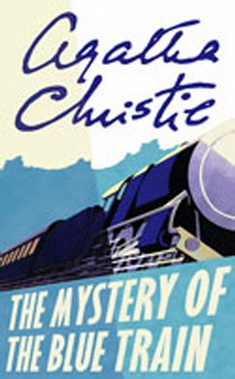
The Mystery of the Blue Train by Agatha Christie

Ruth Kettering is an American heiress who receives a set of valuable rubies as a gift from her father. Despite his warnings to keep them somewhere safe, Ruth takes the jewels with her on a trip to Nice. During her journey through France on the famous Blue Train, Ruth is found strangled to death in her compartment – and the case containing the rubies has disappeared. Hercule Poirot, who also happens to be travelling on the same train, promises to help Ruth’s father solve the crime and identify the killer. Suspicion falls first on Ruth’s husband, Derek Kettering, whom she had been about to divorce, and then on the mysterious Comte de la Roche. Is one of them the murderer?

I grabbed The Mystery of the Blue Train from the library shelf without really knowing anything about it. A bit of research now tells me it’s one of Agatha Christie’s less popular Poirot novels and now that I’ve read it I think I can see why. It was written quite early in her career and at a troubled time in her personal life, and apparently the author herself was unhappy with it. The book does have all the elements that should have added up to a classic Christie novel (a rich heiress, a journey on a luxury train, jewel thieves, the South of France – and Hercule Poirot himself, of course) but while I did enjoy it, I still felt there was something missing.

Compared to the other Agatha Christie books I’ve read, which admittedly isn’t all that many, this one was much longer and seemed to take a while to really get started (the actual crime doesn’t take place until about 100 pages into the book). There was a very long wait before Poirot made his first appearance and instead we spend a lot of time being introduced to other characters, which would have been okay had I liked these characters, but I found them a bit stereotypical, from the American millionaire to the French count to the old antiques dealer.

There were also a few sub-plots that I felt didn’t really add much to the story, although I did enjoy the dialogue between Poirot and Katherine Grey, a young woman he meets on the train who becomes involved in the murder investigation. The mystery itself kept me guessing, though I think there were probably enough clues to be able to work out at least part of the solution, if you were paying more attention than I was! The Mystery of the Blue Train was entertaining in places but is probably my least favourite Christie novel so far.

Why Didn’t They Ask Evans? by Agatha Christie

Continuing my recent forays into the novels of Agatha Christie, Why Didn’t They Ask Evans? is another one that I’ve really enjoyed and one of my favourites so far. This is one of Christie’s standalone novels (i.e. not Poirot, Marple or any other series).

Bobby Jones, son of the vicar of Marchbolt, is playing golf near the sea one day when he discovers that a man has fallen over the cliff. Left alone with the body while his friend goes to get help, Bobby is the only person who hears the man’s dying words: “Why didn’t they ask Evans?” As soon as Bobby informs the dead man’s family of his last words, a number of strange incidents start to occur, ending in Bobby’s beer being poisoned. After consulting with his friend Lady Frances Derwent (known as Frankie), they decide that someone must be trying to silence Bobby before he uncovers the truth behind the man’s death. As Frankie and Bobby attempt to find out what’s going on, they find themselves caught up in a mystery which leads them to a sanatorium run by the sinister Dr Nicholson.

The plot quickly becomes very far-fetched and ridiculous with lots of disguise-wearing, last-minute rescues and amazing coincidences. Frankie and Bobby constantly stumble upon clues and it seems that people give confidential information to them very freely – if it was really that easy to get people to tell you things, every crime would be solved in no time! Frankie and Bobby themselves even remark on the unreality of the situation and that they feel as if they’ve fallen into the pages of a novel.

Due to the number of red herrings and twists in the plot, the mystery is a more complex one than I thought it would be at first. If you could work out the significance of the phrase “why didn’t they ask Evans?” before it is revealed you must be a genius! I would never in a million years have guessed who Evans would turn out to be as it’s not something that can easily be deduced until you’ve been given all the pieces of the puzzle.

Why Didn’t They Ask Evans? is a fast-paced, light-hearted read with a very likeable pair of amateur detectives (particularly the courageous, quick-thinking Frankie). The melodrama and silliness are all part of the fun – this book never takes itself too seriously and despite topics of murder, drug use and kidnapping it never becomes too dark. Be prepared to suspend disbelief for a while, then sit back and be entertained.