Full Dark House by Christopher Fowler

One of the books I hope to be reading soon for the Transworld Book Group challenge is The Water Room, the second in Christopher Fowler’s Bryant and May series. As I already had a copy of the first in the series waiting to be read and I would prefer not to read them in the wrong order, I decided to read Full Dark House first. And I’m glad I did, because Full Dark House definitely has a ‘first in the series’ feel about it.

Arthur Bryant and John May are two elderly detectives who work for the Peculiar Crimes Unit, a branch of the London Metropolitan Police created to deal with unusual cases. When the PCU office is destroyed in an explosion, Bryant, who was inside the building, is presumed dead. His partner, May, who has worked with him for over sixty years, is determined to find out who killed Bryant and why.

In order to understand who may have been responsible for Bryant’s death, we are taken back in time to November 1940, when Bryant and May worked together on their very first case during the London Blitz. While bombs fell on the city night after night, the two young detectives were investigating the murders of several cast members of a controversial new play at the Palace Theatre. As the story moves backwards and forwards between 1940 and the present day, May searches for a connection between the ‘Palace Phantom’ and Arthur Bryant’s death.

With their different strengths and weaknesses, Arthur Bryant and John May complement each other perfectly and each of them approaches the investigation in his own way. Bryant has unconventional ideas, an active imagination and an interest in the paranormal, whereas May is the more logical and methodical of the two. Setting the story in two time periods sixty years apart was a good idea because it allowed us to watch the two detectives meeting each other for the first time in 1940 and to see how their relationship had developed over the intervening years. I liked both of them and am looking forward to getting to know them better throughout the rest of the series.

I loved the descriptions of black-outs, bomb shelters, rationing and other aspects of daily life in London during the Blitz – it all felt very convincing and realistic. In fact, of all the books I’ve read recently set in wartime London, this is probably the one that evokes the era best, which was something I hadn’t expected. I can tell Christopher Fowler must have researched every part of his book very thoroughly, because as well as all the little details that make his portrayal of London so believable, there are also some very detailed descriptions of the backstage layout of the theatre and lots of information on Greek mythology too.

Apart from a section in the middle of the book where the plot moved forward very slowly and nothing seemed to happen for a while, I really enjoyed my first introduction to Bryant and May. With two mysteries to solve, lots of plot twists, and a large cast of colourful characters both within the Peculiar Crimes Unit and at the theatre, Full Dark House is a great opening to the series.

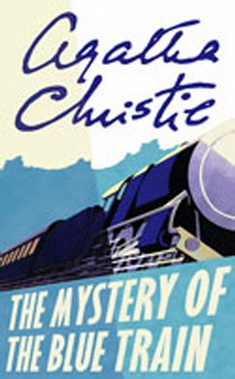
The Mystery of the Blue Train by Agatha Christie

Ruth Kettering is an American heiress who receives a set of valuable rubies as a gift from her father. Despite his warnings to keep them somewhere safe, Ruth takes the jewels with her on a trip to Nice. During her journey through France on the famous Blue Train, Ruth is found strangled to death in her compartment – and the case containing the rubies has disappeared. Hercule Poirot, who also happens to be travelling on the same train, promises to help Ruth’s father solve the crime and identify the killer. Suspicion falls first on Ruth’s husband, Derek Kettering, whom she had been about to divorce, and then on the mysterious Comte de la Roche. Is one of them the murderer?

I grabbed The Mystery of the Blue Train from the library shelf without really knowing anything about it. A bit of research now tells me it’s one of Agatha Christie’s less popular Poirot novels and now that I’ve read it I think I can see why. It was written quite early in her career and at a troubled time in her personal life, and apparently the author herself was unhappy with it. The book does have all the elements that should have added up to a classic Christie novel (a rich heiress, a journey on a luxury train, jewel thieves, the South of France – and Hercule Poirot himself, of course) but while I did enjoy it, I still felt there was something missing.

Compared to the other Agatha Christie books I’ve read, which admittedly isn’t all that many, this one was much longer and seemed to take a while to really get started (the actual crime doesn’t take place until about 100 pages into the book). There was a very long wait before Poirot made his first appearance and instead we spend a lot of time being introduced to other characters, which would have been okay had I liked these characters, but I found them a bit stereotypical, from the American millionaire to the French count to the old antiques dealer.

There were also a few sub-plots that I felt didn’t really add much to the story, although I did enjoy the dialogue between Poirot and Katherine Grey, a young woman he meets on the train who becomes involved in the murder investigation. The mystery itself kept me guessing, though I think there were probably enough clues to be able to work out at least part of the solution, if you were paying more attention than I was! The Mystery of the Blue Train was entertaining in places but is probably my least favourite Christie novel so far.

Why Didn’t They Ask Evans? by Agatha Christie

Continuing my recent forays into the novels of Agatha Christie, Why Didn’t They Ask Evans? is another one that I’ve really enjoyed and one of my favourites so far. This is one of Christie’s standalone novels (i.e. not Poirot, Marple or any other series).

Bobby Jones, son of the vicar of Marchbolt, is playing golf near the sea one day when he discovers that a man has fallen over the cliff. Left alone with the body while his friend goes to get help, Bobby is the only person who hears the man’s dying words: “Why didn’t they ask Evans?” As soon as Bobby informs the dead man’s family of his last words, a number of strange incidents start to occur, ending in Bobby’s beer being poisoned. After consulting with his friend Lady Frances Derwent (known as Frankie), they decide that someone must be trying to silence Bobby before he uncovers the truth behind the man’s death. As Frankie and Bobby attempt to find out what’s going on, they find themselves caught up in a mystery which leads them to a sanatorium run by the sinister Dr Nicholson.

The plot quickly becomes very far-fetched and ridiculous with lots of disguise-wearing, last-minute rescues and amazing coincidences. Frankie and Bobby constantly stumble upon clues and it seems that people give confidential information to them very freely – if it was really that easy to get people to tell you things, every crime would be solved in no time! Frankie and Bobby themselves even remark on the unreality of the situation and that they feel as if they’ve fallen into the pages of a novel.

Due to the number of red herrings and twists in the plot, the mystery is a more complex one than I thought it would be at first. If you could work out the significance of the phrase “why didn’t they ask Evans?” before it is revealed you must be a genius! I would never in a million years have guessed who Evans would turn out to be as it’s not something that can easily be deduced until you’ve been given all the pieces of the puzzle.

Why Didn’t They Ask Evans? is a fast-paced, light-hearted read with a very likeable pair of amateur detectives (particularly the courageous, quick-thinking Frankie). The melodrama and silliness are all part of the fun – this book never takes itself too seriously and despite topics of murder, drug use and kidnapping it never becomes too dark. Be prepared to suspend disbelief for a while, then sit back and be entertained.

Death in the Clouds by Agatha Christie

Death in the Clouds, first published in 1935, is one of Agatha Christie’s many novels featuring the Belgian detective Hercule Poirot.

Ten people are travelling on a plane flying from Paris to London. During the flight a woman is found dead in her seat – apparently a murder has taken place without anyone seeing it happen. Among the other passengers is Poirot, who can’t believe a crime has taken place right under his nose! The mystery proves a difficult one to solve and after landing in England the suspects are allowed to go back to their everyday lives. As Poirot continues to investigate, he uncovers some secrets about the murdered woman and discovers that more than one of her fellow passengers had a reason to want her dead…

Like many classic mysteries, the crime takes place in a confined space so that we know from the beginning who the suspects are. The fact that this novel is set on a plane makes a nice change from the usual country house! The suspects include a beautiful aristocrat with a cocaine addiction, two prominent archaeologists, a doctor, a dentist, a businessman, a hairdresser – and my personal favourite, a crime novelist, whose inclusion gives Christie a chance to have some fun at the expense of her own genre. The characters don’t have a lot of depth and there are only a few that we get to know well, yet Christie makes it easy to remember who is who. There are plenty of red herrings to make the reader suspect first one person and then another; it’s even possible that Poirot himself could have committed the murder!

I enjoyed studying the seating plan at the front of the book and the list of the contents of the passengers’ luggage in an attempt to work out what had happened – but as usual, I didn’t even come close to solving the mystery. In a way I’m glad that my crime-solving skills are so bad because it means I can be surprised by all the twists and turns of the plot as the author intended.

I’m having fun working through all the Agatha Christie books available from my library’s ebook section, so you can expect some more Christie posts from me in the near future. It’s funny because her books had never held much appeal for me in the past, though maybe I was just unlucky with the ones I was choosing to read. Although Death in the Clouds is not one of the best that I’ve read so far, it was still an enjoyable read.

The Daughter of Time by Josephine Tey

Inspector Alan Grant is in hospital recovering from a broken leg. In an attempt to alleviate his boredom, his friend Marta encourages him to investigate an unsolved mystery from his hospital bed. When she brings Grant a picture of Richard III, he’s immediately intrigued. Richard, of course, is widely believed to have murdered his two young nephews, the sons of his brother King Edward IV, to secure his own claim to the throne after Edward’s death. Grant, however, is not convinced. How can this kind, sensitive face belong to one of the most notorious murderers of all time? Over the next few weeks, Grant reads everything he can find about Richard and his alleged crimes, and makes some surprising discoveries about this controversial king.

With my interest in the Plantagenets, the Wars of the Roses, and Richard III in particular, I expected to enjoy this book and I did. It doesn’t compare to Sharon Kay Penman’s wonderful The Sunne in Splendour, which I read last year, but then, it’s a completely different type of book.

Much as I happen to agree with Josephine Tey that Richard has been unfairly treated, this book is obviously very biased in his favour. But the argument she makes for Richard’s innocence is certainly very convincing. She shows how Grant takes one source at a time, looks at who wrote it (often one of Richard’s enemies) and what the writer’s motive could have been in discrediting Richard. The book also considers Richard’s possible motives and what reasons he may have had for committing (or not committing) the crimes of which he was accused.

As Alan Grant, at the beginning of the novel, knows very little about Richard III it means that the reader doesn’t need to have a lot of prior knowledge either and can learn along with Grant. In fact, from reading other reviews it seems that for many people this book has been their first introduction to this period of history. If, like me, you’ve already read one or two books about Richard and have some basic knowledge of the subject, The Daughter of Time is still a fascinating read. I was surprised that the Duke of Buckingham was hardly mentioned, as he is usually considered along with Richard and Henry Tudor to be one of the main suspects for the murder of the two princes. Tey also suggests that the princes were still alive when Henry VII took the throne, which is interesting as the general opinion now seems to be that they died during Richard’s reign.

But whether we agree with Tey’s theories or not isn’t really important. What is important is that we’re aware of the unreliability of many historical sources and how we have to be very careful because something that is now considered to be ‘historical fact’ may actually originate from nothing more than lies or rumours.

The Weed that Strings the Hangman’s Bag by Alan Bradley

The Weed that Strings the Hangman’s Bag is the second book in Alan Bradley’s Flavia de Luce mystery series. I read and loved the first one, The Sweetness at the Bottom of the Pie, last year but it’s taken me so long to find time to read this one that the third book has also now been released and is waiting patiently on my shelf.

For those of you who are new to the series, the novels are set in the small English village of Bishop’s Lacey during the 1950s and feature Flavia de Luce, an eleven-year-old detective and chemistry genius. The mysteries are not particularly complex but Flavia’s unique narrative voice makes the books a lot of fun to read.

The Weed that Strings the Hangman’s Bag begins shortly after the previous book ended, but if you haven’t already read The Sweetness at the Bottom of the Pie I don’t think it would matter too much. And if you have read The Sweetness… you’ll find that this book is really very much the same: Flavia is still conducting experiments in her laboratory, her sister Daffy is still obsessed with books, her other sister Feely is still obsessed with her appearance, Father is still collecting stamps. But the tone of this book is slightly darker than its predecessor and I enjoyed the mystery more as there were a lot of possible suspects and the villain wasn’t immediately obvious – at least not to me!

This time Flavia investigates a murder that takes place during a puppet show in the village hall and begins to connect this death with the hanging of a little boy in Gibbet Wood several years earlier. As a detective, the advantage Flavia has is that being an eleven-year-old girl she can ask questions that the police can’t ask and can convince the local people to tell her things they might not tell an adult. Being an expert in poisons helps too, of course!

Flavia hasn’t changed a lot between the first book and this, but she does feel that little bit older and her sense of humour seems sharper. I’m hoping her character is going to develop further as the series goes on. The thing I love about Flavia is that she is somehow both a believable and an unbelievable character at the same time. She has a vocabulary like no eleven-year-old I’ve ever met and both her chemical and general knowledge are exceptional even by adult standards, but despite this she still feels real to me. She also has fears and insecurities (usually covered up by her tough exterior) and this book continues to explore her difficult relationships with her sisters and father, as well as introducing another family member, Aunt Felicity.

I love the old-fashioned, innocent feel of this series, which reminds me so much of the Enid Blyton books I grew up reading. Hopefully it won’t be too long before I can let you know what I think of A Red Herring Without Mustard!

And Then There Were None by Agatha Christie

Although I usually enjoy mysteries, I’ve never considered myself to be a big fan of Agatha Christie. I didn’t really like the Poirot books I’ve read (though admittedly I’ve only tried a few of them) and Miss Marple didn’t appeal to me either. If only I had started with this one instead!

At the beginning of the book we are introduced in quick succession to ten people who have all been invited to a house on Soldier Island, off the coast of Devon. Each person has been given a different reason as to why their presence on the island is required, but on arriving at the house the group discover that their hosts are mysteriously absent. When, one by one, they begin to suffer gruesome deaths in accordance with the children’s rhyme “Ten Little Soldiers” it becomes obvious that one of the ten is a murderer.

The thing that makes this book such an exciting and suspenseful read is that all ten characters seem suspicious and the more you learn about them the more it appears that any one of them could be the killer. Halfway through the book I thought I had worked it out as there was one character in particular that I had suspected from the start (although it was more just an instinct rather than anything specific that he or she had done). As the story moved towards the conclusion it looked as if I was going to be right…

Do I need to tell you that I got it entirely wrong? I admit that solving whodunits is not one of my strong points, but I think most people would be baffled by this one! Christie expertly leads you to believe one thing, then a few pages later proves you wrong. I was sure that as more and more of the ten were eliminated one of them would emerge as the most obvious suspect, but that didn’t happen.

Have you read this book? Did you guess the solution to the mystery?