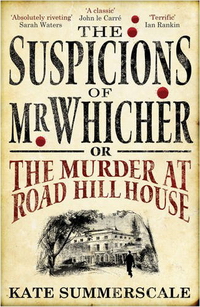
The Suspicions of Mr. Whicher by Kate Summerscale

One night in June 1860 a little boy called Saville Kent was murdered at his home in the village of Road, Wiltshire. As it seemed certain that nobody had entered the house from outside, suspicion fell on the Kent family and their servants. When the local police proved to be incompetent, the Home Secretary requested that Scotland Yard send Detective Inspector Jonathan Whicher to assist them with the investigation. In The Suspicions of Mr. Whicher, Kate Summerscale tells the full story of the case and how it affected Whicher’s career.

This is a non-fiction book based on a true story. Considering the book combines two of my favourite things in literature – mysteries and the Victorians – you won’t be suprised to hear that I thought it was completely fascinating! And although I regretted not reading it sooner (it was first published in 2008), my timing actually couldn’t have been better. Just after finishing the book I discovered that it had been adapted for television, so the story was still fresh in my mind when I sat down to watch it on ITV1 last night (Monday 25th April). I enjoyed the TV adaptation but I’m glad I managed to read the book first.

I appreciated the fact that Summerscale was careful not to give away the solution to the mystery too early in the book, which meant the reader had a chance to study the clues and try to solve the mystery along with Whicher. It was interesting too to see how the vocabulary used in detective work has developed over the years, such as the origins of the word ‘clue’.

Summerscale also explains how during the 19th century people began to place a greater importance on the privacy and security of their homes than they had in the past. Thus a case like the Road Hill one was even more shocking in that it had taken place behind locked doors. The sanctity of the home had been violated and it seemed that the murderer was almost certainly one of the household. This must have made people all over the country afraid that the same thing could happen in their own family home. And with the multitude of new national and local newspapers that had appeared in recent years, detailed reports of this and other horrific crimes could be brought to an even wider audience. This, of course, allowed the public to become ‘armchair detectives’ and come up with their own theories as to what really happened.

The murder at Road Hill House captured the imagination of the British public and inspired a number of fictional detective stories such as The Moonstone by Wilkie Collins, which I read a few years ago. The character of Sergeant Cuff in The Moonstone is thought to be based on Whicher and I can also now see how Collins incorporated some other elements of the Road Hill investigation into his story – the importance which is placed on checking the family’s laundry, for example. I really need to re-read The Moonstone soon because I’m sure that knowing some of the background behind it will help me to get more out of it!

Have you read The Suspicions of Mr Whicher? Are there any other true crime stories that you’ve enjoyed reading?

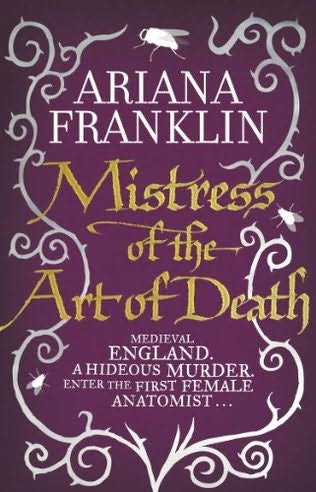
Mistress of the Art of Death by Ariana Franklin

This is my second book for the Great Transworld Crime Caper and is the first in a series of historical mysteries by the late Ariana Franklin. I knew nothing about this series but Mistress of the Art of Death appealed to me because of the medieval setting (I love books set in medieval England).

This book has an unusual heroine. Her name is Adelia Aguilar and she is a trained doctor, very rare in the year 1171. Adelia is from Salerno, where women are allowed to attend medical school. Her speciality, however, is as a ‘doctor of the dead’ – in other words, she is skilled in performing autopsies and finding out the causes of death. When several young children go missing in Cambridge and the city’s Jews are blamed for the disappearances, Adelia is sent to England to investigate.

As I said, I love reading about medieval history and Franklin touches on many different aspects of the period – from the big things, such as the relationship between the church and the monarchy, to the small, such as the clothes people wore and the food they ate. Adelia, being Italian, is unfamiliar with the politics and customs of 12th century England, which allows the reader to learn along with her – so no need to worry if you don’t have much knowledge of the period. Despite some very modern dialogue and Adelia’s distinctly 21st century thought processes, everything else felt suitably ‘medieval’. Setting and atmosphere are so important in fiction and this is an area in which I thought Franklin excelled. It wouldn’t really be fair for me to comment on the historical accuracy as I haven’t studied the 12th century in any detail but I would say that if you’re looking for a serious piece of historical fiction which is correct in every detail then you need to look elsewhere. Accept this book for what it is though, and it’s an enjoyable read.

The writing in the prologue and opening chapters feels quite light and humorous and I expected the whole book to have the same tone, but when Adelia begins to investigate the mystery things start to feel a lot darker. I should point out that the story does revolve around the abduction and murder of children which isn’t nice to read about; it’s quite graphic in places and a bit disturbing. As for the mystery itself, I didn’t guess who the murderer was, but then I wasn’t really trying to guess. Sometimes I prefer not to attempt to work things out and just enjoy the story – and this was one of those occasions.

I found Adelia a fascinating and engaging character although, as I mentioned earlier, she thought, spoke and behaved more like a woman from the 21st century than the 12th. She’s a strong, independent person who is constantly questioning the role of women in society and has a very modern outlook on medicine, the law and life in general; I liked her but she wasn’t a believable medieval woman. Most of the secondary characters are well-rounded and interesting, particularly Adelia’s housekeeper, Gyltha, and her surly but endearing grandson, Ulf – and I loved the depiction of Henry II.

I enjoyed Mistress of the Art of Death and I look forward to being reacquainted with Adelia Aguilar in the other three books in the series. Sadly, Ariana Franklin (Diana Norman) died in January this year aged 77.

I received a copy of this book from Transworld for review.

The Return of Captain John Emmett by Elizabeth Speller

When Captain John Emmett returns from France at the end of World War I, his mother and sister are worried about his mental condition. John is suffering from shell-shock, which is causing him to become aggressive and violent. After spending some time in a nursing home, John escapes and is later found dead in a nearby wood. It is assumed that he committed suicide.

John’s sister, Mary, contacts one of her brother’s old school friends, Laurence Bartram, in the hope that he can help her discover what really happened to her brother. Why would a man who had survived the horrors of the war shoot himself two years later? As Laurence starts to investigate, he begins to wonder whether someone else was behind John’s death.

The Return of Captain John Emmett is a fascinating story. It works well as a historical fiction novel, with its portrayal of the people of 1920s Britain coming to terms with the aftermath of World War I. But it’s also a gripping psychological mystery in which Laurence Bartram reluctantly takes on the role of detective to investigate the circumstances surrounding his friend’s death. There are clues, suspects, red herrings and all the other elements that make up a compelling and well-structured detective story.

The book is also an interesting and poignant study into the effects, both long-term and short-term, that the war had on individuals and their families. How people came back from the war an entirely different person to when they went away. How men dealt with the memories of the atrocities they witnessed. How their wives felt about the part of their husbands’ lives that they had been unable to share. How people were left with physical disabilities and had to learn to adjust.

We are given insights into the thoughts and emotions of a First World War soldier and we learn what it was like to be part of a firing squad. The War Poets are also touched upon, and so are the loyalties and friendships formed in British public schools.

Due to the subject and setting, the book had a sombre and depressing feel, yet I found myself really enjoying it. As the mystery surrounding John Emmett’s death became more and more complex and involved, I was completely drawn into Laurence Bartram’s investigations. The plot relies quite heavily on coincidences in places, but not so much that it spoiled the story for me at all. I loved it and will definitely be looking out for more novels from Elizabeth Speller!

I received a review copy of this book from NetGalley courtesy of Houghton Mifflin Harcourt.

Review: A Moment of Silence by Anna Dean

A Moment of Silence is an entertaining murder mystery set in the early 19th century. It’s the first in a series of novels featuring the wonderful Miss Dido Kent.

The story begins when Dido is summoned to Belsfield Hall, the country estate of the Montague family. Her niece Catherine is engaged to Sir Montague’s son Richard – who has mysteriously disappeared during their engagement party. Dido agrees to help Catherine solve the mystery behind Richard’s disappearance, but events soon take a more sinister turn when a dead body is found in the shrubbery…

This was a light, easy read which should appeal to fans of Jane Austen due to the setting and the elegant, witty writing style – although I’m not a huge Austen fan and I still loved it! A Moment of Silence has all the elements of a classic English country house mystery: clues, red herrings and lots of possible suspects, with almost every one of the guests and family members concealing a secret of some kind. Although some of the clues were quite obvious, there were others that I didn’t figure out and the mystery was interesting enough to hold my attention right to the end.

But rather than the mystery itself, the main reason I loved this book was because of Miss Dido Kent, who is a wonderfully engaging character. She’s intelligent, observant and always speaks her mind, though usually in a good-natured way. Although we’re not told exactly how old she is (unless I missed it) she’s unmarried and her ‘spinster’ status gives her the freedom to investigate and to wander around the estate asking questions and interfering – always with the best intentions of course! I loved reading Dido’s letters updating her sister Eliza on the progress of her investigations (we never actually meet Eliza, but the letters are intended to allow us some insights into Dido’s private thoughts and musings).

I can’t wait to read more Dido Kent mysteries. This was a great start to the series and I’m looking forward to reading the second, A Gentleman of Fortune.

Recommended

Note: This book is published under the title Bellfield Hall in the US.

Review: The Sweetness at the Bottom of the Pie by Alan Bradley

After hearing so many good things about Alan Bradley’s Flavia de Luce mysteries, I had high hopes for this book – and I wasn’t disappointed. It was every bit as enjoyable and delightful as I had been told it was.

Eleven year old Flavia de Luce, who wears her hair in pigtails and rides a bike called Gladys, most be one of the most unusual detectives in fiction. Her biggest passion is for chemistry – and more specifically, for poisons. She loves nothing more than spending time conducting experiments in her own fully equipped laboratory and her heroes include famous chemists such as Marie Paulze Lavoisier, Robert Bunsen and Henry Cavendish.

When a dead bird with a rare stamp impaled on its beak is found on the de Luces’ doorstep, Flavia is puzzled by the effect the discovery has on her father. Later, Flavia finds something much more sinister in the cucumber patch and when her father is accused of murder, she becomes determined to clear his name.

Although this wasn’t a particularly complex mystery, it was an interesting one, involving magic tricks, a sheet of Penny Black stamps and a slice of custard pie. There were parts of it that I could figure out quite easily but others that took me by surprise. I don’t often read mysteries anymore, but this book reminded me of exactly why I used to love them! However, the mystery itself is only one element of this book. I think due to the characters and the setting (which includes all the little period details that place the story firmly in 1950 and perfectly capture a small village atmosphere), this series could appeal even to non-mystery lovers.

The main reason I enjoyed this book so much was Flavia herself. She really is a wonderful character, innocent and lovable one minute, ruthless and vengeful the next (at the beginning of the book she runs away in tears when her sisters Ophelia and Daphne taunt her by pretending she’s adopted – and then proceeds to inject poison ivy into Ophelia’s lipstick). The chemistry aspect of the book particularly interested me as I have a degree in chemistry myself – although I was never as passionate as Flavia about the subject! She seems to have a PhD level grasp of the subject already. And her sphere of knowledge also encompasses literature, history, film and music. She’s so incredibly clever and independent that it’s easy to forget she’s only supposed to be eleven. There’s no way you would expect a real child of that age to speak or behave the way Flavia does – and yet somehow, in a strange way, I was able to overlook the fact that she’s so unrealistic and could accept her as a plausible character.

I’ve seen comparisons with Nancy Drew and Harriet the Spy, but while I was reading this book I was also reminded of Enid Blyton’s Five Find-Outers series, which was also set in a small English village in the 1940s/50s and featured a group of children who always solved the mystery before the village policeman. I have no idea if Alan Bradley would have been inspired by those books at all, but there are definitely some similarities.

I loved this book and now I can’t wait to read The Weed that Strings the Hangman’s Bag!

Review: My Cousin Rachel by Daphne du Maurier


This is the second Daphne du Maurier book I have read this month.  I hope eventually I’ll have time to read all of them because so far none of her books have disappointed me.

Like I’ll Never Be Young Again, which I read at the beginning of May, My Cousin Rachel is written in the first person from a male perspective. Also as in I’ll Never Be Young Again, the male narrator is a naïve, immature man who I found it difficult to sympathise with. His name is Philip Ashley, a twenty-four year old Englishman who has been raised by an older cousin, having lost both his parents at an early age. Philip and his cousin Ambrose have a very close relationship and Philip is left confused and jealous when Ambrose suddenly marries a woman he meets in Italy. This woman happens to be another cousin of theirs – their cousin Rachel.

Early in the novel, Ambrose dies and Rachel returns alone to the Ashley estate in England. At first, Philip is convinced his cousin Rachel was responsible for Ambrose’s death, but after meeting her he’s not so sure…

My Cousin Rachel is often compared with Daphne du Maurier’s most famous book, Rebecca, and although the two books are very different in many ways, I can see the reasons for the comparisons. The books share some common elements, including the estate in Cornwall (based on du Maurier’s own home, Menabilly) and the mysterious, secretive woman, but the biggest resemblance is in the atmosphere the writing conveys. Daphne du Maurier is one of the most atmospheric writers I know of. Whether she’s writing about the streets of Florence or the coast of Cornwall she always manages to convey a mood perfectly suited to the location and draws you completely into the world she has created. My Cousin Rachel has a strong feeling of foreboding, where from the beginning you know something bad is going to happen and you’re just waiting to see what it is.

Throughout the book, my opinion of Rachel was constantly changing. It was hard to form an accurate idea of what Rachel was like, as we only really saw her through Philip’s eyes and he was not a reliable narrator. Another thing that added to the vagueness and uncertainty of the story was that we were never told exactly when it was taking place. It was obvious that the book was set in the 19th century, but which decade? And what was the name of the Ashley estate? Unless I missed it, we weren’t told that either. It seems to be quite typical of Daphne du Maurier to withhold information from us in this way – after all, in Rebecca we aren’t even told the narrator’s name!

There are a lot of loose ends and questions left unanswered at the end of the book, which is something that often bothers me, but in this case I didn’t mind. I liked the way there were aspects of the story that could be interpreted in several different ways. I expect it would have been a good book to read with a group, as the ambiguity would lead to some interesting discussions and theories.

Recommended

Pages: 304/Publisher: Virago Press (Virago Modern Classics 491)/Year: 2008 (originally published 1951)/Source: Library book

Review: The Unburied by Charles Palliser

The title of this book may suggest a horror story complete with zombies and vampires, but The Unburied is actually a scholarly murder mystery which reminded me of The Name of the Rose by Umberto Eco or An Instance of the Fingerpost by Iain Pears.  I wanted to read it because a few years ago I read another Charles Palliser book, The Quincunx, which I really enjoyed.  Like The Quincunx, this one is set (mostly) in Victorian England.  It begins with a mock ‘Editor’s Foreword’ in which we are told that we are about to read an account which will throw new light on the controversial Thurchester Mystery.  This account, known as The Courtine Account, forms the bulk of the book.

Dr Edward Courtine, a historian from Cambridge University, has been invited to spend the week before Christmas with Austin Fickling, an old friend from his student days who is now teaching at a school in the cathedral city of Thurchester.  He and Austin haven’t seen each other since they parted on bad terms twenty years ago, and Courtine is eager to renew their friendship.  He also has another reason for wanting to visit Thurchester – he has been studying King Alfred the Great and has learned that an ancient manuscript detailing the events of Alfred’s reign may be available in Thurchester Library.

On the night of Courtine’s arrival he hears the story of a murder that took place in the cathedral two centuries earlier.  Courtine is fascinated, but as he begins to investigate he becomes involved in another murder mystery – and discovers Austin’s true motive for inviting him to Thurchester.

As the main narrator of the book, I found Courtine very irritating, but at the same time I felt slightly sorry for him.  For such an obviously intelligent person he was completely lacking in perception, constantly saying the wrong things, missing important clues and failing to notice people behaving suspiciously.  Sometimes he would tell us that he was beginning to form a theory or that an idea had occurred to him, but he didn’t let us know what it was.  This was good in one way, as it encouraged me to work things out for myself, but it also annoyed me because I was already finding it difficult enough to keep all the threads of the story straight.

Although the town of Thurchester and its community are vividly depicted, I didn’t find any of the characters particularly memorable.  The fact that some of them had similar names (Slattery, Sheldrick, Sisterton for example) didn’t help.  There is actually a character list at the back of the book but I was trying not to look at it in case I came across any spoilers.  As for the plot, it’s so intricate you really need to read this book in as few sittings as possible so you don’t forget any important details.  There seemed to be a constant stream of unexplained deaths and forged documents, with at least three separate mysteries from different eras all running parallel to each other – and different characters giving different versions of what may or may not have happened.   I wished I had been taking notes from the beginning.

This is a very atmospheric book with lots of gothic elements, from the freezing fog that accompanies Courtine’s arrival in Thurchester to the obligatory ‘ghost’ supposedly haunting the cathedral.  It would have been a good book to read in front of the fire on a cold winter’s night.  In spite of the slow pace the book was relatively quick to read and although it was certainly confusing, I did enjoy it, especially when the various mysteries began to unravel towards the end.  Not as good as The Quincunx, though – if you’ve never read a Charles Palliser book before, try that one first.

Genre: Historical Fiction/Mystery/Publisher: Phoenix/Pages: 389/Year: 1999/Source: My own copy purchased used