Nonfiction Mini-Reviews: A Tudor Christmas and Henry VII

I didn’t have time last month to write about all of the books I read for Nonfiction November, so I’m combining the final two into one post today, which I think is quite appropriate as they are both Tudor related!

First, A Tudor Christmas. If you haven’t finished your Christmas shopping yet, this lovely little book by historian and novelist Alison Weir and her co-author Siobhan Clarke, a guide for Historic Royal Palaces, could be the perfect gift for any history lovers in your life (or for yourself, at any time of year, of course).

Divided into twelve sections to represent each of the twelve days of Christmas, the book takes us through the origins of many of our favourite Christmas traditions, as well as some that were popular in Tudor times but have disappeared over the years. The text is interspersed with recipes, poems, carols and illustrations, so if you don’t want to read it straight through from beginning to end, you could just pick it up and read a page or two whenever you have a few spare moments over the festive period. This is much shorter than the other non-fiction books I’ve read by Alison Weir and obviously doesn’t have the same level of depth, but even so she and Clarke manage to cover a large amount of material, touching on almost every aspect of Christmas you could think of.

I enjoyed reading about the various ways in which St Stephen’s Day/Boxing Day was celebrated in different parts of Europe, ranging from hunting the wren and taking beribboned horses to be blessed by the priest, to distributing alms to the poor. There’s a discussion of when the turkey was first introduced to England, a fascinating chapter about the typical games that would be played at home or at court, and some eye-opening accounts of how much money Henry VIII would spend on celebrating Christmas. There are also descriptions of earlier traditions such as the burning of the yule log and the origins of holly, ivy and mistletoe being used as decorations and, although I would have preferred a tighter focus on the Tudor period itself (which is what I’d expected from the title), I did find the whole book an interesting and worthwhile read.

From a Tudor Christmas to a Tudor king…Henry VII by Gladys Temperley is a biography of the first Tudor monarch who reigned from 1485 to 1509. Originally published in 1914 (and reissued more recently by Endeavour Compass), it does feel a bit dated and dry in places, but I still found it perfectly readable.

I started to read this book shortly after finishing The Tudor Crown by Joanna Hickson, a fictional account of Henry’s life before he became king, so I was particularly interested in the earlier sections which gave the facts behind some of the episodes which were featured in the novel such as Henry’s time in exile and preparations for his return to England at the head of an army. However, all of this is passed over very quickly, to be followed by a much longer section on the rebellions, conspiracies and pretenders to the throne – including Perkin Warbeck and Lambert Simnel – that repeatedly threatened Henry’s reign. As Temperley says, “He trusted few men, suspected many. He had plunged too early into the bitter waters of adversity, and as a fugitive exile, eating the bread of dependence at the courts of France and Brittany, had learnt to watch and school himself until repression had killed all spontaneity.”

Henry VII isn’t one of my favourite kings, but Gladys Temperley seems to have a lot of respect and admiration for him, which I think is a good thing – as long as it doesn’t lead to too much bias, I always think it’s better when an author likes and is genuinely passionate about their subject. Temperley highlights many of Henry’s lasting achievements, such as his ‘Mercantile System’, a policy which aimed to increase foreign trade and improve England’s economy, and the steps he took towards reforming the country’s judicial system.

The book feels thoroughly researched; there are footnotes throughout the text, three appendices giving more information on The Star Chamber, Perkin Warbeck and Juana of Castile, and a very impressive bibliography. You do need to remember, though, that this is a very old biography and that what we know of history is constantly evolving. For a more modern look at Henry VII, I recommend Winter King by Thomas Penn.

Murder by the Book by Claire Harman

I don’t read a lot of non-fiction, but I’ve been reading more of it than usual over the last few weeks in preparation for Nonfiction November. Murder by the Book, an account of a true crime which took place in Victorian London, sounded appealing to me because it promised to explore the possible links between the crime and some of the bestselling novels of the day.

The book begins by describing the events of 6th May 1840, when Lord William Russell’s housemaid found her master in bed with his throat slit. Suicide was suspected at first, but with his head almost severed from his body, this theory was dismissed and a murder investigation began. Russell, an elderly widower, had been leading a quiet, unremarkable life, living alone (apart from his servants) in a respectable Mayfair street. Who could possibly have wanted him dead – and why?

The murder sent shockwaves throughout London, with everyone – including Queen Victoria herself – following the news and voicing their opinions. What made this particular case so shocking was that when the culprit was identified and questioned, it was found that before committing the murder he had been reading Jack Sheppard, a well-known novel by William Harrison Ainsworth. Based on the story of a real life 18th century criminal, Jack Sheppard had been published as a serial in Bentley’s Miscellany from January 1839 until February 1840. With plots involving murder, theft and violence, crime novels of this type had become known as ‘Newgate Novels’ (a reference to the Newgate Prison), and were hugely popular with the public, partly due to the rise in literacy levels during the first half of the 19th century. Following the Russell murder, a debate began regarding the suitability of this sort of reading material.

I enjoyed Murder by the Book, but I didn’t find the true crime element particularly interesting. There didn’t seem to be a lot of mystery surrounding Russell’s death and the murderer was arrested quite quickly. Although Claire Harman did manage to flesh the story out, on its own it wouldn’t have been enough to form a compelling book. The parts where she discussed Jack Sheppard and other popular novels of the time were of much more interest to me. I haven’t read Jack Sheppard, or anything else by William Harrison Ainsworth, and I’d had no idea that it had been so successful in its time. The book was adapted for stage many times, including some musical versions, so even if people hadn’t read it they were likely to have seen it performed.

The reactions of other authors were interesting; Charles Dickens had apparently been a friend of Ainsworth’s, but distanced himself from him after the Russell incident, doing all he could to defend the reputation of his own Oliver Twist, which covered similar themes. Both Dickens and William Makepeace Thackeray followed the outcome of the murder trial and attended the hanging of the culprit and some of their thoughts on this are given in the book.

Anyway, the social aspects of the book were fascinating, even if the true crime parts weren’t – although I was surprised that Claire Harman didn’t draw more parallels between the Jack Sheppard controversy and the perceived influence of modern television, music and video games on violent behaviour. The book reminded me of Kate Summerscale’s The Wicked Boy and I think if you enjoy one you might enjoy the other.

Thanks to Viking for providing a copy of this book for review via NetGalley.

Golden Lads by Daphne du Maurier

When I was making my list for this year’s R.I.P. challenge last week, I remembered that one of the books I read for last year’s R.I.P. was Alan Bradley’s Flavia de Luce mystery As Chimney Sweepers Come to Dust. The title was from Shakespeare’s Cymbeline: “Golden lads and girls all must, As chimney-sweepers, come to dust” – the same lines that inspired the title of Daphne du Maurier’s Golden Lads: A Study of Anthony Bacon, Francis and Their Friends, a book I’ve been interested in reading for a while. Having been reminded of it, I picked it up and started reading, knowing that I have to be in the right mood for non-fiction.

Golden Lads was published in 1975 and was followed a year later by a second volume, The Winding Stair: Francis Bacon, His Rise and Fall, which I may or may not read at some point. I love Daphne du Maurier and since discovering Rebecca as a teenager, I have read almost all of her novels and most of her short story collections, but only one of her non-fiction books, The Infernal World of Branwell Brontë. I remember finding the Brontë biography almost as readable as her fiction, so I hoped this book would be the same. And it is certainly very readable – it only took a few days to read and was quite a page-turner at times, probably because, as stated in the introduction, du Maurier was writing this book with ‘her sort of reader’ in mind.

Anthony Bacon (born in 1558) and his younger brother Francis (born in 1561) were the sons of Sir Nicholas Bacon, who was Elizabeth I’s Lord Keeper of the Great Seal and one of the most powerful men in England. Their mother, Anne Cooke, was the sister-in-law of the Lord High Treasurer William Cecil, Elizabeth’s most trusted adviser. With such impressive family connections, the Bacon brothers were well placed to develop glittering careers of their own, but for Anthony that never quite happened, and for Francis not as quickly as he’d hoped.

After attending Cambridge University together at the ages of fifteen and twelve, their lives went in different directions with Francis entering Gray’s Inn as a lawyer while Anthony spent several years in Europe building up a network of contacts to send intelligence back to Elizabeth’s spymaster, Sir Francis Walsingham. During this period he became a friend of Henri of Navarre (later Henri IV of France) and the French essayist Montaigne. I was intrigued to find that another of his friends was Antonio Perez, whom I met just a few weeks ago in That Lady by Kate O’Brien! On his return to England in 1592, however, Anthony seems to have kept a low profile, which du Maurier explains as being as a result of his increasingly poor health (he suffered from gout and possibly other illnesses as well) but also due to a scandal which took place during his time in Montauban and for which du Maurier found new evidence in the form of archival records.

Francis is the best known of the Bacon brothers today, but most of the accomplishments in science, politics, philosophy and literature for which he is remembered are not discussed in Golden Lads as this book concentrates more on Anthony and only covers the period up to 1601. I didn’t mind this as I knew nothing at all about Anthony and was glad to have the opportunity to learn something new, but I didn’t feel that I got to know Francis very well at all. For that, I will obviously need to read The Winding Stair – although I’m not sure if or when I will get round to reading that book.

I found a lot to like about Golden Lads. As I’ve said, du Maurier’s writing style makes it easy to read and it’s obvious that she is enthusiastic about her subject. She includes extracts from letters and occasional bits of dialogue written in play format, which adds some variety, but readers who are hoping for an academic, scholarly biography might be disappointed as not everything is fully referenced (although she does include a bibliography and list of sources at the back of the book). I thought the first half of the book, which covers the Bacons’ early lives, was very enjoyable, but in the second half the focus switches to Robert Devereux, the Earl of Essex, and his military exploits in Cadiz and Ireland and this is where I started to get bored. I have read about Essex before and although I understand the important role he played in the lives of Anthony and Francis Bacon, I didn’t really want to read about him again in so much detail.

Golden Lads will not be a book for everyone, but I can definitely recommend it to readers who are particularly interested in Elizabethan England. I enjoyed it overall, but I’m not sure if I enjoyed it enough to want to continue with The Winding Stair. Has anyone read it – or any of du Maurier’s other non-fiction?

A Distant Mirror: The Calamitous 14th Century by Barbara W Tuchman

I tend not to read non-fiction very often, but Barbara W Tuchman’s 1978 history of the 14th century, A Distant Mirror, is one I’ve been intending to read for years. It looked like such a long book, and I’d heard that it was also a very detailed one, so I knew I would need to pick the right time to read it – and that time came at the beginning of April this year. It took me all of that month to read it, but I actually found it a much easier read than I’d expected, due partly to the style of Tuchman’s writing and partly, of course, to the 14th century being so fascinating!

I couldn’t possibly list everything that this book covers, but here are some of the topics it explores: the Hundred Years’ War, the conflict between England and France usually dated as beginning in 1337 and ending in 1453 and including the Battles of Crecy and Poitiers; the Black Death which ravaged Europe and then reared its head again and again throughout the rest of the century; the Papal Schism which resulted in a split within the Catholic Church; and the Peasants’ Revolt in England and the similar uprising, the Jacquerie, which occurred in France. A lot of destruction, disaster and devastation, but the book is subtitled The Calamitous 14th Century, after all, and – as Tuchman points out – it tends to be the negative rather than the positive which survives in historical records. It is not really necessary to have any prior knowledge of any of these things before you begin, as Tuchman does take the reader through everything you need to know and more.

In an attempt to pull all of these different threads together, Tuchman uses the life of a French nobleman, Enguerrand de Coucy, as a central point of focus. There are a few reasons for her choice of this particular historical figure: not only did he live through most of the major events of the 14th century (being born in 1340 and dying in 1397), but his noble status means that he appears in historical records and sources, and as the husband of Isabella, daughter of Edward III of England, he had close connections with both the English and the French. When I first started reading, I really liked the idea of seeing the century from one man’s perspective, but actually this aspect of the book wasn’t as successful as I’d hoped. There are whole chapters where Enguerrand is barely mentioned, and others where I felt that too much attention was given to him and his actions when other people or incidents might have been more interesting.

Of course, as well as Enguerrand de Coucy, we do hear about lots of other historical figures of the period – such as Charles the Bad of Navarre, whose horrific-sounding death sticks in the mind! I enjoyed reading about some of the notable women of the time, including the poet Christine de Pisan; Marcia Ordelaffi, left to defend the city of Cesena in her husband’s absence; and in particular, Jeanne de Montfort (Joanna of Flanders), who also proved herself more than capable in moments of crisis:

When Charles de Blois besieged Hennebont, she led a heroic defence in full armour astride a war-horse in the streets, exhorting the soldiers under a hail of arrows and ordering women to cut short their skirts and carry stones and pots of boiling pitch to the walls to cast down upon the enemy. During a lull she led a party of knights out a secret gate and galloped a roundabout way to take the enemy camp in the rear, destroyed half their force and defeated the siege.

War is, understandably, a major theme of the book, as is religion, but Tuchman also covers almost every other aspect of 14th century life you can think of, from food, clothing and housing to music, literature and entertainment. She often goes off on a tangent, for example starting with a description of a visit by the Holy Roman Emperor to the French court then digressing to talking about miracle plays and how they were performed. There are interesting discussions of medieval artwork and why there were so few pictures of children, of the decline of chivalry and the changing role of the knight, and all sorts of odd snippets of information – did you know that during one of France’s failed attempts to invade England they tried to transport an entire portable wooden town across the sea to house the invaders in when they landed?

The book’s title, A Distant Mirror, suggests the mirroring of 14th century events by more recent ones, and Tuchman does draw some parallels with her own century, the 20th, particularly with reference to the two World Wars:

For belligerent purposes, the 14th century, like the 20th, commanded a technology more sophisticated than the mental and moral capacity that guided its use.

She also compares World War I and its effect on society with the devastation caused throughout medieval Europe by the plague:

An event of great agony is bearable only in the belief that it will bring about a better world. When it does not, as in the aftermath of another vast calamity in 1914-18, disillusion is deep and moves on to self-doubt and self-disgust.

However, I’m sure links and similarities could be found between any two periods in history if you looked for them, so I would have liked more specific examples and analysis of why the author considered the 14th century in particular to be ‘a distant mirror’.

I know this sort of long, detailed, in-depth account is not for everyone, especially if you’re not as interested in medieval history as I am, but I enjoyed it and felt that I got a lot out of it. If anyone else has read this book, I would love to know what you thought.

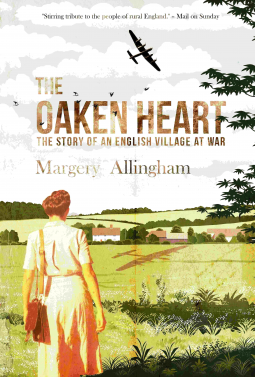
The Oaken Heart by Margery Allingham

Having read several of Margery Allingham’s detective novels, I was intrigued to come across The Oaken Heart, an account of life in her small English village during the Second World War. Originally published in 1941, it was apparently based on letters written to some American friends and expanded into a book at the suggestion of her publisher. It’s interesting to think that she was writing this while the war was still taking place and when nobody knew how much longer it would last or what the outcome would be.

Allingham’s village was Tolleshunt D’Arcy in Essex, but she refers to it in the book as ‘Auburn’ after a line from the poem The Deserted Village by Oliver Goldsmith. She is obviously very proud of Auburn and the way the people who live there work together to cope with whatever the war throws at them; it’s true that all towns and villages have their own unique characteristics, but I think it’s also true that the wartime experiences of the residents of Auburn will have been similar to the experiences of people in other parts of Britain.

Like many other villages, Auburn, in 1938 when the book opens, is still suffering from the effects of the previous war which ended just twenty years earlier. There’s a sense that Allingham and her friends are putting all their faith in Neville Chamberlain, not really believing or wanting to believe that war could possibly happen again. Of course, it does happen again – after a year of preparations, gas mask distributions and discussions of who should take in how many evacuees. The subject of evacuees is an important one to the people of Auburn; at first they are excited at the thought of groups of little schoolchildren from London arriving in the village (since the First World War there has been a shortage of young people in Auburn), but the reality is very different – hundreds of young mothers and babies! Allingham’s descriptions of the newcomers, the culture differences and how the villagers dealt with all of this are quite funny to read about.

I have never read anything about Margery Allingham as a person before, so I don’t know what she was supposed to be like or what impression the people who knew her had of her, but based on her own words in The Oaken Heart, she seems very likeable and down-to-earth. She makes a few references to her writing career now and then (she was working on Traitor’s Purse at the time), but there is never any sense of self-importance or superiority over anyone else in the village. Her writing style is warm, conversational and, as you would expect, very readable.

This is a wonderful book, which I would recommend to anyone who enjoys reading about life during the war. The fact that it is a first-hand account written in 1941 rather than a memoir written years later gives it another layer of interest. As we reach the final page, there is still no end to the war in sight and nobody has any idea if or when it’s all going to stop. I was sorry that the book ended when it did, as I would have liked to have continued reading about the people of Auburn and to find out how they fared later in the war.

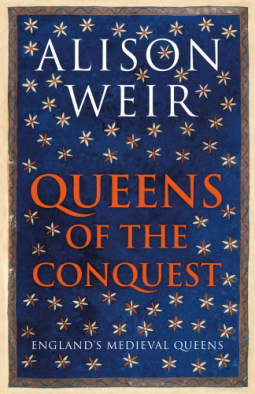
Queens of the Conquest by Alison Weir

In Alison Weir’s new non-fiction book, Queens of the Conquest, she explores the lives of the five queens of England who followed the Norman Conquest of 1066. These five, in the order they appear in the book, are Matilda of Flanders (wife of William the Conqueror), Matilda of Scotland and Adeliza of Louvain (the two wives of Henry I), Matilda of Boulogne (wife of King Stephen), and the Empress Maud, Henry I’s daughter, who was never actually crowned but called herself Lady of the English. Lots of Matildas, then – Maud is also referred to in many sources as Matilda – but with each queen discussed chronologically (apart from where their stories overlap), things aren’t as confusing as you might imagine!

Apart from Maud, whom I have read about several times in fiction, I knew very little about the other queens whose stories are covered in this book. Considering the general lack of information available to us today – we don’t even have a clear idea of what these women looked like due to the absence of contemporary portraits – I think Weir still does a good job of providing as full and comprehensive an account of each queen’s life as she possibly could. There is inevitably a lot of padding – facts about medieval life, descriptions of castles and long passages quoted from letters – but if you don’t know a lot about the period, most of this should still be of interest.

I can’t really comment on the historical accuracy of this book as my own knowledge is very limited, but Weir does provide references to back up most of what she says. In fact, the additional material which includes the references, sources, maps etc takes up about a quarter of the book! There are still times, though, when she is forced to speculate and make assumptions about how one of the queens may have felt or behaved, and resorts to using words like ‘probably’ or ‘possibly’. Usually I prefer more certainty when I’m reading non-fiction, but in this case, I do understand that with the primary sources being so sparse, some guesswork was necessary to round out the characters of the queens and to make this into an entertaining read rather than a dry textbook.

15th century depiction of the Empress Matilda/Maud

The most enjoyable part of the book for me was the section describing the period of civil war known as the Anarchy during which Maud (who was named as her father Henry I’s heir) and Matilda of Boulogne (whose husband, Stephen, was Henry I’s nephew and another claimant to the throne) found themselves on opposite sides. As I’ve read several novels which have this period as a setting, it was good to read a factual account this time instead of a fictional one, while still recognising some of the most interesting episodes, such as Maud’s escape in the snow from the besieged Oxford Castle.

Maud certainly didn’t seem to have made herself very popular, having a reputation for being proud, haughty and arrogant, but I have always assumed that this was probably due to the prejudice of the male chroniclers of the time against a female ruler who didn’t behave the way they expected a woman to behave. Weir points out that Matilda of Boulogne often acted in a similar way but her actions were seen as acceptable because she was taking them on behalf of her husband, King Stephen, rather than for herself, but she also suggests that Maud’s overbearing attitude and poor decision-making may have been due to mood swings caused by early menopause or a long-term illness she suffered following childbirth. This was the one place where I thought there may have been some bias creeping in, as Weir clearly seems to like Matilda of Boulogne much more than the Empress – and I couldn’t help wondering what caused the aggression and lack of judgement of some of the kings mentioned in the book!

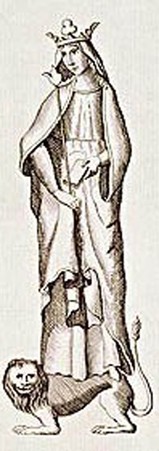
18th-century impression of Matilda of Flanders

I was also interested to read the various theories and legends behind Matilda of Flanders’ marriage to William the Conqueror and the controversies surrounding Matilda of Scotland’s marriage to Henry I (she had previously spent some time in a convent so it was debatable whether or not she was free to marry). I felt that I learned very little about Adeliza, though; while she is described as being particularly beautiful and helping to promote the arts, it seemed that she had less power and political significance than the other queens.

Although I sometimes felt that too much time was devoted to the general history of the period when I would have preferred more analysis of the specific lives and characters of the five queens, I did find Queens of the Conquest a fascinating read. Apparently this is just the first of four volumes which will take us through the rest of the medieval queens to the end of the Wars of the Roses. I will be looking out for the next one.

Thanks to the publisher for providing a copy of this book for review via NetGalley.

Gerald Durrell: Three Singles to Adventure; Golden Bats and Pink Pigeons

The British naturalist Gerald Durrell is probably best known for his trilogy about his childhood in Corfu (which begins with My Family and Other Animals), but he also wrote a large number of other books, many of them describing his journeys to faraway countries to bring back animals for Britain’s zoos. Thanks to Open Road Media, who are reissuing his books in ebook form, I have had the opportunity to read two of them: Three Singles to Adventure and Golden Bats and Pink Pigeons.

three-singles-to-adventure First published in 1954, Three Singles to Adventure is an account of Durrell’s animal-collecting expedition to British Guiana (now Guyana) in 1950. Using the capital city of Georgetown as a base, Durrell and his two companions, Bob and Ivan, begin their mission by purchasing three tickets to Adventure, a village chosen at random from a map because of its intriguing name. First in Adventure, then in two other locations elsewhere in the country, the three begin to gather specimens of the mammals and birds, reptiles and amphibians, which live in that area of South America. These range from lizards, frogs and anteaters to anacondas, opossums and tree porcupines.

Durrell’s enthusiasm for his work really shines through on every page. His descriptions of the animals and birds he discovers are vivid and detailed, full of wonder, fascination and admiration; he even manages to capture the individual personality of each one. My personal favourites were the two-toed sloth who tries to escape in the middle of the night, the capybara who keeps everyone awake by gnawing on the wires of his cage and a big, lovable curassow bird called Cuthbert who gets under everybody’s feet at the most inconvenient of times!

While Bob was absorbed in the job of disentangling the hammocks from their ropes, Cuthbert cautiously approached across the floor and lay down just behind his feet. During the course of his struggles with a hammock Bob stepped backwards and tripped heavily over the recumbent bird behind him. Cuthbert gave a squawk of alarm and retired to his corner again. When he judged that Bob was once more engrossed, he shuffled forward and laid himself across his shoes. The next thing I knew there was a crash, and Bob fell to the floor together with the hammocks. From underneath the wreckage of mosquito-nets and ropes Cuthbert peered, peeting indignantly.

There’s one funny anecdote after another, many of them involving the hapless Bob, who only came along to paint pictures and finds himself joining Durrell in the most hair-raising of escapades!

As an animal lover myself, I couldn’t help feeling sorry for some of the animals, who clearly weren’t meant to be kept in captivity and were transported in sacks, boxes and cages, but having said that, I could see that Durrell did genuinely care about them and treated them in as humane a manner as he was able given the time and place. He would later become known as a conservationist, founding the Durrell Wildlife Conservation Trust with his own zoo in Jersey dedicated to helping endangered species.

golden-bats-and-pink-pigeons The second Durrell book I read, Golden Bats and Pink Pigeons, was originally published in 1977 and describes a trip to Mauritius in search of endangered animals to bring back to Durrell’s Jersey Zoo. Accompanied by his assistant John Hartley and secretary Ann Peters, Durrell was hoping to find specimens of the pink pigeon, of which only a few remained, the golden fruit bat of the island of Rodrigues, whose numbers had also dropped, and three types of rare reptile from Round Island, another island near Mauritius. All of these creatures, like the dodo before them, were at risk as a result of habitat change and new predators – cats, dogs, rats etc – which had been introduced to the islands with the arrival of human beings. Durrell’s intention was to take a small number of each animal to be bred in captivity and eventually re-released into the wild.

This is another fascinating read, with some lovely descriptions of the beautiful scenery – including a whole chapter which describes a swim through a coral reef. I didn’t like it quite as much as Three Singles to Adventure, though, which I think was partly because the types of animals and birds featured in this one appealed to me less. It’s not as funny as the other book either, although Durrell still has some amusing stories to tell about his time in Mauritius. I loved the episode where, on the day of their bat-catching expedition, he and his companions arrive at the airport carrying a large quantity of fruit to use as bait (including a large and particularly smelly Jak fruit), only to find that they are over the weight limit for the plane.

Frantically, we discarded all the heavy items of clothing and equipment we could manage without. It made an interesting pile. If there had been any doubts about our sanity before this, they were soon dispelled, for what sane person would discard shirt, socks, shoes and other items of wearing apparel in favour of bananas, mangoes and a Jak fruit that one was conscious of at fifty paces?

I really enjoyed reading these two books! Each of the new editions includes biographical information on Durrell and a selection of family photographs; Three Singles to Adventure also has an index of the animals and birds mentioned in the text. I would highly recommend either or both of these books and am looking forward to reading more of them.

Thanks to the publisher Open Road Media for providing review copies via NetGalley.