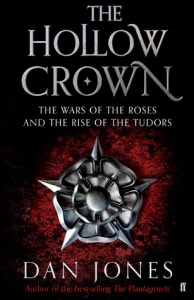
 A rare non-fiction review here today! Having loved Dan Jones’ book on the Plantagenets, I was curious to see how he would approach the Wars of the Roses, which is one of my favourite periods of English history. I was looking forward to another well written, thoroughly researched book that would make a complex subject accessible and easy to understand – and that’s what I got, although there were one or two problems which prevented me from enjoying this book as much as the previous one.
The Hollow Crown: The Wars of the Roses and the Rise of the Tudors begins with the marriage of Henry V and Catherine of Valois, laying the foundation for the years of conflict that would follow. Best known for his victory over the French at Agincourt, Henry V was considered one of England’s great medieval kings, but when he died in 1422 of a sudden illness with his only heir still a baby, the scene was set for decades of uncertainty and instability. As Henry’s son, Henry VI, grew into an adult it became obvious that he was unfit to rule. Suffering from an unspecified mental illness, he was a weak and ineffectual king, and this paved the way for rival claimants to the throne – Richard of York and his son, the future Edward IV.
From the 1450s to the 1480s a series of battles were fought between the two rival branches of the royal house – York and Lancaster. This book takes us through the entire period in chronological order, detailing each battle and its outcome and examining the reigns of Henry VI, Edward IV, Richard III and finally Henry VII, who defeated Richard at the Battle of Bosworth and founded a new royal dynasty – the Tudors. Naturally a lot of the focus is on the male figures of the period – the kings and dukes and earls – but Jones shows understanding and sympathy for some of the women too: Margaret Beaufort who gave birth to Henry Tudor at the age of thirteen and according to Jones may have been left physically and mentally traumatised by the experience, and Henry VI’s wife, Margaret of Anjou, who found herself with the responsibility of trying to maintain some sort of control of the kingdom during her husband’s long spells of illness.
This is a shorter book than The Plantagenets (and focuses more intensely on a shorter period of history) and, like the previous volume, it’s very readable and even quite gripping in places. There was one area, though, where I felt that this book was not as good as the first one. In The Plantagenets I felt that Jones had given a fair and balanced account of the historical people and events concerned but The Hollow Crown feels very biased towards the Lancastrian/Tudor point of view. The bias is most noticeable, maybe not surprisingly, in the sections dealing with Richard III where Jones makes it clear where he stands on the questions of what happened to the Princes in the Tower and how Henry VI met his death. Now, I know Richard is a controversial figure and it would be difficult for any historian not to have an opinion of him one way or the other, but it would have been nice if some alternative theories could have been explored here as well instead of just being dismissed in one or two sentences!
I did enjoy The Hollow Crown, though. Dan Jones’ writing style is lively and entertaining, which means his books are good choices for someone like myself who prefers fiction to non-fiction. I feel that I’m starting to have quite a good knowledge of the Wars of the Roses now but there was still some information here that was new to me (particularly near the end of the book, where he looks at the fate of the de la Poles, the final Yorkist claimants). This book could also be a good place to start if you know nothing about the Wars of the Roses – it’s a very complex and confusing period but Jones does a good job of making it as easy to understand as possible…I hope you’ll find it as fascinating as I do!
I received a copy of The Hollow Crown for review via NetGalley.


 She Reads Novels