Hag-Seed by Margaret Atwood

This month I’ve been taking part in Nonfiction November, but it’s also Margaret Atwood Reading Month hosted by Naomi at Consumed by Ink and Marcie at BuriedInPrint. I was planning to read one of her longer books – The Blind Assassin or possibly Cat’s Eye, but I found myself running out of time towards the end of the month, so I decided on the much shorter Hag-Seed instead. This book is part of the Hogarth Shakespeare series of retellings of Shakespeare’s plays by modern authors.

Felix Phillips had a successful career as Artistic Director of the Makeshiweg Theatre Festival until his assistant, Tony, betrayed him and took his job. Forced to abandon his plans to stage a contemporary version of The Tempest – a play close to his heart, having recently lost his three-year-old daughter Miranda (who shared her name with Shakespeare’s heroine) – Felix drops out of public life and begins to plot his revenge. Under the name of Mr Duke, he applies for a position at Fletcher Correctional, helping to improve the literacy of the prisoners. Here he will have his chance to direct The Tempest after all, while making his enemies pay for what they have done.

The Tempest is a play that I know quite well, although I wish I’d found time to re-read it before starting Hag-Seed. I’m tempted to do that now, but I think reading them in the opposite order would have been more helpful! I enjoyed watching the prisoners as they study the play for the first time and try to interpret it in their own unique way (could Ariel have been an alien rather than a fairy? Would Shakepeare’s songs be improved by rewriting them as rap?) Personally, when it comes to adaptations of books and plays, I don’t usually like to see things being modernised or given ‘contemporary twists’, but even so it was good to see the Fletcher Correctional Players having so much fun and being so inventive.

Felix plays Prospero, the magician and rightful Duke of Milan, in the prisoners’ production, but he also fills the role of Prospero in the framing narrative. The prison represents the magical island to which Prospero is exiled, while Tony is clearly the equivalent of Prospero’s usurping brother, Antonio. Events in Felix’s life mirror events from The Tempest, coincidentally at the beginning, but then intentionally as he begins to orchestrate his plan for revenge. And of course, even as Felix controls and manipulates the other characters, we know that he is also a character and a prisoner, caught between the pages of Margaret Atwood’s novel, controlled and manipulated by Atwood herself.

Having some familiarity with the play does make it easier to understand and unravel the many layers of Hag-Seed, but if you’re not familiar with it, that shouldn’t be a problem as the whole story is told at various points in the novel, in various different ways (including a full summary at the end of the book). We can learn along with the prisoners as they try to identify the nine types of prison portrayed in the play and as they write an analysis of their chosen character and imagine how his or her story might continue after the play comes to an end. I particularly enjoyed the contributions made by Anne-Marie Greenland, the actress and dancer Felix brings in to play the part of Miranda.

As for the real Miranda – Felix’s daughter who died as a child – the novel is as much about Felix’s feelings for her and his inability to let things go and move on as it is about anything else. Without saying too much, I really liked the way that part of the story was resolved and the way the novel ended.

I must read some of those longer Atwood novels soon – and I would like to try another of the Hogarth Shakespeare books too.

The Sentence is Death by Anthony Horowitz

I loved The Word is Murder, Anthony Horowitz’s first book to feature the detective Daniel Hawthorne, so when I heard that there was going to be a second book I couldn’t wait to read it. I didn’t have to wait too long, as this one has been published only a year after the first, and I’m pleased to report that I enjoyed it just as much, if not more.

When high profile divorce lawyer Richard Pryce is found bludgeoned to death with an expensive bottle of wine, the culprit seems quite obvious. Just days earlier, Pryce had been threatened by a client’s ex-wife who poured a glass of wine over his head in a restaurant. Surely that can’t be a coincidence? But Pryce has plenty of other enemies, whose identities come to light as investigations continue. Could one of them have wanted him dead? And what is the significance of the numbers painted on the wall near Pryce’s body? As this is clearly a more complex case than it seemed at first, ex-police detective Hawthorne is asked to assist with solving the crime.

Having worked with Hawthorne on his previous mystery in The Word is Murder, author Anthony Horowitz reluctantly agrees to team up with him again and document the progress of the investigations in a second book, The Sentence is Death. Hawthorne is supposed to be the hero of the book, but this time Anthony decides to do some detecting of his own in the hope of reaching the solution first. Can he solve the mystery before Hawthorne does?

If this sounds confusing, I should explain that, as in the previous novel, Horowitz is a character in his own book. The Anthony in the story is clearly based on the author himself – he frequently discusses his career as a novelist and screenwriter and refers to his wife and his publisher by name – yet he interacts with fictional characters, takes part in fictional storylines and struggles to solve the mystery the real Horowitz has created. I think it’s a clever concept and great fun, though not everyone will agree – it’s probably something you’ll either love or you won’t.

It’s not really necessary to have read the first book before starting this one as the mysteries are entirely separate. Like the first, this is a strong, well-constructed mystery with plenty of clues but plenty of red herrings as well. I didn’t manage to solve it (I confess that I allowed myself to be distracted and misled by every one of those red herrings) but I was happy to be kept in suspense and wait for Hawthorne – or Anthony, of course, if he got there first – to explain it all for me.

However, I would still recommend reading both books in order if you can, so that you can watch the progression of Anthony’s relationship with Hawthorne. Hawthorne is no more pleasant or likeable now than he was when we first met him in The Word is Murder, and he is still every bit as much of an enigma, but we do pick up a few new bits of information about him here, with some glimpses of his home and his life away from his detection work. I think he’s a great character, for all of his flaws, and I love his partnership with the fictional Anthony.

When I read the first novel I found the details of Anthony’s publishing and television career a slight distraction from the main plot, but in this book they seemed to form a more intrinsic part of the story and I liked that aspect much more. Horowitz seems to be having fun at the expense of his fictional self, as Anthony stumbles from one disaster to another; I particularly enjoyed the opening scenes on the set of Foyle’s War and a later scene involving the theft of a book – and I’m curious to know whether the literary fiction author Akira Anno was based on a real person (although if she was, I doubt her true identity will ever be revealed).

I loved this book – and the good news for Horowitz and Hawthorne fans is that there’s going to be a third.

Thanks to Century for providing a copy of this book for review via NetGalley.

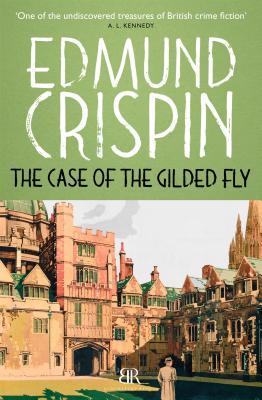
The Case of the Gilded Fly by Edmund Crispin

Like many people, I first encountered Edmund Crispin’s Oxford don detective Gervase Fen in The Moving Toyshop, the third in the series and the one which is usually said to be his best. I loved it and wanted to read more, so going back to the beginning of the series and reading The Case of the Gilded Fly seemed a good idea. As it was published in 1944 I had hoped to read it for last month’s 1944 Club but didn’t have time and ended up reading it after the event was over.

The novel opens with an introduction to each of the main characters as they travel to Oxford on the train. Among them are Gervase Fen, Professor of English Language and Literature at Oxford University, and his old friend the Chief Constable, Sir Richard Freeman. Ironically, Fen’s passion is for detection, while Sir Richard’s is for literature, which leads to some interesting conversations between the two of them. Although this is the first book in the series, it is implied that Fen already has some experience of solving mysteries. He certainly has no difficulty in solving the ‘Case of the Gilded Fly’, even though everyone else finds it baffling.

Also arriving on the same train as Fen and Sir Richard are Robert Warner, a playwright who has chosen an Oxford theatre for the premiere of his new play, and several members of the cast. One of these is the aspiring young actress Yseut Haskell, a spiteful, self-obsessed person who seems to cause trouble everywhere she goes. As we get to know the characters better during their first night in Oxford, we discover that almost everyone has a reason to dislike her, so when Yseut is found dead in a room in the college the next day, there’s no shortage of people with motives. The problem is, none of them seemed to have had an opportunity to enter the room unobserved and carry out the murder. How did the killer manage it? And what is the significance of the Egyptian-style gilded ring found on Yseut’s finger?

This is a complex locked-room-style mystery with a lot of discussion of alibis, floor plans and the timings of events. I didn’t come close to solving it, although Fen works it out very early on but has no proof and keeps us waiting until the end to find out who did it and how it was done. He also faces a moral dilemma: as Yseut was such an unpleasant person and nobody is particularly sorry to see her dead, does he really want the killer to be punished – especially as the police have already decided it was suicide? In my opinion Yseut had done nothing to deserve being murdered, but I suppose this provides a reason why Fen doesn’t immediately tell the police what he knows and bring the novel to an end before it even begins!

I enjoyed this book, but I found it slightly disappointing in comparison to The Moving Toyshop. As a more conventional sort of mystery, it doesn’t have quite the same feeling of originality and novelty, and although there are still plenty of witty comments and literary allusions flying back and forth between Fen and his friends, they are not as much fun as the limericks and ‘Detestable Characters in Fiction’ game in The Moving Toyshop. It’s possible that I would have liked The Case of the Gilded Fly more if I’d read it first and had nothing to compare it with.

Have you read any of the Gervase Fen mysteries? Which ones are your favourites?

The Grave’s a Fine and Private Place by Alan Bradley

After reading Alan Bradley’s Thrice the Brinded Cat Hath Mew’d last month, I decided to move quickly on to the next in the Flavia de Luce mystery series, The Grave’s a Fine and Private Place. This is the ninth Flavia novel and brings me completely up to date with the series (for now; another book is due early next year).

In this book, our twelve-year-old detective is coming to terms with the terrible news she received at the end of the previous novel. Along with her two elder sisters, Feely and Daffy (Ophelia and Daphne), and her father’s old friend and servant, Dogger, Flavia is taking a boating trip to try to relax and recover from the shock. Trailing her hands in the water as they sail down the river, Flavia suddenly feels her fingers get caught between teeth – it seems that she has discovered yet another dead body. Being Flavia, she is more excited than repulsed, and when the corpse of a young man is pulled to the shore she can’t wait to find out how and why he died.

The dead man is Orlando Whitbread, an aspiring actor with a local theatre company. As Flavia delves more deeply into Orlando’s background, she discovers links with a murder that took place several years earlier. In her usual way, she sets about searching for clues and speaking to suspects – but this time she has some help. It seems that Dogger has been carrying out some investigations of his own and is proving to be Flavia’s equal as a detective, while Daffy, who is never to be found without her nose in a book, offers her assistance in solving some literary clues. This is something new for Flavia, for whom crime-solving has always been a very solitary activity.

We see more of Dogger in this book than ever before and he and Flavia are working together almost as equals, but I was particularly happy with the improvement in her relationship with Daffy. She is getting on better with her other sister too, and for the first time seems to be appreciating that there’s more to Feely than meets the eye. Maybe it has taken some family tragedies to make them overcome their differences – or maybe they are all just growing up. There have certainly been some changes in Flavia and she has come a long way from the tantrum-throwing eleven-year-old she was at the beginning of the series. On the other hand, I think she’s less fun as a character and maybe that’s why I can’t help feeling that the last few books in the series have lacked the charm of the earlier ones. That charm was important because it was what kept me reading and loving the Flavia books, even when the mysteries weren’t particularly strong.

The mystery in this one is slightly more complex than some of the others and I enjoyed meeting the characters who are drawn into it, such as Hob Nightingale, the undertaker’s son, and Mrs Palmer, a published poet who befriends Daffy. I found the final solution a bit unconvincing, however – the reasons for both the original murder and Orlando’s death seemed quite weak. Back to Flavia’s personal story, though, and this book has a much happier ending than the previous one! There were hints that the series might be about to go in an intriguing new direction, but I will have to wait for book 10, The Golden Tresses of the Dead, to find out.

The Witches of St Petersburg by Imogen Edwards-Jones

I love reading about Russia, so the title of this novel alone was enough to attract my attention. When I discovered that it was set in the final years of the Romanov dynasty I was even more interested in reading it – it’s such an eventful period of history, yet most of my Russian reading has been set either earlier than that or later.

The novel opens in 1889 with the arrival in St Petersburg of two Montenegrin princesses. Militza and her younger sister Stana (Anastasia) are the daughters of the King of Montenegro and are being married off to members of Russia’s Imperial Court. Despite the high positions they now hold as a result of their marriages, the sisters are not fully accepted by the Russian courtiers who look down on them because of the smallness and perceived insignificance of their home country. They do make some friends, however, including the Tsarina Alexandra who, having given birth to four daughters, is now desperate to provide the Tsar with a son and heir.

Militza and Stana believe they may be able to help. With their knowledge of magic, their ability with spells and charms, and their skill at channelling spirits, they are what many people would call witches, but despite all of their efforts they are still unable to produce a son for the Tsarina and turn at last to a monk from Siberia by the name of Rasputin. Rasputin proves to be a sensation and the princesses are proud to have been responsible for his introduction to court – but when his influence with the Tsar and Tsarina begins to surpass their own, they start to wonder what they have done.

There were things that I liked about The Witches of St Petersburg and things that I didn’t like. I loved the setting as I’d hoped I would, and as I had never read about Militza and Stana before, I enjoyed getting to know them. Stana’s role in the novel is mainly confined to her marital problems – her husband Prince George Maximilianovich spends most of his time in Biarritz with his mistress and Stana longs for a divorce – but Militza is an interesting character and the one who drives the story forward, working to raise the sisters’ profile at court and to get close to the Tsarina. As a ‘witch’, she is also the more powerful of the two, conducting séances and speaking to the dead. The magical aspects of the book confused me, though; I wasn’t sure whether we were supposed to believe that Militza really did have magical powers and really was a witch or whether it was all just a pretence.

The first half of the novel felt too long and repetitive – there were only so many times I wanted to read about the sisters being snubbed at parties and taunted for their provincial background and ‘smelling of goat’ – and I wondered when Rasputin was going to arrive on the scene and liven things up. His first appearance doesn’t come until halfway through the book and the story does become more compelling after that, as Militza and Stana begin to regret their role in bringing him to St Petersburg and wonder how they can get rid of him. However, this is a particularly repulsive portrayal of Rasputin! Some of it may be realistic, but I wished there wasn’t so much graphic detail on how dirty and revolting he was. This is not really a book for the squeamish.

I had a mixture of feelings about The Witches of St Petersburg, then, but overall my interest in the Russian history and in two women I had previously known nothing about was enough to make me keep reading.

Thanks to Head of Zeus for providing a copy of this book for review via NetGalley.

The Turn of Midnight by Minette Walters

This is the sequel to The Last Hours, which followed the fortunes of a group of people during the Black Death which reached England in 1348. When I finished the first novel last year, I wasn’t sure whether I had liked it enough to want to read any more, but in the end I couldn’t resist finding out how the story would conclude.

The Turn of Midnight picks up where The Last Hours left off, with the people of Develish in Dorsetshire living in quarantine while the plague rages across the land. The reason their community has survived largely intact while others around them have been wiped out is because of the precautions taken by Lady Anne, who gathered her people within the moat that surrounds her manor house and burned the bridges, cutting them off from contact with the outside world. Now that winter has come and food supplies are running low, Lady Anne’s loyal serf Thaddeus Thurkell, accompanied by several other young men from Develish, has crossed the moat and ventured into the countryside to see what he can find.

Despite the strong leadership skills of Lady Anne and the intelligence and courage of Thaddeus, Develish has no lord, Lady Anne’s husband Sir Richard having succumbed to the plague early in the previous novel. This has left the demesne in a vulnerable position, so together Thaddeus and Lady Anne come up with a plan to protect the people of Develish…but if they fail Thaddeus could find himself in serious danger.

I’m glad I decided to read this book because I enjoyed it quite a bit more than The Last Hours. It feels faster paced, with more going on, and of course, being the second of a pair of two novels, it has a much more satisfying ending. Where the previous novel was set mainly in and around the manor of Develish, this one has a wider scope, concentrating less on Lady Anne and her family and more on Thaddeus. Towards the end of The Last Hours I felt that Thaddeus and his companions were wandering aimlessly in the countryside without much happening, but this time they have adventure after adventure as they explore desolate towns and villages, make new friends and new enemies, and carry out charades and deceptions.

My main criticism of this book is that I still couldn’t really believe in either Thaddeus or Lady Anne as realistic 14th century characters. As I mentioned in my review of The Last Hours, I found their attitudes and thought processes far too modern and wasn’t at all convinced that they, unlike the rest of the population, could have had such an accurate understanding of how the Black Death was spread and how to protect themselves from it. I was also disappointed that Lady Anne’s stepdaughter, Lady Eleanor, is reduced to such a minor role in this book. Eleanor was very much the villain of the previous novel, but near the end some reasons were given for her terrible behaviour and there were hints that she might have been about to turn a corner. She is certainly much more likeable in this second book, but sadly the transformation of her character is not explored in any depth which I thought was a wasted opportunity.

This is such an interesting period of history to read about, though, and I did find the portrayal of a country devastated by plague vivid and convincing, even if the characters were not. Minette Walters is much better known as a crime author and has moved into new territory with these two novels; I’ll be curious to see whether she writes any more historical fiction in the future.

Thanks to Allen & Unwin for providing a copy of this book for review via NetGalley.

Murder by the Book by Claire Harman

I don’t read a lot of non-fiction, but I’ve been reading more of it than usual over the last few weeks in preparation for Nonfiction November. Murder by the Book, an account of a true crime which took place in Victorian London, sounded appealing to me because it promised to explore the possible links between the crime and some of the bestselling novels of the day.

The book begins by describing the events of 6th May 1840, when Lord William Russell’s housemaid found her master in bed with his throat slit. Suicide was suspected at first, but with his head almost severed from his body, this theory was dismissed and a murder investigation began. Russell, an elderly widower, had been leading a quiet, unremarkable life, living alone (apart from his servants) in a respectable Mayfair street. Who could possibly have wanted him dead – and why?

The murder sent shockwaves throughout London, with everyone – including Queen Victoria herself – following the news and voicing their opinions. What made this particular case so shocking was that when the culprit was identified and questioned, it was found that before committing the murder he had been reading Jack Sheppard, a well-known novel by William Harrison Ainsworth. Based on the story of a real life 18th century criminal, Jack Sheppard had been published as a serial in Bentley’s Miscellany from January 1839 until February 1840. With plots involving murder, theft and violence, crime novels of this type had become known as ‘Newgate Novels’ (a reference to the Newgate Prison), and were hugely popular with the public, partly due to the rise in literacy levels during the first half of the 19th century. Following the Russell murder, a debate began regarding the suitability of this sort of reading material.

I enjoyed Murder by the Book, but I didn’t find the true crime element particularly interesting. There didn’t seem to be a lot of mystery surrounding Russell’s death and the murderer was arrested quite quickly. Although Claire Harman did manage to flesh the story out, on its own it wouldn’t have been enough to form a compelling book. The parts where she discussed Jack Sheppard and other popular novels of the time were of much more interest to me. I haven’t read Jack Sheppard, or anything else by William Harrison Ainsworth, and I’d had no idea that it had been so successful in its time. The book was adapted for stage many times, including some musical versions, so even if people hadn’t read it they were likely to have seen it performed.

The reactions of other authors were interesting; Charles Dickens had apparently been a friend of Ainsworth’s, but distanced himself from him after the Russell incident, doing all he could to defend the reputation of his own Oliver Twist, which covered similar themes. Both Dickens and William Makepeace Thackeray followed the outcome of the murder trial and attended the hanging of the culprit and some of their thoughts on this are given in the book.

Anyway, the social aspects of the book were fascinating, even if the true crime parts weren’t – although I was surprised that Claire Harman didn’t draw more parallels between the Jack Sheppard controversy and the perceived influence of modern television, music and video games on violent behaviour. The book reminded me of Kate Summerscale’s The Wicked Boy and I think if you enjoy one you might enjoy the other.

Thanks to Viking for providing a copy of this book for review via NetGalley.