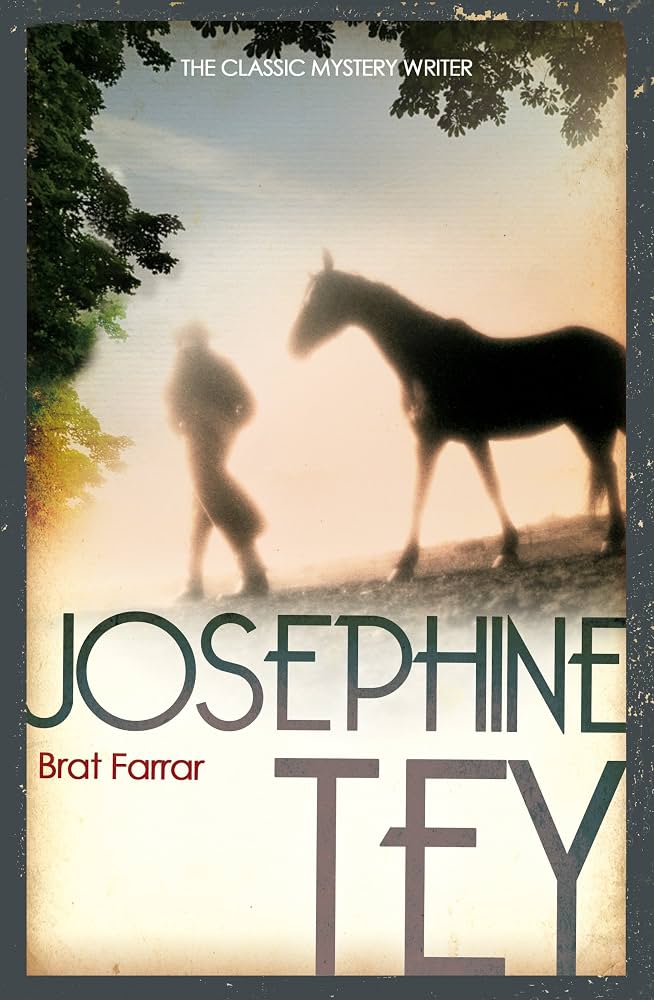
 This week Karen of Kaggsy’s Bookish Ramblings and Simon of Stuck in a Book are hosting another of their clubs where we all read and write about books published in the same year. This time the chosen year is 1949, which seems to have been a particularly great year for literature – last week I posted a list of my previous 1949 reviews and there were eleven of them! I have some more reviews coming this week, starting with this one, Brat Farrar by Josephine Tey, which is also on my Classics Club list.
As a baby, Brat Farrar was abandoned on the steps of an orphanage on St Bartholomew’s Day (hence the name Brat, from Bartholomew or Bart). After spending some time in America working on a ranch, he returns as an adult to England where he is spotted by Alec Loding, an actor. Loding has mistaken Brat for Simon Ashby, a young man whose family he knows well. Simon’s twin brother, Patrick, went missing eight years earlier shortly after their parent’s deaths, and was believed to have drowned himself as his coat and a suicide note were found on a clifftop. Simon is now the sole heir to Latchetts, the family estate, and is due to inherit on his twenty-first birthday, which is almost here.
Brat allows himself to be persuaded to go to Latchetts and pretend to be Patrick Ashby so that he, as the elder twin will inherit everything. Loding coaches him on the family history, the layout of the house and everything else he needs to know to be able to successfully impersonate Patrick. I’m sure if I tried to do that, I would forget it all and get caught out immediately, but Brat does an amazing job and the Ashbys are completely fooled. Or are they?
I’ve been meaning to read this book for years, ever since I read The Ivy Tree by Mary Stewart, which has a very similar plot and even references Brat Farrar several times. My previous experience of Tey’s work has been mixed – I liked The Daughter of Time and found A Shilling for Candles boring – but I really enjoyed this one. I love a good impersonation story and even did a Top Ten Tuesday post on them a while ago! Tey is thought to have taken inspiration from the real life case of the Tichborne Claimant from the 1860s.
The really intriguing thing about this book is that even though we know from the start that Brat is a participant in a deliberate fraud and therefore a criminal, we find ourselves siding with him and rooting for him anyway. This is partly because Simon, the real Ashby heir, is so unlikeable, and partly because Brat, in contrast, is quiet, kind and thoughtful and his motives for going along with the impersonation scheme seem to be not so much for the money but more for the sense of belonging – and also the chance to work with the horses at Latchetts! Naturally, this leads to some internal conflict when he finds himself growing to like and care for the family he is deceiving.
 This book does require some suspension of disbelief. I felt that the Ashbys and their friends and neighbours (apart from Simon, who is immediately sceptical) were very quick to accept that Patrick had returned from the dead and I found it unlikely that anyone could really carry on a deception like that for any length of time without making mistakes and giving themselves away. But apart from that – and the focus on horses, show jumping and racing, which I could have done without – this was an entertaining read and a great choice for 1949 Club!
This is also book 8/50 from my third Classics Club list.


I’m about halfway through this at the moment and really enjoying it.
It’s great, isn’t it? I’m expecting it to be a popular choice for the club.
This is my favourite of Josephine Tey’s novels, partly for the horses (sorry, I was a pony-mad child) but mainly for the lovely picture of family life, despite the malicious Simon. Of course the truth today would be almost instantly solved by a DNA test, but back in the 1940s it wasn’t available, and there are good reasons in the novel why other tests weren’t available either. I’ve read it several times, and unlike some other novels written then, it hasn’t really dated – you’re not brought up short by a throw-away comment that would now be regarded as deeply inappropriate. My other favourite Josephine Tey novel is The Privateer, which is about Henry Morgan (the Caribbean pirate) and gives a sympathetic portrait of him which is almost certainly inaccurate, but also very attractive! It’s also, in her afterword, the source of her brilliant comment about hammy historical dialogue – ‘writing forsoothly’. Ever since, I’ve tried to avoid doing that!
Yes, a lot of older novels have plots that just wouldn’t work today, when modern science or the internet can instantly clear up the whole mystery! I’ll have to look for The Privateer. I read another novel about Henry Morgan a few years ago – Cup of Gold by John Steinbeck – which was also interesting, although not a particularly attractive portrayal and I’m sure not very accurate either.
I have The Franchise Affair in my TBR, but this sounds interesting too.
I haven’t read The Franchise Affair yet, but it’s one I would like to read eventually.
Josephine Tey is on my list of authors to try, I like the sound of family life but I would find the horses a bit dull too, may be I should start with The Daughter of Time?
I really enjoyed The Daughter of Time – and there are no horses in that one!
Such a long time since I’ve read this! Not my favourite Tey, but she’s such a good writer.
I need to read more of Tey’s books – she writes so well and I’ve read so few of them!
That sounds special, and definitely very different from The Daughter of Time, which I enjoyed a lot.
https://wordsandpeace.com/2026/10/12/the-1949-club-older-reads/
I enjoyed The Daughter of Time too, but yes, this one is completely different!
I think it is her best book although The Daughter of Time may be the most unusual and influential (I mean, how can one read it and not become a Ricardian?). I am in a group of lawyers who meet every quarter to discuss a book and I chose this for December, which should be interesting.
As you say, in the long term, could one effectively maintain an impersonation? I suppose if one were as quiet as Brat to begin with. After all, witnesses who babble usually betray themselves if they have something to hide. That is why we lawyers always warn people to answer the questions as briefly as possible. On the other hand, the more you get used to someone’s current persona, the more it supersedes what you remember, which I notice at college reunions.
Hmm, I own the Privateer but have not read it and am not sure where it is; must look for it, now that your commenter has praised it.
Yes, this is the best of her books I’ve read so far, although I did enjoy The Daughter of Time as well (I was already a Ricardian thanks to Sharon Penman’s The Sunne in Splendour). It should be a good choice for your group with lots of interesting points to discuss!
” The Ivy Tree by Mary Stewart, which has a very similar plot and even references Brat Farrar several times.” VERY interesting! I really liked Daughter of Time but Man in the Queue constantly repeated a racial slur that my family didn’t use back in the day the book was set/written. It got very “old” very fast. I did finish the book though.
That’s a shame about the racial slur. I would like to read more of Josephine Tey’s books, but maybe I’ll leave that one for now.
Skip it–there are better ones! It was a different time.
Yes, I enjoyed this one, too. I missed the references in The Ivy Tree, though! Of course, I might have read this one after that one. Well, I did, but I’ve read Stewart’s books many times.
It seems that the references to Brat Farrar were edited out of the older US editions of The Ivy Tree. I don’t know why they did that, but it could explain why you don’t remember them.
Oh, how strange! No wonder I don’t remember that. Do you suppose they thought we just wouldn’t understand them? But there are lots of references I don’t understand. I just go with the flow.
It’s sort of like the assumption that we wouldn’t be familiar with the Philosopher’s Stone, so changing it to Sorcerer’s Stone. I am certainly familiar with Philosopher’s Stone. They always think Americans are uninformed.
What an amazing plot, very Hollwoody-Bollywoody. Excellent review and since I have only read one Tey, this seems to be great second!
Yes, it’s a great plot. I would definitely recommend making this your second Tey!
As usual, despite your reservations, I can see there’s a lot in here to like, so thanks!
It’s definitely worth reading, despite the few negative points I’ve mentioned.
I also really like this one, and didn’t realise that The Ivy Tree is similar – I’ve only read one or two Stewarts, so will keep an eye out for that one now.