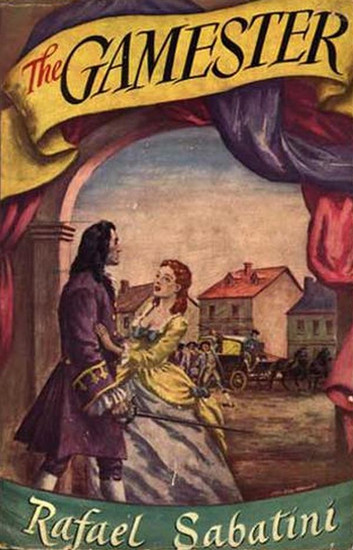
 This is my second book for this week’s 1949 Club (hosted by Karen of Kaggsy’s Bookish Ramblings and Simon of Stuck in a Book). I’ve loved some of Rafael Sabatini’s other novels, so I was pleased to find that he had one published in 1949. Sabatini was born in Italy to an English mother and Italian father; he was an accomplished linguist and wrote all of his novels in English even though it was actually his sixth language!
The Gamester was Sabatini’s final book, published a year before his death. It’s set in the early 18th century and tells the story of the Scottish financier and economist John Law, the Laird of Lauriston. Many people today probably haven’t heard of Law, but he was hugely important and influential in his time, establishing France’s first central bank, the Banque Générale, which issued the country’s first paper money. He also founded the Mississippi Company to manage France’s colonial trade in America. The word ‘millionaire’ was first used to describe the company shareholders who made their fortunes in what was known as the Mississippi Bubble (before it burst in 1720). You can see how his legacy still lives on today, then.
In The Gamester, Sabatini follows John Law from the time of his arrival in France in 1715. Having escaped from prison in England, after being sentenced to death for killing a man in a duel, Law has been wandering Europe for many years, making his fortune through cards and dice. Hearing of the death of King Louis XIV of France and the establishment of the regency of Philippe d’Orléans, Law sees a chance to make himself useful to the new regime and heads straight for Paris. The novel then covers his role in founding the Banque Générale and the Mississippi Company, as well as his long-running rivalry with Count Antoine-Joseph of Horn (the villain of the book).
John Law undoubtedly led a fascinating and eventful life, but I didn’t enjoy this book as much as I’d hoped to. I think Sabatini is at his best when he’s writing about fictional characters and creating his own storylines (definitely read Scaramouche if you haven’t already!) and his books about real people feel a bit dry in comparison. Although he does take some liberties with the real John Law’s character, for example involving him more heavily than he really was in the foiling of the treasonous plot known as the Cellamare Conspiracy, in general I felt he was too constrained by historical fact to make the story feel truly exciting. This is the same problem I noted with The Minion, his novel about the Overbury Affair.
 There were still plenty of things that I did enjoy about the book, particularly the parts dealing with the relationship between Law and his wife, Catherine, whom he considers bitter and shrewish. It’s obvious to the reader that there’s much more to Catherine than Law sees or appreciates, but sadly his family seem to be very low on his list of priorities – he and Catherine have children but we barely see them and aren’t even told their names. When his fortunes eventually change again and he does begin to understand what’s really important in life, we can only hope it’s not too late. It’s an interesting novel, then, with a lot going on, but the focus on money, gambling, banking and dealing in stocks and shares just didn’t really appeal to me. I’ll continue to work through his novels and hope that I get on better with the next one I try.


Sounds like an interesting subject but a shame the telling of his tale wasn’t as exciting as it could have been!!
Definitely not one of his better books, but the subject was fascinating at least!
The period and setting do sound interesting
Yes, it’s a really interesting period and setting. It just wasn’t as exciting as some of his other books.
I remember John Law from my university days, but I’m not sure that I need to read a book about banking!
He seemed to lead a fascinating life, but I could have done without all the details of banking and finance!
I know Sabatini was a big influence on Heyer so I have always been curious about his books (although maybe not sufficiently so to read them!).
His books vary a lot in quality, but some of them are excellent and definitely worth reading. His pirate novels Captain Blood and The Sea Hawk are very similar to Heyer’s Beauvallet so maybe you would enjoy those.
Probably not one for me. But maybe one of his other books. Which one of his books do you like best?
My favourite is definitely Scaramouche, but his pirate novels Captain Blood and The Sea Hawk are both fun too.
This seems to be something you run into with writers who write great fictional characters. It’s like they’re too cautious with the characters who really lived.
Yes, I’ve noticed that with other authors as well.
If I remember correctly, this was the only Sabatini book I quit reading (after one or two chapters). I read most of Sabatini’s works available on Project Gutenberg, including those about other historical events and figures. His history books weren’t light reading, but learning about John Law was too heavy for me!
I can understand why you didn’t finish this one! It’s obviously well written, like all of his books, but there is a lot of history in it and it’s quite dry compared to most of his others. I’m hoping the next one I read will be more entertaining.
Thanks for adding it to the club, and sorry it wasn’t a big success. I struggle with historical fiction at the best of times, and this probably won’t be the one to tempt me to the genre!
No, probably not one for you! Most of his other books combine history with adventure or romance, which works better for me. This one was much less fun!