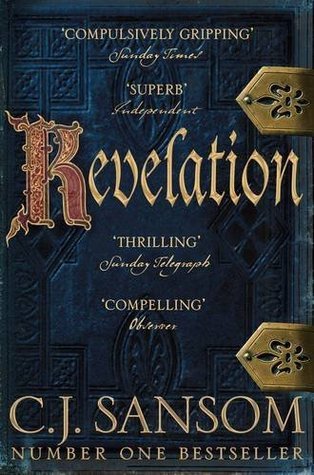
Revelation by CJ Sansom

revelation After reading Sovereign recently, I was desperate to continue with the next of CJ Sansom’s Shardlake mysteries – and luckily for me, I managed to find a copy of Revelation in the library the next day. I had said that Sovereign was my favourite in the series so far, so I was curious to see whether Revelation could possibly be as good. Well, it is; it’s even better! Before I continue, though, just a quick warning: although I’ve done my best to avoid spoilers here, this is the fourth book in the series and the appearance of certain characters in it will mean you can rule them out as suspects in the previous ones. My recommendation would be to start with book number one, Dissolution, and work through them in order.

Revelation is set in 1543, the year in which Katherine Parr becomes the sixth and final wife of Henry VIII, and after their adventures in York (described in Sovereign), lawyer Matthew Shardlake and his assistant Jack Barak are back in London. Shardlake has no desire to become embroiled in any more mysteries, but when a friend is found dead with his throat cut and his blood turning the water of a fountain red, it seems he will have no choice.

The dead man’s widow, Dorothy, is an old love interest of Shardlake’s, and he promises to help bring her husband’s killer to justice. However, it soon emerges that this is just the latest in a series of bizarre murders and, at the request of Archbishop Cranmer, Shardlake agrees to investigate. His involvement will bring him into contact with a circle of powerful men, including Edward and Thomas Seymour, brothers of the late Queen Jane, who have their own reasons for wanting the killer caught. Meanwhile, Shardlake has also taken on another intriguing case, one which involves a young man whose obsessive praying has resulted in imprisonment in the asylum known as Bedlam and could lead to him being arrested as a heretic.

As a murder mystery, I thought Revelation was excellent. There are plenty of suspects and although my guess turned out to be completely wrong, looking back I think we were given enough clues to at least have a chance of solving the mystery. I loved the way the murders corresponded to passages in the Book of Revelation from the Bible. The deaths are quite gruesome, but I didn’t find the book excessively graphic – although it depends on how high your tolerance is for that kind of thing, I suppose.

Four books into the series, I feel that I’m getting to know Shardlake well and I’m able to settle into his narration from the very first page. I think one of the reasons I find him such an engaging character is that, while he’s generally likeable, he does have flaws and he does make mistakes and lose his temper from time to time. He doesn’t seem to have much luck with women and I wondered if he would find love with Dorothy this time. I won’t tell you whether he does or not, of course! Barak isn’t faring much better in the relationship stakes either. I was quite fond of him in the previous novels and I still am, I think, but his treatment of Tamasin in this book really frustrated me.

Barak is by Shardlake’s side, as ever, as he investigates each murder, but I was pleased to see that another of Shardlake’s old friends, Guy Malton, also has a big part to play in the story. Guy, the former monk from Scarnsea Monastery in Dissolution, is now working as a physician in London and his medical skills prove to be very useful in establishing the causes of the deaths and also in offering assistance to the boy locked in the Bedlam. However, Guy has taken on a new apprentice whom Shardlake dislikes and distrusts from their first meeting, and this puts a big strain on their friendship.

In addition to all of this, we are treated to the usual vivid portrayal of Tudor life I’ve come to expect from Sansom, drawing us into the political and religious debates that marked this stage of Henry’s reign. I found it all fascinating and am looking forward to reading Heartstone, which I hope I’m going to enjoy even more than this one.

The Romance of the Forest by Ann Radcliffe

the-romance-of-the-forest If you were going to write a Gothic novel, what sort of things would you include? Dark forests? Ruined abbeys? Stormy weather? Wicked noblemen? Secret manuscripts? Skeletons? Well, you’ll find all of those and more in Ann Radcliffe’s 1791 classic, The Romance of the Forest. Radcliffe was one of the earliest pioneers of the Gothic novel and, while I can see that her books won’t appeal to everyone, I’ve now read four of them and enjoyed them all – although this one is not her best.

The story is set in 17th century France and opens with Pierre de la Motte, who has found himself in debt, fleeing Paris with his wife and servants, hoping to get as far away from his creditors as possible. Losing their way in the dark, they see lights shining from a house in the distance and Pierre knocks on the door to ask for help. He gets more than he bargained for, however, when the man who answers the door pushes a beautiful young lady towards him and begs Pierre to take her away with him. Pierre agrees and the family, with the addition of the girl, whose name is Adeline, continue on their way.

They find refuge in an old, deserted abbey and decide to settle there for a while, safe in the knowledge that their pursuers are unlikely to find them in such a remote and gloomy place. Inside the abbey, though, there are new terrors to face. The discovery of a skeleton, a rusty dagger and a faded manuscript point to a murder in the abbey’s history – and when the sinister Marquis de Montalt arrives on the scene, Adeline senses that her own life could also be in danger.

Ann Radcliffe is not known for her strong heroines and Adeline is no exception, so be prepared for some fainting and swooning and lots of melodrama. Having said that, she does have strong principles, and tries, in her own way, to fight for what she wants and believes in. Like Emily St Aubert in The Mysteries of Udolpho, she also has a habit of picking up her lute and breaking into song from time to time (giving Radcliffe an opportunity to insert her own poems into the text).

I didn’t find this book quite as atmospheric as her others (certain sections of The Italian, in particular, have a darkness and an eeriness that are never matched in this book), but her descriptive writing is still beautiful:

Dark woods, intermingled with bold projections of rock, sometimes barren, and sometimes covered with the purple bloom of wild flowers, impended over the lake, and were seen in the clear mirror of its waters. The wild and alpine heights which rose above were either crowned with perpetual snows, or exhibited tremendous crags and masses of solid rock, whose appearance was continually changing as the rays of light were variously reflected on their surface, and whose summits were often wrapt in impenetrable mists.

I also enjoyed seeing the plot unfold in the final third of the novel, with revelation following upon revelation. There are some coincidences which are too convenient or too ridiculous to be believed and any big holes in the plot are explained away as ‘fate’ or ‘destiny’. These are things that would bother me in any other type of novel, but in an 18th century Gothic novel, they’re exactly what I would expect and so I was able to suspend my disbelief without any problems!

This is a weaker Radcliffe novel, in my opinion, so if you’ve never read any of her books before I would probably recommend beginning with a different one. The Italian, The Mysteries of Udolpho and A Sicilian Romance are the others I’ve read and any of those might be a better starting point.

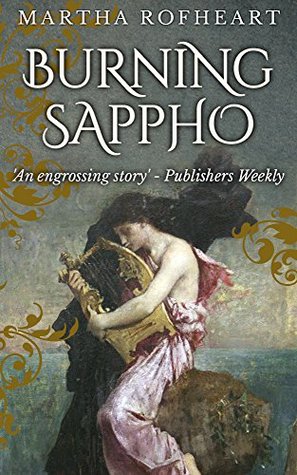
Burning Sappho by Martha Rofheart

burning-sappho There are some historical women whose lives have been written about in fiction many times but I think it’s safe to say that Sappho, the Greek lyric poet, doesn’t seem to be one of them. This novel, first published in 1974, is the first I’ve come across that tells her story and much as I do enjoy reading about Tudor queens and medieval princesses, it’s always refreshing to have the opportunity to read about somebody different!

Very little is known for certain about Sappho’s life. We do know that she was born on the Greek island of Lesbos, possibly between 630 and 612BC, and grew up in the port town of Mitylene. We know the probable names of some of her family members and we know that she was exiled from Mitylene twice. Beyond this, most of the information we have about Sappho is unreliable or based on the remaining fragments of her poetry, which may or may not have been autobiographical. It’s enough to build a novel around, though, and in Burning Sappho Martha Rofheart uses the known facts as a starting point to give a possible interpretation of what Sappho’s life could have been like.

We don’t have much factual information about the other characters who appear in the novel either – and I have to admit, I hadn’t even heard of most of them and didn’t know whether they were real or fictional, so Google proved very useful there! Some of the most notable characters include Gorgo, a girl from Sparta who angers Sappho by befriending Andromeda, the Nubian slave purchased by Sappho’s father; Alkaios, a fellow poet and the man Sappho loves; Pittakos, who rules Mitylene after the downfall of the Tyrant, Melanchros; and the famous courtesan Doricha, known as Rhodopis. I was also pleased to see Aesop make a few appearances – one character I had at least heard of!

The novel is divided into five sections; there are two narrated by Sappho herself and one each from the points of view of Alkaios, Doricha/Rhodopis and the sea trader, Kerkylas of Andros. There’s not a lot of difference between the voices of the narrators so it took a while to adjust to each change of perspective, but otherwise I thought the structure worked well. I preferred Sappho’s own narration, but hearing from other people who were close to her helped me to form a more balanced view of her as a person. There seems to be a lot of debate surrounding Sappho’s sexuality (the word lesbian is derived from the name of Sappho’s home, Lesbos), but Rofheart portrays her as having relationships with both men and women. In particular, she is shown to be in love with a girl called Atthis, whose name is mentioned in some of her love poetry.

I always admire people who write fiction set in ancient periods; I think it must be very difficult, when we have such limited knowledge of how people lived in those times. On reading Martha Rofheart’s Author’s Note and list of acknowledgments at the end of the book, I can appreciate the efforts she went to in researching her novel – for example, she states that as the geographical landscape has changed so much over the centuries, she has based her descriptions of the Greek islands on how they appeared in ancient writings rather than modern day ones. However, I still felt that there was something a little bit too ‘modern’ about this book – maybe it was the attitudes of some of the characters and the language they used. It wasn’t a huge problem, but the best way I can explain it is that I was always conscious that I was reading a story written in the 1970s, rather than being completely swept away to another time and place.

Still, I thought this was a fascinating novel and an educational one too. I knew absolutely nothing about this period before I started to read so I don’t feel qualified to comment on the historical accuracy or the choices Rofheart makes, but even if not everything happened as she describes it, I feel that I’ve learned a lot about the history of Lesbos. Although the focus is usually on Sappho and her music, she lived through a time of political turmoil; one of the most memorable scenes in the book describes the overthrow of Melanchros the Tyrant (which is sparked, in Rofheart’s version of events, by Sappho’s performance of a song she has written in protest against the custom of child sacrifice).

Burning Sappho (also published as My Name is Sappho) was an enjoyable read. Although it wasn’t quite as immersive as I would have liked, I thought it was much better than Lionheart, the other Martha Rofheart book I’ve read. She has written several other historical novels, all set in different periods, and I’m looking forward to working my way through them. As for Sappho, I can only find details of one or two other novels about her, but there seems to be plenty of non-fiction, including collections of her surviving writings. Now that I’ve been introduced to this fascinating woman, I’m interested in reading more about her!

Note: The spellings of names and places used in this review are as they appear in the novel and may vary between different sources.

I received a review copy of this book from the publisher via NetGalley.

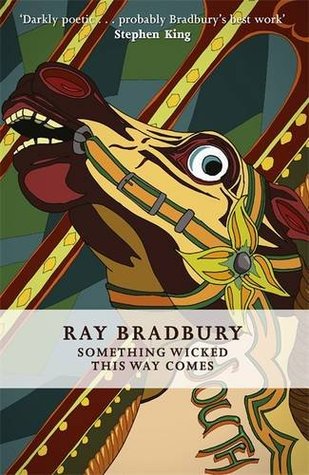
Witch Week Readalong: Something Wicked This Way Comes

witch-week-2016 I read this Ray Bradbury novel for a readalong as part of Witch Week, hosted by Lory at The Emerald City Book Review, but I’m sure I would have read it eventually anyway. It’s a book I’ve been interested in reading for a while – mainly, I have to confess, because I liked the title. It comes from a line spoken by one of the witches in Shakespeare’s Macbeth: “By the pricking of my thumbs, Something wicked this way comes”. I didn’t really have any idea what the novel itself was about, so the Witch Week readalong seemed a good opportunity to find out!

Published in 1962, Something Wicked This Way Comes tells the story of two teenage boys, Will Halloway and Jim Nightshade, who live in Green Town, Illinois. Not only are Will and Jim neighbours and best friends, they share another special bond: they were born just a few minutes apart, Will one minute before Halloween and Jim one minute after. They are inseparable, but they also have very different personalities – Will is the more sensible and cautious of the two, whereas Jim is more reckless and daring. The boys are thirteen years old as the novel opens one day in October when they have an encounter with a mysterious lightning rod salesman who warns that a storm is approaching.

something-wicked-this-way-comes That same night, a carnival – Cooger & Dark’s Pandemonium Shadow Show – is heading towards Green Town. Will and Jim watch it arrive at three o’clock in the morning, excited that a carnival has come so late in the year. Their excitement quickly starts to fade, however, as strange things begin to happen in connection with the carnival and its sinister owners. When they spot Mr Cooger riding on a carousel while the music plays backwards, they realise they are witnessing something which shouldn’t have been possible, something which tells them that this is no ordinary carnival – and that their lives could be in danger.

I didn’t know what to expect from this novel, as it’s the first I’ve read by Ray Bradbury, but I’m pleased to say that I enjoyed it. The writing style is unusual and took a while to get used to, but I found the use of language very intriguing. The streets are ‘footstepped’, for example, the rain ‘chuckles’ and ‘nuzzles’ at the windows, the people of the town ‘breathe back and forth’ to the carnival and laughter ‘walks on panther feet’. I’m not sure if I particularly liked the writing – the choice of words and the structure of the sentences are often so unconventional that I found it quite distracting – but it’s certainly one of the things I’ll remember most about this book.

I’ll also remember the philosophical musings of Charles Halloway, Will’s father:

So in sum, what are we? We are the creatures that know and know too much. That leaves us with such a burden again we have a choice, to laugh or cry. No other animal does either. We do, depending on the season and the need.

And the many wonderful descriptions of the library, where he works:

When rivers flooded, when fire fell from the sky, what a fine place the library was, the many rooms, the books. With luck, no one found you. How could they! – when you were off to Tanganyika in ’98, Cairo in 1812, Florence in 1492!?

Some of the readalong participants have discussed the fact that the two main characters (in the first half of the book, at least) are teenage boys and how the age we are when we first read the book could affect our ability to relate to the boys and their lives. Although I did still enjoy it anyway, I do wonder whether I might have had a different impression of it if I’d read it when I was younger. Later in the book, Charles Halloway begins to play a bigger part in the story, providing an adult perspective and bringing his experience, knowledge and wisdom to the fight against the evil forces of the carnival.

Good versus evil is obviously one of the major themes of the novel. A feeling of malice and danger hangs over the carnival from the moment it arrives and the people connected with it are both strange and sinister – particularly the blind Dust Witch who hovers over the boys’ houses in a hot air balloon in one of the creepiest scenes in the book. There are other themes too, though, such as life and death, age and the passing of time, the ties of friendship and the power of happiness and of love. Something Wicked This Way Comes is a fascinating read and one which left me with a lot to think about.

Children of Earth and Sky by Guy Gavriel Kay

children-of-earth-and-sky I love Guy Gavriel Kay’s books, so I really don’t know why it is that I’ve read so few of them! I’ve had Under Heaven waiting on my Kindle since finishing The Last Light of the Sun more than a year ago, but for some reason there always seems to be something else that needs to be read first. When I noticed his latest novel, Children of Earth and Sky, in the library I decided to forget Under Heaven for now and read this one first, while I was in the mood for it.

Guy Gavriel Kay’s books are a wonderful and unique blend of fantasy and historical fiction. Children of Earth and Sky is set in the same world as several of his other novels, including The Lions of Al-Rassan – a world with two moons, one blue and one white, in which the three main religious groups are the sun-worshipping Jaddites, the Asharites who pray to the stars and the Kindath who worship the moons (corresponding to Christians, Muslims and Jews respectively). The action in this book takes place mainly in thinly disguised versions of Venice, Dubrovnik and Constantinople – which Kay renames Seressa, Dubrava and Asharias – in what is clearly supposed to be the Renaissance period.

The plot is quite a complex one, with multiple storylines which meet and intersect from time to time, so rather than attempting to describe it in any detail, I’m just going to mention a few of the characters we meet.

First, there’s Pero Villani, a young artist from Seressa, who has been sent on a mission to the Osmanli (Ottoman) court at Asharias with a commission to paint a portrait of the Grand Khalif, Gurçu the Destroyer. However, Seressa’s Council of Twelve have another task in mind for Pero to carry out at Asharias, one which could put his life in danger. The Council are also keen to place a spy in the rival republic of Dubrava and enlist the services of Leonora Valeri, a woman with a troubled past who welcomes the chance to escape from Seressa.

The ship on which Pero and Leonora embark on the first stage of their journey is owned by the family of Marin Djivo. As the younger son of a Dubrava merchant, Marin has a lot of experience of the world of trade and shipping, but this particular voyage is about to change his life. Sailing from Seressa to Dubrava, his ship is boarded by pirates from the walled town of Senjan, and among them is the archer Danica Gradek, a young woman who is desperate to prove herself as a warrior and avenge her family against the Osmanli. Finally, there’s Damaz, who was captured as a child and trained to fight in the Osmanli army.

The lives of these five characters become closely entwined as their paths cross, then part, then cross again, and the actions of one may have consequences – sometimes unintentional – which affect the lives of one or all of the others. Now that I’ve read several of Kay’s novels, I can see that this seems to be a recurring theme in his work.

I have been to both Venice and Dubrovnik – and would highly recommend visiting them if you haven’t already – and even though Kay’s versions have different names, the descriptions of both locations are still clearly recognisable. If you have a good knowledge of the history of Renaissance Europe, you should be able to draw historical parallels, as well as geographical, between this fantasy world and the real one – but remember that it is a fantasy world (even though the magical elements are small and understated), which gives Kay the freedom to take the story in any way he wishes without sticking rigidly to historical fact.

I found a lot to love about this book; my only disappointments were the ending and the lack of emotional engagement I felt with the characters. When I think of the thought-provoking epilogue that ended Tigana, or the dramatic conclusion of The Lions of Al-Rassan, that’s what was missing from Children of Earth and Sky. The novel’s various storylines were wrapped up too neatly and too completely at the end of the book and didn’t make much of an emotional impact on me, which was a shame after spending so long getting to know this set of characters.

This is not one of my favourite Kay novels so far, but I did enjoy it and am looking forward to reading the rest of his work, probably beginning with Under Heaven!

Small and Spooky, edited by M.R. Nelson

small-and-spooky As it’s Halloween on Monday, I thought today would be a good time to tell you about the wonderful collection of classic ghost stories I’ve just had the pleasure of reading. It’s called Small and Spooky and the six stories it contains were selected by M.R. Nelson, editor of two other short story collections (she refers to them as ‘taster flights’), one of which – Love and Other Happy Endings – I read and enjoyed earlier in the year.

Three of the stories in this collection are by authors I already know and love, while the other three are by authors who were new to me. All six share a common theme – they all feature a child or the ghost of a child – but otherwise they’re all quite different. It’s difficult to know how much you can say about short stories without spoiling them, so I’m just going to give a brief overview of each one.

The first is The Marble Child (1918) by E. Nesbit, a favourite childhood author of mine. I remember loving her children’s novels The Railway Children and The Phoenix and the Carpet, but had no idea until recently that she had also written ghost stories. This story about a little boy who is fascinated by the marble child he sees in the church gets the collection off to a good start. Part of the story is written from the boy’s perspective and part from an adult’s which, as the editor points out in her notes, makes this story a sort of bridge between children’s and adult fiction.

The next story is a great one: The Wind in the Rose-Bush (1903) by Mary E. Wilkins Freeman, an American author I had never heard of until now. The story follows Rebecca Flint as she travels to a small, remote town hoping to see her young niece, who has been living with her stepmother since her parents died. From the moment Rebecca arrives and sees a rosebush moving when there’s no wind, she knows something is wrong. I found it easy to guess what was going on in this story, but Rebecca didn’t know and I could really feel her growing sense of unease and confusion as the truth began to unfold.

Next is Their Dear Little Ghost (1890) by Elia Wilkinson Peattie (also another new author for me), which as you might guess from the title is not a scary ghost story at all. It’s actually quite a sweet and moving little story about a child who dies just before Christmas and her godmother’s love for her even in death. I found this one of the weakest stories in the book, but I still liked it and thought it made a nice contrast to the previous one, which was quite creepy!

The following story, Morella (1835), is by Edgar Allan Poe. Poe is another author I love and I was already familiar with Morella (I think I read nearly all of his short stories and poems years ago when I was given his complete works as a Christmas present). This tale of reincarnation is not one of his scariest and I don’t think it’s one of his best either, but I can see why it was chosen for this collection as it does fit the theme.

The fifth story is another strong one: The Old Nurse’s Story (1852) by Elizabeth Gaskell. I was convinced I had read this one before – it appears in Gaskell’s Gothic Tales which I borrowed from the library a few years ago – but when I started to read, I didn’t remember it at all. In this atmospheric story set in winter, a ghostly child haunts the Northumberland countryside. I love Gaskell’s writing and this is an excellent example of a Victorian ghost story.

Finally, we have The Doll’s Ghost (1911) by F. Marion Crawford, another author I’ve never read before. This is an unusual story about a child’s doll which is broken and given to a dolls’ hospital to repair. Although I found this story a bit eerie, the ghost was a nice ghost, which meant the collection finished on an uplifting note! I would be happy to read more by this author.

These are six very enjoyable stories and perfect for those readers who, like me, prefer their ghost stories to be spooky but not terrifying! It was good to revisit Nesbit, Gaskell and Poe – and also to be introduced to three new authors, all of whom I’m now interested in exploring further.

Thanks to M.R. Nelson for providing a copy of Small and Spooky for review.

A Room of One’s Own by Virginia Woolf

a-room-of-ones-own For Phase 5 of Heavenali’s #Woolfalong, we are asked to read some of Virginia Woolf’s non-fiction – essays or diaries. As I hadn’t read any of her essays or diaries at all until now, the choice was easy for me: A Room of One’s Own, her 1929 classic and possibly the book for which she’s best known. I don’t read a lot of non-fiction books so I wondered what I would think of this one. Well, I thought it was fascinating! The edition I read had just over 100 pages but so much is packed into those pages that I feel quite overwhelmed trying to write about it all.

A Room of One’s Own is Woolf’s famous extended essay based on a series of lectures she gave at two women’s colleges at Cambridge University in October 1928. In the essay, Woolf uses a fictional narrator – whom she refers to at various points as Mary Beaton, Mary Seton or Mary Carmichael, names taken symbolically from a 16th century Scottish ballad – to explore the subject of women and fiction. As a starting point, she states that “a woman must have money and a room of her own if she is to write fiction” and then goes on to explain why she believes this statement to be true.

For many women living in the modern day and experiencing a level of equality women in the past could only dream of, it may be hard to imagine a lack of money or a room of our own preventing us from writing if that is what we wish to do, but in Woolf’s day – and especially in the decades and centuries before that – these things could be very real obstacles. I’m not sure I completely agree that women must have a certain amount of money and their own room to be able to write, but Woolf’s arguments are very thought-provoking and make a lot of sense.

Near the beginning of the book, we see the narrator attempting to enter a library and being turned away because it is for men only – ladies aren’t admitted unless they are accompanied by a man or have a letter of introduction. This is just one illustration of how women in the past were denied the same rights and freedoms which were available to men. Obviously this made it more difficult for them to bring the same depth of knowledge and experience to their writing that a man would have – and also much more difficult to become financially independent. Living in poverty, Woolf explains, meant that women were more likely to be deprived of a private space in which to sit and write and the spare time in which to do it.

Here I am asking why women did not write poetry in the Elizabethan age, and I am not sure how they were educated; whether they were taught to write; whether they had sitting rooms to themselves; how many women had children before they were twenty-one; what, in short, they did from eight in the morning till eight at night. They had no money evidently; according to Professor Trevelyan they were married whether they liked it or not before they were out of the nursery, at fifteen or sixteen very likely. It would have been extremely odd, even upon this showing, had one of them suddenly written the plays of Shakespeare…

The narrator then goes on to imagine that Shakespeare had a sister, Judith, who was just as talented as her brother but had no opportunity to use her ability. She wasn’t sent to school, was given no encouragement to read and write, and ran away from home when her father tried to force her into an early marriage. Judith’s story is tragic, and Woolf uses it to show that talent alone isn’t enough; without equality and opportunity, it would have been impossible for Shakespeare’s sister to achieve Shakespeare’s success.

Another aspect of the book I particularly enjoyed was Woolf’s discussion of the work of four female authors I love – Charlotte Brontë, Emily Brontë, George Eliot and Jane Austen – exploring and comparing the ways in which their lifestyles and the opportunities open to them may have affected their writing. She talks about Jane Austen’s lack of a separate study to work in and how she tried to hide her manuscripts when a visitor walked into the room, and about Charlotte Brontë’s anger at being interrupted during the writing of Jane Eyre and how this influenced her writing:

She left her story, to which her entire devotion was due, to attend to some personal grievance. She remembered that she had been starved of her proper due of experience — she had been made to stagnate in a parsonage mending stockings when she wanted to wander free over the world. Her imagination swerved from indignation and we feel it swerve.

As I’ve mentioned, this is a short book, but despite that I decided to read it slowly – the six chapters over six evenings – because I wanted to have time to think about what I’d read and to digest all the ideas and issues Woolf raises in each chapter. I would definitely recommend this approach to reading the book – and I would also recommend keeping a pen and paper beside you as you may find yourself desperate to make a note of your favourite passages as you read!

So far this year I’ve read three books by Virginia Woolf; To the Lighthouse just wasn’t for me, but I loved this one and Flush. I haven’t decided yet whether I’ll be taking part in the final phase of the #Woolfalong – I’ll try to, if I have time – but if not, I’m sure I’ll be exploring more of Woolf’s work eventually anyway. I’ve already read Orlando, which I enjoyed, but any other recommendations would be welcome.