 Welcome to my monthly post on all things historical fiction. After doing something slightly different in June with an attempt at completing the I-Spy book cover challenge, I’m returning to my guides to individual authors and their work. Previously I have written about Elizabeth Chadwick, Anya Seton and Edward Rutherfurd; this month it’s the turn of one of my absolute favourite authors of historical fiction – Dorothy Dunnett. If you have been following my blog for a while, you will probably have noticed that I never miss an opportunity to mention Dunnett’s novels and how wonderful they are, so you won’t be surprised to hear that she is the author I have been most looking forward to featuring here.
Dorothy Dunnett was born in Dunfermline, Scotland, in 1923 and died in 2001. You can find out more about her life and work at the Dorothy Dunnett Society website.
I read my first Dunnett novel in February 2012 and just over a year later I had read all fifteen of her historical novels – the six books that form her Lymond Chronicles, the eight in her other series, The House of Niccolò, and her standalone novel, King Hereafter. She also wrote a series of contemporary mystery novels, but I am still working through those, and for the purposes of this post I will concentrate on her historical fiction only.
If you’ve never read Dunnett before you will be wondering where you need to begin. My recommendation would be to start in the same place that I started – with The Game of Kings, the first book in the Lymond Chronicles. I have seen some people suggest that Niccolò Rising is more accessible and easier to read, and perhaps it is, but I personally didn’t find it quite the stunning, unforgettable read that The Game of Kings was.
The Lymond Chronicles
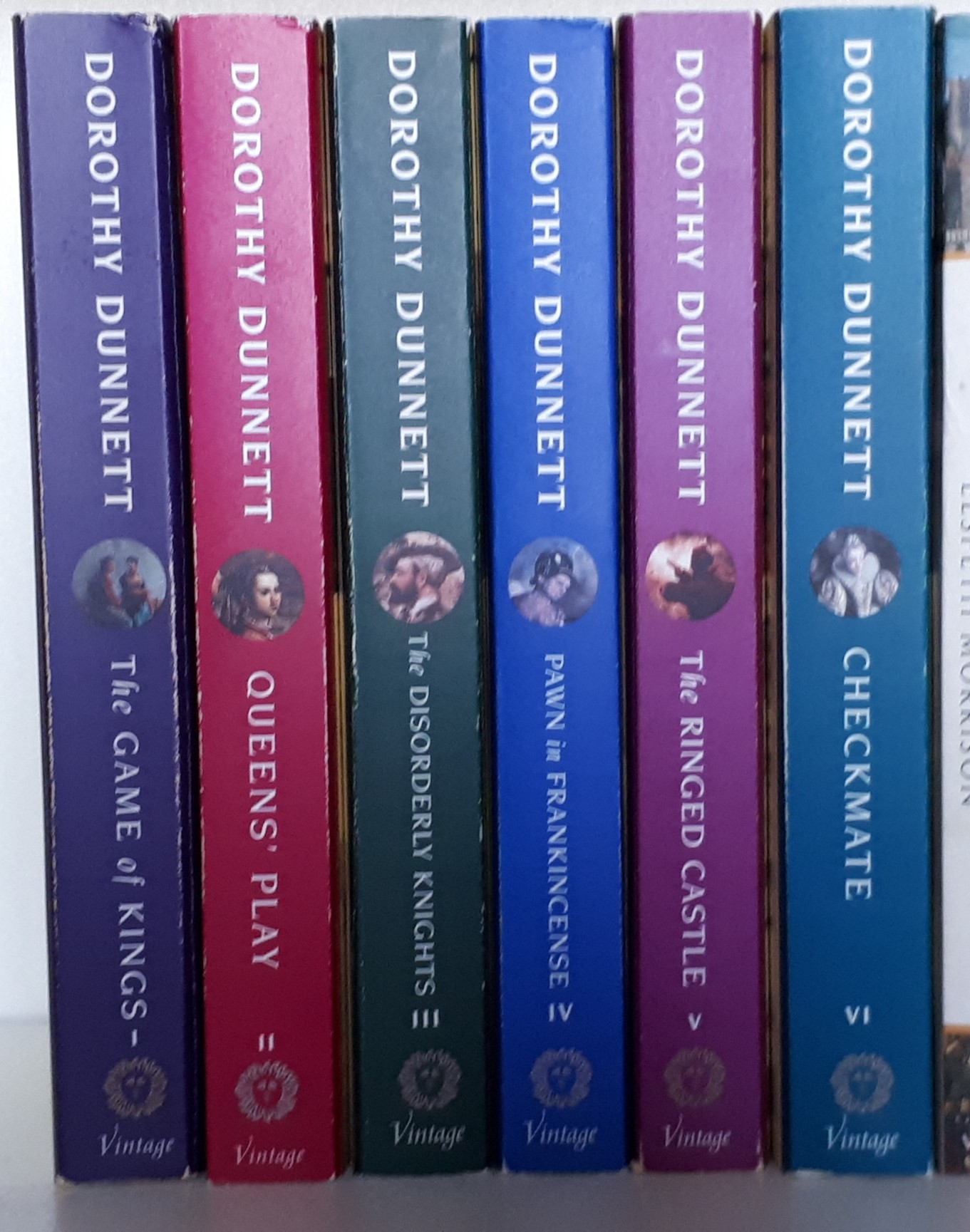
This series of six novels, published between 1961 and 1975, follow the adventures of Scottish nobleman Francis Crawford of Lymond in 16th century Europe and beyond. Here are my reviews of the books:
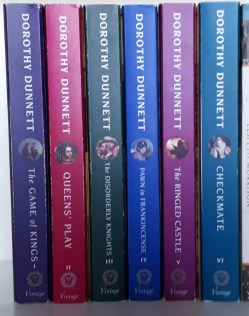 The Game of Kings
Queens’ Play
The Disorderly Knights
Pawn in Frankincense
The Ringed Castle
Checkmate
I think my comments on finishing the series back in April 2012 say everything that needs to be said:
“For anyone who has yet to read these books, I can promise you that although they’re not the easiest of reads, it’s definitely worth making the effort and getting to know Francis Crawford of Lymond, one of the most complex, charismatic, fascinating characters you’re ever likely to meet in literature. Working through the six books of the Lymond Chronicles has been one has been one of the greatest experiences in my lifetime of reading.”
The House of Niccolò
Dunnett’s second series, published from 1986 to 2000, is longer and, if such a thing is possible, even more complex and intricately plotted. It follows the rise in fortunes of Nicholas de Fleury, whom we first meet as a dyer’s apprentice in 15th century Bruges.
This is what I had to say after finishing the last book in 2013. As you can see, I did love this series too, but not quite as much:
“I’ve really enjoyed working my way through this series, but the House of Niccolò hasn’t had quite the same effect on me as the Lymond Chronicles, mainly because Nicholas himself, to me, is a less appealing character than Lymond – though I know others will disagree…Still, I did love the series as a whole and am looking forward to reading all the books again and looking out for some of the things I know I missed during the first read.”
The eight books, again with links to my reviews, are:
Niccolò Rising
The Spring of the Ram
Race of Scorpions
Scales of Gold
The Unicorn Hunt
To Lie With Lions
Caprice and Rondo
Gemini
Dunnett’s own advice was apparently to read The Lymond Chronicles first then The House of Niccolò, then Lymond again in order to pick up on the links between the two series (and they are linked in some very clever ways, although I won’t say any more about that here). I can almost guarantee you will want to read Dunnett’s books more than once anyway. There are so many layers that it’s impossible to fully understand everything the first time and re-reading will allow you to pick up on some of the things you missed.
The Dorothy Dunnett Companion and The Dorothy Dunnett Companion II

The amount of time and effort you want to put into reading these books depends on how much you’re hoping to get out of them. If, like me, you find that you want to shed more light on the literary allusions, fragments of poetry and appearances by real historical figures, both famous and obscure, help is at hand – the two-volume Dorothy Dunnett Companion provides translations, explanations, maps and sources.
King Hereafter
Dunnett’s only standalone historical novel is based around the idea that Macbeth, the 11th century King of Alba (Scotland), and Thorfinn, Earl of Orkney, were one and the same. King Hereafter is the result of a huge amount of research and as with all of Dunnett’s novels the writing is excellent. I can’t recommend this book highly enough!
My review of King Hereafter from 2013.
~
I have attempted to give a good overview of Dunnett’s work here, without going into too much detail. I hope I’ve succeeded! Next month I will be choosing another historical fiction author to feature, but for now I look forward to hearing your thoughts on Dorothy Dunnett…
Have you read any of her novels? If not, would you like to? And if you have, how did you discover them? Which of her books are your favourites? What can you say to encourage new readers to try Dunnett for the first time?




 She Reads Novels