Ready for R.I.P. XI

R.I.P. XI

(Thanks to Abigail Larson for the banner)

It’s September, which means it’s time for one of my favourite reading events of the year – R.eaders I.mbibing P.eril. R.I.P. is hosted by Carl at Stainless Steel Droppings and is now in its eleventh year!

As always, the idea of R.I.P. is to read books from one or more of the following categories during the months of September and October:

Mystery
Suspense
Thriller
Gothic
Horror
Dark Fantasy

There are different levels of participation to choose from and I am signing up for Peril the First:

Read four books, of any length, from the very broad categories earlier defined as perilous. They could all be by the same author, a series of books, a random mix of classic and contemporary or whatever you like.

ripnineperilfirst

Here are some of the books I currently have on either my shelf or my Kindle which I could choose from for this event:

Mystery Mile by Margery Allingham
The Dead in their Vaulted Arches by Alan Bradley
Magpie Murders by Anthony Horowitz
The Moving Toyshop by Edmund Crispin
The Romance of the Forest by Ann Radcliffe
The Red House Mystery by AA Milne
Savage Magic by Lloyd Shepherd
The Mummy Case by Elizabeth Peters
The Plague Charmer by Karen Maitland
The Protector by SJ Deas
Blood Harvest by Sharon Bolton
The Strangler Vine by MJ Carter
Bleeding Heart Square by Andrew Taylor
A Shilling for Candles by Josephine Tey

I certainly don’t expect to read all of these, but it’s nice to have a good choice. I could also end up reading books which are not on my list, if I come across other suitable R.I.P. reads as the weeks go by!

Will you be participating this year? What will you be reading?

My Commonplace Book: August 2016

A summary of this month’s reading, in words and pictures.

commonplace book
Definition:
noun
a notebook in which quotations, poems, remarks, etc, that catch the owner’s attention are entered

Collins English Dictionary

~

Margaret Beaufort

She could have asked, of course, but she would not get any answers. She thought of all the words that went unspoken in the world, throughout time: what happened to them, where did they go? What would happen if they were all spoken? How different would the world be then?

Succession by Livi Michael (2014)

~

“Molly, I cannot have you speaking so to Lady Harriet,” said Mrs. Gibson, as soon as she was left alone with her stepdaughter. “You would never have known her at all if it had not been for me, and don’t be always putting yourself into our conversation.”

“But I must speak if she asks me questions,” pleaded Molly.

“Well! if you must, you must, I acknowledge. I’m candid about that at any rate. But there’s no need for you to set up to have an opinion at your age.”

“I don’t know how to help it,” said Molly.

Wives and Daughters by Elizabeth Gaskell (1865)

~

I know very little about my mother, and have no family to help me fill in the gaps. I am an only child and my father’s two elder sisters died several years ago. I am intrigued by this photograph and would like to find out more about the people in it…I hope you don’t mind me asking all these questions. Any information you could offer would mean a great deal to me.

The People in the Photo by Hélène Gestern (2011)

~

Penny dreadful

Since cheap magazines were traded on street corners, in playgrounds and factory yards, each issue could have many readers. Penny fiction was Britain’s first taste of mass-produced popular culture for the young, and was often held responsible for the decay of literature and of morality.

The Wicked Boy by Kate Summerscale (2016)

~

It can’t have been much of a life, can it? for a woman of over seventy, living alone in lodgings, in debt to her landlady, wearing our cast-off clothes, trotting round after jobs that never materialised, writing articles that nobody would publish, and eating bread and margarine for supper. There really was something rather pathetic about that awful room of hers – crowded with papers full of impossible schemes…I don’t suppose there can ever have been anyone whose life was much less important, or who had less influence on anybody else.

Poor Caroline by Winifred Holtby (1931)

~

It was something he’d learned in the war: only think about what is directly in front of you. No, that wasn’t quite right. He’d had to plan ahead all the time…but not to feel ahead. For a man of Giles’s far-seeing, intricate temperament that had been a hard lesson. But Simon, he could see, knew it by instinct.

Exposure by Helen Dunmore (2016)

~

Red Cocker Spaniel

Hers was the pale worn face of an invalid, cut off from air, light, freedom. His was the warm ruddy face of a young animal; instinct with health and energy. Broken asunder, yet made in the same mould, could it be that each completed what was dormant in the other? She might have been — all that; and he — But no. Between them lay the widest gulf that can separate one being from another. She spoke. He was dumb. She was woman; he was dog. Thus closely united, thus immensely divided, they gazed at each other.

Flush by Virginia Woolf (1933)

~

“I play,” he once said to me, “for the best musician in the world – he may not be there, but I play as if he were”. I thought to myself that he was always there when Sebastian was playing, but I did not say so, for that was the kind of thing which did not please him.

The Little Chronicle of Magdalena Bach by Esther Meynell (1925)

~

It is quite beautiful, a metaphoric triumph over adversity, with every millimetre of its gnarled trunk proudly displaying its struggle.
I wonder now why humans hate the map of their life that appears on their own bodies, when a tree like this, or a faded painting, or a near-derelict uninhabited building is lauded for its antiquity.

The Olive Tree by Lucinda Riley (2016)

~

I cannot say – I had misjudged him before – yet I do think, in that moment, he had his battle to fight – one fierce as his fiercest charge. Cosmas waited, devouring him with his eyes. And I waited; a sudden, amazing sense springing up in me, that if he yielded, as I had so desired him to yield, this King who might be would never be the Prince whom I had served and loved.

Rupert, by the Grace of God by Dora Greenwell McChesney (1899)

~

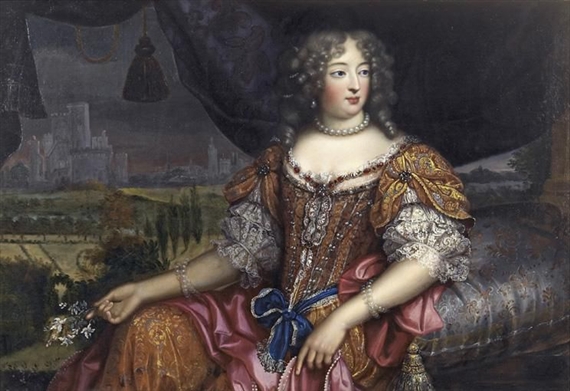
louisedelavalliere

“Life, monsieur,” said Planchet, laughing, “is capital which a man ought to invest as sensibly as he possibly can.”

Louise de la Vallière by Alexandre Dumas (1850)

~

Hélène wondered whether the lady was protesting a bit too much in order to convince her, or to convince herself. Could she start a new life at her age? You can start a new game of cards or redecorate the living room, but life itself, can you do that again?

The Travels of Daniel Ascher by Déborah Lévy-Bertherat (2013)

~

And now? Overseas in England, his brethren in the faith were fighting, were dying, to achieve the freedom which he had sought. Before his eyes rose the grey, thronged sea-port town he knew, the richer fields, the narrower skies; and yet here, in this strenuous bleakness, he had found his soul.

Cornet Strong of Ireton’s Horse by Dora Greenwell McChesney (1903)

~

Love for her was to be a slow, ripening process, the fruit of many meetings and mutual interests. She had never believed in love at first sight. That surely, she told herself, was an invention of novelists, whose business it was to make everything slightly larger than life.

The Jewelled Snuff Box by Alice Chetwynd Ley (1959)

~

Fountains Abbey 1

The queen responded a week later. “We are sending a young gentleman up to Yorkshire to resolve the matter. We do not wish to hear from you again.”

It was a measure of Mr Aislabie’s poor standing at court that I was the young gentleman in question.

A Death at Fountains Abbey by Antonia Hodgson (2016)

~

Favourite books this month: Wives and Daughters, Flush and Exposure

Wives and Daughters by Elizabeth Gaskell

Wives and Daughters - Elizabeth Gaskell Now that I’m starting to come towards the end of my Classics Club list, I’m having to tackle some of the books I’ve been putting off reading since I put the list together in 2012. I’m really not sure why I haven’t picked up Wives and Daughters until now; I’ve enjoyed everything else I’ve read by Gaskell (North and South, Sylvia’s Lovers, The Moorland Cottage, Cranford and Mr Harrison’s Confessions) so it seemed likely that I would enjoy this one too. And did I? Yes, of course I did!

Wives and Daughters is set in a village in England in the 1830s, a world similar to the one Gaskell created in Cranford, where everyone knows everyone else’s business. Molly Gibson, our heroine, is the daughter of the village doctor; her mother is dead and, as an only child, Molly is very close to her father. The two have a strong relationship built around love and trust, but the harmony of their little household is disrupted when Mr Gibson decides to marry again. His new wife is the beautiful widow, Hyacinth Kirkpatrick, former governess to the Duke of Cumnor’s children, and he hopes she will provide the seventeen-year-old Molly with the motherly guidance he is unable to give. Unfortunately, Hyacinth proves to be a selfish, manipulative woman and she and Molly don’t always see eye to eye.

As well as a new stepmother, Molly also has a new stepsister – Cynthia. Although she and Cynthia have very different personalities, the two girls become good friends – and it is this friendship which will get Molly into trouble when she tries to help Cynthia find a way out of her tangled love affairs. Meanwhile, there’s a romance for Molly too but it’s quite a subtle one and also quite one-sided, as the man she loves appears to be in love with someone else, so poor Molly has to keep her feelings to herself.

Wives and Daughters is a very long novel, with more than 700 pages, and there were times when it seemed to be going on forever, but I didn’t really mind because once I’d been pulled into Molly’s world I didn’t want to leave it again. I didn’t want to leave the characters behind either – they were drawn with so much care and in so much depth. I loved Molly for her honesty, intelligence and kind heart, and Cynthia, with all her charms, flaws and vulnerabilities, was also an interesting character. But I particularly enjoyed reading about the family at nearby Hamley Hall: the old country squire, his invalid wife, and their two sons, Osborne and Roger.

First published as a serial between 1864 and 1866, this was Elizabeth Gaskell’s last novel, sadly left unfinished at the time of her death. I was aware that it was unfinished before I started to read, so I was prepared to be left feeling frustrated (as I was when I read Dickens’ The Mystery of Edwin Drood) but luckily this wasn’t the case. At the point where the novel finished I could see the direction in which the plot was heading and I was satisfied that, if the story had continued, things would have worked out in the way that I’d hoped.

Gaskell has a style all of her own, but I think this particular book would appeal to readers of Jane Austen; I could see some similarities in the characterisation, the dialogue and the shape of the plot. So far all of the books I’ve read by Gaskell have been quite different from each other. Wives and Daughters is probably my favourite so far, but I’m looking forward to reading the other two novels I haven’t read yet – Ruth and Mary Barton.

The Travels of Daniel Ascher by Déborah Lévy-Bertherat

The Travels of Daniel Ascher When I read The People in the Photo a few weeks ago for Women in Translation Month (#WITMonth on Twitter), I didn’t expect to have time to read another book for the same event, but I’ve had this one on my Kindle for a while and have managed to squeeze it in before the end of the month. The Travels of Daniel Ascher was originally published in French in 2013; I read an English translation by Adriana Hunter.

At the beginning of the novel, twenty-year-old Hélène Roche has just moved to Paris to begin studying archaeology at university. Her great-uncle, Daniel Ascher, also lives in Paris and has offered to let her rent one of the upstairs rooms in his house, but when Hélène arrives she finds that he is out of the country, on a trip to Tierra del Fuego. This is nothing surprising – for as long as Hélène can remember, Daniel has been off on his travels, visiting one exotic location or another – and actually, his absence doesn’t bother her too much as she has always found her eccentric great-uncle slightly embarrassing.

As Hélène gets to know her fellow students, she discovers that most of them are fans of The Black Insignia, a series of novels in which the hero travels the world, having exciting adventures in locations as varied as the Amazon, Machu Picchu and Pompeii. Hélène alone has never read a Black Insignia book, partly because she thinks the stories sound childish and uninteresting and partly because the author of the series is her great-uncle Daniel, writing under the name HR Sanders. Her new friend Guillaume, however, is so enthusiastic about the books that Hélène is persuaded to look at them again – and in the process she makes some surprising discoveries about the life of Daniel Ascher.

The Travels of Daniel Ascher is a very short book (I easily read it in one evening) and I think it’s probably aimed at young adults, although that’s not to say it has nothing to offer an adult reader too. When the truth about Daniel Ascher’s childhood begins to emerge (I’m trying not to spoil anything here) it’s a story which has been written about many times before, but the way in which Déborah Lévy-Bertherat chooses to approach that story feels fresh and different.

I thought the book was generally well written, although as with all translated novels, unless you’re able to read the original, it’s difficult to know whether anything has been lost in translation. I do have a criticism, though, and that relates to the dialogue, which is written without quotation marks and presented as one continuous paragraph, with what one character says separated from the next by a comma. I’m really not sure why so many contemporary authors think this sort of thing is a good idea – I find anything other than conventional dialogue very distracting and unnecessary. In this particular novel, I suppose it helped to create a dreamlike atmosphere, but at the same time it made it difficult to connect with the characters and took away some of the emotional impact of the story.

WITMonth 2016 The Travels of Daniel Ascher wasn’t a perfect book, then (at least not for me), but it was an interesting and unusual one and I don’t feel that I wasted my time reading it.

Exposure by Helen Dunmore

Exposure What a great book! I have to admit, I wasn’t sure about reading it; I thought Helen Dunmore’s previous novel, The Lie, was disappointing, and the descriptions of this one as a Cold War spy novel didn’t sound very appealing to me. I wanted to give Dunmore another chance, though, so I decided it would be worth giving Exposure a try.

The first thing I need to say is that although Exposure certainly is a Cold War spy novel of sorts, it’s also a compelling story of love and betrayal, secrets and lies, as seen through the eyes of a wonderful cast of strong and complex characters. One of them, Simon Callington, is a quiet, unambitious young man who works for the Admiralty in London and who looks forward to coming home to his wife and children at the end of each day. The last thing he wants is to be involved in any controversy, but that is exactly what happens one night in November 1960 when he receives a call for help from his friend and colleague, Giles Holloway.

As a student, Simon had been drawn to Giles because he was older and more sophisticated; now, however, Giles is a rather sad and lonely man with a drink problem, and when he falls down the stairs and ends up in hospital with a broken leg, Simon is the only person he feels he can trust. Just before he fell, Giles was working on a secret file – a file he should never have brought home from work – and he needs Simon to retrieve it from his desk and return it to the office before anyone notices it was missing. Simon agrees, but unknown to him, Giles’s home is being watched.

The decisions Simon makes on that fateful night and in the days which follow will have serious consequences for both Simon himself and for his family – his wife, Lily, and their three children, Paul, Sally and Bridget. It’s Lily, in my opinion, who is the real star of this novel. Having fled to England with her mother as Jewish refugees in the 1930s, she has spent her whole adult life trying to hide her German origins and now, with Simon in trouble, it’s more important than ever that her past is kept a secret. Lily is put under a huge amount of pressure, yet remains strong, resourceful and determined to do whatever it takes to protect her husband and children.

Simon also has a secret which he has been concealing even from Lily and if it is revealed his situation will become even more precarious than it already is. With all three of our main characters – Giles, Simon and Lily – at risk of exposure, the tension and the atmosphere of darkness and danger build and build throughout the story. The writing and structure of the novel are both excellent, dipping into the past where necessary to explore a character’s background, helping us to understand the person they are in the present. Dunmore also includes just enough period detail to set the story firmly in the early 1960s without going into an excessive amount of description.

Some elements of the novel made me think of the plot of E. Nesbit’s The Railway Children (and I’m sure we’re supposed to make the connection) but Exposure is also an exciting and original novel in its own right. I loved it and am so pleased I didn’t let The Lie put me off reading more of Helen Dunmore’s books!

Flush by Virginia Woolf

Flush Phase 4 of Ali’s year-long #Woolfalong involves reading biographies by or about Virginia Woolf during the months of July and August. I didn’t think I would have time to participate, but Flush, Woolf’s biography of Elizabeth Barrett Browning’s dog, is a very short book and I have managed to fit it in before the end of the two month period. Flush is a book I’d been interested in reading for a long time and I’m pleased to say that I wasn’t disappointed!

Flush, a red cocker spaniel, is given to the poet Elizabeth Barrett by her friend Mary Russell Mitford. Unmarried and an invalid, Elizabeth is confined to her bedroom in the family home on London’s Wimpole Street, where she lives with her father and siblings. Flush immediately forms a strong bond with his new mistress and although at first he misses the open spaces of his old home with the Mitfords, he quickly becomes spoiled and pampered, happy to stay curled up at Elizabeth’s feet in front of the fire. It’s not long, however, before Flush’s happiness is threatened by the arrival of another contender for Elizabeth Barrett’s love: the poet Robert Browning.

As Browning’s visits to the Barratt home become more frequent, Flush is forced to deal with new emotions he has never experienced before: jealousy and rivalry. When Barrett and Browning elope, Flush goes with them to Italy. Here Elizabeth finds a new strength and independence away from the control of her father and the stifling seclusion of her Wimpole Street bedroom – and in one of many parallels between the life of woman and dog, Flush rediscovers some of the freedom he had enjoyed as a young puppy.

Flush is a wonderfully creative combination of fiction and non-fiction. For factual information, Woolf draws on Elizabeth Barrett Browning’s two poems about her dog and also the letters of Elizabeth and Robert, some of which she quotes from in the text. From a fictional point of view, the book is written from Flush’s perspective, imagining how a dog might feel and behave in a variety of different situations. The result is a book which is fascinating, unusual and a delight to read!

Flush works on at least three levels. First, it’s exactly what it appears to be: the biography of a dog, taking us from puppyhood to adulthood and old age, immersing us in a canine world – a world of intriguing scents and mysterious sounds. It’s also the biography of two poets, exploring the lives of both Elizabeth Barrett Browning and Robert Browning through a dog’s eyes. Finally, it gives Woolf a chance to examine various aspects of class and society. For example, on his occasional outings in London with Wilson, the maid, Flush notices that not all dogs are equal:

But the dogs of London, Flush soon discovered, are strictly divided into different classes. Some are chained dogs; some run wild. Some take their airings in carriages and drink from purple jars; others are unkempt and uncollared and pick up a living in the gutter. Dogs therefore, Flush began to suspect, differ; some are high, others low…

If this book sounds of any interest to you at all, then I would highly recommend giving it a try. It’s insightful, amusing and entertaining and I think it might be a good place to start for a reader who has never read Woolf before; I found it a much lighter and easier read than To the Lighthouse, for example, which I read earlier this year. Although I haven’t managed to take part in every phase of the Woolfalong, there are still another two to come so I may be tempted to read more Woolf before the year is over!

The Olive Tree by Lucinda Riley

The Olive Tree I wasn’t sure, when I first heard about The Olive Tree, whether I really wanted to read it or not. I’ve enjoyed most of Lucinda Riley’s previous novels but part of the appeal is the way she intertwines past and present, linking the lives of modern day characters with ones who lived in times gone by. The Olive Tree is not like that; it has a contemporary setting, with the action taking place mostly in 2006 with a few chapters bringing us right up to date in 2016. I thought I would miss the historical element, but actually, once I started reading, I found I didn’t mind that it was a different sort of book and I ended up enjoying it anyway (although not quite as much as the historical ones).

The Olive Tree is the story of a family holiday in Cyprus. The setting couldn’t be more idyllic – a house called Pandora, with its own pool, a sunny terrace and a beautiful view – but the holiday itself is the holiday from hell. As its Greek name suggests, Pandora holds a lot of secrets and some of them are about to be revealed.

Pandora belongs to Helena Cooke, the novel’s main female character, who is returning to the house for the first time in years, having recently inherited it from her godfather. Almost as soon as she arrives, however, she wonders whether coming back was a mistake: Alexis, with whom she had a teenage romance in Cyprus more than twenty years earlier, is still living nearby and still seems to have feelings for Helena. Her husband, William, is not going to be pleased!

Someone else whose life has been thrown into turmoil by the presence of Alexis is Helena’s eldest son, thirteen-year-old Alex. Alex has never known the identity of his biological father…could it be Alexis? As Alex retreats to the privacy of his tiny bedroom to write in his diary and pour out his hopes and fears, another troubled family arrives to stay at Pandora. They are the Chandlers: William’s alcoholic best friend, Sacha; his long-suffering wife, Jules, and their two children, one of whom is Alex’s worst enemy. With the additions of Chloe, William’s teenage daughter from a previous marriage, and Helena’s friend Sadie, who is getting over a break-up with her latest boyfriend, it’s going to be a difficult summer!

At nearly 600 pages, this was a surprisingly quick read, which is something I’ve found with most of Lucinda Riley’s novels; she knows how to tell a good story and how to hold the reader’s attention from one chapter to the next. I don’t think the book needed to be quite so long (the Sadie storyline, for example, added very little to the overall plot) but otherwise I did enjoy spending time getting to know the Cooke and Chandler families. There were some twists in the story towards the end and although I’d had my suspicions, I was still surprised by some of the revelations.

Interspersed throughout the novel are passages from Alex’s diary and I particularly liked reading these sections. I found Alex an intriguing character; having been assessed as a gifted child with an exceptionally high IQ, sometimes he seems much older than thirteen, but in other ways – such as his attachment to his toy rabbit, Bee – he feels very young and insecure. I think if the whole novel had been narrated by Alex it might have been too much, but I always looked forward to returning to his diary entries – they were written with such a unique combination of humour, wisdom and vulnerability.

This isn’t my favourite Lucinda Riley novel but with its sunny, summery setting it was a perfect August read. I’m now looking forward to reading The Shadow Sister, the next book in her Seven Sisters series, which is coming out later this year.

Thanks to the publisher for providing a copy of The Olive Tree for review.