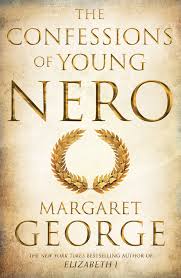
 It’s been a few years since I read Margaret George’s Elizabeth I – still the only one of her novels I’ve read – but I’ve always intended to read more and the publication of The Confessions of Young Nero, the first of two volumes on the life of the Roman Emperor, seemed a good opportunity. Until recently, this particular book wouldn’t have appealed to me (Ancient Rome has never been a favourite historical period of mine) but tastes changes and, having read the wonderful Cicero trilogy by Robert Harris, I now feel more enthusiastic about the subject.
The Confessions of Young Nero is a fictional account of the early years of Nero – or Lucius Domitius Ahenobarbus, to give him the name by which he was known as a child. Narrated in his own words, Nero begins by taking us through the events of his childhood, starting with one of his earliest memories: the time his uncle, the Emperor Caligula, tried to drown him. This is the young Nero’s first experience of the ruthless plotting and scheming which surrounds those close to the imperial family; it is never far from his thoughts as he grows older and, following the deaths of first Caligula and then his successor Claudius, becomes emperor himself.
Although, as I’ve mentioned, most of the story is narrated by Nero, there are several much shorter sections scattered throughout the book narrated by two other characters: Locusta, a poisoner whose skills are very much in demand, and Acte, the former slave who becomes Nero’s lover. This was one of the least successful aspects of the book, in my opinion. I really don’t think those sections added anything to the story and I’m not sure why those two characters in particular were chosen, as there were plenty of others who had just as much significance in Nero’s life.
Nero himself is portrayed much more sympathetically than I’d expected. Admittedly I don’t know a huge amount about him, but from the little I had previously read I had formed a very different impression of Nero than the one given by this novel. I can see from Margaret George’s author’s note that she has deliberately taken a revisionist approach to Nero’s story, believing that he has been unfairly treated by history and that some of the accounts we rely on for information about him were written to discredit him. I can accept this (it reminds me of the way Tudor propaganda was intended to discredit Richard III) but I personally found this version of Nero far too nice! Nothing was ever really his fault and on occasions where he did commit a wicked act, it was because he had been driven to it and left with no choice. I think a more complex, morally ambiguous character would have been of more appeal to me.
I did like the characterisation of the main female characters in the novel, particularly Messalina, Agrippina and Poppaea, three ambitious women each of whom wields power in her own way. Something which comes across very strongly throughout the novel – and especially when one of these women is involved – is the continuous sense of danger and the way in which anyone of importance in the Roman Empire had to be constantly on their guard against an attempt on their life.
Having such limited knowledge of Ancient Rome, I found the complicated family relationships difficult to follow at first, but I think Margaret George does an excellent job of clarifying them for readers like myself and by the time I was a few chapters into the book I was starting to get Nero’s family tree clear in my mind. As this is quite a long novel and only tells the first half of Nero’s story, it allows plenty of time to explore the major personal and political incidents which take place during this stage of Nero’s life; some of this was familiar to me, but much of it was new and I found it all fascinating. While important events such as Boudicca’s revolt are described in detail, Margaret George also devotes many pages to discussing Nero’s love of music, poetry and sport. I can appreciate how much research must have gone into the writing of this novel!
I’m pleased that I’ve read this book as I think I’ve learned a lot from it – and despite having some negative feelings about it as well as positive ones, I do want to read the rest of the story and will be looking out for the sequel. Meanwhile, I’ve been reminded that I have Margaret George’s novel on Mary, Queen of Scots on my TBR – I’m looking forward to it as that’s a period of history I’m much more comfortable with!
Thanks to Pan Macmillan for providing a copy of this book for review via NetGalley.